CCSP vs XCLOUDP
CCSP is the most recognised cloud security certification globally. XCLOUDP focuses on applied multi-cloud security across AWS, Azure, and GCP with live labs and a practitioner-assessed capstone. This article compares both credentials for cloud security professionals in 2026.
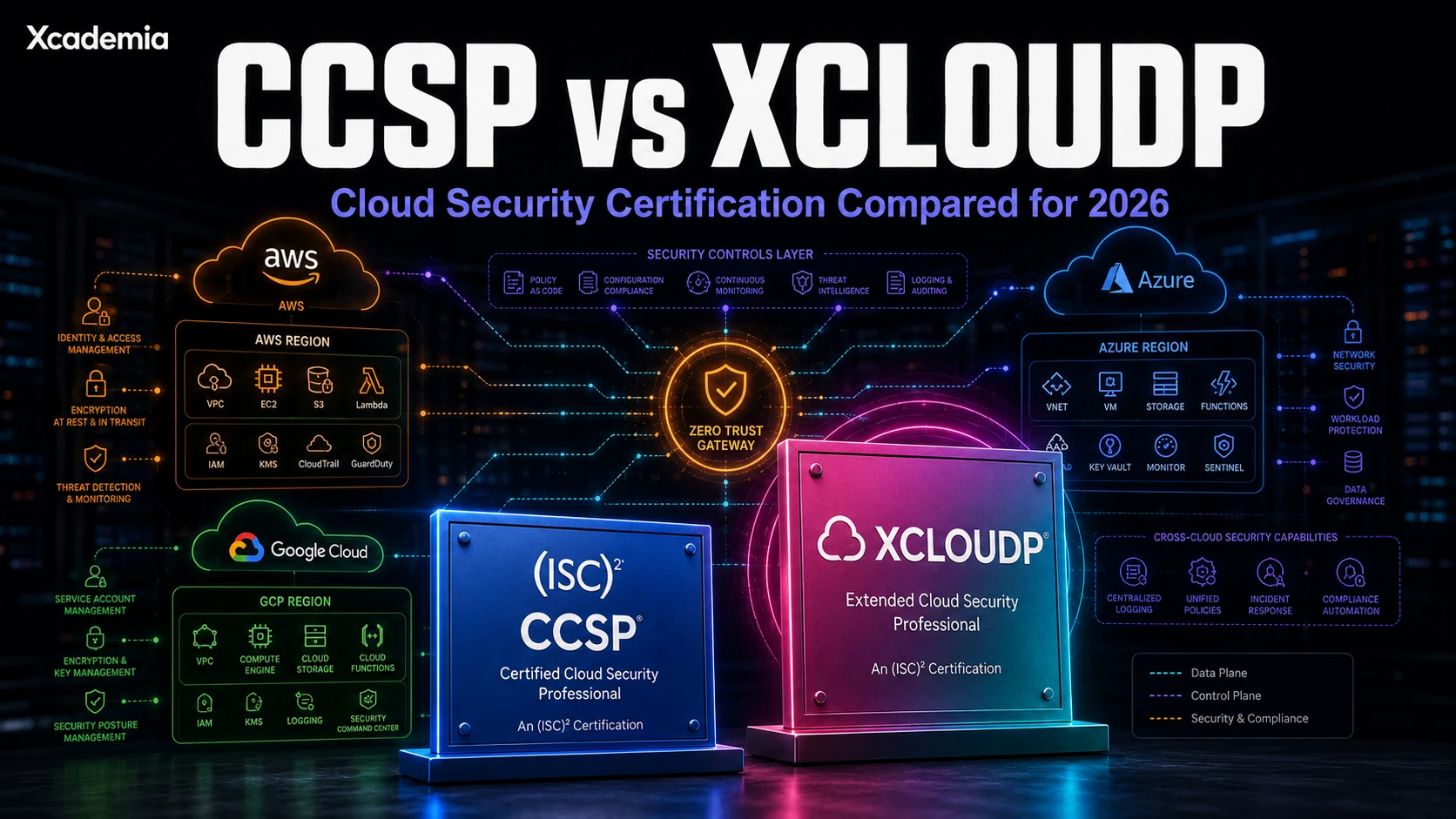
Cloud Security Certification Compared for 2026
CCSP is (ISC)2's Certified Cloud Security Professional, one of the most widely recognised cloud security credentials globally. It covers six domains of cloud security at a breadth and depth that makes it the closest thing to a comprehensive cloud security standard in the certification market.
XCLOUDP is Xcademia's Cloud Security Practitioner certification. Six instructor-led days. Practitioner-assessed. Built around the hands-on cloud security skills that security engineers and architects need to actually secure multi-cloud environments.
Both are serious credentials for serious cloud security professionals. The question is which one is right for your specific situation.
The cloud security professional of 2026 works across AWS, Azure, and often GCP simultaneously. The certification that prepares them must address all three platforms at depth, not just describe cloud security principles in vendor-neutral terms.
What CCSP Covers and Where It Excels
CCSP covers six domains: cloud concepts, architecture and design, cloud data security, cloud platform and infrastructure security, cloud application security, cloud security operations, and legal, risk, and compliance. The examination is 125 adaptive questions over three hours, using the CAT format familiar from CISSP.
CCSP is genuinely comprehensive at the conceptual and architectural level. It covers the full cloud security lifecycle from architecture design through operations and governance. It addresses compliance in cloud environments, data security in multi-tenancy, and the legal and regulatory considerations that differ in cloud from on-premise deployments.
Where CCSP delivers strongest value
Global recognition: CCSP is the most globally recognised cloud security credential and is known by hiring managers in every mature cloud security market
Breadth: the six-domain structure covers cloud security more comprehensively than any other single examination
(ISC)2 community: the professional network and continuous development access have genuine career value
Vendor-neutral architecture: the conceptual framework applies across all cloud providers, making it particularly valuable for professionals working in multi-cloud environments where no single provider's certification is sufficient
Compliance and governance coverage: CCSP covers cloud-specific legal and regulatory considerations that cloud-provider certifications largely ignore
The honest gap
CCSP is a vendor-neutral conceptual certification. The examination tests whether you understand cloud security principles across the six domains. It does not require you to configure an AWS VPC security group, implement an Azure Conditional Access policy, set up GCP VPC Service Controls, or design a cross-cloud zero trust architecture. The security engineer who holds CCSP has broad conceptual knowledge. The one who can demonstrate those implementations on real platforms has applied capability.
CCSP is the cloud security credential that proves you understand the concepts. The employer who needs to know whether you can actually implement a security landing zone in AWS or configure Azure Defender for Servers needs a different kind of evidence. Competitor pricing correct at time of publication.
What XCLOUDP Covers and How It Is Assessed
XCLOUDP is Xcademia's Cloud Security Practitioner certification. Six instructor-led days. Live cloud platform labs throughout. Practitioner-assessed capstone.
Programme scope
Cloud security architecture: Shared responsibility model applied, secure cloud landing zone design, network segmentation in cloud environments, multi-account and multi-region architecture security
Identity and access management in cloud: AWS IAM, Azure Active Directory and Entra ID, GCP IAM — policies, roles, service accounts, least privilege implementation
Data security in cloud: Encryption at rest and in transit across all three major CSPs, key management services, data classification in cloud, object storage security
Cloud network security: VPCs, security groups, network ACLs, Azure NSGs and VNets, GCP VPC firewall rules, Cloud WAF configuration
Cloud security monitoring: AWS CloudTrail and Security Hub, Azure Monitor and Defender for Cloud, GCP Cloud Audit Logs and Security Command Centre
Container and serverless security: EKS, AKS, and GKE security controls, Lambda and Azure Functions security, container image scanning in cloud pipelines
Zero trust in cloud: Implementing zero trust network access using native cloud capabilities and third-party tools
Cloud compliance and governance: AWS Config, Azure Policy, GCP Organization Policy — compliance as code, automated control enforcement
Cloud incident response: Forensics in cloud environments, evidence preservation in ephemeral infrastructure, cloud-specific IR playbooks
The capstone
The XCLOUDP capstone presents candidates with a realistic multi-cloud security architecture scenario. A financial services organisation is migrating from on-premise to a hybrid multi-cloud environment spanning AWS and Azure. They must design the security architecture for the migration, configure the identity federation, implement the network security controls, set up the monitoring and alerting stack, and produce a cloud security operations runbook. The capstone is conducted in a live cloud lab environment and assessed by a senior Xcademia cloud security practitioner. Verifiable at xcademia.com/verify.
The XCLOUDP capstone is a real cloud environment with real platform security controls to configure. Not a simulation. Not a multiple choice test about what those controls should be. The professional who passes it has built a security architecture that works.
FULL COMPARISON MATRIX
CCSP ((ISC)2) | XCLOUDP (Xcademia) | |
|---|---|---|
Awarding body | (ISC)2 | Xcademia |
Assessment format | 125 adaptive MCQ, 3 hours | Practitioner capstone, mentor sign-off |
Duration | Self-study (4-8 months) | 6 intensive instructor-led days |
Experience required | 5 years IT, 3+ in cloud security | Cloud security practitioner expected |
Exam cost | $599 USD | Included in £4,995 |
Renewal | Every 3 years, 90 CPE + $125 USD AMF/yr | No renewal required |
Cloud platform depth | Vendor-neutral, conceptual across CSPs | AWS, Azure, GCP labs throughout programme |
Architecture coverage | Strong conceptual architecture | Applied cloud security architecture decisions |
Zero trust in cloud | Introduced in current version | Hands-on ZTA implementation in lab environments |
Market recognition | Very strong globally. Strong UK, US, UAE. | UK and UAE, growing |
What it proves | Advanced cloud security knowledge across (ISC)2 domains | Applied cloud security architecture and implementation capability |
The Platform Certification Question
AWS Security Specialty, AZ-500, and Google Cloud Professional Cloud Security Engineer are the vendor-specific cloud security certifications from each major provider. Each covers security within a single cloud platform at significant depth. They are valued by employers who need platform-specific expertise.
CCSP is vendor-neutral and conceptually broader. XCLOUDP covers all three major platforms at operational depth. The professionals who are most valuable in organisations running multi-cloud environments are the ones who can move fluently across platforms, which is what XCLOUDP specifically develops and what CCSP conceptually addresses without platform-specific labs.
For professionals with strong AWS skills who also need Azure depth, or Azure professionals building GCP knowledge, XCLOUDP provides the cross-platform development that vendor-specific certifications do not.
The cloud security professional who holds CCSP for conceptual breadth and has done XCLOUDP for applied multi-cloud implementation is more valuable to most modern organisations than the one who holds two vendor-specific certifications covering only one or two platforms.
Who Should Choose CCSP
You are building the (ISC)2 credential portfolio (CISSP then CCSP) and need the globally recognised cloud security credential
You are targeting cloud security roles at the architecture and governance level where conceptual breadth matters more than platform-specific implementation depth
Your target employers specifically list CCSP as a preferred or required qualification
You work in or are targeting compliance and governance-heavy environments where the legal and regulatory coverage of CCSP is particularly relevant
CCSP best for global recognition and conceptual cloud security breadth:
CCSP is the most recognised cloud security credential globally. If your target market requires it or values it specifically, it is the right credential to pursue. Build platform-specific implementation skills alongside it through hands-on lab environments.
Who Should Choose XCLOUDP
You are a security engineer, cloud architect, or security operations professional who needs to demonstrate applied multi-cloud security implementation capability
You work in or are targeting roles where you will be assessed on your ability to configure real security controls in AWS, Azure, and GCP rather than describe them conceptually
You want six days of intensive hands-on cloud security training with live platform labs and a real architecture capstone
You hold CCSP or vendor-specific cloud certifications and want to add demonstrated multi-cloud implementation capability
Your next role involves designing or implementing cloud security architecture across multiple platforms
XCLOUDP best for applied multi-cloud security implementation:
XCLOUDP develops and assesses the applied cloud security capability that CCSP conceptually describes. Live labs across AWS, Azure, and GCP. Real architecture capstone. Practitioner-assessed. No MCQ. No renewal. Verifiable at xcademia.com/verify.
The Combination Worth Building
For the senior cloud security professional, CCSP provides the globally recognised credential that signals cloud security expertise across all markets. XCLOUDP provides the platform-specific implementation evidence that CCSP alone cannot demonstrate. Together they answer both questions that cloud security employers ask: does this person understand cloud security? And can they actually implement it?
Add AWS Security Specialty for AWS-heavy environments, AZ-500 for Azure-heavy work. The combination of CCSP, XCLOUDP, and one or two platform certifications is the most credible cloud security practitioner portfolio available in the market today.
The cert gets you in the room. CCSP gets you the cloud security room. XCLOUDP proves you can do the work once you are there.
Build Applied Multi-Cloud Security Capability With XCLOUDP XCLOUDP: six instructor-led days with live labs across AWS, Azure, and GCP. Identity, network, data, monitoring, containers, and zero trust in real cloud environments. Architecture capstone assessed by a practitioner. No MCQ. No renewal. Verifiable at xcademia.com/verify. Explore XCLOUDP |
|---|
Ready to go deeper?
Professional Training
Hands-on, mentor-led training aligned with industry certifications.
About the Author
Sharper every day
Daily tutorials, analysis, and career playbooks across all 12 Xcademia disciplines, straight to your inbox. No spam.