XDEVSEC
Most DevSecOps certifications test concepts, not implementation. XDEVSEC is built for engineers who ship: real CI/CD pipelines, live security gates, SAST, DAST, IaC, and supply chain security in a hands-on capstone.
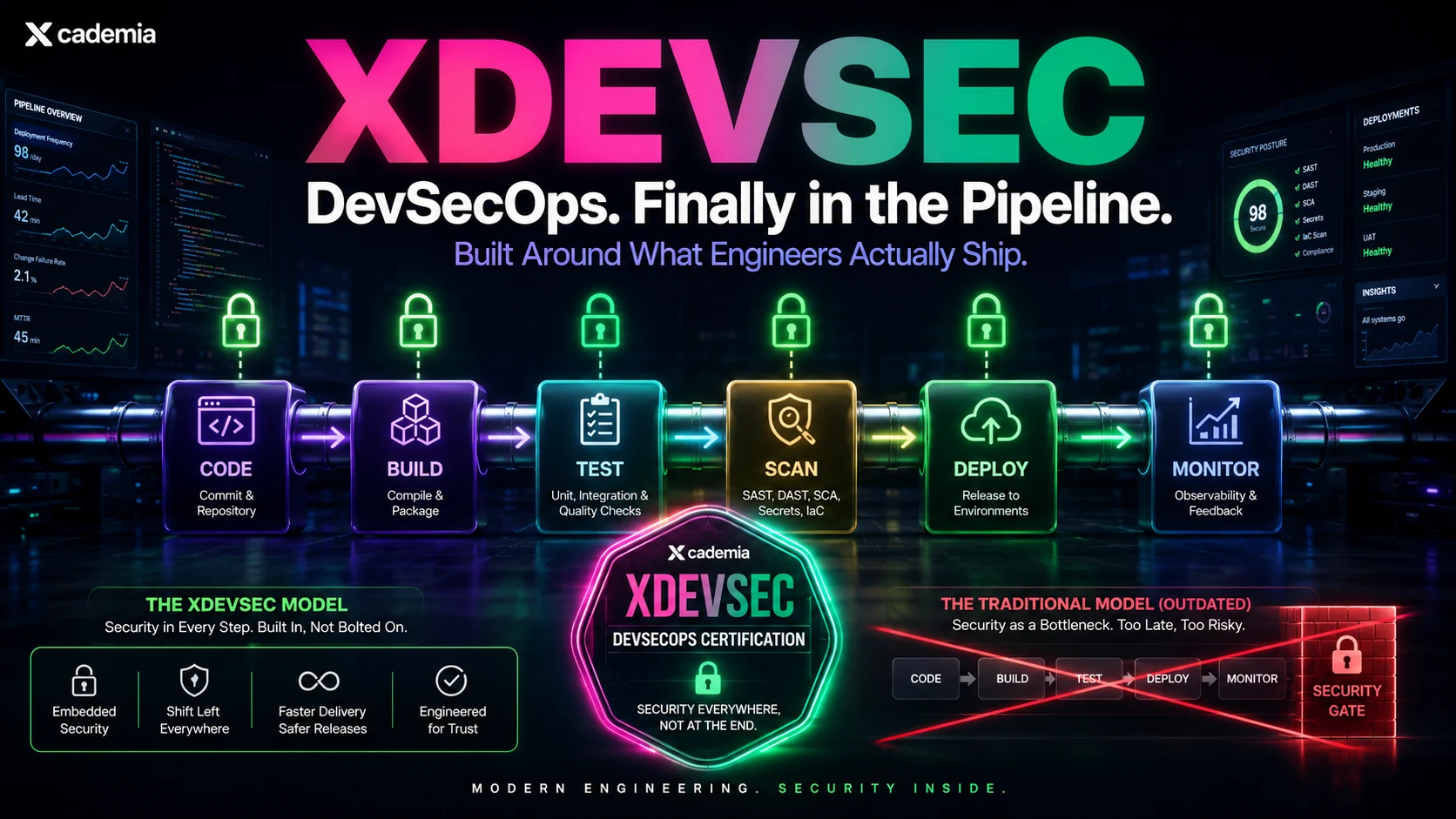
The DevSecOps Certification Built Around What Engineers Actually Ship
DevSecOps is one of the most searched terms in modern security. It is also one of the most poorly implemented. Organisations declare themselves DevSecOps and then run SAST scans on Friday before deployment. The concept is understood. The practice is inconsistent. The people who can build genuine security into CI/CD pipelines at a practitioner level are genuinely scarce.
The certification market for DevSecOps has grown to match the interest, but most of the available credentials address the concept rather than the practice. They test whether you understand DevSecOps principles. They do not test whether you can configure a GitHub Actions workflow to include SAST, DAST, secret scanning, container image scanning, and IaC security checks, and integrate the findings into a developer workflow that does not destroy velocity.
XDEVSEC is built around the practice, not the concept.
The difference between understanding DevSecOps and implementing it is the same as the difference between knowing what a penetration test is and being able to run one. Certification programmes that test the understanding are useful. Programmes that assess the implementation are the ones that produce professionals who can actually do the job.
Why the Existing Options Fall Short
CompTIA SecurityX (formerly CASP+, DevSecOps domain)
CompTIA SecurityX includes DevSecOps as a domain within a broader advanced security certification. The coverage is conceptual and vendor-neutral. It does not require candidates to configure a pipeline, review code for vulnerabilities using real tools, or produce a working security gate in a CI/CD environment. It tests whether you understand DevSecOps. It does not test whether you can do it.
DevOps Institute DevSecOps Foundation
The DevOps Institute DevSecOps Foundation certification is a concept-level credential covering DevSecOps principles, culture, and frameworks. It is well-structured as an awareness certification. It does not address implementation: how to configure Semgrep, how to integrate Trivy into a container build pipeline, how to write a GitHub Actions workflow that fails a build on high-severity findings without breaking the developer experience.
Vendor certifications
AWS, Google Cloud, and GitHub all offer certifications related to security in their respective ecosystems. These address security within a specific platform but not the cross-platform, tool-chain-agnostic DevSecOps implementation skill that engineering teams in mixed environments need.
The certification gap in DevSecOps is not a knowledge gap. Security professionals understand the principles. The gap is practical: which tools, in which configuration, integrated in which way, to produce a pipeline that is genuinely secure without becoming an obstacle to engineering velocity.
What XDEVSEC Covers Across Six Days
The programme is structured around the actual DevSecOps toolchain that engineering teams use in 2026. No conceptual frameworks without implementation. Every topic has an associated lab.
Days 1-2: Secure SDLC and Threat Modelling
The software development lifecycle from a security perspective: Where vulnerabilities are introduced and where they can be eliminated at lowest cost
Threat modelling for applications: STRIDE applied to realistic web application and microservices architectures
Security requirements elicitation: Translating threat model output into developer-actionable security requirements
Security in Agile: Integrating security activities into sprint planning, backlog management, and definition of done
Lab: Threat model a real web application architecture and produce a security requirements document
Days 3-4: Pipeline Security Implementation
SAST (Static Application Security Testing): Semgrep, SonarQube configuration and rule tuning, reducing false positive rates, integrating into PR workflows
DAST (Dynamic Application Security Testing): OWASP ZAP in CI/CD, configuring automated scans, interpreting findings, blocking builds on critical findings
Secret scanning: GitHub Advanced Security, Gitleaks configuration, preventing secrets in repositories, handling historical secret exposure
Software Composition Analysis (SCA): Dependabot, Snyk, OWASP Dependency-Check for third-party library vulnerability management
Container security: Trivy for container image scanning, Dockerfile security best practices, base image hardening
IaC security: Checkov and tfsec for Terraform and CloudFormation security scanning, policy-as-code with OPA
Lab: Build a full GitHub Actions pipeline integrating SAST, secret scanning, SCA, and container scanning with automated build-breaking thresholds
Days 5-6: Supply Chain Security and Capstone
Software supply chain security: SBOMs (Software Bill of Materials) generation and consumption, SLSA framework, dependency pinning
Signing and verification: Sigstore, image signing in container registries, provenance attestation
Security metrics and reporting: DORA metrics from a security perspective, tracking mean-time-to-remediate, developer experience measurement
Vulnerability management integration: Connecting pipeline findings to ticketing systems, SLAs for remediation by severity, developer communication
Capstone: Design and implement the full DevSecOps security toolchain for a realistic engineering team scenario, including pipeline configuration, policy definitions, metrics framework, and developer onboarding guide
The capstone assessment
Candidates produce a working DevSecOps security implementation for a realistic scenario: a mid-size engineering team running a web application and three microservices, using GitHub Actions for CI/CD and deploying to AWS. The implementation must include SAST, DAST, secret scanning, SCA, container scanning, IaC scanning, and SBOM generation. It must also include a developer-facing runbook explaining how the security gates work and what developers should do when a build fails. Assessed by a senior Xcademia DevSecOps practitioner. Verifiable at xcademia.com/verify.
The XDEVSEC capstone is a working implementation, not a presentation about one. The practitioner who passes it has built a security pipeline that works against real code, in a real CI/CD environment, and produced documentation that a real engineering team could use.
FULL COMPARISON MATRIX
CompTIA SecurityX | XDEVSEC (Xcademia) | |
|---|---|---|
Awarding body | CompTIA | Xcademia |
Assessment format | 90 questions, MCQ + PBQ, 90 min | Practitioner capstone, code review + pipeline lab |
Duration | Self-study (2-4 months) | 6 intensive instructor-led days |
Exam cost | $392 USD | Included in £3,995 |
Renewal | Every 3 years, 60 CEUs | No renewal required |
Primary scope | DevSecOps concepts, supply chain security, SBOMs | Practical secure SDLC: code review, pipeline security, container hardening, IaC scanning |
Hands-on labs | Performance-based items in exam | Labs throughout all 6 days, capstone pipeline build |
Code review practice | Conceptual coverage | Live code review exercises in multiple languages |
Pipeline security | Conceptual, vendor-neutral | GitHub Actions, GitLab CI, Jenkins labs |
Market recognition | Growing globally | UK and UAE, growing |
What it proves | DevSecOps knowledge across CompTIA framework | You can integrate security into a real CI/CD pipeline |
Who Needs XDEVSEC
The professionals who need this certification sit at the intersection of software engineering and security.
AppSec engineers building and maintaining security tooling for engineering teams
Security engineers responsible for DevSecOps programme design and implementation
DevOps engineers making the transition into security-focused roles
Platform engineers responsible for CI/CD infrastructure who need to embed security controls
Security architects designing the security controls for modern software delivery pipelines
Engineering managers leading teams that need to shift security left and need a qualified practitioner to do it
XDEVSEC built for the practitioner who implements it:
XDEVSEC covers the actual DevSecOps toolchain: SAST, DAST, secret scanning, SCA, container scanning, IaC scanning, and supply chain security. All with live labs and a working pipeline capstone. Six days. Practitioner-assessed. No MCQ. No renewal. Verifiable at xcademia.com/verify.
The Career Context
DevSecOps engineering is one of the fastest-growing specialisms in cybersecurity precisely because it sits at the intersection of two disciplines that have historically been separated: software engineering and security. The professionals who are fluent in both, who can have a conversation about pipeline performance with a DevOps engineer and a conversation about threat model findings with a security architect, are valuable in a way that specialists in only one discipline cannot replicate.
The salary premium for demonstrated DevSecOps implementation capability reflects this. Security engineers who can configure and maintain a production DevSecOps toolchain command significantly above average security engineering salaries in the UK and UAE markets. The supply of qualified practitioners is still catching up with demand.
Security that developers find useful is security that gets implemented. The DevSecOps professional who understands how to make security gates that help engineers rather than obstruct them is the one who builds a programme that actually works. That understanding requires doing the work, not just studying the concept.
Build Applied DevSecOps Capability With XDEVSEC XDEVSEC: six instructor-led days covering SAST, DAST, secret scanning, SCA, container security, IaC scanning, and supply chain security. Live labs throughout. Working pipeline capstone. Practitioner-assessed. No MCQ. No renewal. Verifiable at xcademia.com/verify. Explore XDEVSEC |
|---|
Ready to go deeper?
Professional Training
Hands-on, mentor-led training aligned with industry certifications.
About the Author
Sharper every day
Daily tutorials, analysis, and career playbooks across all 12 Xcademia disciplines, straight to your inbox. No spam.