
IDC: Why Networking Has Become the Critical Foundation for Scaling Agentic AI
IDC's latest research reveals that networking infrastructure, not AI models, is becoming the biggest barrier to production-ready agentic AI. Security, governance, and operational control are now central to enterprise AI success.
Xcademia Team
Xcademia Research Team
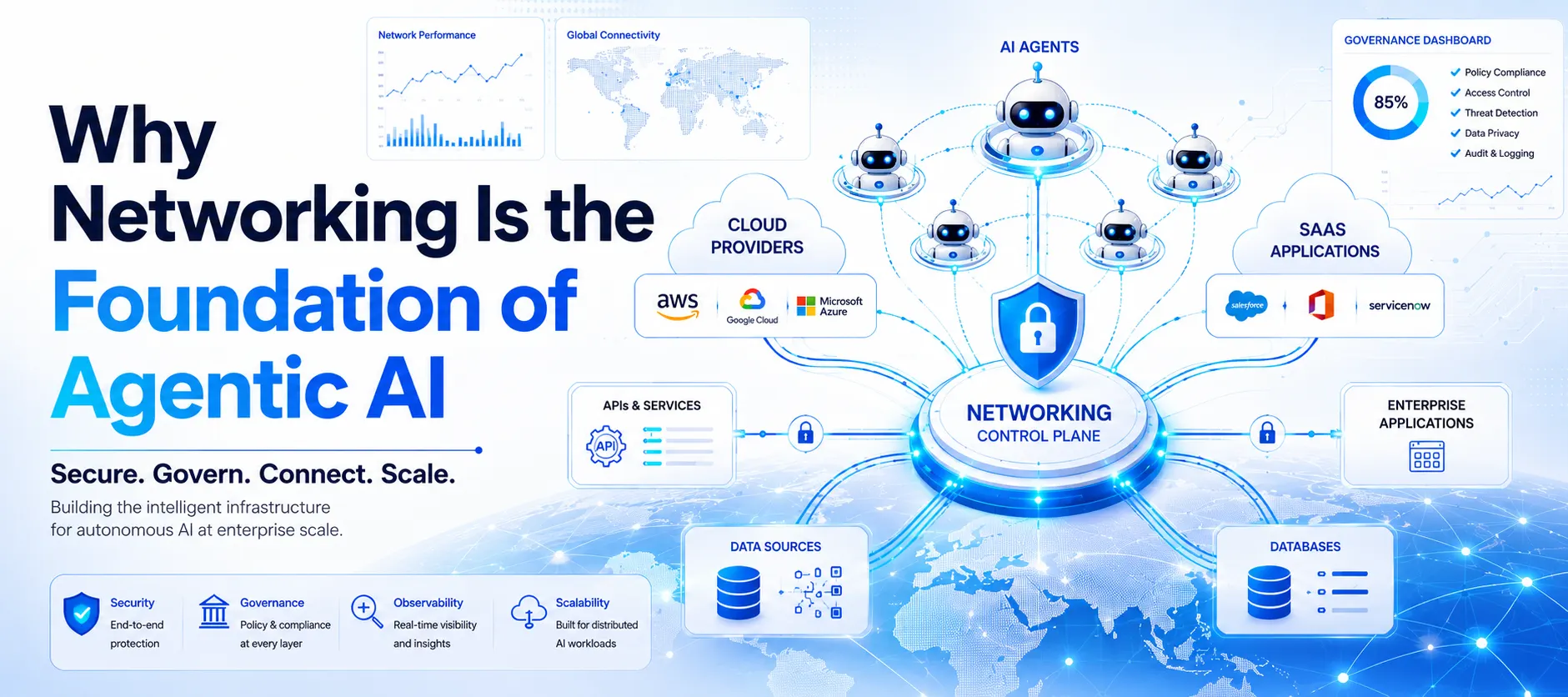
The Hidden Infrastructure Challenge Behind Agentic AI
Artificial intelligence adoption continues to accelerate across industries, but many organizations are discovering that building AI models is only one part of the journey. The larger challenge often emerges when businesses attempt to move AI projects from experimental pilots into full-scale production environments.
According to IDC's 2026 AI in Networking Special Report Survey, networking infrastructure has become one of the most significant obstacles preventing organizations from successfully operationalizing AI initiatives. As enterprises embrace agentic AI systems that can autonomously interact with applications, APIs, databases, and cloud services, traditional infrastructure approaches are being pushed beyond their limits.
The findings suggest that networking is no longer merely a connectivity layer. It is rapidly becoming the foundation for security, governance, observability, and operational control across increasingly complex AI ecosystems.
For enterprises planning large-scale AI deployments, this shift represents a fundamental change in how AI infrastructure must be designed and managed.
Why AI Projects Are Stalling Before Production
Despite significant investments in AI innovation, many organizations continue to struggle with deployment and scaling challenges.
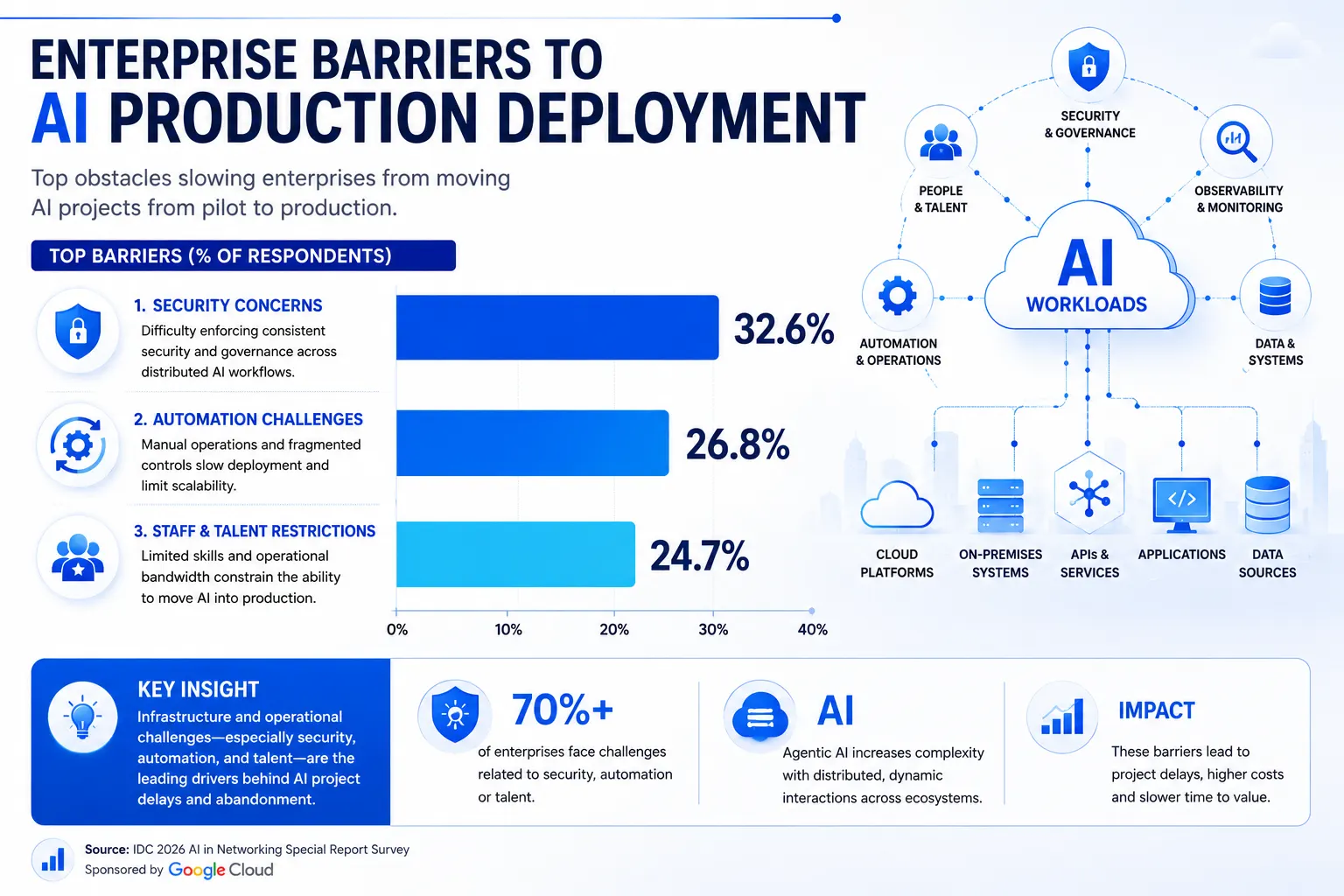
IDC's survey highlights three primary barriers slowing AI adoption:
32.6% cited security concerns
26.8% reported automation challenges
24.7% identified staffing and talent limitations
These findings indicate that infrastructure and operational readiness are becoming more critical than model development itself.
Unlike traditional software systems, modern AI environments require continuous interaction between multiple services, data sources, cloud platforms, and security frameworks. As these environments grow more complex, maintaining visibility and control becomes increasingly difficult.
Agentic AI amplifies these challenges because autonomous agents often make decisions and initiate actions independently across distributed systems.
Agentic AI Creates New Infrastructure Demands
Agentic AI differs significantly from traditional AI applications.
Instead of processing isolated requests, autonomous AI agents continuously interact with external systems, tools, services, APIs, databases, cloud environments, and other AI models.
These interactions may involve:
Multiple AI model providers
Various cloud platforms
SaaS applications
Open-source frameworks
Internal enterprise systems
Third-party APIs
As a result, organizations face a rapidly expanding operational and security surface area.
Every connection introduces potential governance risks, policy inconsistencies, and security vulnerabilities. Without proper infrastructure controls, enterprises can lose visibility into how AI agents access data, communicate with services, and execute tasks.
This growing complexity has elevated networking from a support function to a strategic AI enabler.
Networking Is Becoming the Control Plane for Agentic AI
IDC argues that networking should no longer be viewed as simple connectivity infrastructure.
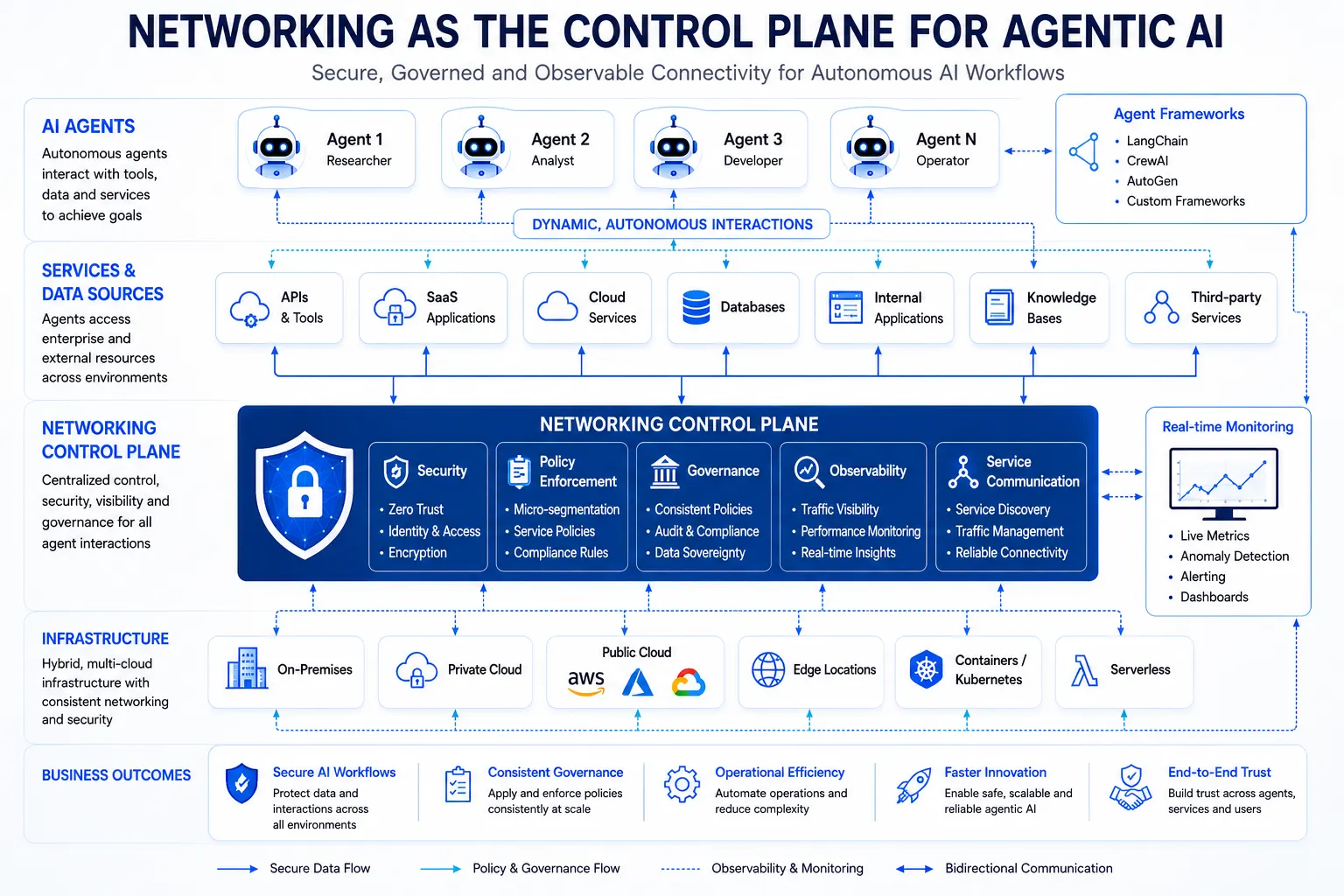
Instead, networking is increasingly serving as a critical control plane that governs how AI agents operate across distributed environments.
Modern networking platforms help organizations:
Enforce security policies
Maintain governance standards
Control service-to-service communication
Monitor AI behavior
Improve observability
Protect sensitive data flows
Support cross-cloud operations
This becomes particularly important because application-level controls alone often fail when AI agents operate across multiple platforms and environments.
Infrastructure-level networking controls provide a broader and more consistent framework for managing AI operations regardless of where agents run or which tools they use.
For enterprises deploying autonomous systems at scale, this approach can reduce policy fragmentation while improving visibility and compliance.
The Growing Need for Governance and Observability
One of the most pressing concerns surrounding agentic AI is the rise of unmanaged or "shadow" AI activity.
As AI agents become more autonomous, organizations risk losing oversight of:
Agent interactions
Data access patterns
Decision-making processes
Service communications
Security compliance requirements
Framework-level governance can help manage specific applications, but IDC suggests that it is insufficient for large-scale deployments spanning multiple clouds, operating environments, and AI ecosystems.
Infrastructure-led governance offers a more comprehensive solution by embedding controls directly into the network layer.
This allows enterprises to maintain:
Consistent policy enforcement
End-to-end observability
Secure service discovery
Identity verification
Centralized monitoring
Such capabilities are becoming increasingly essential as organizations pursue enterprise-grade AI deployments.
Platform Versus Best-of-Breed: The Enterprise AI Debate
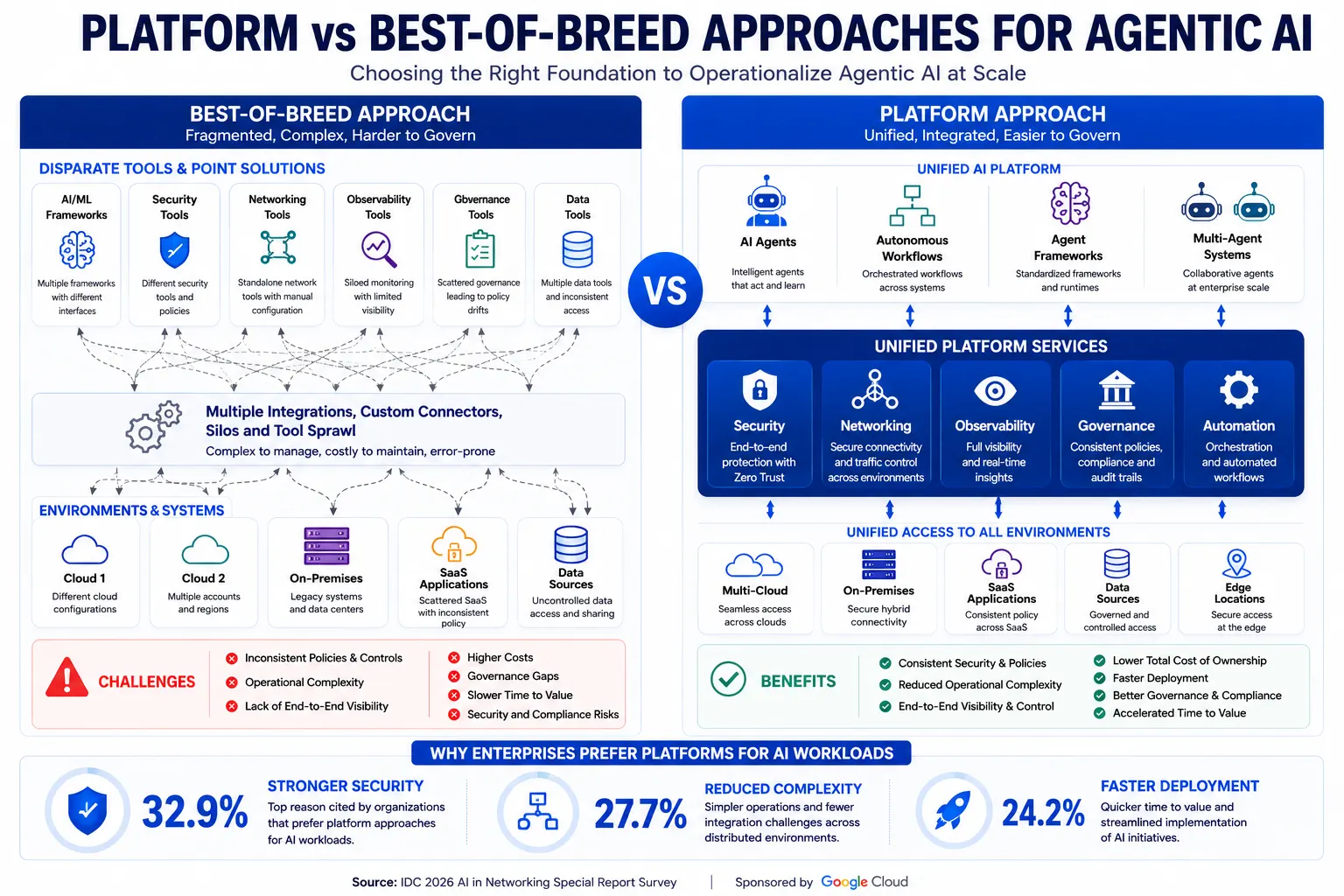
A major challenge facing enterprises is choosing between platform-centric architectures and best-of-breed technology stacks.
Best-of-breed solutions often provide specialized functionality that addresses unique technical requirements. However, introducing multiple independent tools can also create operational complexity and governance gaps.
IDC's survey revealed that organizations favoring platform approaches cited several key benefits:
32.9% pointed to stronger security
27.7% cited reduced operational complexity
24.2% highlighted faster deployment
The findings suggest that many enterprises view integrated platforms as a way to simplify AI operations while improving consistency and governance.
However, IDC does not advocate for a rigid platform-only strategy.
Instead, the research recommends a balanced model where organizations leverage platform foundations while maintaining the flexibility to integrate specialized third-party capabilities when necessary.
Open and Extensible Platforms Will Define the Future
As agentic AI continues evolving, enterprises require infrastructure platforms that can adapt to changing technologies, standards, and business requirements.
According to IDC, future-ready AI infrastructure should possess several characteristics:
Openness
Support for open standards and interoperability across ecosystems.
Flexibility
Ability to integrate third-party services, frameworks, and tools.
Extensibility
Capacity to evolve without requiring complete architectural redesigns.
Governance
Built-in mechanisms for security, policy management, and compliance.
Observability
Comprehensive visibility into AI agent activity and interactions.
These characteristics allow organizations to innovate while maintaining operational stability and trust.
What This Means for Enterprise Technology Leaders
The rise of agentic AI is fundamentally changing infrastructure priorities.
Organizations can no longer focus solely on AI model performance. They must also consider how autonomous systems interact across networks, applications, cloud environments, and business processes.
Technology leaders should evaluate whether their networking infrastructure can:
Support distributed AI workloads
Enforce consistent security policies
Deliver end-to-end observability
Enable multi-cloud operations
Scale autonomous AI interactions
Maintain governance and compliance
Those that fail to modernize their infrastructure risk creating bottlenecks that limit AI adoption and business value.
Conclusion
IDC's latest research highlights a critical reality for enterprises pursuing agentic AI: networking infrastructure is becoming just as important as the AI models themselves.
As autonomous agents increasingly interact across clouds, applications, APIs, and data systems, organizations face new challenges related to security, governance, observability, and operational control. Traditional infrastructure approaches are often insufficient for these highly distributed environments.
The research suggests that successful AI deployments will depend on adopting infrastructure-led networking strategies that provide consistent policy enforcement, centralized visibility, and scalable governance. At the same time, enterprises must strike a balance between integrated platforms and specialized tools to maintain both flexibility and operational simplicity.
Looking ahead, the organizations that build open, extensible, and secure networking foundations today will be best positioned to unlock the full potential of agentic AI tomorrow.
Source: Google Cloud Blog
About the Author