
Claude on Google Cloud Brings Frontier AI to Enterprise Production
Google Cloud has expanded its AI platform with Claude, giving enterprises a fully managed way to deploy frontier AI models with global scalability, enterprise security, regional data residency, and production-ready infrastructure for building intelligent AI agents.
Xcademia Team
Xcademia Research Team
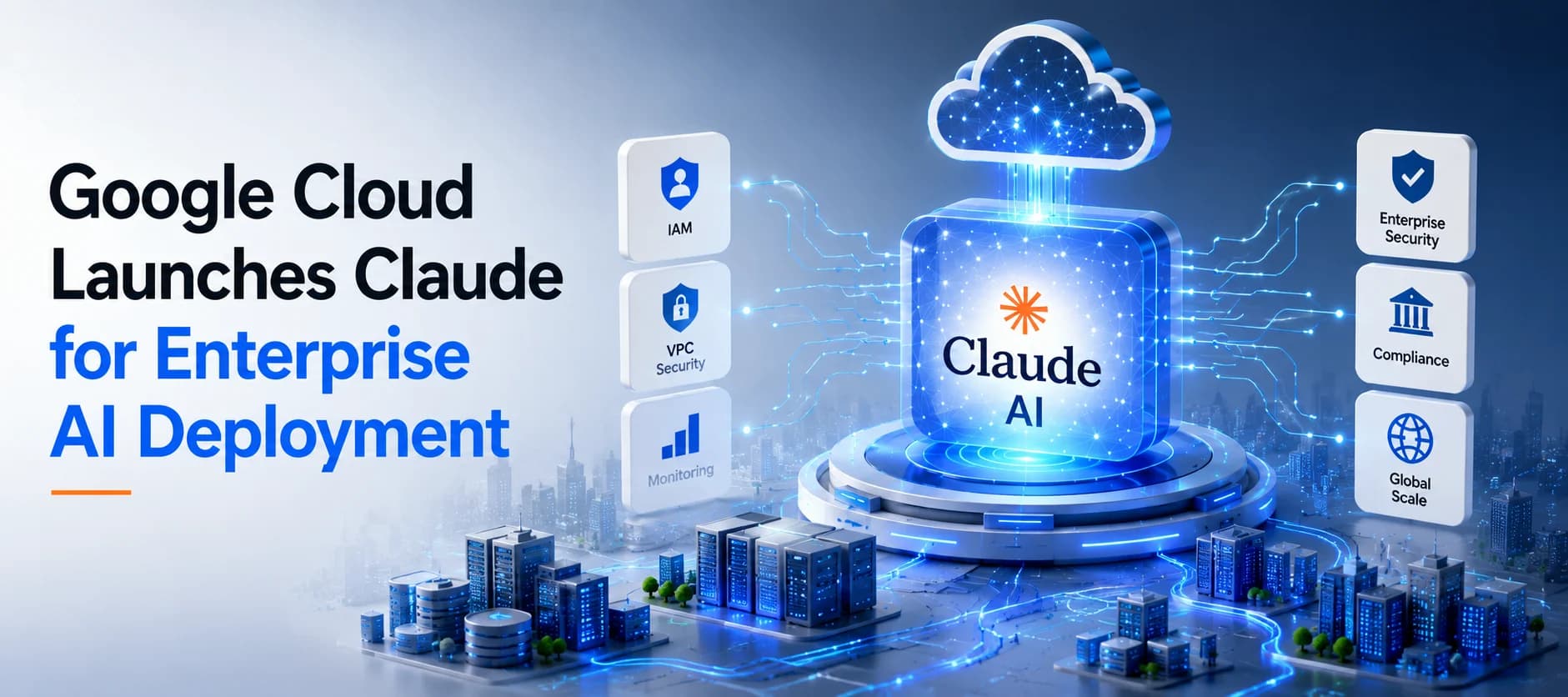
Claude on Google Cloud Simplifies Enterprise AI Deployment
Deploying frontier AI in production requires far more than choosing a powerful language model. Enterprises also need resilient infrastructure, global scalability, enterprise-grade security, regulatory compliance, predictable costs, and the ability to operate AI applications reliably at scale.
To address these challenges, Google Cloud has announced Claude on Google Cloud, a production-ready deployment model that combines Anthropic's advanced Claude family of AI models with Google Cloud's enterprise infrastructure.
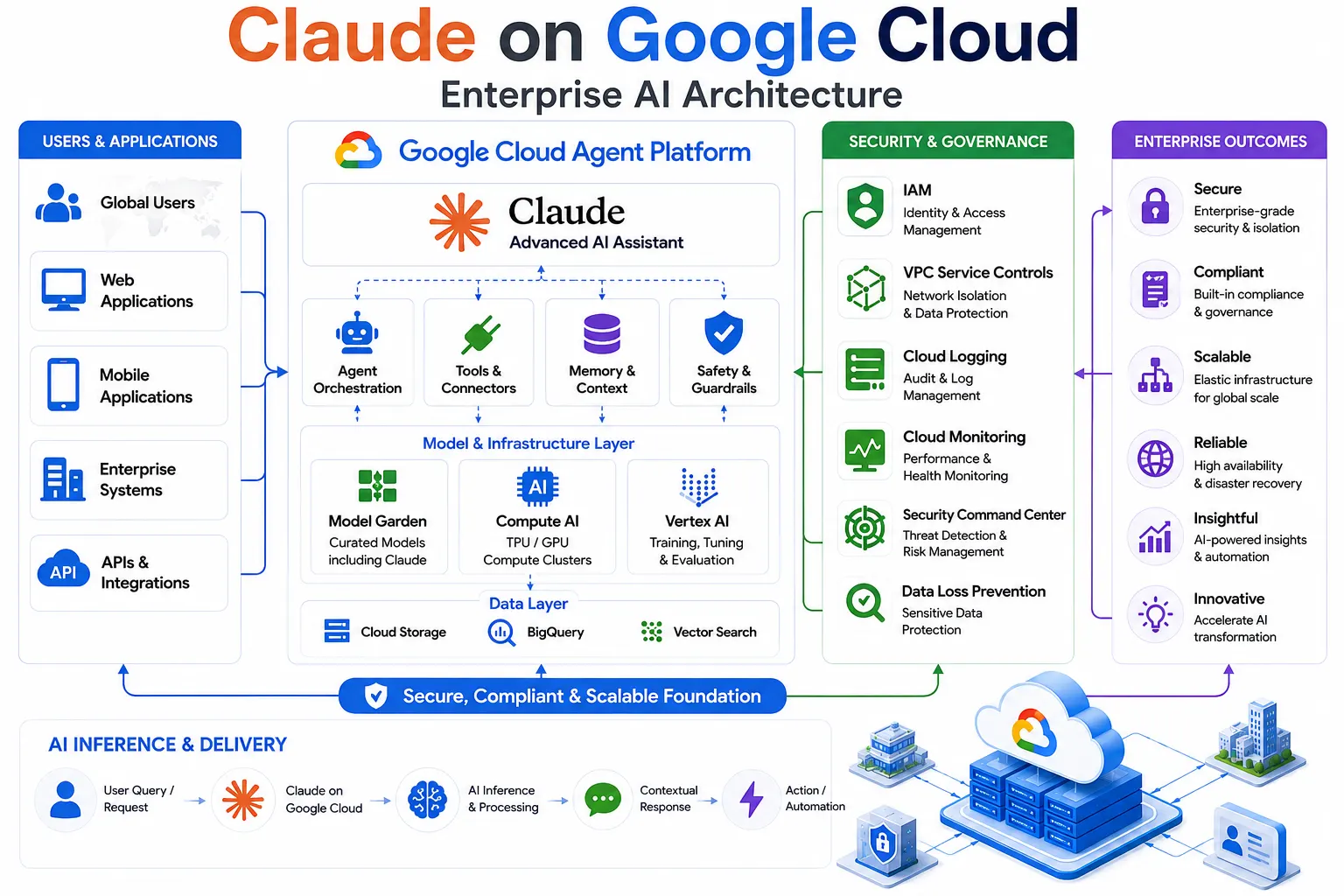
Instead of organizations building and maintaining complex inference clusters, networking layers, failover systems, and compliance controls, developers can access Claude through Google Cloud's Agent Platform using the same infrastructure, identity management, networking, and monitoring services already used across their cloud environments.
The result is a unified platform where enterprises can deploy frontier AI applications while focusing on innovation instead of infrastructure management.
Why Enterprise AI Requires More Than Powerful Models
Modern AI workloads require organizations to manage GPU infrastructure, maintain high availability across multiple regions, support long-context inference, meet regulatory requirements, maintain consistent performance during traffic spikes, and optimize operating costs.
Google Cloud positions Claude as a managed service that removes much of this operational complexity.
Rather than provisioning compute clusters or designing custom inference pipelines, developers interact with Claude using standard REST APIs through Google Cloud's Agent Platform.
This approach allows AI workloads to inherit existing cloud governance, making AI deployment similar to deploying any other Google Cloud service.
Fully Managed Infrastructure Reduces Operational Complexity
One of the biggest advantages highlighted by Google Cloud is its fully managed infrastructure.
Google Cloud handles compute provisioning, automatic scaling, load balancing, infrastructure monitoring, capacity management, and failover automatically. This allows engineering teams to focus on building AI applications instead of maintaining inference infrastructure.
# Import Anthropic Vertex AI SDK
from anthropic import AnthropicVertex

# Initialize client
client = AnthropicVertex(
    project_id="your-project-id",
    region="uk"
)

# Send request to Claude model
message = client.messages.create(
    model="claude-opus-4-8",
    max_tokens=1024,
    messages=[
        {
            "role": "user",
            "content": " Technical Analysis this system architecture."
        }
    ]
)
Claude is available through Vertex AI Model Garden as a managed Model-as-a-Service offering, allowing developers to access Anthropic's latest models using Google Cloud's enterprise infrastructure.
Because requests inherit existing IAM policies and VPC configurations automatically, organizations avoid managing separate authentication systems or API keys.
This significantly reduces operational overhead for enterprise development teams.
Global Endpoints Deliver Low Latency Worldwide
One of the major engineering challenges in AI deployment is serving users across multiple geographic regions.
A single inference endpoint can introduce increased response times, regional bottlenecks, higher failure risks, and capacity limitations, particularly for organizations serving users across multiple continents.
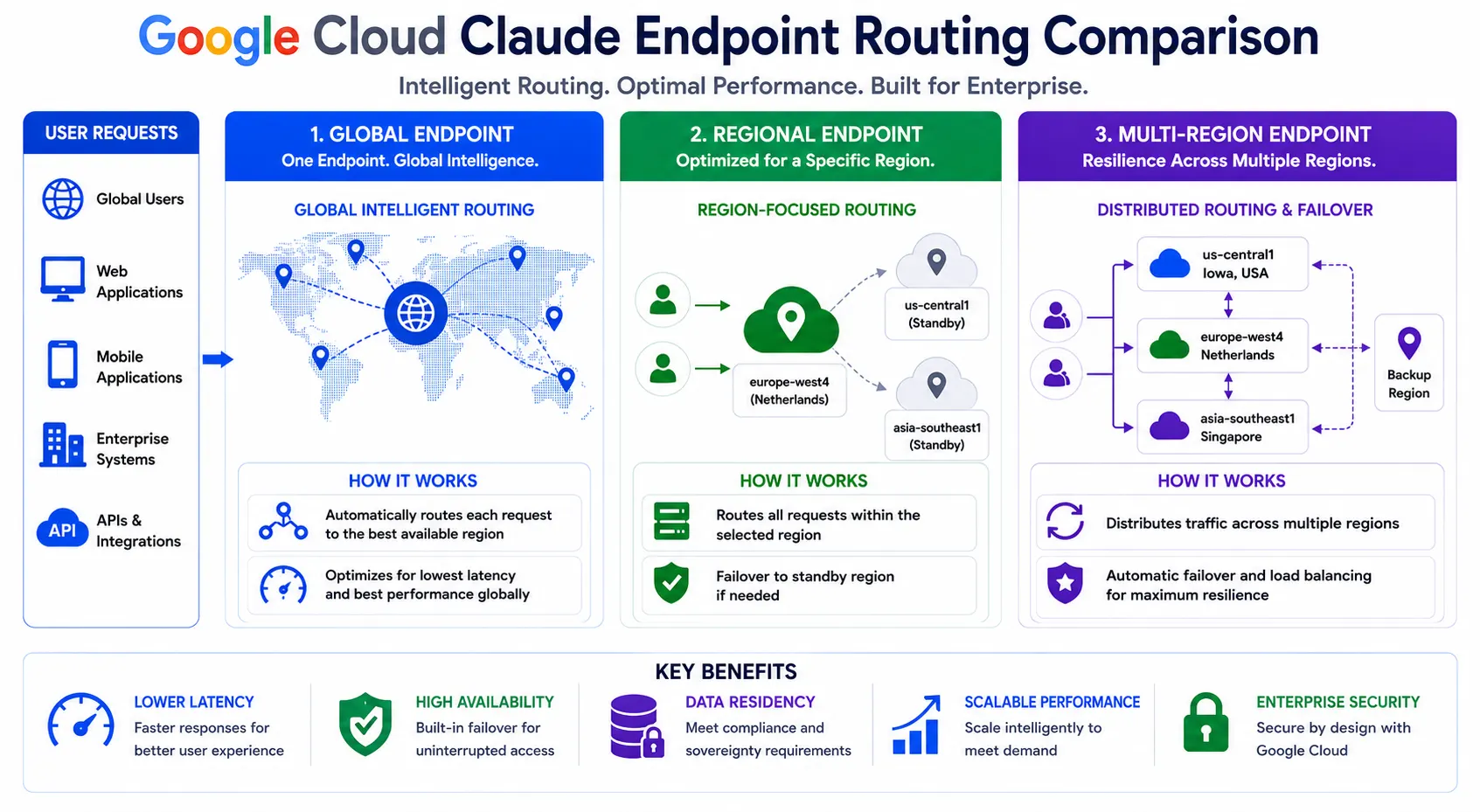
Google Cloud addresses this through three different endpoint architectures.
(1) Global Endpoints
Global endpoints automatically route requests to regions with available AI capacity.
If one region experiences heavy demand, traffic is redirected to another available location without requiring application changes.
This provides:
Automatic failover
Geographic load balancing
Higher availability
Lower operational complexity
(2) Regional Endpoints
Regional endpoints keep prompts, completions, and intermediate inference data within a single geographic region.
These deployments are particularly valuable for organizations with:
Financial regulations
Healthcare compliance
Government security requirements
Local data residency policies
They also provide lower latency for regional users.
(3) Multi-Region Endpoints
Multi-region endpoints combine the advantages of resilience and regulatory compliance.
Instead of depending on one region, traffic dynamically moves across approved regional locations while maintaining U.S. or European data residency requirements.
This architecture helps enterprises remain operational during regional outages or infrastructure constraints.
Enterprise Security and Compliance Built Into the Platform
Security remains one of the biggest concerns for enterprise AI adoption.
Organizations handling regulated information cannot risk exposing prompts, generated responses, or intermediate inference data.
Google Cloud addresses these concerns by allowing Claude deployments to inherit its existing enterprise security architecture.
Key capabilities include:
(1) Identity and Access Management
Claude endpoints use the same IAM framework already protecting Google Cloud resources.
Organizations can continue using existing access policies without creating separate authentication systems.
(2) VPC Service Controls
Virtual Private Cloud Service Controls create security perimeters around AI resources, reducing the risk of unauthorized data movement or exfiltration.
(3) Cloud Logging and Monitoring
Operations teams receive near real-time visibility into:
Token usage
Request latency
Error rates
Quota consumption
Service performance
This observability helps enterprises monitor production AI systems using familiar Google Cloud tools.
(4) Compliance Support
Claude deployments also inherit Google Cloud compliance certifications including:
FedRAMP High
HIPAA
These certifications support organizations operating in:
Healthcare
Government
Financial services
Highly regulated industries
Instead of redesigning compliance strategies specifically for AI, enterprises can extend existing governance models.
Performance Optimization Without Sacrificing Cost
Running frontier AI at enterprise scale can become expensive if infrastructure and model efficiency are not optimized together.
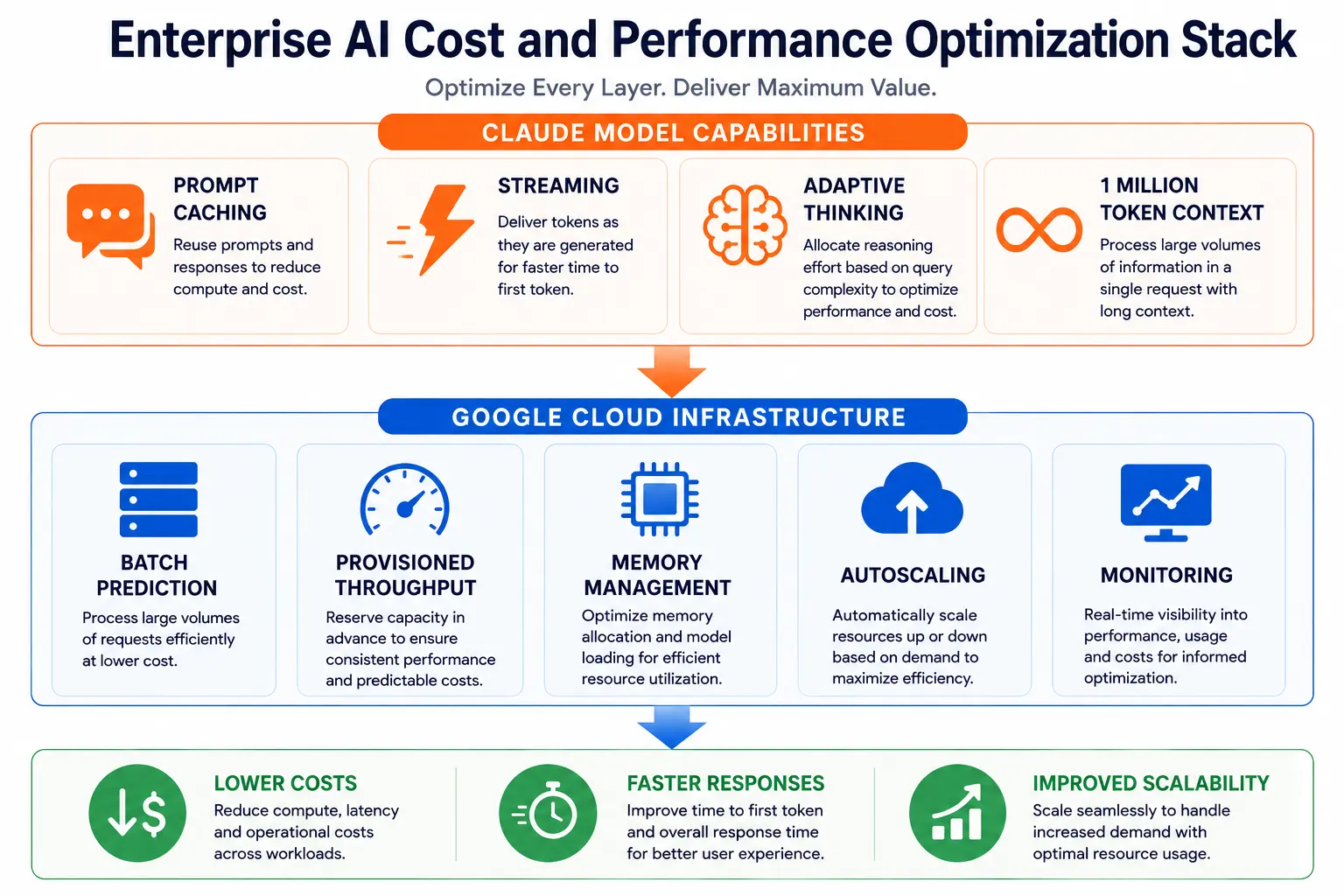
Google Cloud combines Claude's native optimization capabilities with infrastructure-level controls.
Claude Native Features
Several optimization features are available directly within Claude.
Prompt Caching
Prompt caching stores repeated prompt prefixes such as:
Legal documentation
System prompts
Large codebases
Google Cloud states this can reduce:
Request latency by up to 80 percent
Costs by up to 90 percent
for eligible workloads.
Streaming Responses
Streaming delivers generated tokens immediately instead of waiting for the entire response.
This creates faster user experiences for:
Chatbots
Coding assistants
Interactive applications
Adaptive Thinking
Claude dynamically adjusts reasoning effort based on task complexity.
Developers can balance:
Performance
Response quality
Computational cost
depending on workload requirements.
Extended Context Windows
Claude supports context windows reaching up to 1 million tokens in newer Opus and Sonnet models.
This enables:
Large document analysis
Enterprise knowledge processing
Extensive codebase understanding
Multi-document reasoning
Infrastructure-Level Performance Features
Google Cloud complements Claude's model capabilities with infrastructure optimization.
These include:
(1) Batch Prediction
Ideal for offline workloads such as:
Content moderation
Document classification
Bulk summarization
Batch processing reduces costs by running asynchronous inference.
(2) Provisioned Throughput
Organizations with mission-critical applications can reserve dedicated inference capacity.
Benefits include:
Predictable latency
Consistent performance
Isolation from public demand spikes
(3) Infrastructure Memory Management
Google Cloud manages scheduling and memory allocation for long-context AI requests, helping maintain reliable performance for large-scale inference.
Together, these capabilities allow enterprises to optimize both AI model efficiency and cloud infrastructure utilization.
Moving Beyond AI Inference Toward Intelligent Agents
Google Cloud also positions Claude as the foundation for intelligent enterprise agents.
Rather than only answering prompts, Claude can coordinate multi-step workflows across enterprise systems.
The platform follows a three-step development process.
(1) Build
Developers select Claude models from Model Garden and build agents using the Agent Development Kit.
Supported programming languages include:
Python
Go
Java
TypeScript
(2) Deploy
Agents can be deployed through:
Agent Runtime
Cloud Run
Google Kubernetes Engine
GKE Agent Sandbox
(3) Interoperate
Google Cloud supports the Agent2Agent (A2A) protocol, allowing Claude-powered agents to communicate with agents from an open ecosystem supported by more than 150 organizations
This enables AI systems capable of delegating specialized tasks across broader enterprise ecosystems while remaining governed under unified identity management and auditing.
Why This Announcement Matters
Google Cloud's integration of Claude marks another step in the evolution of enterprise AI platforms. Rather than offering access to advanced language models alone, cloud providers are increasingly delivering complete ecosystems that simplify deployment, security, governance, and operations. For enterprises, this reduces the complexity of adopting generative AI while accelerating the journey from experimentation to production.
The Bigger Picture for Enterprise AI
The announcement reflects a broader industry trend where cloud providers are becoming complete AI operating platforms rather than simply infrastructure providers.
Organizations increasingly expect managed AI deployment, integrated security, compliance-ready architectures, global scalability, agent development tools, and predictable operational costs from their cloud providers.
By combining Anthropic's Claude models with Google Cloud's managed infrastructure, Google aims to lower the operational barriers that often slow enterprise AI adoption.
Instead of building complex inference environments from scratch, enterprises can focus on developing applications, automating workflows, and deploying intelligent AI agents using familiar Google Cloud services.
As enterprises continue investing in generative AI, infrastructure is becoming just as important as the models themselves. By combining Anthropic's Claude with Google's managed cloud services, Google Cloud is positioning itself as a platform where organizations can build, deploy, secure, and scale AI applications without the operational burden traditionally associated with frontier models. The announcement also highlights the industry's shift toward fully integrated AI platforms that combine infrastructure, governance, and intelligent agents under a single enterprise ecosystem.
Source: Google Cloud Blog
About the Author