
Google Shows How BigQuery Can Turn Gemini Enterprise Data Into a Powerful AI Governance Engine
Google has unveiled a blueprint for analyzing and governing Gemini Enterprise usage at scale with BigQuery, helping organizations monitor AI adoption, enforce compliance, investigate security events, and measure business value from enterprise AI deployments.
Xcademia Team
Xcademia Research Team
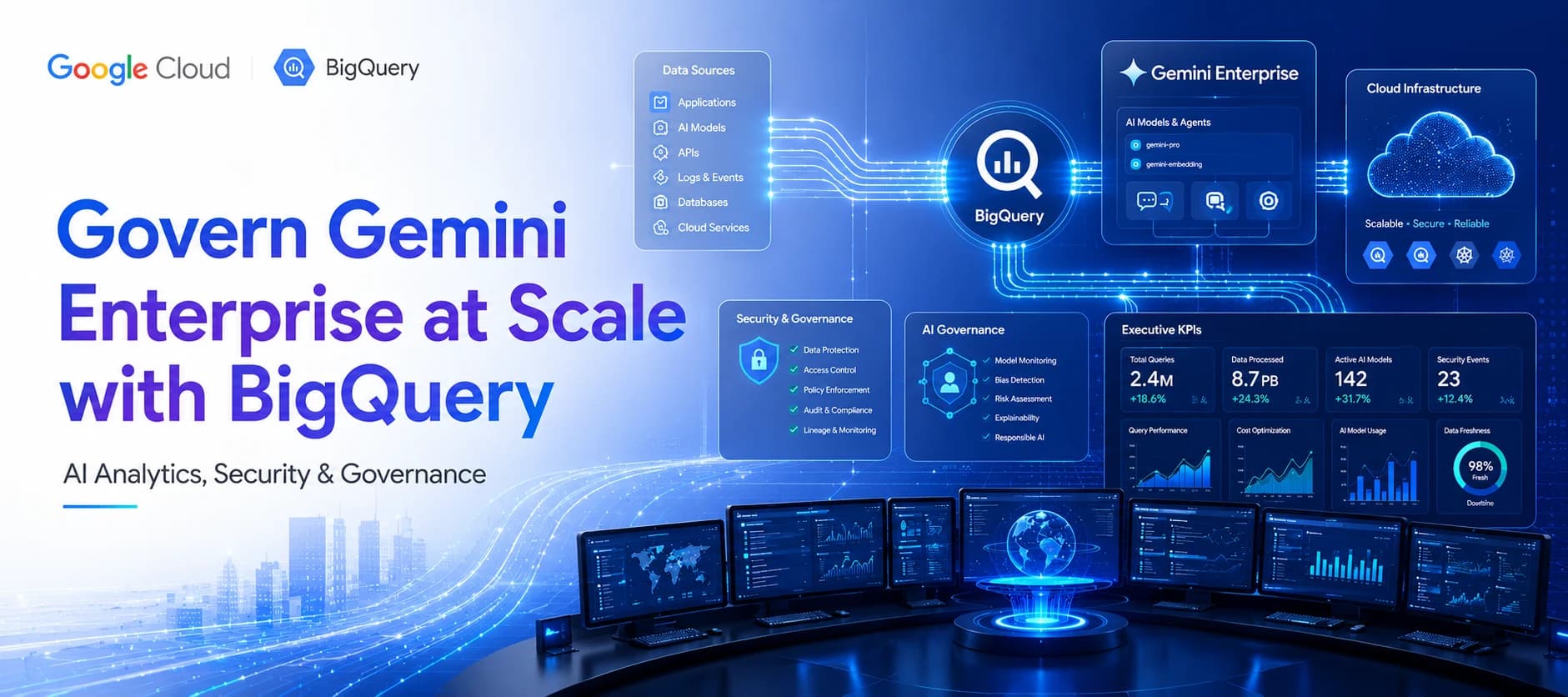
Google Expands Enterprise AI Governance with BigQuery Analytics
As organizations rapidly deploy generative AI across their workforce, visibility into how employees use these tools is becoming a critical challenge. While AI platforms can dramatically improve productivity, they also create new governance, compliance, and security requirements.
Google Cloud has introduced a comprehensive approach that combines Gemini Enterprise with BigQuery to help organizations analyze, govern, and extract insights from AI usage at scale. The framework enables IT, security, and data teams to move beyond basic usage dashboards and gain deeper operational intelligence from enterprise AI deployments.
The announcement highlights how organizations can use BigQuery as a centralized analytics platform to monitor Gemini Enterprise adoption, investigate security incidents, audit compliance activities, and quantify business outcomes.
Why AI Governance Is Becoming a Business Priority
Enterprise adoption of AI is accelerating across departments, from customer support and software engineering to marketing and research. As usage grows, organizations need answers to several critical questions:
Which teams are using AI most effectively?
How many custom AI agents are being created?
What business value is being generated?
Are employees accessing sensitive data appropriately?
How can security teams investigate AI-related incidents?
Traditional analytics dashboards often provide high-level adoption metrics but may lack the organizational context needed for deeper governance and strategic decision-making.
Google positions BigQuery as the solution for transforming large volumes of Gemini Enterprise telemetry into actionable intelligence.
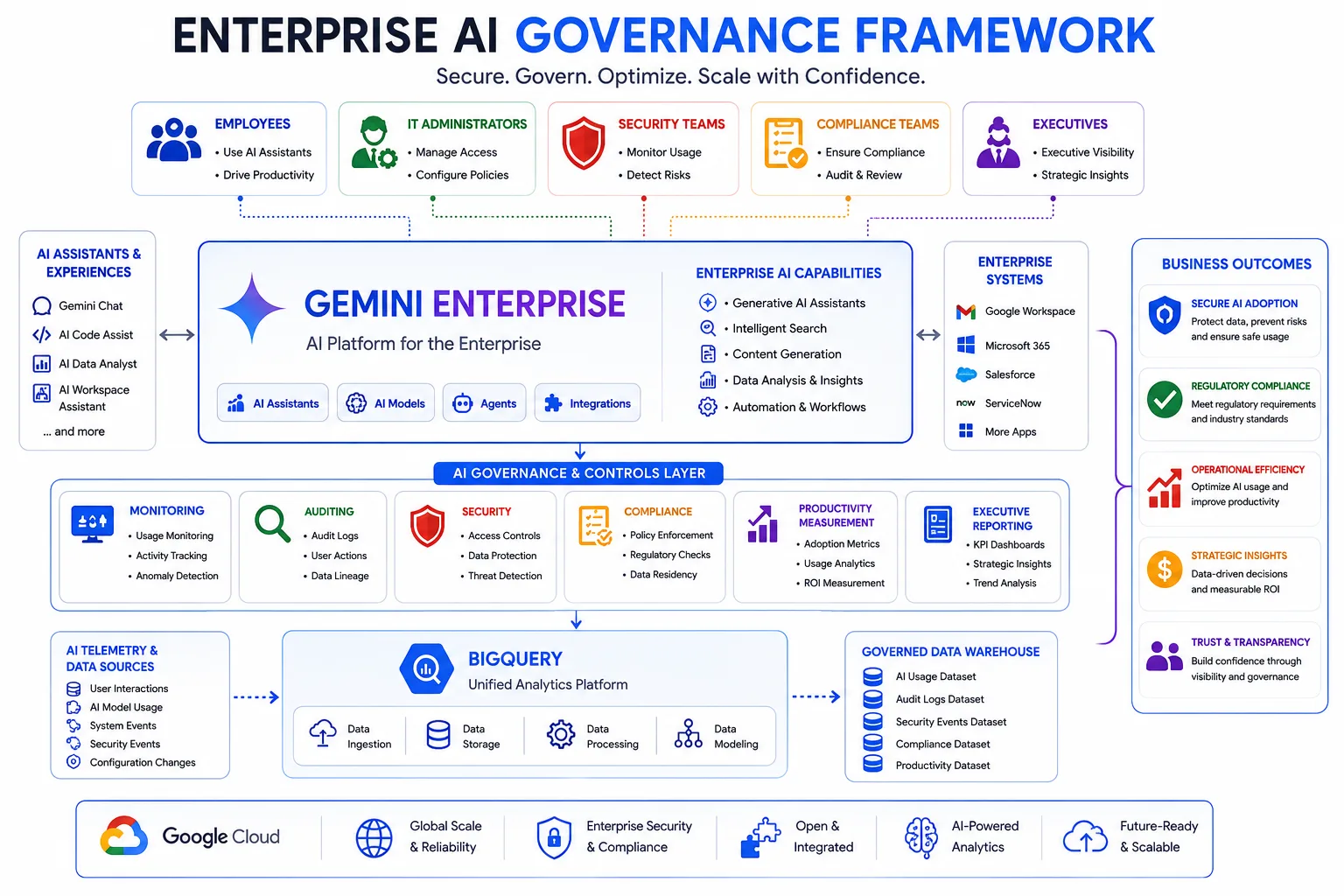
How Gemini Enterprise and BigQuery Work Together
Google's architecture relies on automated telemetry collection and analytics pipelines that feed Gemini Enterprise data into BigQuery.
The approach allows organizations to analyze AI usage without building custom monitoring systems from scratch.
According to Google, BigQuery enables organizations to:
1. Profile AI Adoption Across Teams
Organizations can:
Analyze AI usage by department
Monitor NotebookLM adoption
Track custom AI agent creation
Measure agent-to-employee ratios
Identify high-performing teams
This visibility helps leaders understand where AI adoption is creating the most value.
2. Quantify Business Impact
One of the most interesting capabilities involves combining Gemini usage data with internal business systems.
Organizations can correlate AI activity with:
HR datasets
Operational metrics
Business workflows
Productivity measurements
This allows enterprises to estimate time savings and evaluate AI-driven productivity improvements across departments.
3. Strengthen Compliance and Data Governance
Compliance teams can use BigQuery to audit:
Grounding queries
Enterprise data access
File access paths
Directory interactions
Sensitive information usage
This creates a more transparent environment for regulated industries and organizations with strict data governance requirements.
4. Accelerate Security Investigations
When AI security controls trigger alerts, administrators can query historical logs to determine:
Which prompt triggered the event
Which user initiated the interaction
What content was processed
Whether policy violations occurred
This significantly reduces investigation time for security teams.
The Five Key Telemetry Sources
Google organizes Gemini Enterprise telemetry into five primary BigQuery data sources:
Telemetry Source | Purpose |
|---|---|
Gen AI User Messages | Stores user prompts |
Gen AI Choices | Stores model responses and reasoning metadata |
User Activity Telemetry | Captures user identity and grounding activity |
Cloud Audit Activity | Tracks administrative actions |
Cloud Audit Data Access | Records data access and search interactions |
Additionally, organizations can export aggregate metrics such as:
Seats purchased
Seats claimed
User engagement metrics
Adoption trends
Historical utilization data
This provides both operational and executive-level visibility.
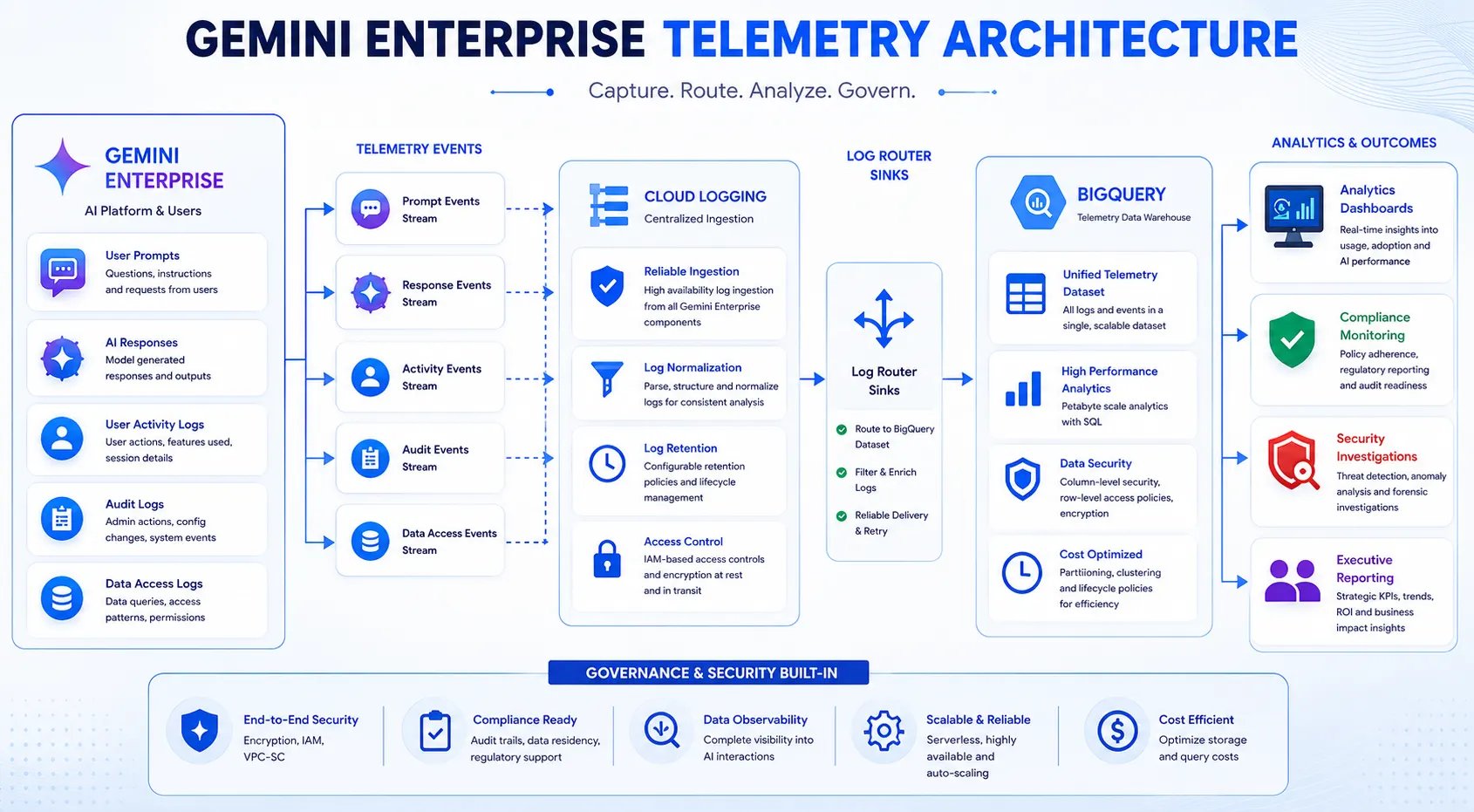
Building the AI Observability Pipeline
Google's implementation relies on two primary pipelines.
1. Streaming Analytics Pipeline
The streaming pipeline continuously captures:
User prompts
Model responses
Grounding events
AI interactions
This provides near real-time visibility into enterprise AI activity.
2. Governance and Audit Pipeline
The governance pipeline captures:
Administrative changes
Configuration updates
Agent creation activities
Data access operations
These records help organizations maintain compliance and support forensic investigations.
Together, the pipelines create a comprehensive observability framework for enterprise AI operations.
Gemini-Powered Analytics Inside BigQuery
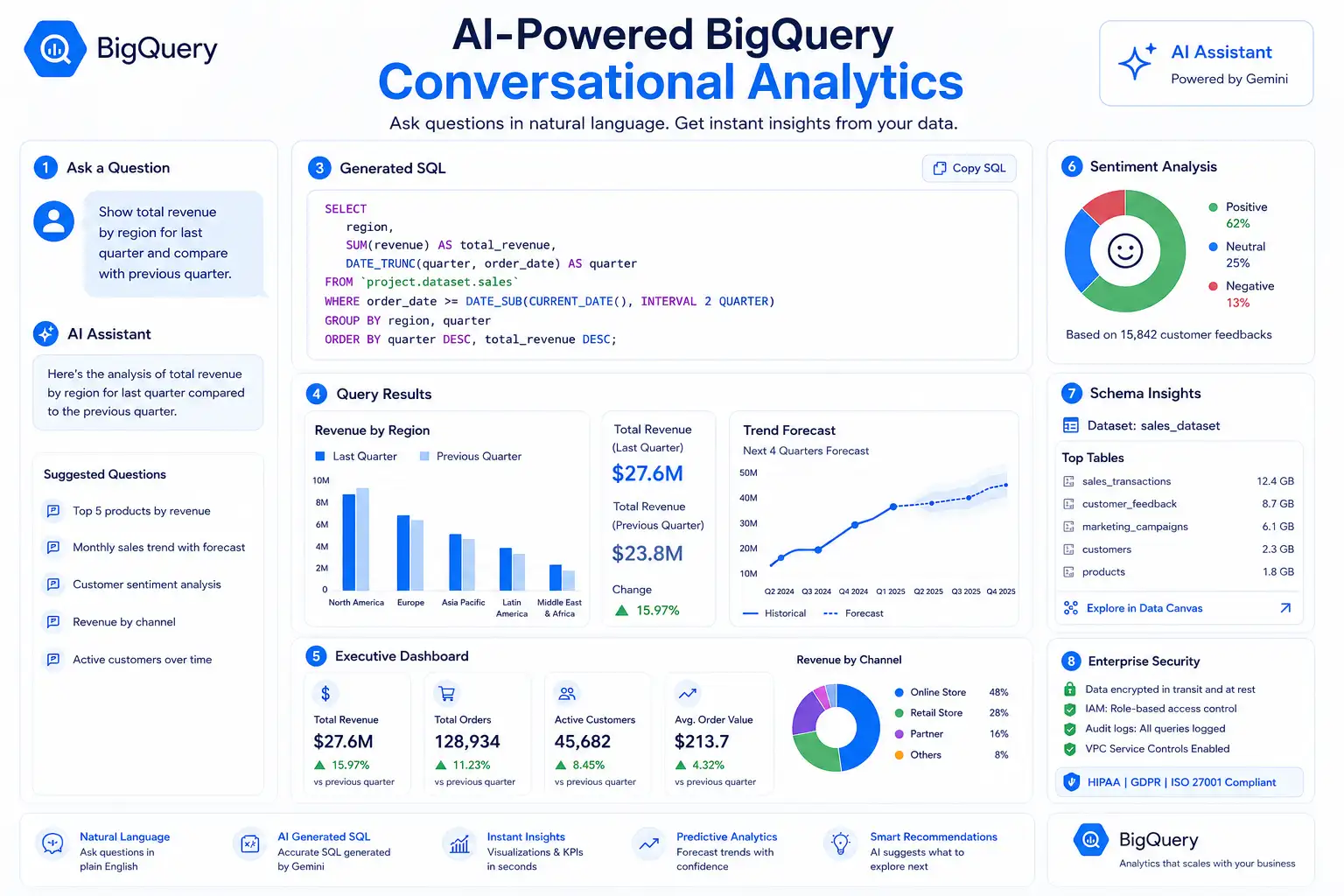
One of the most notable capabilities is the integration of Gemini within BigQuery itself.
Google's BigQuery Conversational Analytics (BQ CA) enables administrators to query complex datasets using natural language instead of writing SQL manually.
For example, administrators can ask questions such as:
"Compare the usage of NotebookLM, Deep Research, and custom agents."
The system automatically:
Generates SQL queries
Executes analysis
Returns results
Explains reasoning behind outputs
This lowers the technical barrier for administrators and business users who need insights from AI telemetry.
Automated Schema Understanding and Metadata Intelligence
Large-scale telemetry datasets can be difficult to understand.
Google addresses this challenge with:
AI-Generated Documentation
BigQuery automatically creates:
Table descriptions
Column explanations
Data relationship mapping
Metadata insights
Data Profiling
Administrators can analyze:
Null value rates
Data distributions
Unique value counts
Anomalies
Business Glossaries
Organizations can define custom terminology to ensure AI analytics systems interpret internal business language correctly.
These features reduce the effort required to manage increasingly complex AI telemetry environments.
Executive Dashboards for Business Leaders
Google also highlights the role of Looker Studio (formerly Data Studio) in transforming telemetry into executive-friendly visualizations.
Organizations can build dashboards that track:
AI Adoption Metrics
Department-level adoption
Active users
Custom agent growth
Seat utilization
Data Grounding Activity
Google Drive usage
Gmail integration activity
SharePoint utilization
Connector performance
Safety and Compliance Metrics
Model Armor blocks
Content safety incidents
User feedback trends
Policy enforcement events
These dashboards provide leadership teams with a clear view of how AI initiatives are performing across the organization.
What This Means for Enterprise Security and AI Teams
The announcement reflects a broader trend in enterprise AI adoption: organizations increasingly need governance frameworks that scale alongside AI usage.
Several themes stand out:
AI Governance Is Becoming Operational
AI is moving from experimentation to production. Governance capabilities must become embedded into everyday operations.
Security Teams Need Better Visibility
Prompt activity, grounding data access, and model interactions now represent important parts of an organization's security landscape.
Analytics Is Central to AI Success
Organizations cannot optimize AI investments without understanding how employees use AI tools and what outcomes they generate.
Natural Language Analytics Will Expand
Tools such as BigQuery Conversational Analytics demonstrate how AI can simplify the analysis of increasingly complex enterprise datasets.
Looking Ahead
As enterprise AI adoption accelerates, governance platforms will likely evolve into comprehensive AI operations centers.
Future developments may include:
Automated compliance monitoring
AI risk scoring systems
Real-time anomaly detection
Advanced productivity measurement
Cross-platform AI governance frameworks
Organizations that establish strong telemetry and analytics foundations today will be better positioned to manage AI securely and effectively as adoption expands.
Conclusion
Google's latest Gemini Enterprise and BigQuery integration demonstrates that successful AI deployment is no longer just about giving employees access to powerful models. It is equally about visibility, governance, security, and measurable business outcomes.
By combining Gemini Enterprise telemetry with BigQuery's analytics capabilities, organizations can monitor adoption, investigate security incidents, enforce compliance requirements, and quantify the value generated by AI initiatives.
As AI becomes deeply embedded in enterprise workflows, platforms that provide both productivity and governance capabilities will play an increasingly important role in helping organizations scale AI responsibly.
Source: Google Cloud
About the Author