
Google AlloyDB Brings AI-Powered Multilingual Search to PostgreSQL with Native Gemini Integration
Google Cloud's new AlloyDB AI features enhance PostgreSQL search by integrating Gemini AI Functions directly into the database. Developers can build faster, smarter multilingual full-text and hybrid search experiences without complex ETL pipelines or external AI services.
Xcademia Team
Xcademia Research Team
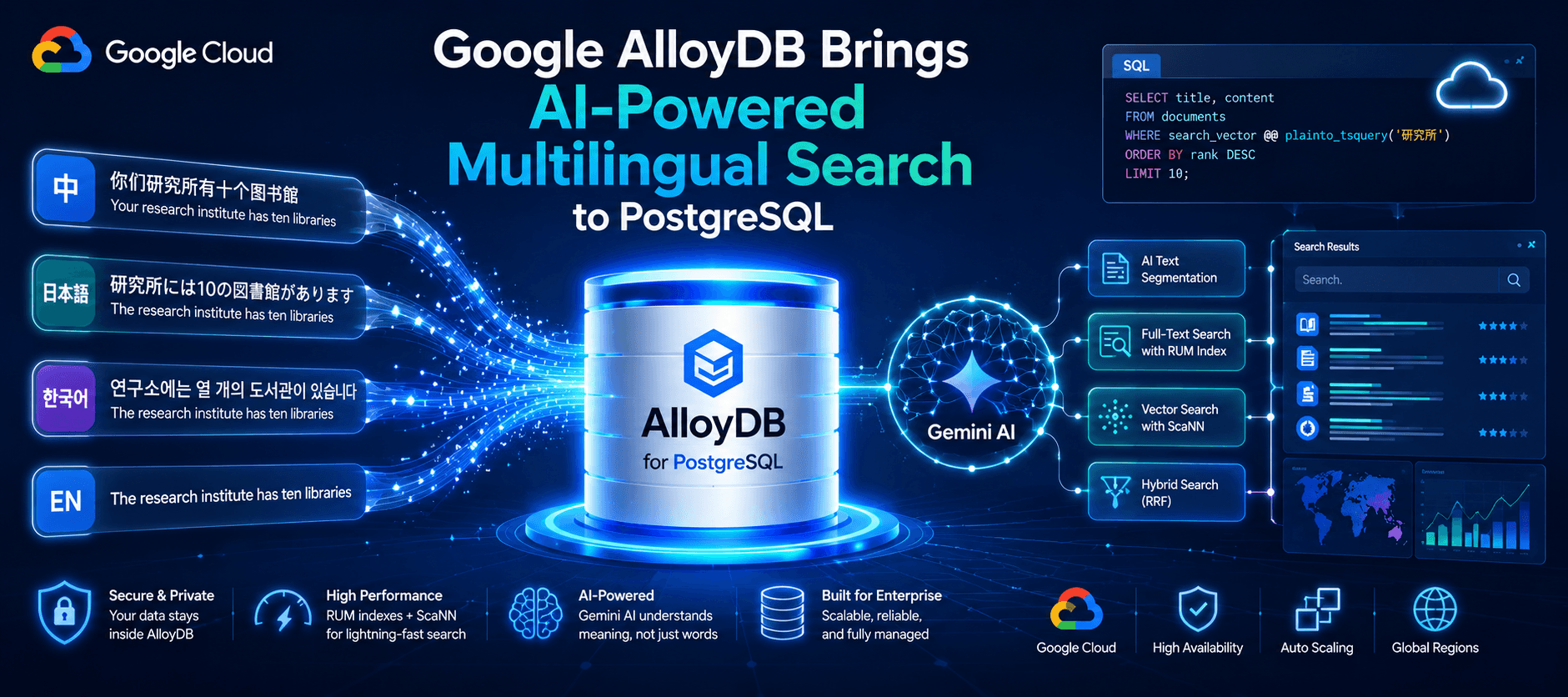
Google Introduces AI-Powered Multilingual Search for AlloyDB
As enterprise applications become increasingly global, developers are expected to support users searching in multiple languages while maintaining high performance and accuracy. Although PostgreSQL remains one of the world's most trusted open source relational databases, its traditional full-text search capabilities have long struggled with languages such as Chinese, Japanese, and Korean because these writing systems do not separate words with spaces.
To address this challenge, Google Cloud has announced a significant enhancement to AlloyDB AI, enabling developers to perform intelligent multilingual text processing directly inside the database using Gemini AI Functions. Instead of relying on external preprocessing services or custom tokenization libraries, organizations can now use Gemini's language understanding to prepare text for indexing while keeping data securely inside AlloyDB.
The update is part of Google's broader strategy to transform databases into AI-native platforms that combine structured data management with advanced language understanding, helping enterprises build smarter search systems, AI assistants, and Retrieval-Augmented Generation (RAG) applications.
The Challenge with Traditional PostgreSQL Full-Text Search
Full-text search is one of PostgreSQL's most valuable features. It works by converting text into searchable tokens, known as lexemes, using the built-in to_tsvector() function. For languages such as English, French, or Spanish, this process is highly effective because words are naturally separated by spaces.
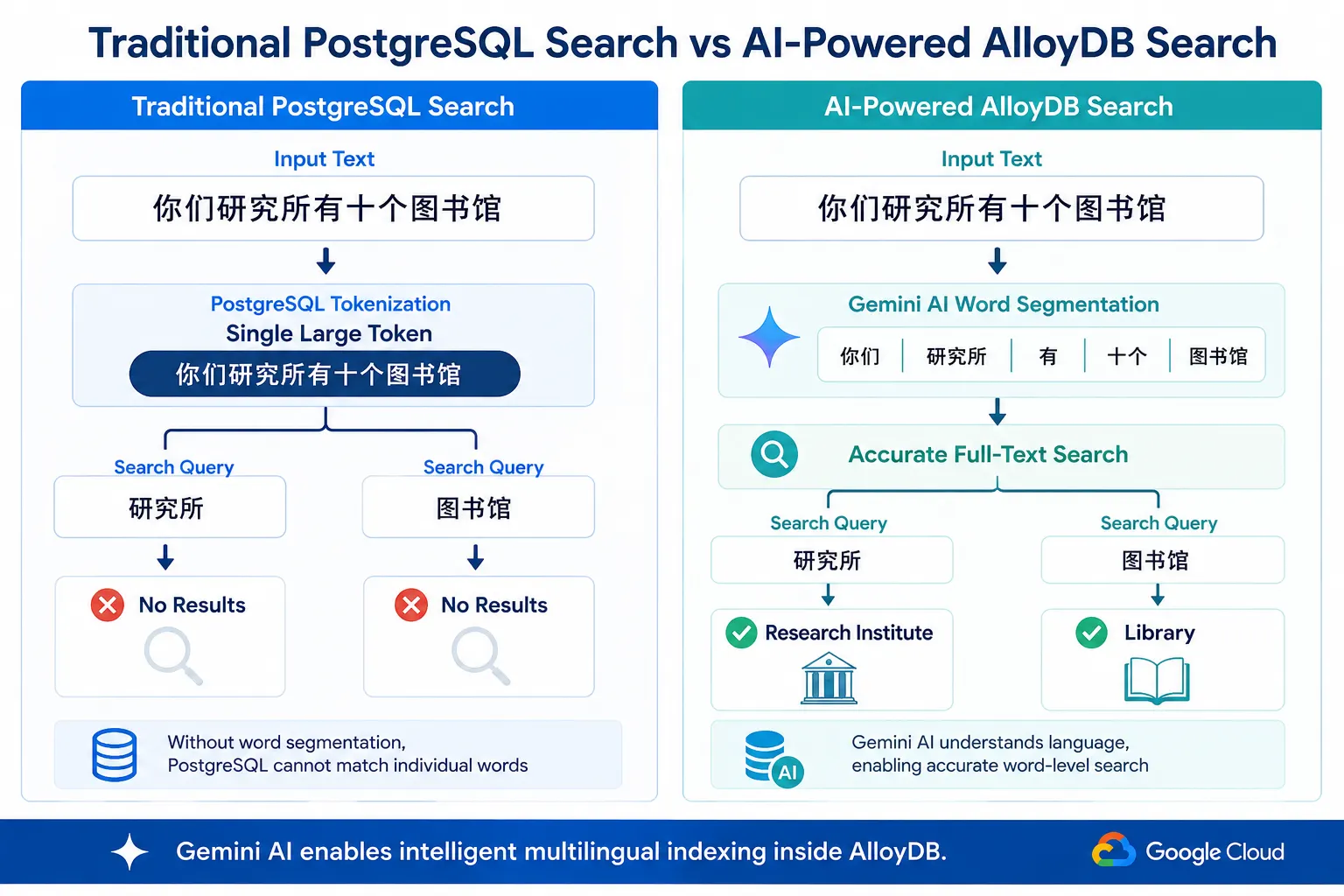
However, languages including Chinese, Japanese, and Korean use continuous text without whitespace between words. As a result, PostgreSQL's default tokenization treats an entire sentence as one large searchable token instead of breaking it into meaningful words.
For example, consider the following Chinese sentence:
你们研究所有十个图书馆
While humans can easily recognize separate concepts such as 研究所 (research institute) and 图书馆 (library), PostgreSQL indexes the entire sentence as one continuous lexeme. Searching for either keyword individually often produces no results because the database cannot distinguish individual words inside the sentence.
For organizations operating multilingual applications, this limitation can significantly impact search accuracy, customer experience, and knowledge discovery.
Why Existing Solutions Are Not Enough
Over the years, developers have adopted several methods to improve multilingual search in PostgreSQL. While these approaches can partially solve the problem, each introduces additional complexity and operational overhead.
One popular option is using PostgreSQL extensions such as zhparser or pg_jieba, which perform Chinese word segmentation before indexing. However, these extensions often rely on static dictionaries and predefined rules. They may struggle with newly introduced terminology, technical jargon, brand names, or context-sensitive meanings. In addition, many fully managed cloud database services do not support installing custom extensions, limiting their practical use.
Another common solution involves exporting database content to external preprocessing services. In this architecture, a Python application or another microservice performs word segmentation before storing the processed content back in PostgreSQL.
Although functional, this workflow introduces several disadvantages:
Additional ETL pipelines that must be maintained
Increased infrastructure costs
Higher network latency
More complex application architecture
Greater security concerns because sensitive data leaves the database environment
As enterprise AI applications continue growing, maintaining these external pipelines becomes increasingly expensive and difficult.
AlloyDB AI Keeps Intelligence Inside the Database
Google Cloud's latest enhancement eliminates many of these operational challenges by introducing native AI Functions directly into AlloyDB.
Instead of exporting data to external AI services, developers can invoke Gemini models from SQL using the built-in ai.generate() function. This enables multilingual word segmentation, intelligent preprocessing, and contextual language understanding without leaving the database environment.
Because all AI processing occurs inside AlloyDB, organizations benefit from:
Reduced network latency
Improved data privacy
Lower operational complexity
Simplified application architecture
Faster deployment of AI-powered search features
This native integration allows developers to combine traditional SQL workflows with advanced AI capabilities while avoiding the administrative burden of managing external AI infrastructure.
Building an AI-Ready Documents Table
One of the key implementation steps described by Google Cloud is creating a table that stores both the original document and its AI-processed version. AlloyDB automatically generates a searchable text vector and a vector embedding whenever the segmented content is updated.
CREATE TABLE documents (
    id SERIAL PRIMARY KEY,
    title TEXT NOT NULL,
    original_content TEXT NOT NULL,
    content_segmented TEXT,

    search_vector tsvector GENERATED ALWAYS AS (
        to_tsvector('english', content_segmented)
    ) STORED,

    embedding vector(3072) GENERATED ALWAYS AS (
        embedding('gemini-embedding-001', content_segmented)
    ) STORED
);
By defining search vectors and embeddings as generated columns, developers no longer need additional application logic to keep indexes synchronized. Whenever the segmented content changes, AlloyDB automatically updates both indexes, reducing maintenance effort and improving consistency.
Processing Documents with Gemini AI Functions
Google Cloud also demonstrates how developers can call Gemini directly from SQL using AlloyDB AI Functions.
A simplified example looks like this:
SELECT ai.generate(
    prompts => ARRAY[
        'Perform Chinese word segmentation on the text.'
    ],
    model_id => 'gemini-2.5-flash-lite'
);
This capability allows developers to preprocess multilingual text without deploying separate AI services. Instead, SQL becomes the interface for invoking Gemini, keeping both enterprise data and AI intelligence within the same managed database platform.
Optimizing Large-Scale Document Processing
While processing individual documents is relatively simple, enterprise databases often contain hundreds of thousands or even millions of records. Handling this volume efficiently requires careful optimization.
Google recommends using stored procedures with array-based batching rather than processing one row at a time. Documents are grouped into batches, processed in parallel by Gemini AI, and immediately committed back to the database.
This strategy offers several operational advantages:
Parallel AI processing for improved throughput
Lower memory consumption
Reduced row-lock contention
Faster indexing of large datasets
Improved reliability during long-running operations
Immediate transaction commits also reduce the risk of losing progress if interruptions occur during processing, making the approach more suitable for production environments.
Query-Time Preprocessing Makes Search More Accurate
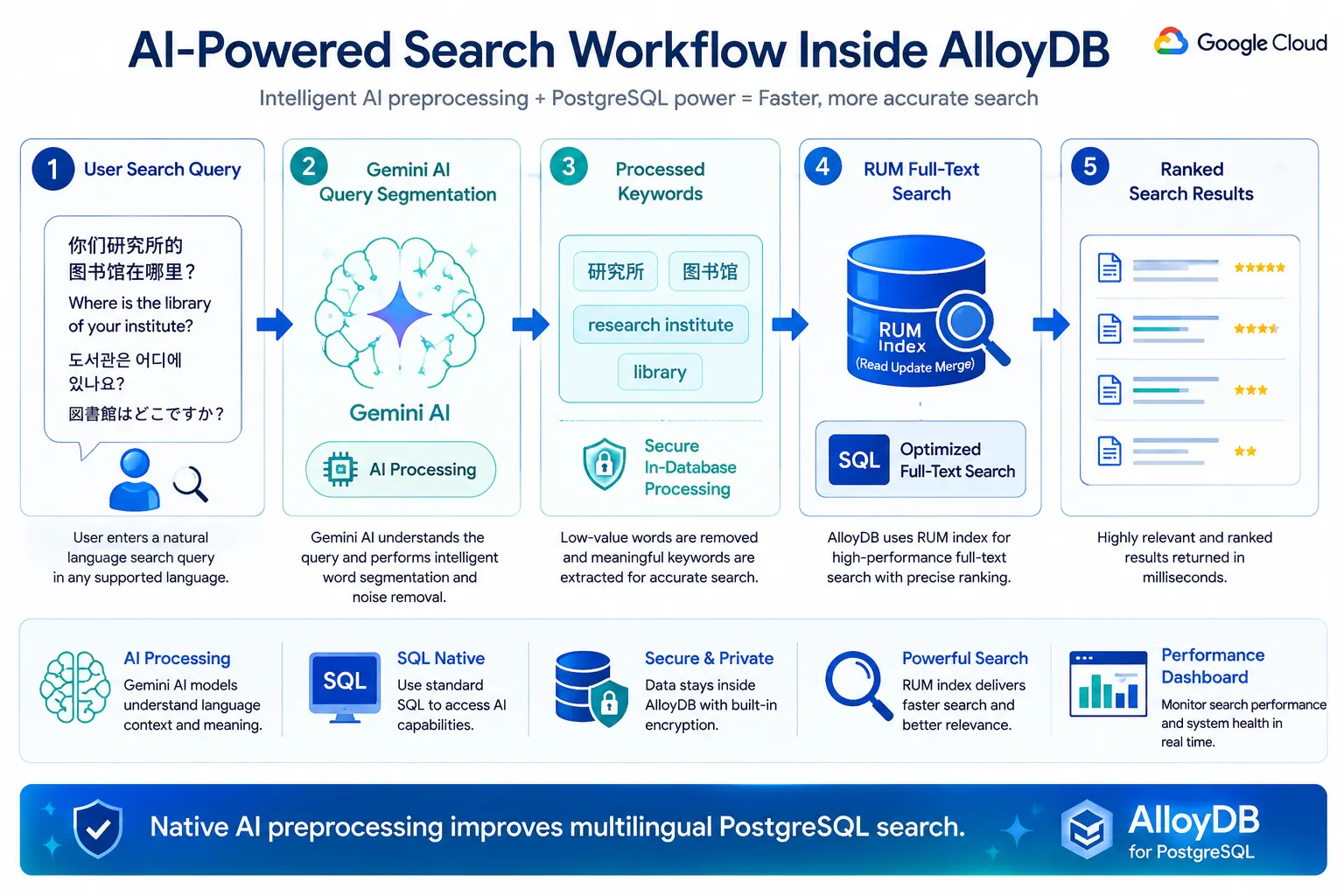
Preparing documents for indexing is only one part of the search process. To achieve consistent results, incoming user queries must also be processed using the same segmentation logic. If indexed documents are segmented but search queries are not, PostgreSQL may still fail to find relevant matches.
Google Cloud addresses this challenge by allowing developers to preprocess search queries using Gemini AI Functions before executing SQL searches. Instead of treating a sentence as one continuous string, Gemini intelligently identifies meaningful keywords while filtering out unnecessary grammatical words.
For example, a natural language query containing pronouns, particles, and question words can be transformed into a concise keyword list before it reaches the search engine.
Example: Processing a Search Query
SELECT ai.generate(
    'Perform Chinese word segmentation (分词) on the provided search query.

Additionally, remove low-value grammatical noise such as particles,
pronouns, comparison words, and question words.

Rules:
- Insert a single space between every meaningful word.
- Output ONLY the processed keywords.

Query:
你们研究所的图书馆在哪里?'
);
Output
研究所 图书馆By indexing both documents and user queries using the same AI-driven segmentation strategy, AlloyDB significantly improves multilingual search accuracy while reducing irrelevant search results.
Accelerating Search with RUM Indexes
After documents have been segmented and indexed, Google recommends using RUM (Read Update Merge) indexes to further optimize PostgreSQL full-text search.
Traditional PostgreSQL deployments typically rely on GIN (Generalized Inverted Index) for full-text search. Although GIN indexes efficiently locate matching documents, they often require additional scans to calculate ranking scores and determine how closely keywords appear together within a document.
RUM indexes overcome this limitation by storing lexeme positions directly inside the index. This enables AlloyDB to calculate search relevance and word distance much more efficiently, reducing query latency while improving ranking quality.
Creating a RUM Index
CREATE INDEX idx_docs_rum
ON documents
USING rum (search_vector rum_tsvector_ops);
Once the RUM index has been created, developers can execute highly optimized full-text searches using standard SQL.
Running a Full-Text Search
SELECT
    id,
    title,
    original_content,
    search_vector <=> plainto_tsquery(
        'english',
        '研究所 & 图书馆'
    ) AS distance
FROM documents
WHERE search_vector @@
      plainto_tsquery(
          'english',
          '研究所 & 图书馆'
      )
ORDER BY distance ASC;
Because the RUM index stores ranking information internally, AlloyDB can return highly relevant results within milliseconds, even when working with very large datasets.
Extending Beyond Keywords with Hybrid Search
While keyword search excels at finding exact matches, enterprise users often search using different wording than what appears inside documents.
For example, an employee searching for "research organization" may expect results containing "research institute," even though the exact phrase is different.
To solve this challenge, Google combines traditional keyword search with semantic vector search, allowing AlloyDB to understand the meaning behind documents rather than relying solely on exact keyword matches.
This capability is particularly valuable for:
Enterprise knowledge bases
AI chatbots
Customer support systems
Legal document repositories
Research platforms
Retrieval-Augmented Generation (RAG)
ScaNN Enables High-Speed Vector Search
Semantic search depends on comparing vector embeddings generated by AI models. Searching millions of vectors directly can become computationally expensive.
To improve performance, AlloyDB integrates ScaNN (Scalable Nearest Neighbors), Google's vector indexing technology designed for high-speed similarity searches across massive datasets.
Developers can create a ScaNN index directly within AlloyDB.
Creating the ScaNN Index
CREATE EXTENSION IF NOT EXISTS alloydb_scann;

CREATE INDEX idx_docs_scann
ON documents
USING scann (embedding cosine);
ScaNN dramatically accelerates vector searches while allowing developers to continue working within PostgreSQL rather than deploying separate vector databases.
Combining Keyword and Semantic Search
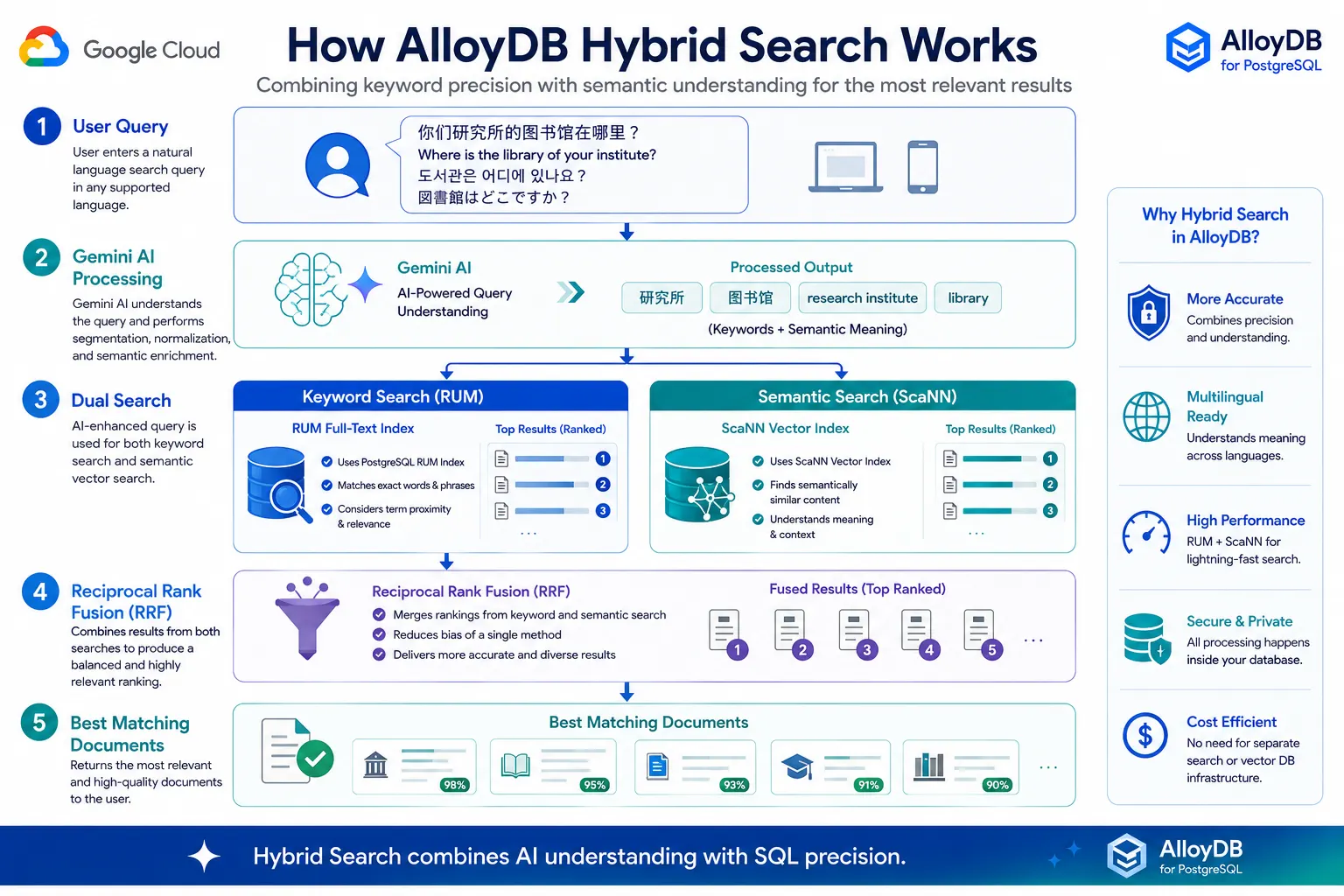
One of AlloyDB AI's most powerful capabilities is Hybrid Search, which combines keyword search with semantic search inside a single SQL query.
Google demonstrates this using Reciprocal Rank Fusion (RRF), a ranking algorithm that merges results from multiple search techniques into one unified relevance score.
Hybrid Search Example
WITH vector_search AS (
    SELECT id,
           RANK() OVER (
               ORDER BY embedding <=>
               ai.embedding(
                   'gemini-embedding-001',
                   '研究所 图书馆'
               )::vector
           ) AS rank
    FROM documents
    LIMIT 10
),

text_search AS (
    SELECT id,
           RANK() OVER (
               ORDER BY search_vector <=>
               plainto_tsquery(
                   'english',
                   '研究所 & 图书馆'
               )
           ) AS rank
    FROM documents
    WHERE search_vector @@
          plainto_tsquery(
              'english',
              '研究所 & 图书馆'
          )
    LIMIT 10
)

SELECT
COALESCE(vector_search.id,text_search.id) AS id
FROM vector_search
FULL OUTER JOIN text_search
ON vector_search.id=text_search.id;
This approach combines semantic similarity with exact keyword matching, producing search results that are both contextually relevant and highly accurate.
Why This Matters for Enterprise AI
Google's latest AlloyDB AI enhancements represent more than just an improvement to PostgreSQL search. They demonstrate how modern cloud databases are evolving into intelligent AI platforms capable of handling structured data, semantic understanding, and advanced search within a unified environment.
Key advantages include:
Native AI processing without external services
Improved multilingual search accuracy
Reduced ETL complexity
Lower infrastructure costs
Better data security by keeping processing inside the database
Faster deployment of enterprise AI applications
Unified SQL and AI workflows
These capabilities are particularly valuable for organizations building multilingual search platforms, AI assistants, enterprise knowledge systems, and Retrieval-Augmented Generation applications that require both precise keyword matching and semantic understanding.
Real-World Enterprise Use Cases
Google Cloud's latest AlloyDB AI enhancements are designed to address real-world challenges faced by enterprises managing multilingual content and AI-driven applications. By combining relational database capabilities with Gemini's language understanding, organizations can simplify search infrastructure while improving accuracy and performance.
1. Enterprise Knowledge Management
Large organizations often store millions of internal documents across multiple departments and languages. Employees searching for policies, technical documentation, research papers, or operational procedures need fast and relevant results regardless of the language used.
With AI-powered multilingual indexing and hybrid search, AlloyDB enables teams to discover information more efficiently while reducing the complexity of maintaining separate search platforms.
2. Customer Support Platforms
Modern customer support systems process large volumes of FAQs, troubleshooting guides, manuals, and historical support tickets.
Traditional keyword search may fail when customers use different wording than the original documentation. AlloyDB's semantic search helps support agents and AI chatbots retrieve relevant answers based on meaning rather than exact wording, improving customer experience and reducing response times.
3. AI Assistants and Retrieval-Augmented Generation (RAG)
Generative AI applications require accurate access to enterprise knowledge. Retrieval-Augmented Generation (RAG) systems depend on high-quality search results to provide context before generating responses.
By combining keyword search with semantic vector search, AlloyDB helps AI assistants retrieve more relevant documents, improving answer quality and reducing the likelihood of AI hallucinations.
4. Global E-commerce Platforms
International retailers often maintain multilingual product catalogs containing technical specifications, localized descriptions, and regional terminology.
AlloyDB AI enables customers to find products using natural language searches in different languages while understanding contextual meaning instead of relying solely on exact keyword matches.
5. Research and Academic Institutions
Universities, research organizations, and government agencies manage extensive collections of multilingual publications.
Hybrid search allows researchers to discover related studies even when different terminology or synonyms are used across documents, making knowledge discovery more efficient.
How AlloyDB AI Simplifies Enterprise Architecture
Before native AI integration, organizations typically built multilingual search using several independent components:
Relational database
External preprocessing service
AI API integration
ETL pipeline
Search engine
Vector database
Data synchronization processes
Each additional component increased infrastructure costs, operational overhead, maintenance requirements, and security considerations.
With AlloyDB AI, many of these capabilities are consolidated into a single managed database platform. Developers can use familiar SQL syntax to access Gemini models, generate embeddings, create search indexes, and execute hybrid searches without deploying separate AI services or maintaining complex data pipelines.
This unified architecture reduces operational complexity while helping organizations accelerate AI application development.
Conclusion
Google Cloud's latest AlloyDB AI enhancements represent a major advancement for PostgreSQL users building multilingual and AI-powered applications.
By integrating Gemini AI Functions directly into AlloyDB, Google enables developers to perform intelligent word segmentation, automate indexing, generate semantic embeddings, and execute hybrid search entirely within the database. This approach eliminates many of the operational challenges associated with traditional multilingual search while reducing infrastructure complexity and improving performance.
Combined with RUM indexes, ScaNN vector search, and Reciprocal Rank Fusion (RRF), AlloyDB delivers a unified platform that supports both precise keyword matching and AI-driven semantic understanding.
As enterprise AI adoption continues to accelerate, databases are becoming more than repositories for structured data. They are evolving into intelligent platforms capable of powering next-generation search, analytics, and generative AI applications. Google's latest AlloyDB AI capabilities highlight this transformation and provide developers with practical tools to build scalable, multilingual, and AI-ready applications using familiar PostgreSQL workflows.
Source: Google Cloud Blog
About the Author