
Google, Android, and Valtech Introduce AI-Defined Vehicles Powered by Nexus SDV and Bigtable
Google, Android Automotive, Google Cloud, and Valtech are advancing the future of connected mobility with an AI-defined vehicle platform powered by Nexus SDV, Bigtable, Gemini and Android Automotive OS, enabling intelligent, predictive, and software-driven automotive experiences.
Xcademia Team
Xcademia Research Team
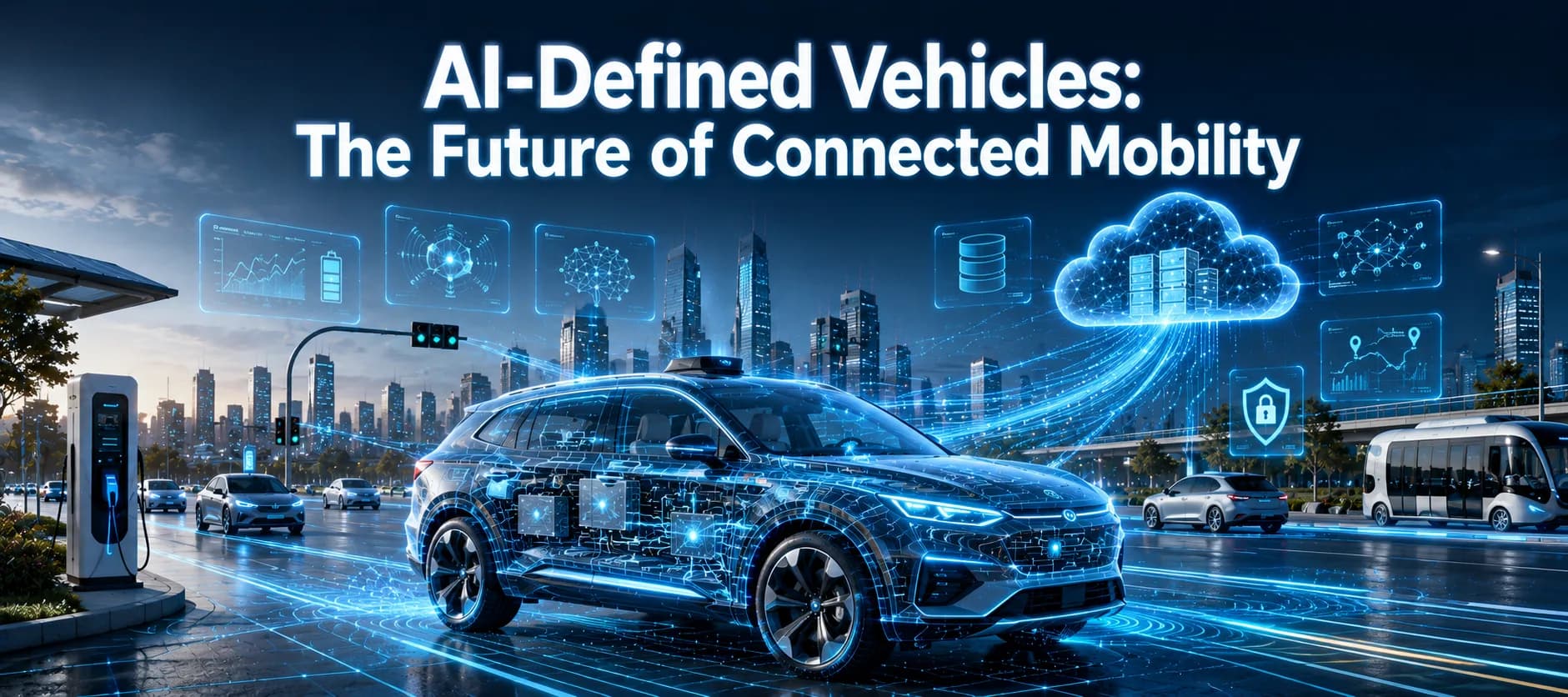
The Automotive Industry Is Entering the AI-Defined Era
The automotive industry is undergoing one of its biggest technological transformations since the invention of the modern automobile. Vehicles are no longer evolving solely through improvements in engines, batteries, or mechanical engineering. Instead, innovation is increasingly being driven by software, cloud computing, artificial intelligence, and continuous connectivity.
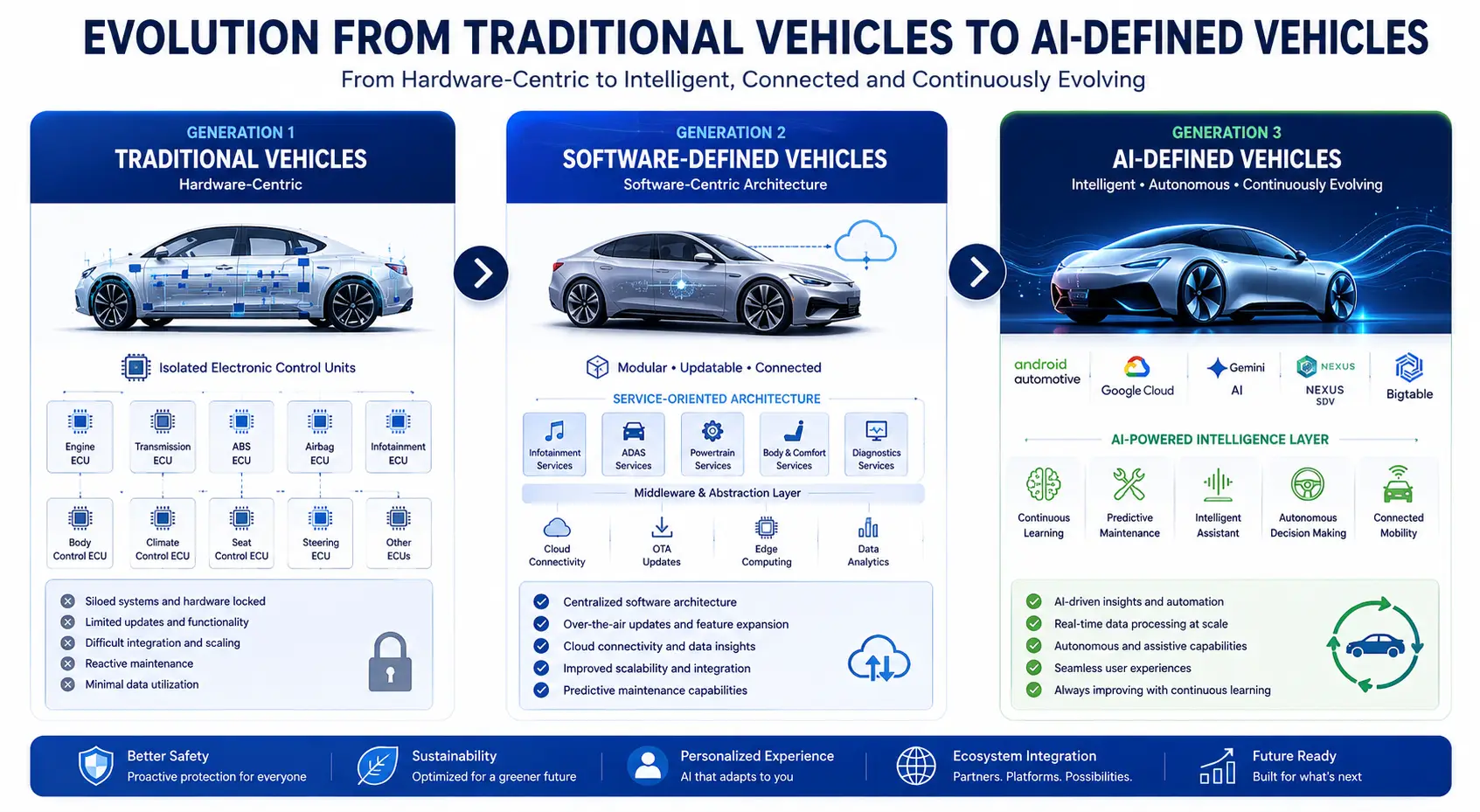
Today, automakers are embracing a new software-first strategy known as the Software-Defined Vehicle (SDV). Rather than treating software as a supporting component, SDVs position software as the foundation of the entire vehicle. This shift enables continuous feature updates, smarter diagnostics, personalized driver experiences, predictive maintenance, and AI-powered automation throughout a vehicle's lifecycle.
Google, Android, Google Cloud, and Valtech are now taking this concept even further. Together, they are introducing an end-to-end architecture that combines Android Automotive OS, Google Cloud infrastructure, Gemini AI, Bigtable, and the Nexus SDV platform to create what they describe as the next generation of AI-defined vehicles.
Instead of simply connecting vehicles to cloud services, this architecture enables vehicles to actively reason, learn from data, communicate with cloud-based AI systems, and make intelligent decisions that improve both driving experiences and vehicle operations.
For automotive manufacturers, this represents a significant opportunity to simplify software development while accelerating innovation. Rather than building every connected service independently, OEMs can leverage a standardized platform that integrates cloud infrastructure, AI services, real-time telemetry, and secure communication into a unified ecosystem.
Why Software-Defined Vehicles Are Becoming the New Industry Standard
Modern vehicles generate extraordinary amounts of data every second.
Hundreds of onboard sensors continuously monitor engine performance, battery health, braking systems, steering inputs, tire pressure, environmental conditions, GPS location, camera feeds, radar signals, and increasingly sophisticated driver assistance systems.
Traditional automotive architectures were never designed to process this level of information efficiently.
Instead, many manufacturers developed isolated systems supplied by different vendors. Each subsystem often stored its own data independently, creating disconnected information silos across the vehicle. As a result, extracting meaningful insights from the complete vehicle became increasingly difficult.
Software-Defined Vehicles address this challenge by replacing fragmented architectures with modular software services that communicate through standardized interfaces.
Rather than tightly coupling software to dedicated hardware components, SDVs separate software functionality from physical electronic control units. This allows vehicle capabilities to evolve through software updates instead of expensive hardware redesigns.
The benefits include:
Faster feature development
Continuous over-the-air software updates
Improved scalability across vehicle models
Better integration of cloud services
Reduced engineering complexity
Enhanced customer experiences
Easier deployment of AI-powered capabilities
For manufacturers, SDVs also create opportunities to introduce entirely new business models through subscription services, advanced driver personalization, predictive maintenance, fleet optimization, and intelligent mobility platforms.
As vehicles become increasingly connected, software becomes one of the most valuable competitive differentiators in the automotive market.
Android Automotive OS Forms the Intelligent Foundation
At the center of Google's vision is Android Automotive OS (AAOS), Google's open source operating system built specifically for vehicles.
Unlike smartphone integration platforms, Android Automotive operates directly inside the vehicle itself. It serves as the primary software platform responsible for coordinating vehicle services while providing developers with a consistent environment for creating automotive applications.
Google's Software-Defined Vehicle implementation extends Android Automotive beyond infotainment.
The platform introduces a modular Service-Oriented Architecture (SOA) that separates vehicle functions into reusable software services.
Instead of relying on tightly integrated hardware controllers, essential vehicle capabilities become discoverable software components.
These services include functions such as:
Vehicle services such as climate control, diagnostics, lighting, seating, windows, and other connected systems.
This architecture allows software components to communicate dynamically without depending on proprietary hardware implementations.
When new capabilities are introduced, developers can integrate them into the existing service ecosystem without redesigning the entire software stack.
For manufacturers managing multiple vehicle platforms across different regions and product lines, this modular approach dramatically reduces software maintenance complexity while improving development speed.
Cloud-Based Digital Twins Accelerate Development
Building software for vehicles has traditionally required expensive prototype hardware.
Engineers often needed physical vehicles before testing many software functions, slowing development and increasing costs.
Google addresses this challenge through the Android Cuttlefish Emulator.
This cloud-based development environment creates highly accurate digital twins of vehicles.
Instead of waiting for production hardware, developers can simulate entire vehicles inside the cloud while generating realistic sensor data streams.
These virtual environments replicate vehicle sensors, electronic control systems, driver interactions, connected services, hardware behavior, and software updates, allowing developers to validate software before production hardware is available.
Developers can validate software with identical behavior before physical components are manufactured.
Digital twins also support continuous testing throughout the software lifecycle, enabling rapid validation of updates without interrupting production vehicles.
For global automotive manufacturers developing multiple vehicle platforms simultaneously, cloud simulation significantly shortens development cycles while improving software reliability.
Nexus SDV Connects the Vehicle to the Cloud
Valtech's Nexus SDV platform acts as the bridge connecting intelligent vehicles with Google's cloud ecosystem.
Rather than simply transmitting raw vehicle data, Nexus SDV discovers available vehicle services, organizes telemetry information, and securely streams operational data into Google Cloud.
This creates a standardized communication layer between vehicles and cloud services.
High-frequency telemetry generated throughout the vehicle is continuously collected and transmitted for analysis.
Examples include:
Telemetry includes battery performance, motor efficiency, suspension behavior, brake pressure, tire pressure, cabin temperature, charging activity, and driving patterns.
Instead of maintaining separate communication pipelines for each subsystem, Nexus SDV consolidates information into a unified architecture.
This simplifies both cloud integration and AI analysis while reducing operational complexity for automotive manufacturers.
Perhaps more importantly, critical vehicle services continue operating independently even when the primary infotainment system is turned off.
Functions such as remote monitoring, diagnostics, and telemetry collection remain active while minimizing power consumption, helping preserve both traditional 12-volt batteries and electric vehicle battery packs.
This always-on capability provides continuous visibility into vehicle health without negatively affecting energy efficiency.
AI Agents Move Beyond Voice Assistants
Traditional in-car assistants primarily respond to simple voice commands.
AI-defined vehicles expand these capabilities dramatically.
Using Google's service discovery architecture, AI agents can understand driver intent, interact with multiple vehicle systems simultaneously, and execute coordinated actions across the entire vehicle.
Instead of treating every request independently, multimodal AI systems combine conversational understanding with real-time vehicle information, environmental conditions, and historical driving behavior.
For example, a driver might simply say:
"I'm feeling too warm."
Rather than only lowering the cabin temperature, the AI could intelligently:
Adjust individual climate zones
Lower selected windows
Modify fan speed
Activate seat ventilation
Reduce sunroof exposure
Adjust interior lighting
Consider outside weather conditions
This represents a significant shift from reactive infotainment systems toward proactive, intelligent vehicle assistants capable of understanding context, anticipating needs, and coordinating multiple vehicle functions seamlessly.
AI-Defined Vehicles Move Beyond Connected Cars
While Software-Defined Vehicles represent a major advancement over traditional automotive architectures, Google and its partners believe the industry is already moving toward an even more intelligent future: the AI-Defined Vehicle (AIDV).
In an AI-defined vehicle, artificial intelligence is not an optional feature layered onto existing systems. Instead, AI becomes part of the vehicle's core operating logic.
This means the vehicle continuously perceives its environment, understands driver intent, analyzes historical and real-time data, reasons through complex situations, and takes proactive actions to improve safety, efficiency, and convenience.
Rather than simply reacting to commands, AI-defined vehicles can anticipate needs before drivers even ask.
Imagine preparing for a long-distance journey. Instead of displaying a simple low-battery warning, the vehicle could automatically analyze:
Your calendar schedule
Planned destinations
Current traffic conditions
Weather forecasts
Charging station availability
Charging speeds
Battery temperature
Remaining driving range
Using Google's Gemini AI models, the vehicle could recommend the optimal charging stop, reserve a charging slot where supported, pre-condition the battery for faster charging, and adjust navigation automatically.
The result is a driving experience that feels less like operating a machine and more like collaborating with an intelligent digital companion.
This level of contextual understanding is what distinguishes AI-defined vehicles from today's connected cars.
Why Automotive Data Has Become a Competitive Advantage
Every connected vehicle generates an enormous stream of operational information.
Connected vehicles continuously monitor battery voltage, motor temperature, steering angle, brake pressure, tire wear, cabin conditions, GPS location, camera inputs, radar observations, and vehicle diagnostics.
A single connected fleet can generate petabytes of telemetry over time.
Historically, this information has been stored across multiple disconnected systems managed by different suppliers. Engineers often needed to combine datasets manually before meaningful analysis could begin.
This fragmentation creates several challenges:
Duplicate information
Inconsistent data formats
Delayed diagnostics
Limited visibility across systems
Higher operational costs
Difficult AI model training
Without a unified data platform, extracting business value from vehicle telemetry becomes increasingly difficult.
Google's AI-native architecture addresses this challenge by centralizing vehicle information into a scalable cloud platform capable of processing massive amounts of structured and unstructured telemetry in real time.
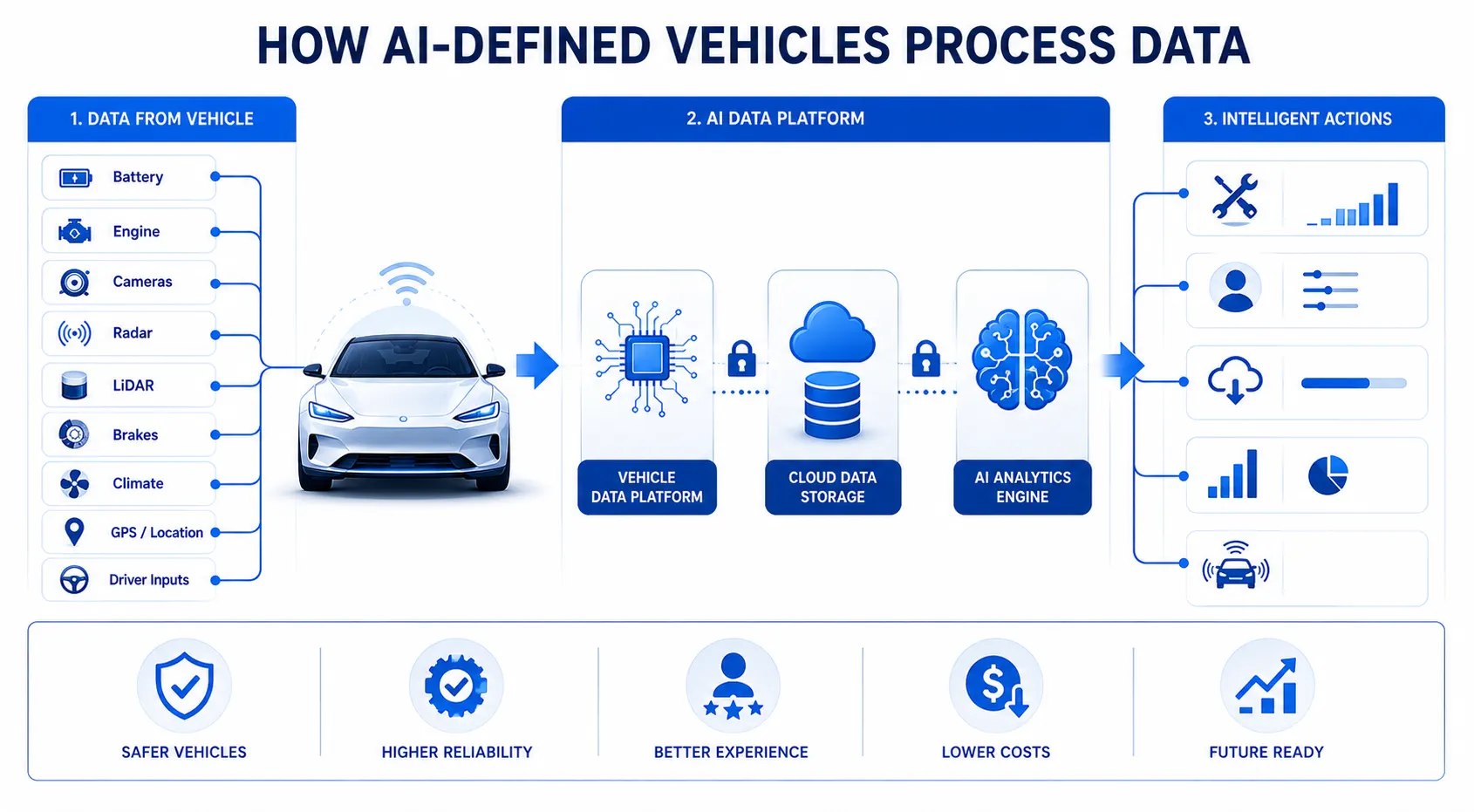
Bigtable Becomes the Data Backbone for Intelligent Mobility
Processing automotive telemetry requires infrastructure capable of handling enormous data volumes without sacrificing speed.
This is where Google Cloud Bigtable plays a central role.
Originally developed to support Google's own large-scale services, Bigtable is engineered for extremely high ingestion rates, low latency, and massive scalability.
For automotive manufacturers, these capabilities are essential because connected vehicles continuously produce high-frequency telemetry every second they operate.
Bigtable enables OEMs to store:
Engine performance metrics
Battery health information
Vehicle diagnostics
Sensor readings
Charging history
Fleet telemetry
Manufacturing data
LiDAR point clouds
Environmental measurements
Unlike traditional relational databases, Bigtable uses a flexible schema that allows manufacturers to evolve their data models without interrupting operations.
As new sensors or software capabilities are introduced, additional data can be incorporated without redesigning the entire database.
This flexibility is especially valuable as automotive technology continues evolving rapidly.
Managing Massive Time-Series Data Efficiently
Vehicle telemetry is fundamentally time-series data.
Every reading has both a value and a precise timestamp.
Modern vehicles can generate millions of these observations every day.
Bigtable is specifically optimized for storing and retrieving this type of chronological information.
Instead of struggling with traditional database limitations, manufacturers can efficiently analyze:
Historical battery degradation
Long-term engine performance
Fleet-wide component reliability
Driver behavior trends
Charging efficiency
Seasonal operating conditions
Continuous Materialized Views Reduce Computational Overhead
Another important capability highlighted by Google is Continuous Materialized Views (CMVs).
Instead of recalculating frequently requested metrics every time analysts query the database, CMVs continuously update important calculations as new data arrives.
Examples include:
Average battery temperature
Fleet-wide energy consumption
Average motor vibration
Torque distribution
Charging efficiency
Battery degradation trends
Because these metrics are always available, applications receive answers almost instantly while significantly reducing processing costs.
For AI workloads requiring real-time analysis, this optimization becomes particularly valuable.
AI Agents Transform Data into Automated Decisions
Collecting data alone does not improve vehicles.
The real value comes from turning information into action.
Google integrates Bigtable with its Agent Development Kit (ADK) to enable intelligent software agents that continuously monitor incoming telemetry.
These AI agents can:
Detect abnormal operating conditions
Trigger maintenance workflows
Generate alerts
Recommend repairs
Launch automated software updates
Coordinate fleet operations
When combined with frameworks such as Apache Spark, the platform continuously analyzes incoming telemetry streams while initiating automated workflows in real time.
For manufacturers managing millions of vehicles globally, automation dramatically improves operational efficiency while reducing manual intervention.
Nexus SDV Creates an End-to-End Connected Vehicle Platform
Valtech's Nexus SDV platform brings together Android Automotive, Google Cloud services, Gemini AI, Bigtable, and BigQuery into a unified connected mobility ecosystem.
Instead of requiring manufacturers to assemble dozens of disconnected technologies independently, Nexus SDV provides a ready-to-deploy foundation that accelerates software-defined vehicle development.
The platform enables OEMs to build customized customer experiences across multiple touchpoints, including:
Vehicle infotainment systems
Mobile applications
Customer portals
Service centers
Fleet management platforms
Because the architecture uses standardized cloud services, manufacturers can focus their engineering resources on creating unique brand experiences rather than rebuilding foundational infrastructure.
Vehicle connectivity is achieved using the open-source Synadia NATS communication interface, supported by cloud and vehicle SDKs that simplify service discovery and secure communication.
Although optimized for Android Automotive OS, Nexus SDV is designed to integrate with a wide variety of vehicle software frameworks.
This flexibility makes the platform suitable for manufacturers following different development strategies while maintaining compatibility with Google's cloud ecosystem.
Security Is Built Into Every Layer
As vehicles become increasingly connected, cybersecurity becomes one of the industry's highest priorities.
Connected vehicles exchange sensitive information that includes:
Driver preferences
Vehicle identity
Software updates
Fleet operations
Diagnostic information
Location data
Protecting this information requires security that extends across both vehicles and cloud infrastructure.
Nexus SDV adopts a Defense-in-Depth security strategy that layers multiple protections throughout the platform.
Key security capabilities include:
Mutual TLS authentication for encrypted communication
Google Cloud Certificate Authority Service for trusted vehicle identities
Private Google Kubernetes Engine clusters for network isolation
Secure AI Framework (SAIF) to safeguard AI systems and machine learning workflows
These technologies help manufacturers protect sensitive customer information while securing valuable automotive intellectual property.
As software becomes increasingly central to vehicle operation, robust cybersecurity will become just as important as mechanical safety.
Predictive Maintenance Shows the Power of AI-Defined Vehicles
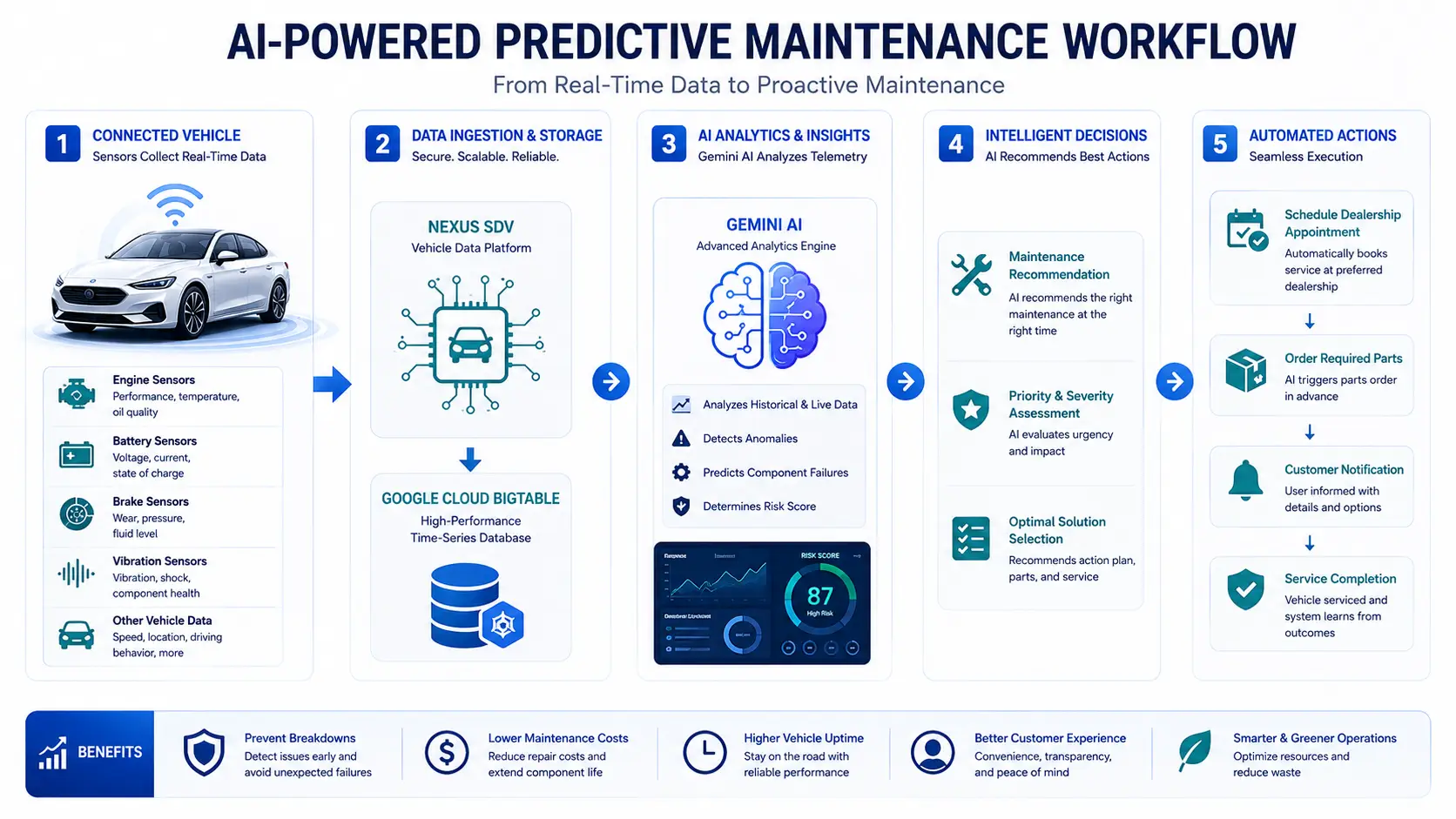
One of the most compelling applications of AI-defined vehicles is predictive maintenance. Instead of waiting for a component to fail or relying on fixed service schedules, AI continuously monitors vehicle health and recommends maintenance before issues become critical.
Traditional maintenance is largely reactive. Drivers either follow scheduled service intervals or visit a repair center after a warning light appears. This approach can lead to unnecessary servicing, unexpected breakdowns, higher warranty costs, and reduced customer satisfaction.
The process begins with continuous telemetry collected from major vehicle systems, including:
Engine RPM
Battery temperature
Brake pressure
Fluid levels
Suspension performance
Tire pressure
Motor vibration
Charging cycles
Energy consumption
Environmental conditions
This telemetry is securely streamed through Nexus SDV into Google Cloud Bigtable, where it is stored as a continuously growing time-series dataset. AI models analyze live and historical data, while Continuous Materialized Views maintain rolling metrics such as battery temperature trends and engine vibration patterns. This enables AI to detect subtle anomalies that traditional monitoring systems might miss.
For example, a gradual increase in motor vibration combined with unusual battery temperature fluctuations could indicate early component wear. Instead of waiting for a warning light or breakdown, the system identifies the issue well in advance.
Gemini-powered reasoning engines then evaluate additional context, including:
Vehicle age
Mileage
Service history
Driving habits
Upcoming trips
Nearby dealerships
Parts availability
Based on this analysis, the system can recommend a service appointment, notify the driver through the infotainment system, and automatically arrange replacement parts before the vehicle arrives at the dealership. This proactive approach reduces downtime, lowers warranty costs, improves customer satisfaction, and delivers a more reliable ownership experience.
Business Benefits for Automotive Manufacturers
Beyond technological innovation, Google's AI-defined vehicle architecture delivers measurable business advantages for automotive manufacturers.
A unified software and cloud platform helps reduce engineering complexity while accelerating the development of new digital services. Rather than maintaining separate infrastructure for different vehicle systems, manufacturers gain a standardized foundation that supports continuous innovation.
Some of the key business benefits include:
Faster software development cycles
Scalable cloud-native architecture
Continuous over-the-air software updates
Improved fleet visibility
Lower warranty and maintenance costs
Increased vehicle uptime
Stronger cybersecurity across connected fleets
By reducing the effort required to build foundational infrastructure, OEMs can focus more resources on differentiating their products through unique digital experiences, intelligent services, and brand-specific innovations.
The Future of Connected Mobility Is AI Native
The transition from hardware-defined vehicles to software-defined platforms marked a significant milestone for the automotive industry. However, Google's latest collaboration with Android Automotive, Google Cloud, and Valtech suggests that the next evolution has already begun.
AI-defined vehicles represent more than incremental improvements. They introduce a new operating model in which artificial intelligence continuously interprets data, understands driver intent, predicts future events, and automates complex decisions across the entire vehicle ecosystem.
Platforms such as Nexus SDV combine Android Automotive OS, Gemini AI, Bigtable, BigQuery, and secure cloud infrastructure into a unified architecture capable of supporting the next generation of intelligent mobility.
Rather than simply collecting data, future vehicles will transform that information into actionable insights that improve safety, efficiency, convenience, and customer satisfaction.
For automotive manufacturers, adopting AI-native architectures offers an opportunity to modernize development processes, simplify software integration, strengthen cybersecurity, and accelerate innovation while delivering personalized experiences that continue to improve long after the vehicle leaves the factory.
As software, cloud computing, and artificial intelligence become increasingly central to vehicle design, the definition of a car is changing. The next generation of vehicles will not only transport passengers but also learn, adapt, collaborate, and proactively assist throughout every journey.
The AI-defined vehicle is no longer a concept for the future. With Android Automotive, Google Cloud, Bigtable, Gemini, and Nexus SDV, it is rapidly becoming a reality.
Conclusion
The collaboration between Google, Android, Google Cloud, and Valtech highlights how the automotive industry is evolving toward intelligent, cloud-connected, and AI-native mobility. By combining Android Automotive OS with Nexus SDV, Bigtable, Gemini AI, and secure Google Cloud services, manufacturers gain a powerful platform for building smarter, safer, and more personalized vehicles.
From real-time telemetry processing and predictive maintenance to proactive AI assistants and continuous software updates, this unified architecture enables automakers to innovate faster while improving operational efficiency and customer experience. As AI-defined vehicles become more common, software and data will play an even greater role in shaping the future of transportation, transforming cars into intelligent digital platforms that continue to evolve throughout their lifetime.
Source: Google Cloud Blog
About the Author