
Google Cloud Report: 83% of Organizations Must Upgrade Infrastructure for Agentic AI Success
A new Google Cloud report reveals that 83% of organizations need infrastructure upgrades to support agentic AI. The study highlights fluid compute, edge AI, unified data, governance, and energy-efficient infrastructure as critical priorities for AI at scale.
Xcademia Team
Xcademia Research Team
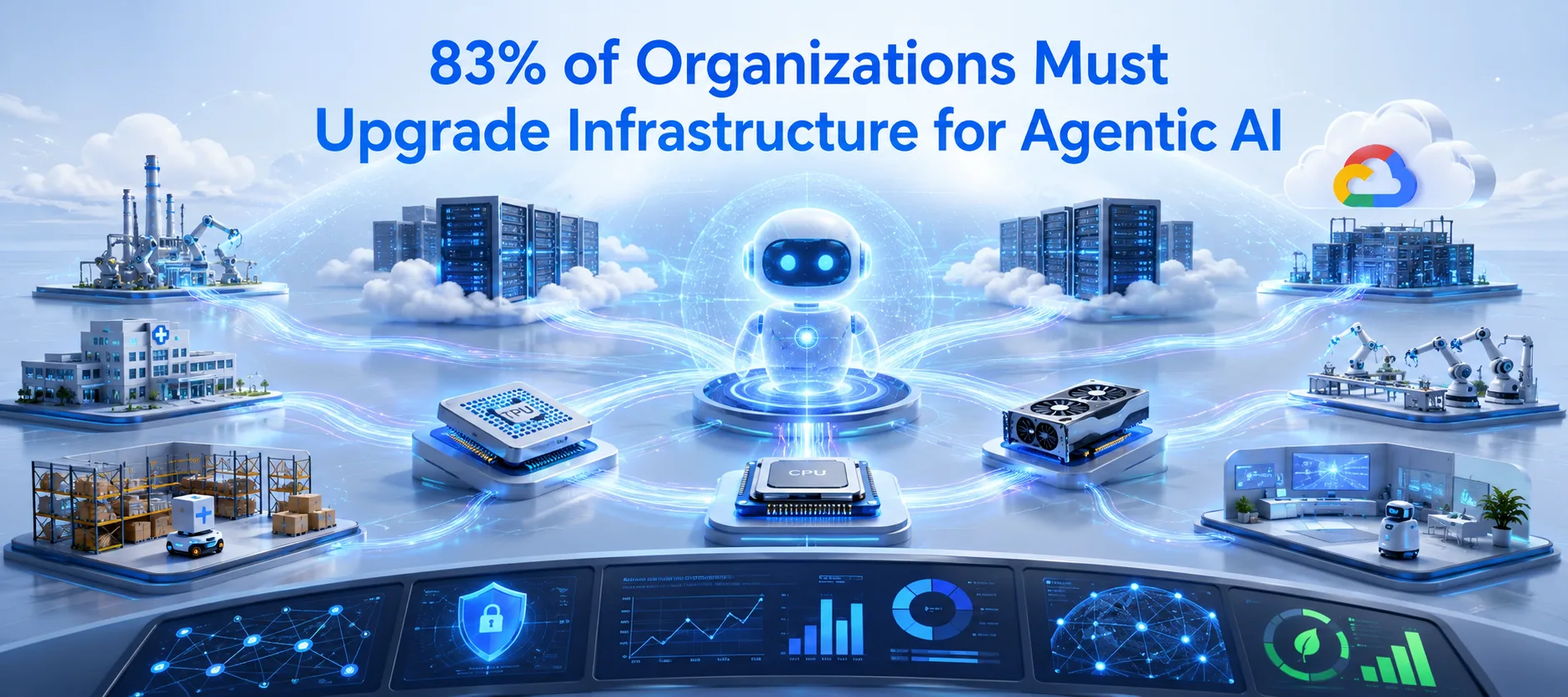
Google Cloud Report Finds 83% of Organizations Need Infrastructure Upgrades to Support Agentic AI
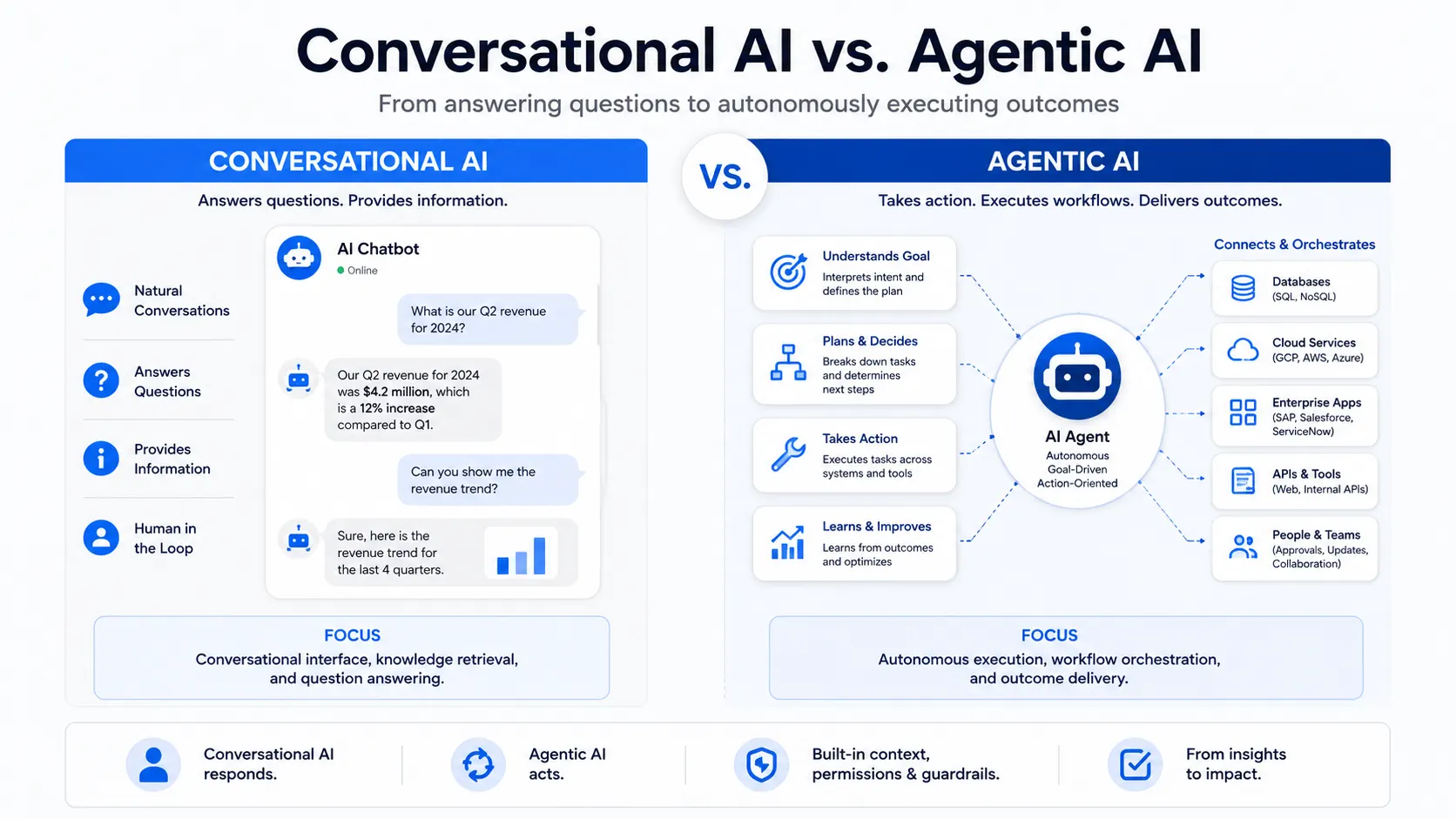
Artificial intelligence is entering a new phase. While conversational AI transformed how businesses interact with customers, the next generation of AI is expected to do far more than answer questions. Autonomous AI agents can reason, make decisions, execute workflows, and perform complex tasks with minimal human intervention.
This shift toward agentic AI is creating unprecedented demands on enterprise infrastructure. According to Google Cloud's latest State of AI Infrastructure Report, organizations are increasingly recognizing that legacy IT environments are no longer capable of supporting production-scale autonomous AI systems.
Based on a global survey of more than 1,400 senior IT leaders, the report reveals that 83% of organizations believe they need infrastructure upgrades before they can successfully deploy agentic AI in production.
The findings paint a clear picture: achieving the full potential of autonomous AI requires rethinking compute, storage, networking, governance, and energy efficiency from the ground up.
From Conversational AI to Autonomous AI
Over the past several years, enterprise AI has largely focused on chatbots, virtual assistants, and customer support automation.
Agentic AI changes that model entirely.
Instead of simply responding to prompts, autonomous agents can:
Execute multi-step workflows
Access enterprise applications
Read and analyze documents
Query databases
Coordinate with other AI agents
Make operational decisions
Automate business processes
A single user request may trigger hundreds of interconnected actions across multiple enterprise systems.
While these capabilities unlock enormous business value, they also introduce infrastructure challenges that conventional cloud architectures were never designed to handle.
The Growing Infrastructure Gap
Google Cloud's research highlights a widening gap between AI ambitions and infrastructure readiness.
Among the most significant findings:
83% require infrastructure upgrades for production agentic AI.
81% identify operational complexity as a major barrier.
62% report rising AI inference costs.
79% consider governance and security the biggest scaling challenge.
90% say edge AI deployment is important.
91% now evaluate hardware based on energy consumption.
Collectively, these statistics indicate that organizations can no longer treat AI as an application layer. Instead, infrastructure itself must become AI-native.
Escaping the "Inference Tax" with Fluid Compute
Running autonomous AI agents continuously is significantly more resource-intensive than serving traditional chatbot responses.
Each interaction may involve:
Large context windows
Multiple reasoning cycles
Calls to external tools
Database lookups
Model orchestration
Memory-intensive processing
Google refers to the resulting operational burden as the "inference tax."
According to the report, 62% of organizations are experiencing increased costs driven by:
Data egress charges
Idle accelerator hardware
Storage growth
Resource overprovisioning
To overcome this challenge, Google recommends adopting fluid compute, an infrastructure model that dynamically matches workloads with the most appropriate processing hardware.
Examples include:
TPU 8t
Designed for large-scale AI training, Google's latest TPU 8t provides the computational power needed to build advanced foundation models efficiently.
TPU 8i
Optimized for inference, TPU 8i offers increased on-chip memory to support low-latency reasoning for real-time AI agents.
Google Axion CPUs
Arm-based Google Axion processors are positioned as efficient orchestration engines capable of handling reinforcement learning, control-plane operations, and AI workflow coordination at lower cost.
This workload-specific allocation of compute resources improves both performance and operational efficiency.
Managing Thousands of Autonomous Agents
As organizations deploy increasing numbers of AI agents, governance becomes one of the largest operational concerns.
Unlike traditional applications, autonomous agents may:
Read emails
Access sensitive business records
Trigger financial transactions
Modify enterprise workflows
Interact with external services
Without centralized oversight, organizations risk creating uncontrolled "agent sprawl."
The report found that 79% of technology leaders identify governance, security, and MLOps as the primary obstacles to scaling AI inference.
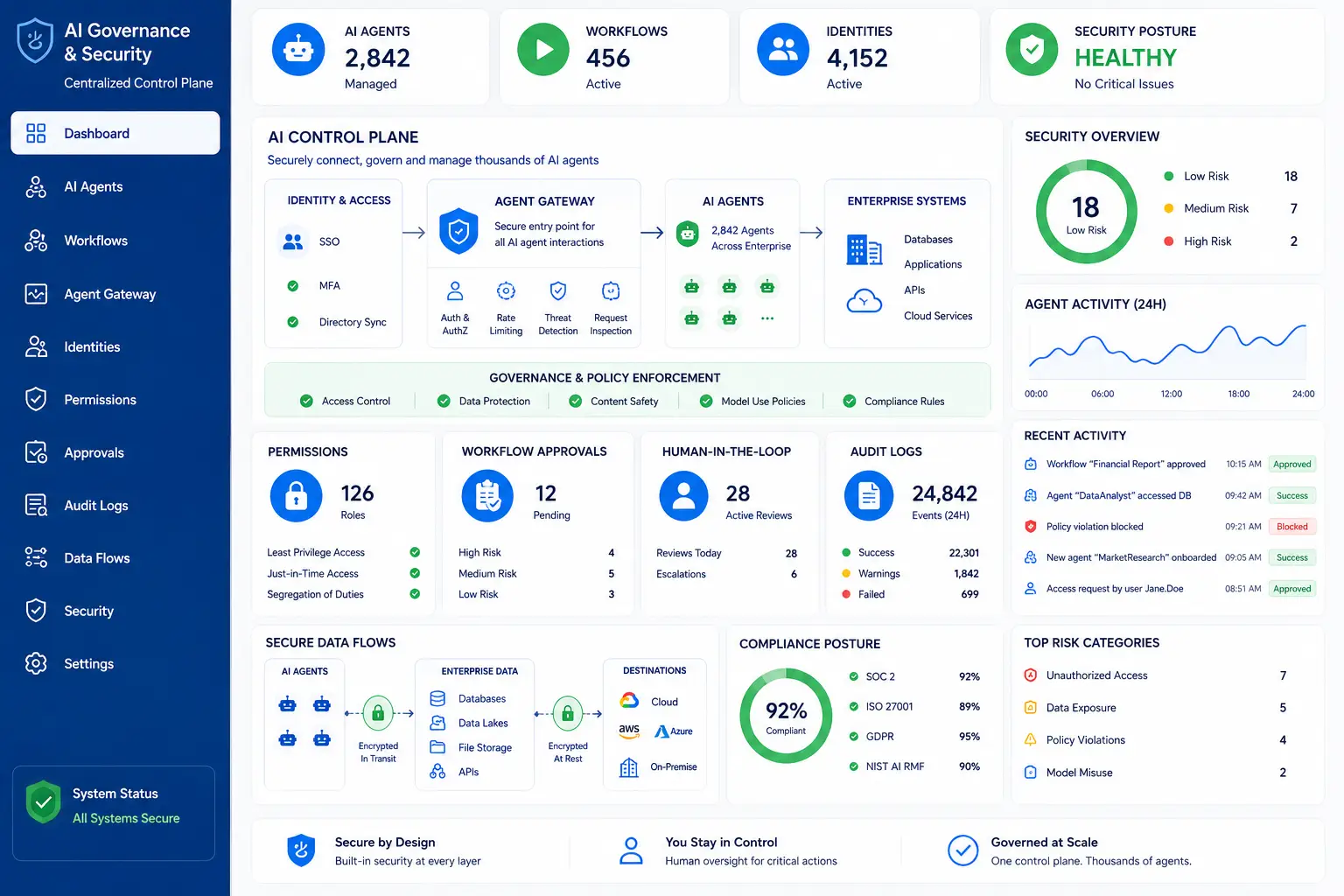
Google recommends establishing a centralized control plane capable of managing:
Agent identities
Permissions
Workflow approvals
Audit logs
Data sharing policies
Human oversight
Solutions such as Agent Gateway provide visibility into agent activity while enabling organizations to enforce enterprise-grade governance and human-in-the-loop approvals for sensitive operations.
Interestingly, 78% of organizations now source their generative AI platforms from their primary cloud provider—a 30-point increase since 2025—reflecting growing demand for integrated governance capabilities.
Why a Unified Data Layer Matters
Agentic AI depends heavily on access to accurate, comprehensive organizational data.
However, enterprise information often resides across disconnected systems, including:
Cloud storage
Data warehouses
SaaS applications
Legacy databases
File repositories
On-premises infrastructure
When data remains fragmented, AI agents lack the business context required for effective decision-making.
Google recommends implementing a unified data layer using technologies such as:
Smart Storage, which automatically enriches and indexes unstructured content
Cross-Cloud Lakehouse, enabling AI to query data across cloud environments without duplication
This architecture reduces data silos while giving autonomous agents secure, real-time access to enterprise knowledge.
Hybrid Multicloud Becomes the Enterprise Standard
The report suggests that the long-running debate between public cloud and on-premises infrastructure has effectively ended.
Today, 52% of surveyed organizations operate hybrid multicloud environments.
This shift is driven by several factors:
Regulatory compliance
Data residency requirements
Digital sovereignty
Existing enterprise investments
Workload flexibility
Nearly 48% of technology leaders prioritize infrastructure capable of meeting regional data residency regulations.
Google argues that modern AI infrastructure must allow organizations to deploy workloads wherever legal, operational, and business requirements demand—including public cloud, private cloud, and air-gapped environments through Google Distributed Cloud.
AI Moves Closer to the Edge
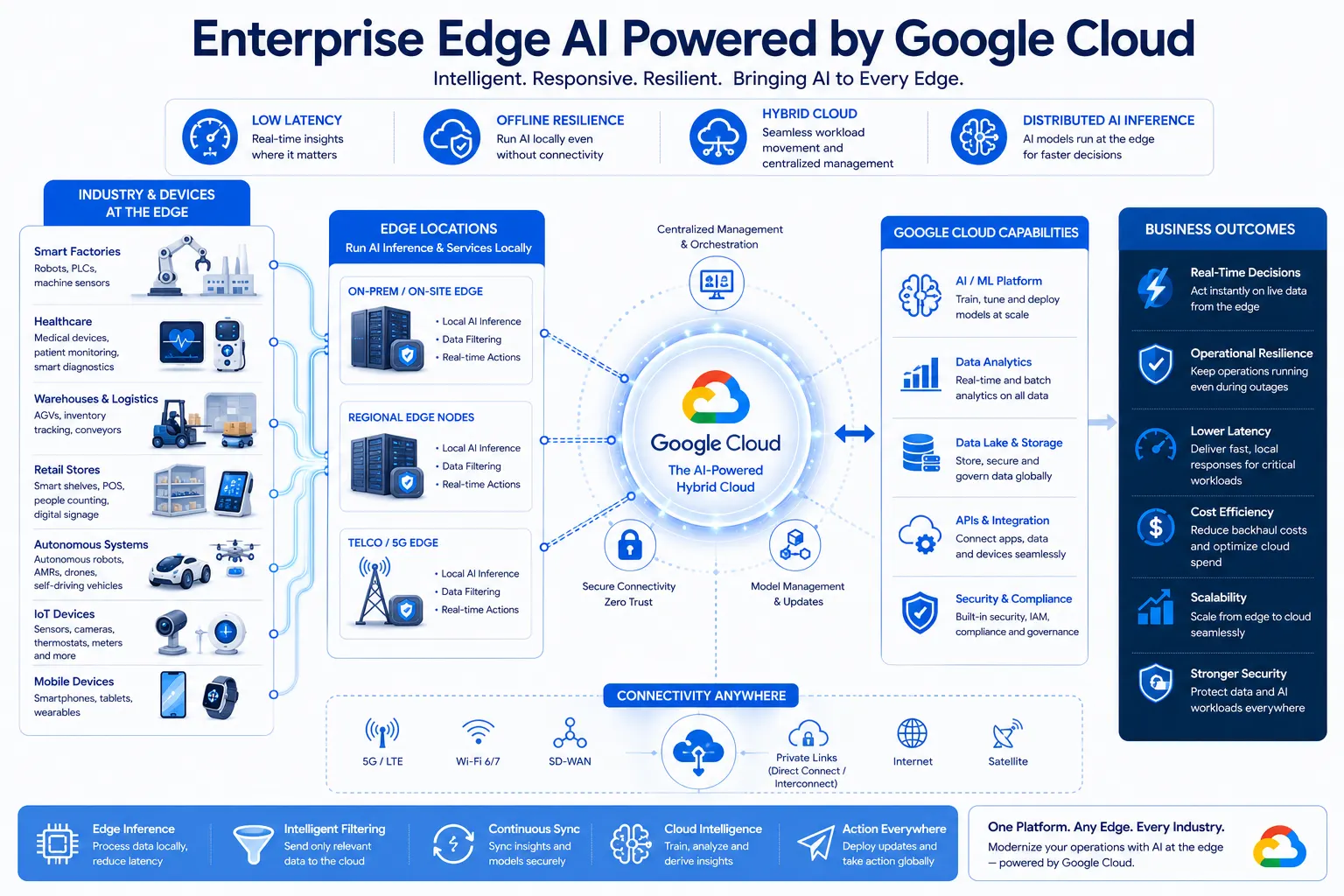
The report identifies edge computing as another major requirement for agentic AI.
A remarkable 90% of organizations consider edge deployment important, while 72% rate it as very or extremely important.
Running AI closer to users and devices provides three primary advantages.
Lower Latency
Applications such as voice assistants, industrial automation, and financial trading require near-instant decision-making that centralized cloud environments cannot always deliver.
Operational Resilience
Factories, hospitals, retail stores, and remote facilities can continue operating AI systems even when internet connectivity is disrupted.
Reduced Operating Costs
Executing optimized AI models on edge devices minimizes continuous cloud inference costs and reduces bandwidth requirements.
Breaking Through the Energy Barrier
As AI workloads continue expanding, electricity consumption has become a strategic business concern rather than simply a sustainability metric.
Google's research found that:
91% of organizations evaluate power efficiency when selecting AI hardware.
61% consider energy consumption a primary purchasing factor.
The report highlights three key energy-related challenges:
Grid Capacity Constraints
In many regions, additional electrical capacity is limited, restricting data center expansion.
Regulatory Requirements
Governments increasingly mandate stricter energy efficiency standards. For example, Germany requires new data centers to achieve a Power Usage Effectiveness (PUE) of 1.2 or lower, while Ireland has introduced stringent on-site power generation requirements for large facilities.
Infrastructure Costs
Higher-power AI hardware often demands expensive cooling systems, specialized racks, and facility upgrades, increasing total cost of ownership.
Google argues that performance per watt should become a core infrastructure metric. Its latest TPU 8t reportedly delivers nearly three times the performance of the previous generation while being up to twice as energy efficient.
Building Unified AI Infrastructure
Rather than optimizing individual infrastructure components independently, Google advocates a unified architecture where compute, networking, storage, and software are engineered together.
This vision underpins Google Cloud AI Hypercomputer, which integrates:
Custom TPUs
GPUs
Google Axion CPUs
Virgo high-bandwidth networking
Managed Lustre storage
Hyperdisk
Google Kubernetes Engine (GKE)
By co-designing every layer, organizations can reduce integration complexity while improving scalability, reliability, and operational efficiency.
From Digital Intelligence to Physical AI
One of the report's most forward-looking themes is the emergence of physical AI.
As infrastructure becomes increasingly capable, AI agents will extend beyond digital workflows into physical environments.
Examples include:
Industrial inspection robots
Warehouse automation
Smart manufacturing
Autonomous logistics
Intelligent drones
AI-assisted healthcare
Digital twin simulations
Google envisions AI systems training extensively in cloud-based digital environments before safely performing real-world tasks.
Final Thoughts
Google Cloud's State of AI Infrastructure Report underscores a pivotal shift in enterprise technology. Agentic AI is no longer a future concept. It is rapidly becoming the next phase of enterprise computing, demanding infrastructure designed specifically for autonomous intelligence.
The research shows that organizations preparing for success are investing in fluid compute, centralized governance, unified data platforms, hybrid multicloud architectures, edge deployment, and energy-efficient infrastructure.
For enterprises aiming to move AI from experimentation to production, modernizing infrastructure is no longer optional. It is the foundation upon which the next generation of intelligent applications will be built.
Source: Google Cloud Blog
About the Author