Claude Apps Gateway for Google Cloud: Enterprise-Ready Security, Governance, and Cost Control for Claude Code
Anthropic and Google Cloud have introduced the Claude Apps Gateway, enabling organizations to securely deploy Claude Code with centralized identity management, policy enforcement, spend controls, and enterprise-grade governance.
Xcademia Team
Xcademia Research Team
Claude Apps Gateway for Google Cloud Brings Enterprise Governance to Claude Code
Organizations adopting AI-powered coding assistants often face a challenge: scaling developer access securely without creating operational complexity. To address this, Anthropic and Google Cloud have introduced the Claude Apps Gateway for Google Cloud, a self-hosted service that helps enterprises deploy Claude Code with centralized governance, security controls, and usage management.
The new gateway simplifies enterprise adoption by acting as a secure layer between developers using Claude Code and Google Cloud infrastructure, ensuring that AI inference remains within an organization's Google Cloud environment while providing administrators with greater visibility and control.
Why Enterprises Need the Claude Apps Gateway
For individual developers, connecting Claude Code to Google Cloud is relatively straightforward. However, as organizations expand AI-assisted development across hundreds or thousands of engineers, challenges emerge around credential management, policy enforcement, cost monitoring, and usage attribution.
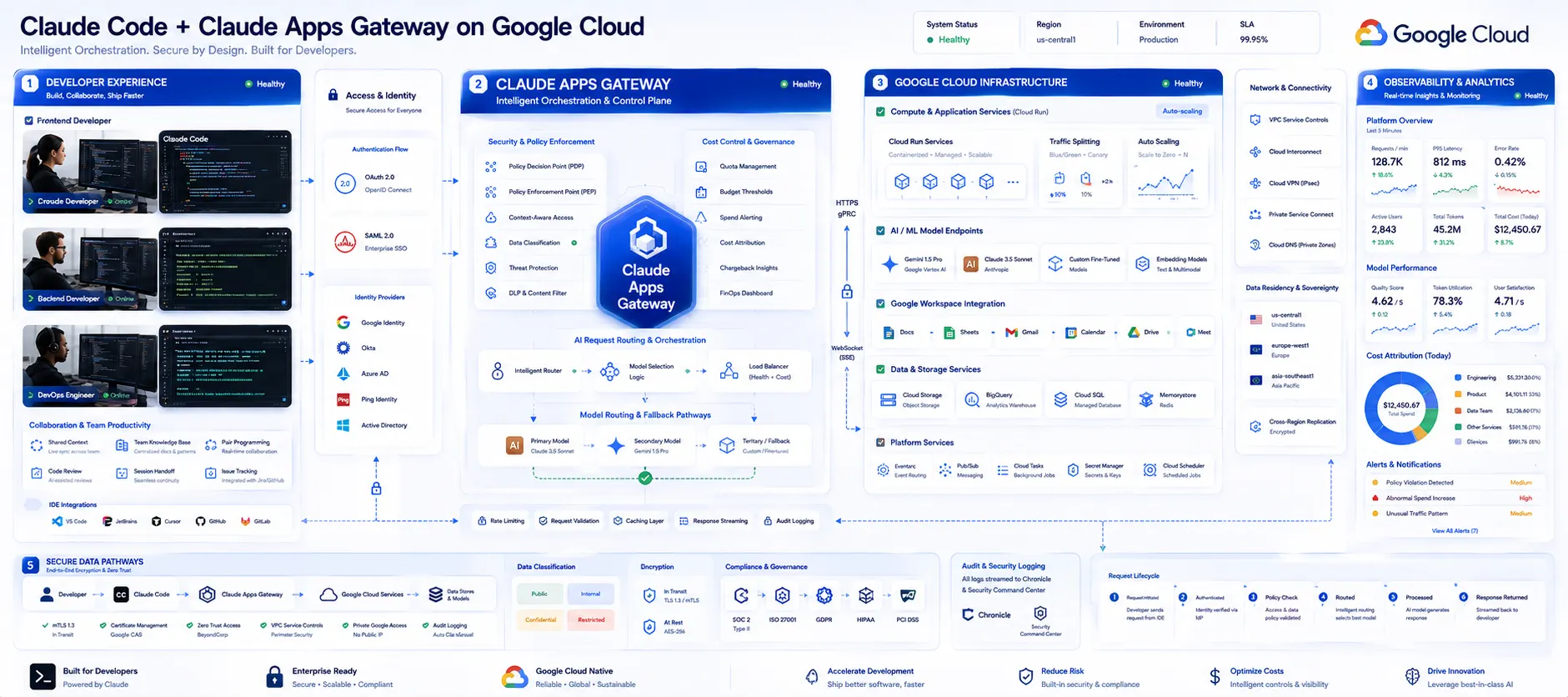
The Claude Apps Gateway addresses these concerns through five core capabilities:
Centralized identity management
Server-side policy enforcement
Detailed telemetry and monitoring
Spend controls and usage limits
Intelligent request routing
Instead of managing cloud credentials on every developer device, organizations can centralize governance within a single gateway deployment.
Identity Management Without Local Credentials
One of the gateway's most significant benefits is secure authentication.
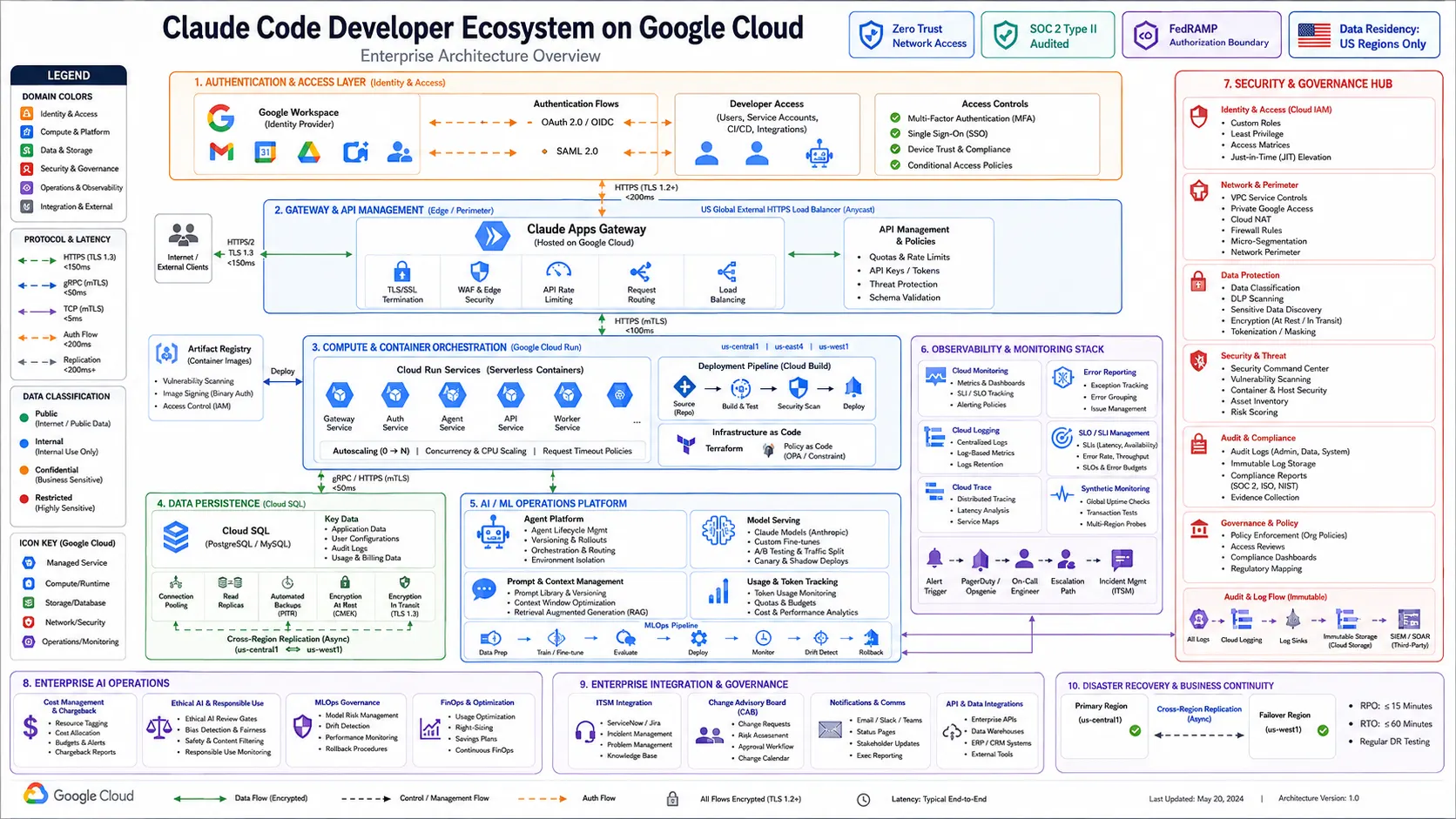
Developers authenticate through an organization's identity provider, such as Google Workspace or any OpenID Connect (OIDC) provider. The gateway exchanges authentication tokens for short-lived sessions, eliminating the need to store:
Service account keys
API keys
Project-specific credentials
Sensitive configuration details
This approach simplifies onboarding and offboarding. Administrators can grant or revoke access simply by managing user membership within identity provider groups.
As a result, organizations reduce credential sprawl while maintaining stronger security practices.
Centralized Policy Enforcement
The gateway enables administrators to define role-based access control (RBAC) policies in a single configuration file.
Rather than relying on locally managed settings that users could potentially modify, policy decisions are enforced server-side. Every request is validated against centrally managed rules before being forwarded to Google Cloud services.
This allows organizations to:
Restrict model access by team
Define tool permissions
Control usage across departments
Apply policy changes organization-wide
Updates become effective across the entire developer fleet without requiring manual changes on individual machines.
Enhanced Telemetry and Usage Visibility
Enterprise AI deployments require accurate monitoring and attribution.
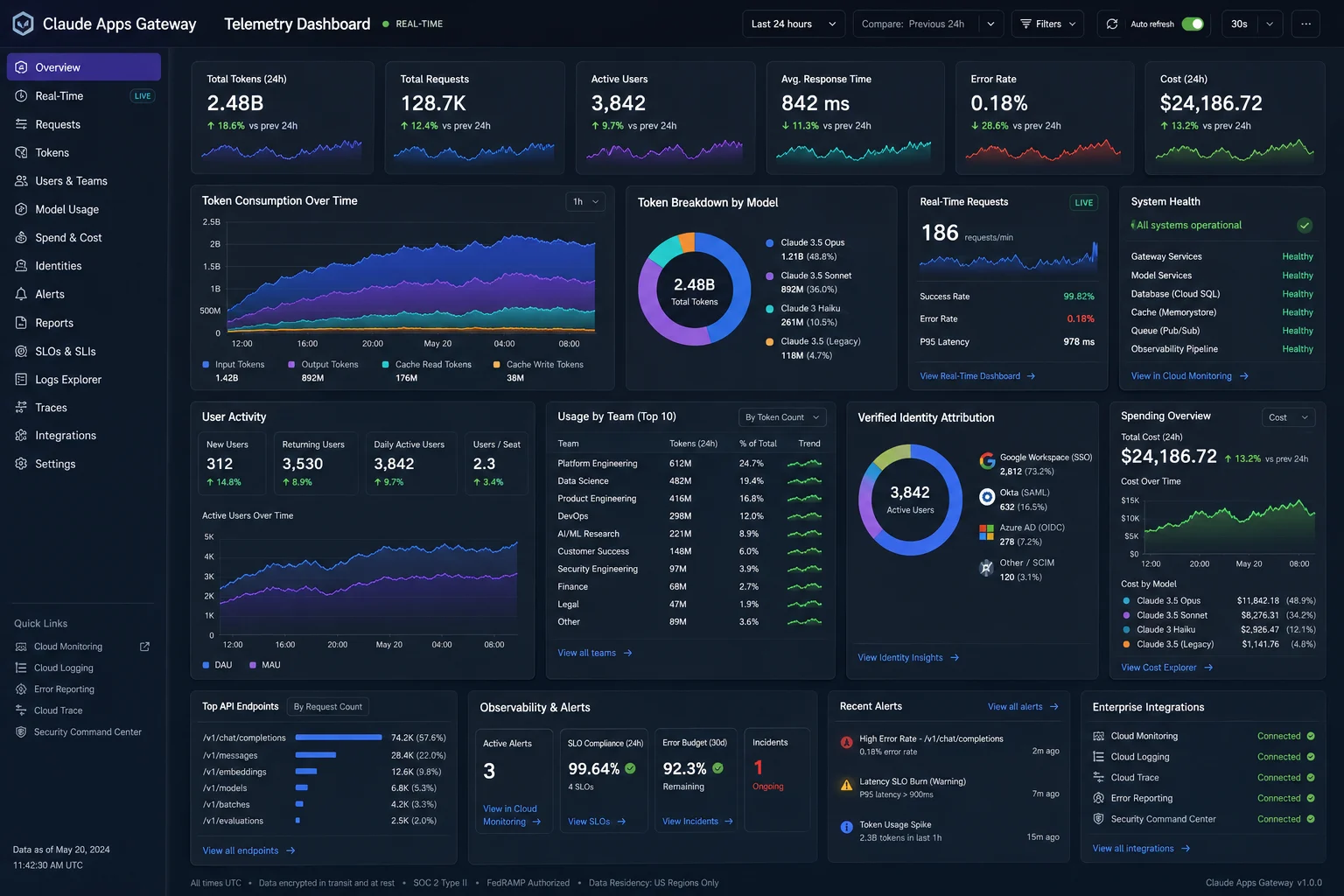
The Claude Apps Gateway attaches verified user identities and group information to usage metrics, enabling organizations to understand:
Who is using AI services
Which teams consume the most resources
How tokens are being utilized
Overall platform adoption trends
Metrics can be forwarded to popular observability platforms including:
Cloud Monitoring
Grafana
Datadog
Other OpenTelemetry-compatible systems
This provides administrators with a reliable foundation for governance and reporting.
Built-In Spend Controls
Cost governance remains a key concern for organizations deploying AI tools at scale.
The gateway introduces configurable spending limits that can be applied at multiple levels:
Individual users
Teams or groups
Entire organizations
Administrators can define:
Daily spending caps
Weekly limits
Monthly budgets
When usage reaches a configured threshold, the gateway automatically rejects additional requests, helping prevent unexpected cost overruns.
A Cloud SQL database tracks usage and maintains the spending ledger used for enforcement.
Intelligent Routing and Reliability
The Claude Apps Gateway also simplifies traffic management.
All AI requests are routed through a single Cloud Run service identity, keeping inference within the organization's Google Cloud project and maintaining existing:
Billing structures
Compliance controls
Data processing agreements
Quota management
Organizations can configure regional endpoints or multiple upstream services to provide failover protection during service disruptions, helping improve reliability for developers.
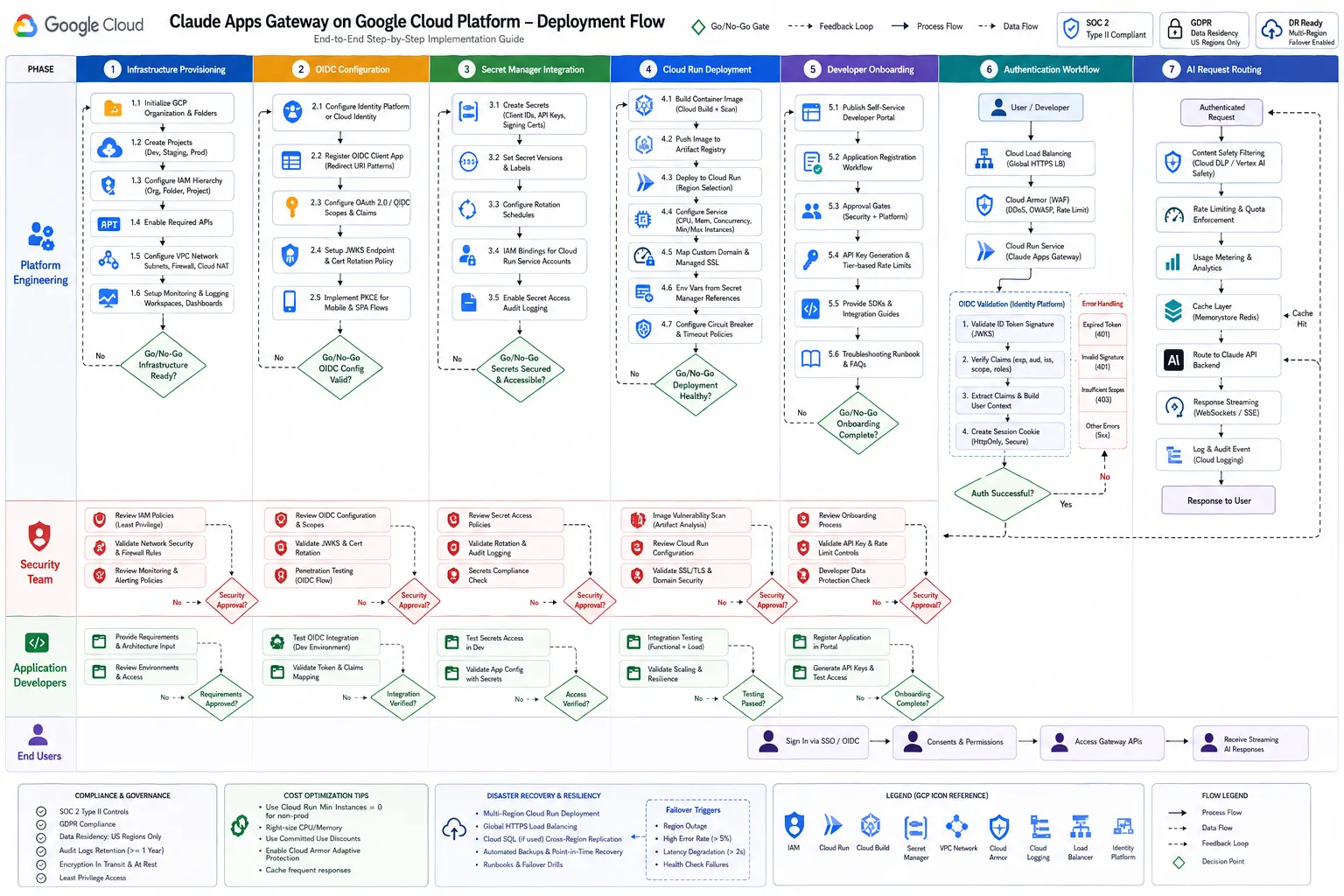
How the Architecture Works
The gateway is designed as a stateless container running on Google Cloud Run.
The workflow follows a straightforward path:
Developer uses Claude Code locally.
Requests are sent securely to the Claude Apps Gateway.
The gateway validates user sessions and policies.
Requests are forwarded to Google Cloud's Agent Platform.
Usage metrics are collected and exported.
Cloud SQL stores session and spending information.
Because the gateway is stateless, it can scale horizontally to support growing development teams.
Deploying the Gateway on Google Cloud
Organizations can deploy the gateway in four major steps:
Provision Google Cloud Infrastructure
Required services include:
Agent Platform
Cloud SQL
Secret Manager
Cloud Run
A dedicated service account is created with appropriate AI Platform permissions.
Configure Gateway Settings
Administrators define:
OIDC authentication settings
Authorized email domains
PostgreSQL connection details
Agent Platform routing configuration
Sensitive values are stored securely within Secret Manager.
Deploy to Cloud Run
The gateway container is deployed using Cloud Run, benefiting from:
Automatic scaling
Managed infrastructure
High availability
Simplified operations
Organizations can also deploy on GKE if Kubernetes is already part of their infrastructure strategy.
Onboard Developers
Developers receive managed settings through enterprise device management tools.
Once configured, users authenticate through their organization's identity provider and gain secure access to Claude Code without manually managing cloud credentials.
Group-Based AI Governance
The gateway also supports advanced policy configurations.
Organizations can integrate with identity providers that expose group memberships and apply differentiated access policies. For example:
Engineering teams may access advanced models.
Security teams may receive specialized tools.
Contractors may have restricted permissions.
Different departments can operate under separate usage limits.
This provides a flexible framework for enterprise AI governance while maintaining a consistent user experience.
The Bigger Picture
The Claude Apps Gateway represents a significant step toward enterprise-ready AI development workflows. By combining Anthropic's Claude Code with Google Cloud's infrastructure, organizations gain a secure and manageable pathway to scale AI-assisted software development.
Rather than distributing credentials and governance responsibilities across individual developers, enterprises can centralize identity, security, compliance, monitoring, and cost management within a single deployment.
As AI coding tools become increasingly important across software engineering teams, solutions like the Claude Apps Gateway will play a crucial role in helping organizations adopt these technologies safely and at scale.
Source: Google Cloud Blog
About the Author