
Google Cloud Brings Looker’s Governed Data Layer to Gemini Enterprise
Google Cloud is integrating Looker’s governed semantic layer with Gemini Enterprise, helping AI agents deliver trusted business metrics, deterministic SQL, interactive charts, and permission-aware data access.
Xcademia Team
Xcademia Research Team
Google Cloud Connects Looker’s Semantic Layer With Gemini Enterprise
Enterprise AI is becoming increasingly capable of working with documents, conversations, and other unstructured information. But when AI agents need to answer questions about business metrics stored in enterprise databases, accuracy becomes more complicated.
Large language models can work effectively with text-based information, but raw enterprise databases contain complex schemas, relationships, business rules, and organization-specific definitions.
A simple question such as "What is our revenue?" can therefore become surprisingly difficult for an AI system. A natural-language-to-SQL model may need to determine which tables to use, how they should be joined, which filters apply, and which business definition of "revenue" the organization follows.
Google Cloud is addressing this challenge by integrating Looker's governed semantic layer with Gemini Enterprise.
The integration gives Gemini Enterprise access to structured business data through Looker's governed definitions and logic, allowing users to explore enterprise data through natural-language conversations while maintaining existing governance controls.
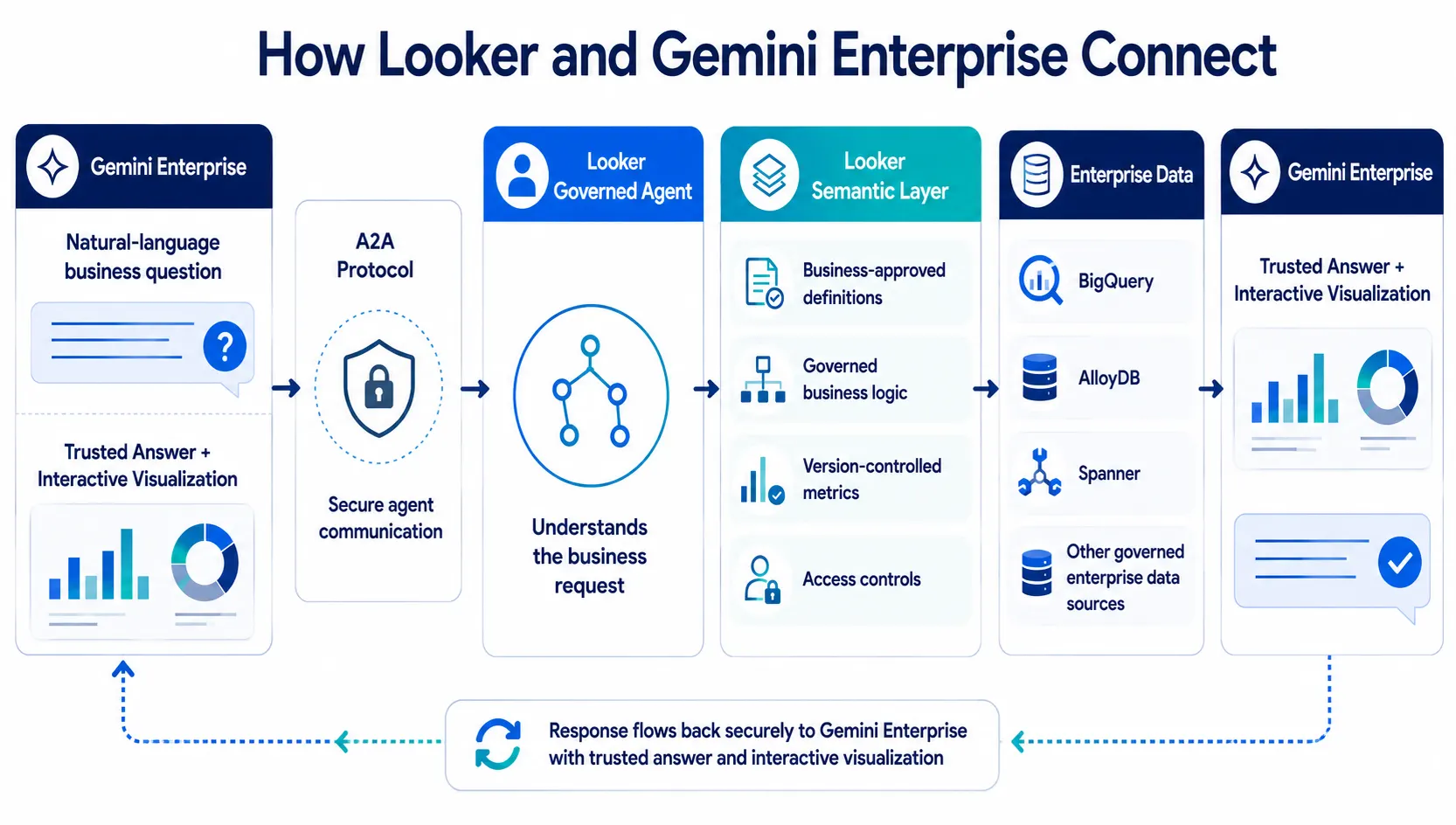
Looker analysts and administrators can also publish conversational agents natively into Gemini Enterprise through the Agent-to-Agent (A2A) protocol.
The result is a bridge between conversational AI and governed enterprise analytics.
Why a Semantic Layer Matters for Enterprise AI
AI systems can be very good at understanding language.
Enterprise data, however, is rarely as straightforward as the language used to ask questions about it.
A company may have multiple databases containing information about customers, products, transactions, employees, and financial performance.
Even when two teams use the same term, they may have different definitions.
For example, "revenue" could depend on specific filters, business rules, time periods, or data sources.
Without a governed semantic layer, an AI system generating SQL may have to infer these relationships.
That creates several risks:
Inconsistent metrics
Incorrect joins
Unpredictable queries
Different answers to the same question
AI-generated hallucinations
Reduced confidence in enterprise AI
Looker's semantic layer provides a governed layer of business definitions and logic between conversational requests and underlying enterprise databases.
Instead of asking Gemini Enterprise to guess how enterprise data should be interpreted, the Looker agent can use predefined business logic to generate more precise and predictable queries.
Connecting Structured and Unstructured Data
The integration is designed to bring structured and unstructured information together in Gemini Enterprise.
Users can ask questions about structured business data while also working with information contained in documents and other unstructured sources.
This creates a more complete context for business decisions.
For example, a team could move from understanding a business metric to exploring the surrounding context without switching between multiple analytics and productivity tools.
Google Cloud describes Gemini Enterprise as a single front door for AI in the workplace.
With Looker agents available inside that environment, governed business intelligence becomes part of the same conversational experience.
The goal is not simply to make analytics conversational.
It is to make trusted analytics easier to discover and use across the organization.
Reducing AI Hallucinations With Governed Business Logic
One of the biggest advantages of the integration is the way Looker's semantic layer can reduce ambiguity when AI agents work with business data.
Consider an executive asking Gemini Enterprise:
"What was our revenue last quarter?"
A conventional AI system connected directly to a database could potentially make assumptions about:
Which revenue table to use
Which fields represent revenue
Which dates define the quarter
Which transactions should be excluded
Which joins are required
Looker's semantic layer provides this business context in a codified form.
The Looker agent can then generate SQL based on governed definitions rather than attempting to infer the organization's business logic from the raw database structure.
This creates a more deterministic path:
User Question → Looker Agent → Semantic Layer → Governed SQL → Enterprise Data → Answer
The approach is particularly important for business metrics where consistency matters.
If multiple executives ask the same question, organizations need confidence that the underlying definition remains consistent.
Secure Access Without Replicating Enterprise Data
Making enterprise data available to AI introduces another major concern: security.
Organizations need to ensure that conversational AI does not accidentally expose information that a user was never authorized to access.
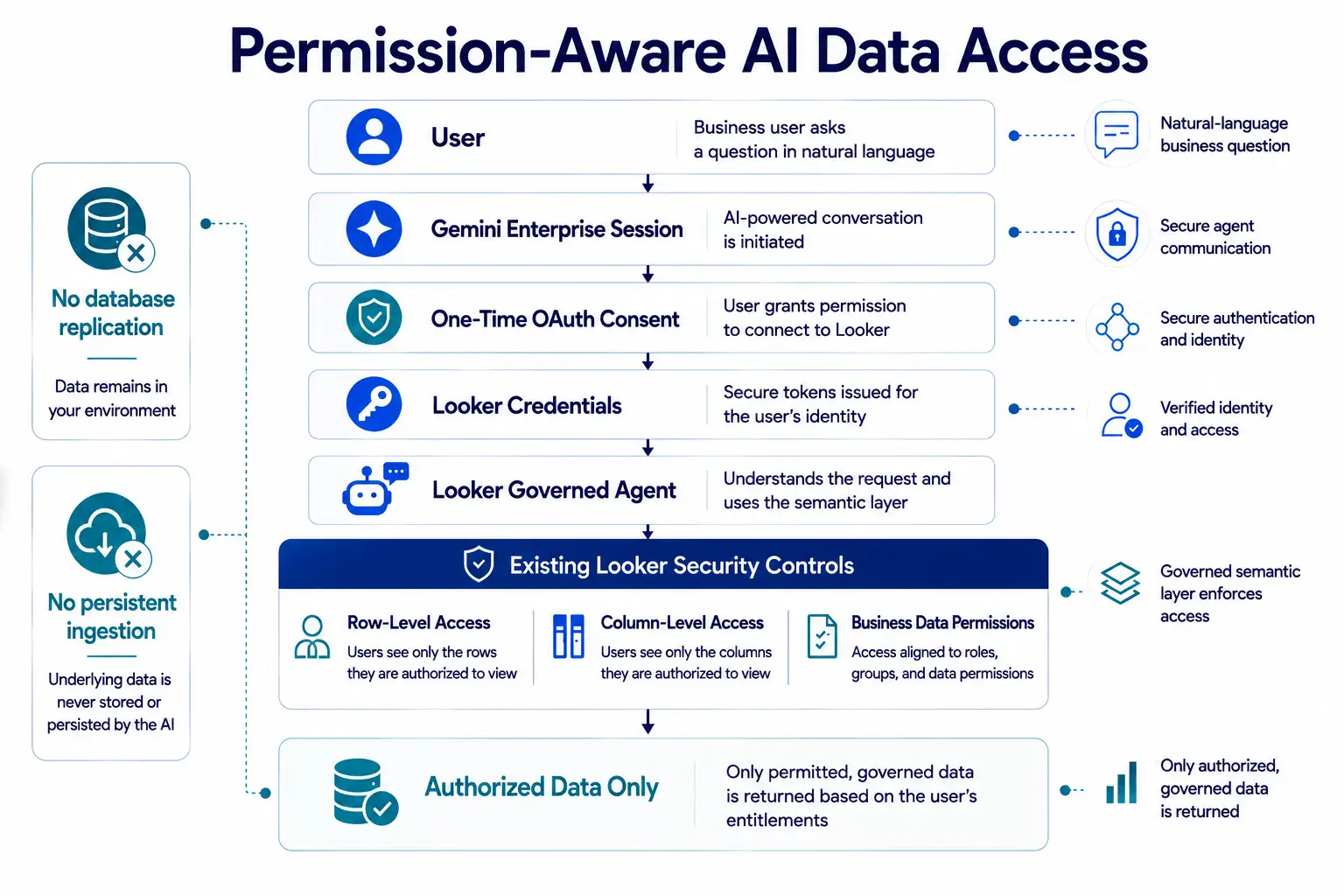
Google Cloud says the Looker and Gemini Enterprise integration uses a pass-through architecture rather than ingesting, replicating, or persistently storing the underlying database records in Gemini Enterprise.
The integration operates through the A2A protocol and preserves Looker's existing security controls.
Three elements are particularly important.
OAuth Authorization
Users provide a one-time OAuth consent when interacting with a Looker agent in Gemini Enterprise.
This connects the user's Gemini Enterprise session with their Looker credentials.
Existing Governance Controls
Because queries pass through Looker, existing row-level and column-level access controls remain part of the data access process.
This means organizations do not need to create an entirely separate permission model for the Gemini environment.
Security Isolation
Looker agents do not bypass permissions simply because they are available inside Gemini Enterprise.
If a user does not have permission to access sensitive financial or regional payroll information through Looker, the agent restricts that information in Gemini Enterprise as well.
Even when an agent is published to the Agent Gallery for easier discovery, the underlying security controls remain in place.
Interactive Charts Bring Business Intelligence Into the Conversation
The integration is not limited to text-based answers.
Looker agents published into Gemini Enterprise can also provide interactive data charts.
When users ask about trends such as monthly sales performance or regional distribution, the Looker agent can return visual representations of the underlying data directly within the Gemini Enterprise conversation.
This changes the experience from simply receiving an explanation to interacting with business information visually.
Instead of moving from an AI conversation to a separate dashboard, users can receive presentation-ready visualizations within the same workspace.
Google Cloud notes that organizations that published Looker agents in Gemini Enterprise before Looker release 26.12 should update or refresh those agents to take advantage of the enhanced visualization capabilities.
Looker Agents Can Work With Other AI Agents
Another important capability is interoperability.
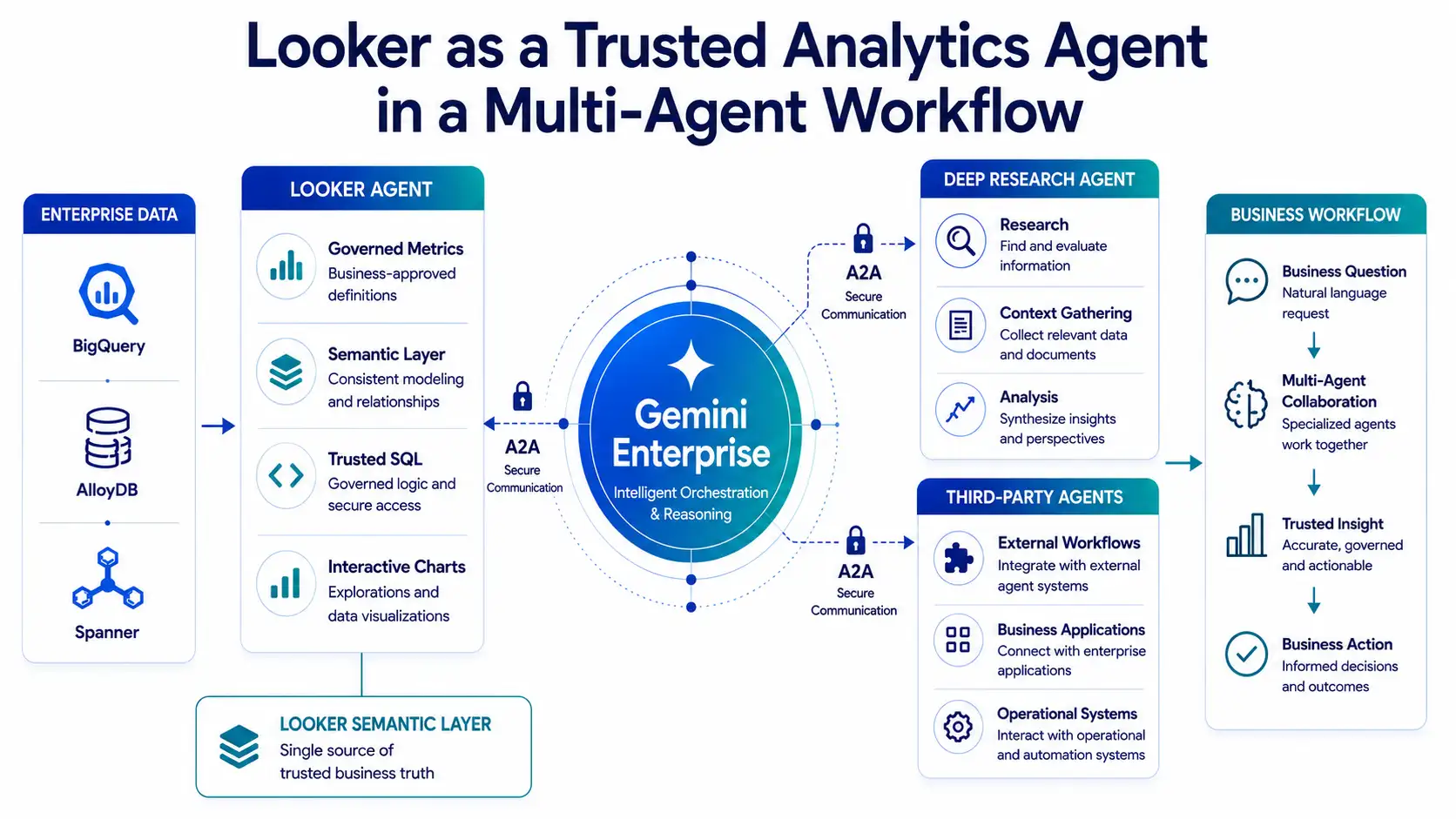
Looker agents published to Gemini Enterprise can understand context across different agents and data sources.
Through standard communication frameworks, governed insights from Looker agents can be shared with other first-party Google Cloud agents, including the Deep Research Agent, as well as third-party agents.
This creates the foundation for more complex multi-agent workflows.
For example, an operational agent could request governed business data from a Looker agent and use that information as an input for another workflow involving productivity, research, or supply-chain operations.
The key idea is that business intelligence does not have to remain isolated inside a dashboard.
Governed analytics can become a reusable capability within an agentic workflow.
Making Trusted Data More Accessible Across the Enterprise
The integration reflects a broader shift in how organizations are approaching business intelligence.
Traditional analytics often requires users to know where dashboards are located, which reports to open, and how to interpret different metrics.
Conversational interfaces can lower that barrier.
Employees can ask questions using natural language instead of navigating complex analytics environments.
But conversational access only becomes valuable when the underlying answers can be trusted.
That is where the combination of Gemini Enterprise and Looker becomes important.
Gemini Enterprise provides the conversational interface and agentic environment, while Looker's semantic layer provides governed context for structured enterprise data.
Together, they create a path from:
Natural Language → Governed Analytics → Actionable Insight
This can make business intelligence more accessible to employees who may not be experienced SQL users or data analysts.
What This Means for Enterprise AI
The Looker and Gemini Enterprise integration highlights an important principle for enterprise AI: better models alone are not enough.
AI agents also need reliable access to business context.
Without consistent definitions, even a highly capable model can produce an answer that sounds convincing but does not reflect the organization's actual metrics.
A governed semantic layer provides the missing context.
It establishes the definitions, relationships, and logic that should govern how business data is interpreted.
The architecture also shows why governance needs to be part of the AI experience rather than added as an afterthought.
Authentication, row-level permissions, column-level controls, and data access policies remain connected to the user's existing identity and permissions.
That combination can help organizations expand AI adoption without abandoning the governance structures already protecting their data.
The Bigger Picture for Business Intelligence
Google Cloud's integration of Looker with Gemini Enterprise represents a broader movement toward agentic business intelligence.
Instead of treating analytics as a separate destination, organizations can increasingly make governed data available as a capability that AI agents can use during everyday workflows.
That could change how employees interact with business data.
A finance professional could ask a question about performance.
A sales team could explore regional trends.
An operations team could request a metric and use the result within a broader workflow.
The common requirement is that the underlying data remains governed and consistent.
Looker's semantic layer provides that foundation for structured data, while Gemini Enterprise provides the conversational environment through which users and agents can interact with it.
Conclusion
Google Cloud is bringing Looker's governed semantic layer into Gemini Enterprise, giving organizations a way to connect conversational AI with trusted enterprise business data.
The integration uses Looker agents and the A2A protocol to connect Gemini Enterprise users with governed analytics while preserving existing authentication and data-access controls.
The approach addresses several challenges associated with enterprise AI, including inconsistent business metrics, unpredictable SQL generation, data access restrictions, and the difficulty of combining structured data with conversational workflows.
It also expands what users can do with analytics by bringing interactive charts, data storytelling, and multi-agent interoperability into the Gemini Enterprise environment.
The bigger takeaway is that enterprise AI needs more than access to data.
It needs trusted definitions, governed access, and reliable business context.
By putting Looker's semantic layer between conversational agents and enterprise data, Google Cloud is positioning governed business intelligence as a foundational capability for the agentic workplace.
The future of enterprise AI may not be about giving agents more data. It may be about giving them better-defined data they can actually be trusted to use.
Source: Google Cloud Blog
About the Author