
Google Opens AI Agent Marketplace: Developers Can Now Publish Gemini Enterprise Agents to Google Cloud Marketplace
Google has introduced a new way for developers and software vendors to publish AI agents directly to Gemini Enterprise and Google Cloud Marketplace. The move simplifies enterprise AI adoption while giving organizations access to trusted, ready-to-use intelligent agents.
Xcademia Team
Xcademia Research Team
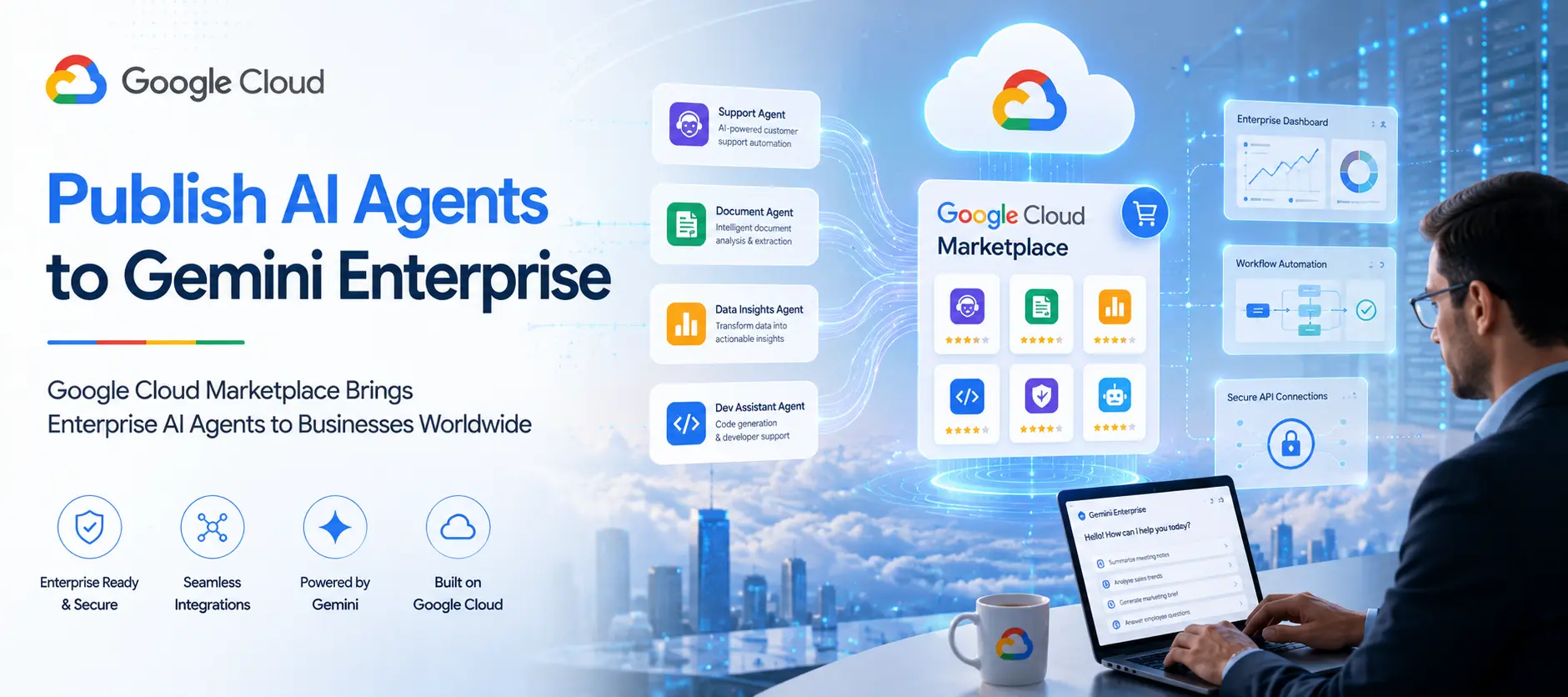
Google Expands Enterprise AI Distribution with a New Marketplace for Intelligent Agents
Artificial intelligence is rapidly moving beyond chatbots and virtual assistants. Businesses today are looking for AI systems that can perform meaningful work, automate repetitive tasks, connect with enterprise applications, and support employees across departments. These intelligent systems, commonly known as AI agents, are becoming a major focus for organizations seeking greater productivity and operational efficiency.
Recognizing this growing demand, Google Cloud has announced a significant expansion of its AI ecosystem. Developers and software vendors can now publish AI agents directly to Gemini Enterprise and Google Cloud Marketplace, making enterprise-ready AI solutions easier to discover, deploy, and manage.
The announcement represents more than a new distribution channel. It reflects Google's broader vision of creating an open ecosystem where organizations can access trusted AI agents from multiple providers instead of building every solution internally. Businesses gain faster access to specialized AI capabilities, while developers receive a global platform to reach enterprise customers.
This development also highlights how cloud marketplaces are evolving. Rather than offering only infrastructure and software subscriptions, they are becoming destinations for intelligent services capable of reasoning, automating workflows, and collaborating with employees across business functions.
What Google Announced
Google Cloud has introduced a publishing capability that enables developers, independent software vendors (ISVs), and enterprise solution providers to distribute their AI agents through Gemini Enterprise and Google Cloud Marketplace.
Instead of delivering AI applications as standalone products, organizations can now package specialized AI agents that integrate directly into enterprise environments. Customers can browse these agents, evaluate their capabilities, and deploy them using familiar Google Cloud purchasing and management processes.
The initiative is designed to make enterprise AI adoption significantly easier by connecting three major components:
AI agent developers creating specialized business solutions
Gemini Enterprise, where employees interact with AI agents
Google Cloud Marketplace, providing trusted discovery, procurement, and deployment
This approach reduces many of the traditional barriers associated with enterprise AI implementation. Rather than spending months developing custom solutions, organizations can adopt purpose-built agents that address specific operational needs.
Google also emphasizes interoperability, allowing published agents to work alongside existing enterprise systems, cloud services, and business applications. This helps organizations integrate AI into established workflows instead of replacing existing technology investments.
Another notable aspect of the announcement is Google's focus on giving developers greater visibility. By publishing through Google Cloud Marketplace, software providers gain exposure to organizations already investing in Google Cloud technologies, potentially accelerating customer acquisition and deployment.
Why This Matters
The introduction of an enterprise AI agent marketplace signals an important shift in how businesses will consume artificial intelligence over the coming years.
Until recently, implementing AI often required organizations to assemble machine learning teams, build custom infrastructure, train models, and maintain ongoing integrations. These projects demanded significant time, expertise, and financial investment.
The new marketplace model changes this dynamic.
Organizations can increasingly select pre-built AI agents designed for specific business scenarios, including customer support, document analysis, IT operations, software development assistance, sales productivity, compliance workflows, and knowledge management.
For developers, this creates a scalable distribution channel similar to traditional app marketplaces, but focused on intelligent automation rather than conventional software.
For enterprises, it reduces deployment complexity while expanding access to innovative AI solutions from trusted partners.
The announcement also reinforces a broader industry trend. Major cloud providers are moving toward ecosystems where AI agents become reusable business tools rather than isolated experimental projects. This marketplace approach encourages innovation while giving organizations greater flexibility to choose solutions that match their operational requirements.
As enterprise AI adoption accelerates, platforms that combine trusted procurement, governance, and seamless deployment are likely to become increasingly valuable for both technology providers and business customers.
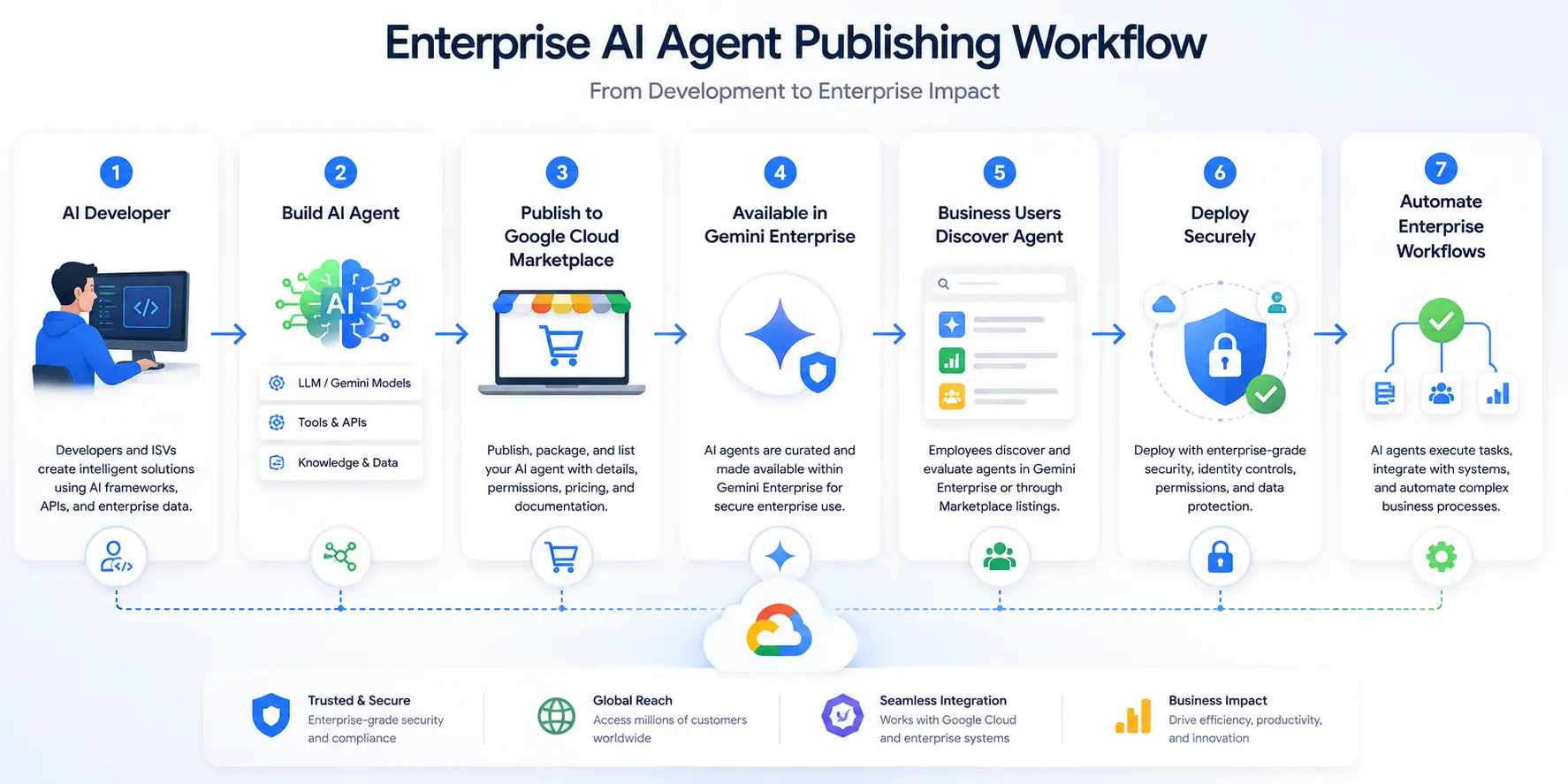
How Developers Can Publish AI Agents
Google's latest announcement makes it easier for developers to bring enterprise-ready AI solutions to a global audience. Instead of distributing AI applications through separate websites or custom deployments, developers can now publish their AI agents directly to Gemini Enterprise and Google Cloud Marketplace, where organizations can easily discover and deploy them.
The publishing process is designed to support both independent software vendors (ISVs) and enterprise developers building AI-powered business solutions. Developers create an AI agent using Google's supported development frameworks and Agent Development Kit (ADK), configure the agent's capabilities, define permissions, and package it with the necessary documentation before submitting it for publication.
Once approved, the AI agent becomes available to enterprise customers through Google Cloud Marketplace. Businesses can review the agent's features, deployment requirements, and supported integrations before adding it to their Google Cloud environment.
Unlike traditional software distribution, this model focuses on intelligent services that can reason, respond to user requests, automate tasks, and interact with business systems rather than simply providing static functionality.
Another important advantage is discoverability. Publishing through Google Cloud Marketplace gives developers access to organizations already investing in Google Cloud technologies, increasing visibility without requiring separate sales or deployment channels.
Google also provides standardized publishing guidelines that help maintain consistency, security, and quality across marketplace offerings, giving enterprise customers greater confidence when adopting third-party AI agents.
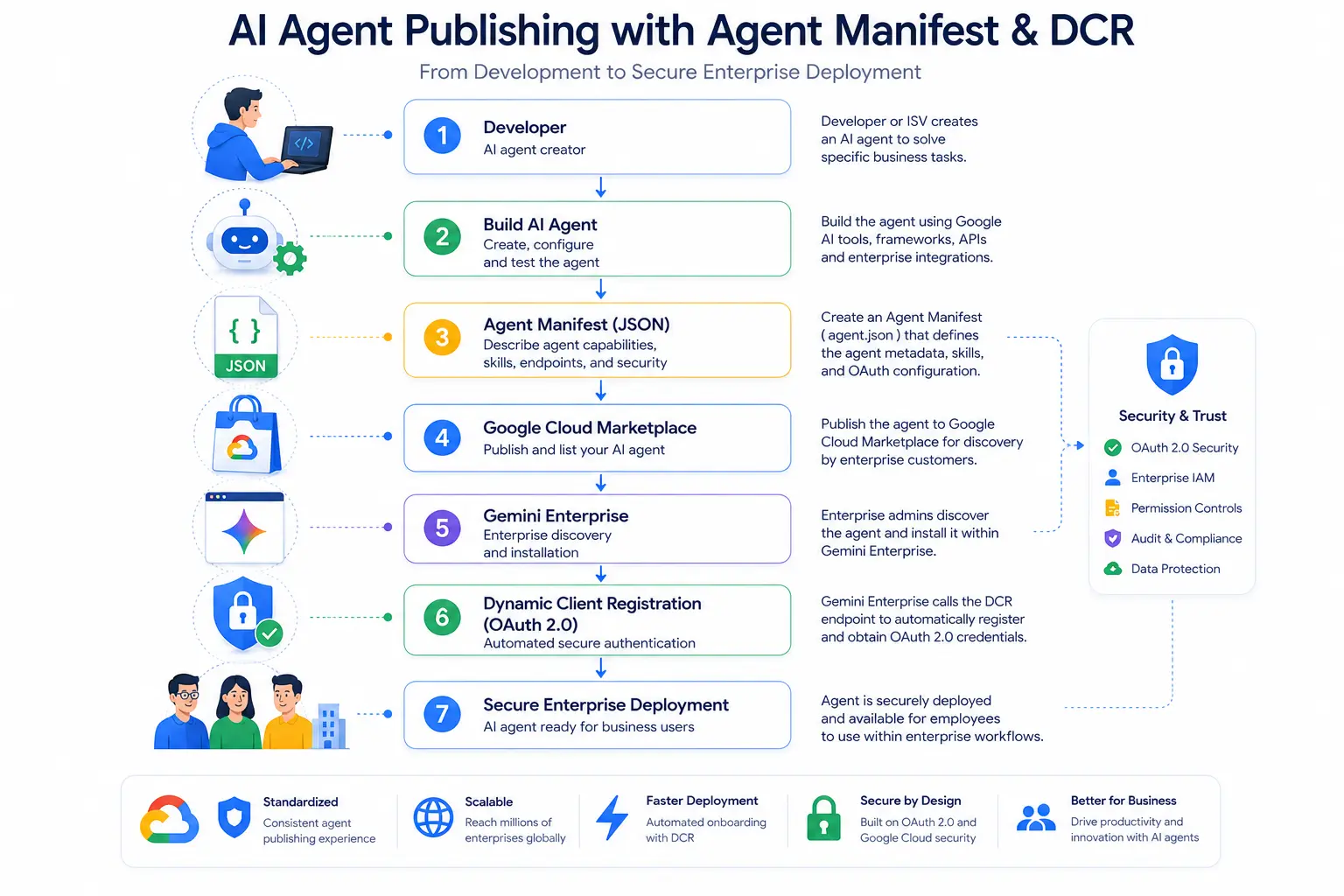
Technical Highlights: Agent Manifest and Dynamic Client Registration (DCR)
While Google's announcement is aimed at simplifying enterprise AI adoption, it also introduces several technical components that make publishing and deploying AI agents more standardized and secure.
One of the core requirements is an Agent Manifest, a JSON configuration file that describes the AI agent. Rather than containing application logic, the manifest acts as metadata that tells Gemini Enterprise how to communicate with the agent. It includes details such as the agent's name, description, endpoint URL, supported capabilities, available skills, authentication methods, and provider information.
Another important feature is Dynamic Client Registration (DCR). Instead of requiring every enterprise customer to manually create OAuth credentials, DCR allows Gemini Enterprise to automatically register with the AI agent provider during deployment. This streamlines onboarding, reduces configuration errors, and enables secure authentication using standardized OAuth 2.0 workflows.
Together, the Agent Manifest and DCR create a consistent publishing framework that simplifies how developers distribute AI agents and how enterprises securely deploy them at scale.
Why this placement works
Logical flow: Readers first learn how developers publish AI agents, then they see the technical mechanisms (Agent Manifest and DCR), and only afterward learn how those agents integrate into Gemini Enterprise.
Audience balance: Business readers can skip this subsection, while developers get valuable implementation context without disrupting the overall news narrative.
Gemini Enterprise Integration
One of the most significant aspects of Google's announcement is the deep integration between published AI agents and Gemini Enterprise.
Gemini Enterprise serves as the central workspace where employees interact with AI-powered assistants throughout their daily work. Instead of switching between multiple applications, users can access specialized AI agents from a familiar interface while continuing their existing workflows.
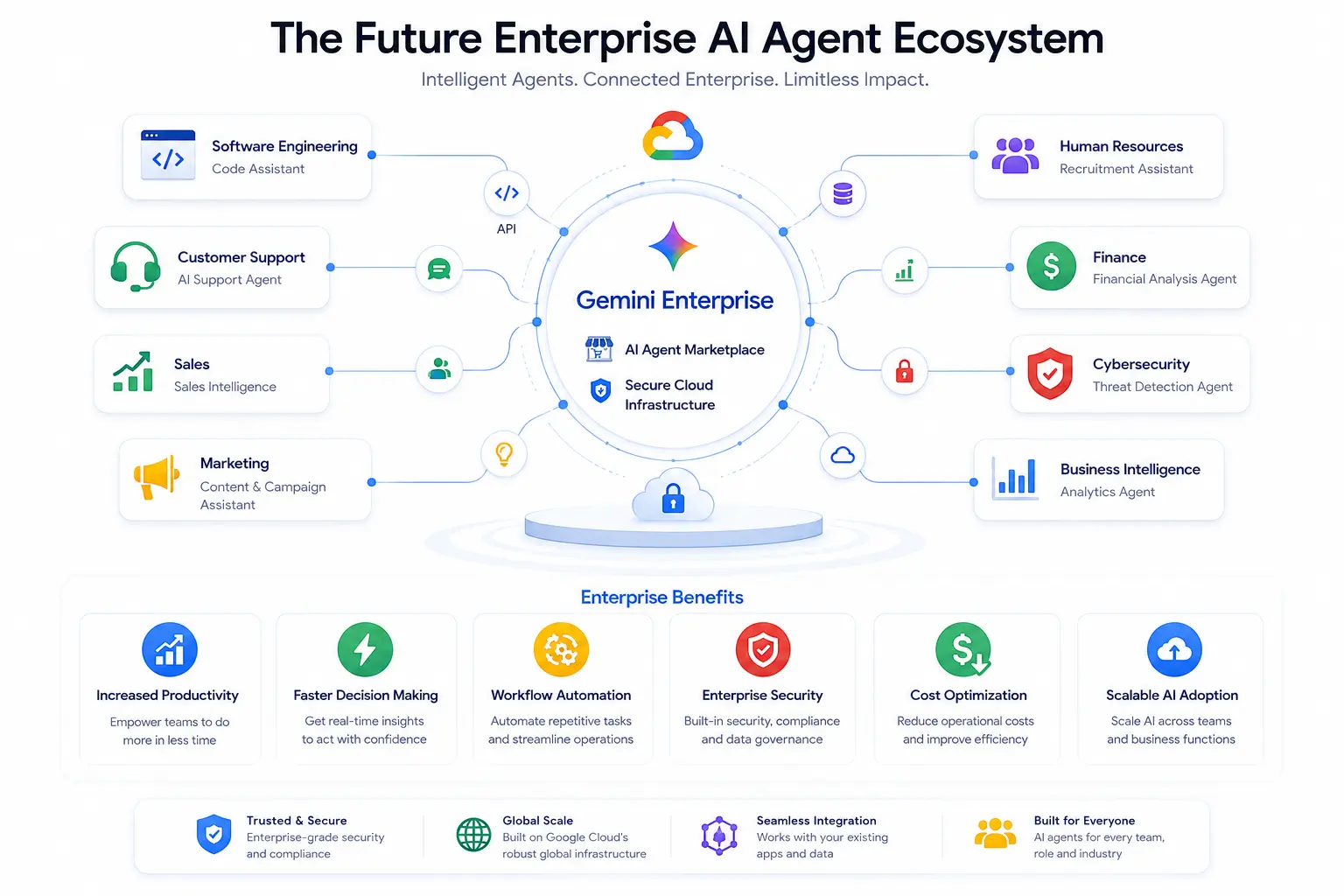
For example, a marketing team could access an AI agent that generates campaign reports, while an HR department might use another agent to summarize employee policies or assist with recruitment processes. Software development teams could deploy coding assistants, and finance departments could use AI agents for document analysis and compliance reviews.
Because these agents operate within Gemini Enterprise, organizations can provide employees with specialized expertise without requiring them to learn entirely new software platforms.
Integration also enables AI agents to work alongside existing Google Workspace services and connected enterprise systems. This creates a more unified experience where information flows securely between AI agents and business applications.
Google has also emphasized enterprise-grade governance, allowing administrators to manage permissions, monitor usage, and control how AI agents access organizational data. These capabilities are particularly important for industries that must meet strict compliance and security requirements.
As businesses adopt more AI-powered workflows, centralized management within Gemini Enterprise can help reduce operational complexity while ensuring consistent user experiences across teams.
Google Cloud Marketplace Workflow
Google Cloud Marketplace has long served as a trusted platform for discovering infrastructure solutions, software products, and cloud services. With the introduction of AI agent publishing, the marketplace is evolving into a destination for intelligent business automation.
The workflow is designed to be straightforward for both developers and enterprise customers.
Step 1: Develop the AI Agent
Developers create an AI agent using Google's AI development tools, APIs, and supported frameworks. The agent is configured to perform specific business tasks such as customer support, document processing, software development assistance, or workflow automation.
Step 2: Package and Publish
The developer prepares the AI agent with metadata, permissions, pricing (if applicable), documentation, and deployment requirements before submitting it for publication through Google Cloud Marketplace.
Step 3: Review and Availability
Google reviews the submission to ensure it meets marketplace standards. Once approved, the AI agent becomes searchable within Google Cloud Marketplace and Gemini Enterprise.
Step 4: Enterprise Discovery
Organizations can browse available AI agents, compare capabilities, evaluate documentation, and select solutions that match their operational needs.
Step 5: Secure Deployment
Businesses deploy the AI agent into their Google Cloud environment using existing enterprise procurement and administration processes.
Step 6: Ongoing Management
Administrators can monitor usage, update configurations, manage permissions, and maintain governance through Google's enterprise management tools.
This structured workflow simplifies what has traditionally been a complex AI deployment process, allowing organizations to move from discovery to production much more quickly.
Benefits for Businesses
Google's new publishing model delivers advantages for organizations that want to adopt AI without building every solution internally.
Faster AI Adoption
Instead of spending months developing custom AI systems, businesses can deploy ready-made AI agents designed for specific tasks. This accelerates implementation while reducing development costs.
Access to Specialized Expertise
Different AI agents are built for different business functions. Organizations can choose solutions for customer service, software engineering, HR, finance, legal operations, marketing, IT support, and more, selecting only the capabilities they need.
Reduced Operational Complexity
Because AI agents are integrated with Gemini Enterprise and Google Cloud Marketplace, deployment follows familiar cloud management practices rather than requiring complex custom integrations.
Enterprise Security
Organizations benefit from Google's enterprise-grade security model, including identity management, permission controls, governance policies, and secure deployment workflows. This helps businesses adopt AI while maintaining compliance requirements.
Scalable Innovation
As new AI agents become available through the marketplace, businesses can continually expand their AI capabilities without replacing existing infrastructure. This creates a flexible ecosystem that evolves alongside changing business needs.
Improved Productivity
AI agents can automate repetitive tasks, summarize information, assist employees with decision-making, and streamline workflows across departments. By reducing manual work, organizations can improve operational efficiency while allowing employees to focus on higher-value activities.
Overall, Google's latest initiative transforms AI adoption from a large-scale technical project into a more accessible marketplace experience, making enterprise AI practical for organizations of all sizes.
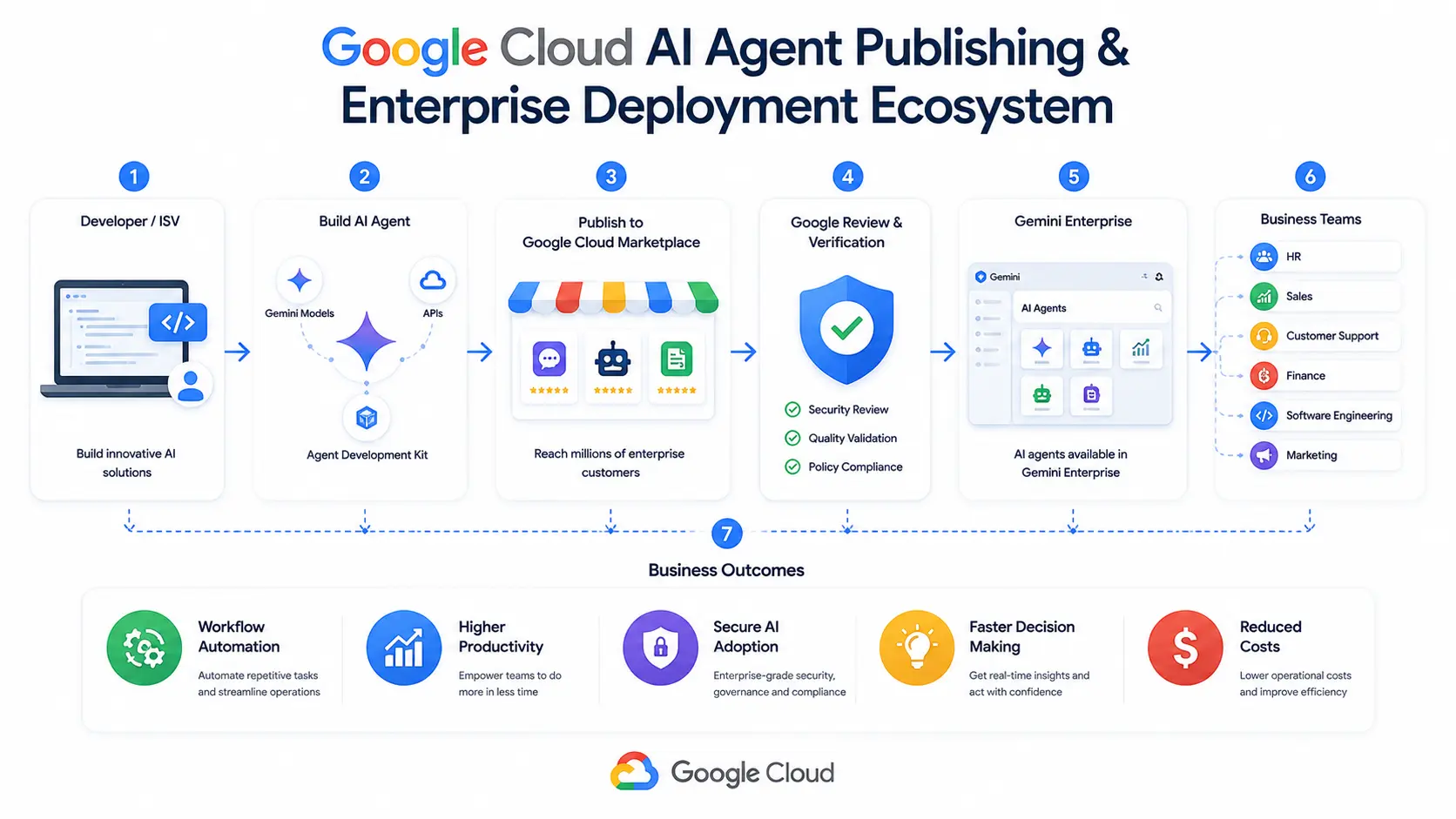
Enterprise Use Cases
The launch of AI agent publishing for Gemini Enterprise and Google Cloud Marketplace opens the door to a wide range of practical business applications. Rather than relying on a single AI assistant for every task, organizations can deploy specialized AI agents that are designed for specific departments, workflows, and business objectives.
Customer Service
AI agents can handle customer inquiries around the clock by answering frequently asked questions, processing support requests, and escalating complex issues to human representatives when needed. This reduces response times while improving the overall customer experience.
Software Development
Engineering teams can use AI agents to generate code snippets, explain unfamiliar codebases, review pull requests, identify bugs, and assist with documentation. These capabilities help developers spend more time building features and less time on repetitive tasks.
Sales and Marketing
Sales teams can leverage AI agents to summarize customer interactions, draft personalized outreach emails, analyze sales pipelines, and recommend next-best actions. Marketing departments can automate campaign planning, generate content ideas, analyze performance metrics, and create reports more efficiently.
Human Resources
HR teams can deploy AI agents to answer employee questions, simplify onboarding, screen resumes, summarize policy documents, and assist with recruitment workflows. This allows HR professionals to focus on employee engagement and strategic planning.
Finance and Operations
Finance departments can automate invoice processing, expense reviews, financial reporting, and compliance checks. Operations teams can use AI agents to monitor business performance, analyze operational data, and identify opportunities for greater efficiency.
IT and Security Operations
IT teams can deploy AI agents that assist with incident response, troubleshoot infrastructure issues, summarize system logs, and recommend solutions based on historical data. Security teams can also use AI-powered assistants to investigate alerts, analyze vulnerabilities, and streamline routine security operations.
These examples illustrate how organizations can assemble an ecosystem of specialized AI agents rather than depending on a single, general-purpose assistant.
Security and Governance
As AI becomes integrated into enterprise workflows, security and governance remain critical priorities. Google's marketplace approach emphasizes responsible deployment by providing organizations with tools to manage AI agents within existing enterprise security frameworks.
Administrators maintain control over which AI agents employees can access, ensuring that only approved solutions are deployed across the organization. Identity and Access Management (IAM) policies help enforce role-based permissions so users only interact with AI agents appropriate for their responsibilities.
Google Cloud also supports enterprise security features such as authentication, encryption, audit logging, and centralized administration. These capabilities help organizations monitor AI usage, investigate activity when necessary, and maintain visibility into how AI agents interact with enterprise systems.
Governance extends beyond technical controls. Organizations can establish internal policies for AI adoption, define acceptable use cases, and ensure that AI-generated outputs align with business requirements and regulatory obligations.
For industries such as healthcare, finance, government, and legal services, these governance capabilities are especially important. Businesses can adopt AI while maintaining compliance standards and reducing operational risk.
By combining secure deployment with centralized management, Google aims to make enterprise AI both powerful and trustworthy.
Industry Impact
Google's latest announcement reflects a broader transformation taking place across the technology industry. AI is increasingly shifting from standalone chat interfaces to specialized agents capable of performing real business tasks.
This evolution is expected to influence several areas of the enterprise technology market.
A Growing AI Economy
Developers now have another commercial channel for distributing AI solutions. Instead of building custom integrations for every customer, they can publish AI agents once and reach organizations through Google Cloud Marketplace.
Lower Barriers to AI Adoption
Small and medium-sized businesses often lack the resources to build custom AI systems. Ready-to-deploy AI agents make advanced capabilities more accessible, allowing organizations to adopt intelligent automation without significant technical investment.
Acceleration of Digital Transformation
As enterprises gain easier access to AI-powered business tools, digital transformation initiatives can progress more quickly. Organizations can experiment with multiple AI agents, evaluate business value, and expand successful deployments over time.
Increased Competition
Google's marketplace initiative also intensifies competition among major cloud providers. As enterprise demand for AI continues to grow, cloud platforms are evolving into ecosystems where customers expect not only infrastructure but also intelligent services, automation, and industry-specific AI solutions.
A New Marketplace for Innovation
Independent developers, startups, consulting firms, and software vendors now have opportunities to create highly specialized AI agents that address niche business challenges. This encourages innovation while expanding the range of AI solutions available to enterprise customers.
Future of AI Agent Marketplaces
The introduction of AI agent publishing represents an early step in what could become one of the most significant changes in enterprise software over the next decade.
Rather than purchasing large software suites with fixed functionality, businesses may increasingly assemble collections of AI agents tailored to their unique workflows. Each department could have dedicated AI assistants that collaborate with employees, communicate with enterprise applications, and automate repetitive processes.
Future marketplaces are also likely to become more intelligent themselves. Businesses may receive recommendations for AI agents based on their industry, existing cloud infrastructure, compliance requirements, or operational goals. AI agents could even collaborate with one another to complete complex, multi-step business processes.
As generative AI models continue to improve, enterprise marketplaces may expand beyond simple task automation to include autonomous research assistants, financial analysts, software architects, legal document reviewers, and industry-specific experts.
Google's latest announcement positions the company to participate in this emerging ecosystem by connecting developers, enterprise customers, and AI-powered services through a unified marketplace experience.
While the technology is still evolving, one trend is becoming increasingly clear: enterprise software is moving toward intelligent, modular, and collaborative AI solutions that can be deployed as easily as traditional cloud applications.
Expert Analysis
Google's decision to open Gemini Enterprise and Google Cloud Marketplace to third-party AI agents marks a strategic shift in how enterprise artificial intelligence will be adopted over the coming years. Rather than positioning Gemini solely as an AI assistant, Google is transforming it into a platform where organizations can discover, deploy, and manage specialized AI solutions from multiple developers.
This approach mirrors the evolution of mobile app stores and cloud marketplaces, where ecosystems became more valuable as more developers contributed applications. In the AI era, the same concept applies to intelligent agents. Businesses are unlikely to rely on a single AI model for every task. Instead, they will build collections of specialized AI agents tailored to different departments, workflows, and business objectives.
For developers, this announcement creates a significant opportunity. Publishing through Google Cloud Marketplace provides access to a large enterprise customer base without requiring organizations to build custom integrations or negotiate separate deployment processes. This can shorten sales cycles and accelerate adoption for innovative AI solutions.
From an enterprise perspective, the marketplace model reduces the complexity of AI adoption. Instead of investing months in developing custom AI systems, businesses can evaluate pre-built agents, deploy them securely, and expand their AI capabilities over time. This lowers both the technical and financial barriers that have traditionally slowed enterprise AI initiatives.
Security also remains a defining advantage. By integrating AI agents into Gemini Enterprise and leveraging Google's existing cloud governance, identity management, and security controls, organizations can adopt AI while maintaining oversight of permissions, compliance requirements, and operational risk.
Looking ahead, AI agent marketplaces are likely to become a standard component of enterprise cloud platforms. As generative AI models continue to mature, businesses will increasingly expect cloud marketplaces to offer not only infrastructure and software but also intelligent services capable of automating work, assisting employees, and supporting decision-making across the organization.
Google's latest announcement positions the company to compete more aggressively in this emerging market while encouraging developers to build specialized AI solutions for enterprises worldwide.
Final Thoughts
Google's introduction of AI agent publishing for Gemini Enterprise and Google Cloud Marketplace represents more than a product enhancement. It signals the next phase of enterprise AI, where intelligent agents become as easy to discover and deploy as traditional cloud applications.
For businesses, this means faster access to trusted AI solutions, simplified deployment, and greater flexibility to adopt automation without extensive custom development. Organizations can choose AI agents tailored to specific business functions while managing them through familiar enterprise tools and governance policies.
For developers and software vendors, the marketplace offers a scalable way to distribute AI innovations to a global enterprise audience. By lowering barriers to publication and increasing visibility, Google is helping create an ecosystem where specialized AI solutions can reach organizations more efficiently.
As enterprises continue their digital transformation journeys, marketplaces for AI agents are expected to play an increasingly important role. Organizations will no longer evaluate AI solely based on model performance but also on how easily intelligent agents integrate with existing workflows, security requirements, and business objectives.
This announcement reinforces a broader industry trend: the future of enterprise software is becoming more intelligent, modular, and collaborative. Companies that embrace AI agent ecosystems today will be better positioned to improve productivity, accelerate innovation, and remain competitive in an increasingly AI-driven business landscape.
Source: Google Cloud Blog
About the Author