
Schrödinger Accelerates Molecular Discovery by 4x Using Google DeepMind’s AlphaEvolve
Schrödinger and Google Cloud have achieved a major breakthrough in computational chemistry. By deploying AlphaEvolve, an AI-powered coding agent from Google DeepMind, researchers accelerated molecular discovery workflows by 4x, dramatically reducing drug discovery and materials
Xcademia Team
Xcademia Research Team

Schrödinger Uses AlphaEvolve to Transform Molecular Discovery
The race to accelerate scientific discovery is increasingly being driven by artificial intelligence. In a new collaboration with Google Cloud, Schrödinger has demonstrated how AI-generated code can significantly improve the speed of molecular simulations, achieving a remarkable fourfold increase in performance across key machine-learned force field (MLFF) workflows.
The breakthrough comes through the use of AlphaEvolve, an evolutionary AI coding agent developed by Google DeepMind. By automatically generating and refining optimized algorithms, AlphaEvolve helped eliminate critical performance bottlenecks in Schrödinger’s computational chemistry pipeline, opening the door to faster drug discovery, catalyst development, and advanced materials research.
The Challenge: Speed vs Accuracy in Computational Chemistry
For decades, researchers have faced a difficult trade-off when simulating molecular interactions.
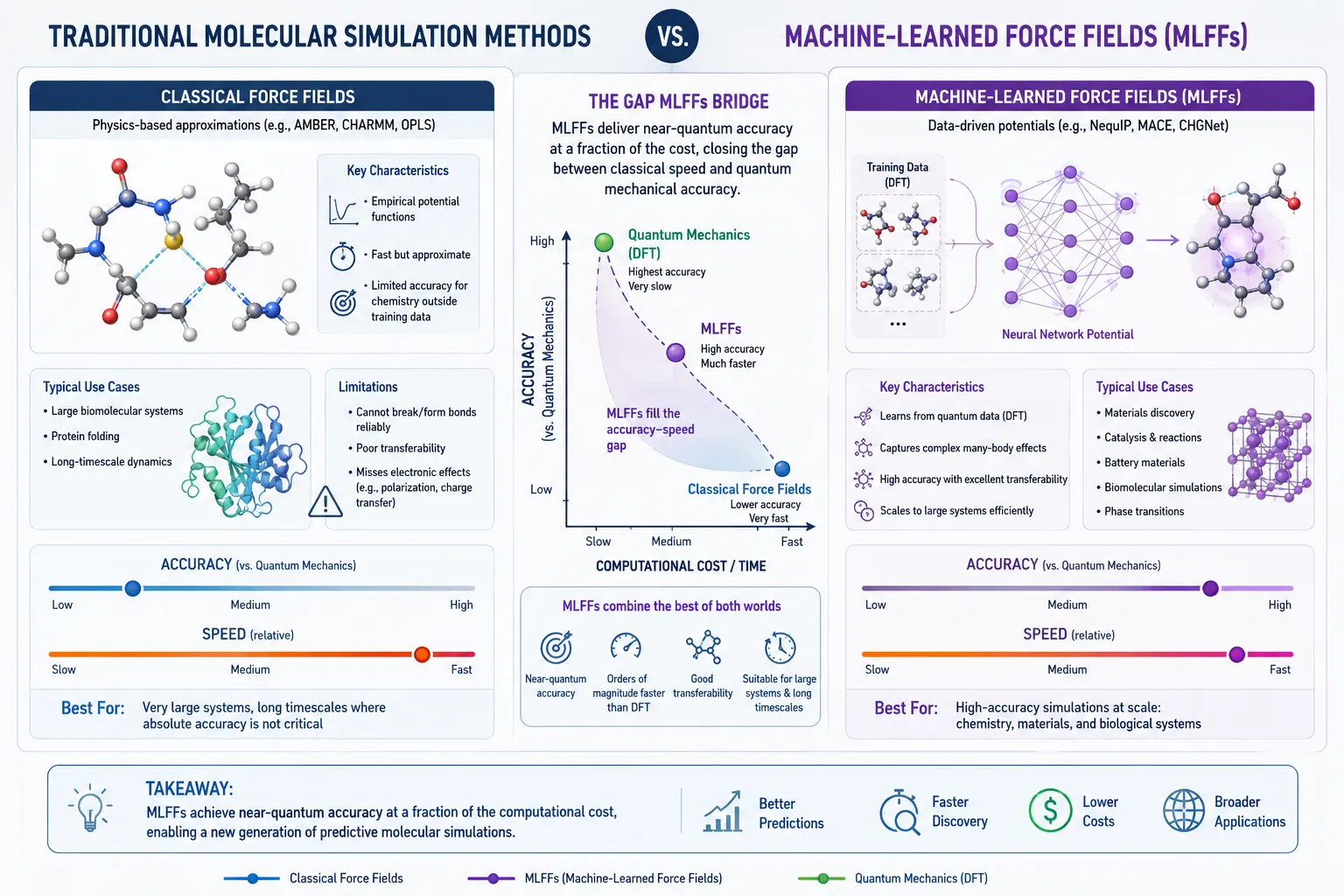
Traditional approaches typically fall into two categories:
Classical force fields, which are fast but less accurate.
Quantum-mechanical simulations, which provide high precision but require substantial computational resources.
Machine-learned force fields have emerged as a promising middle ground, using neural networks trained on high-quality quantum data to deliver both speed and accuracy. However, as scientific organizations increasingly work with massive chemical libraries, even MLFF systems face performance limitations.
Schrödinger identified two major computational bottlenecks within its MLFF training infrastructure:
Neighbour list computation
Ewald summation calculations
These algorithms are essential for accurately modelling molecular interactions but become increasingly expensive as simulation complexity grows.
How AlphaEvolve Optimized the Code
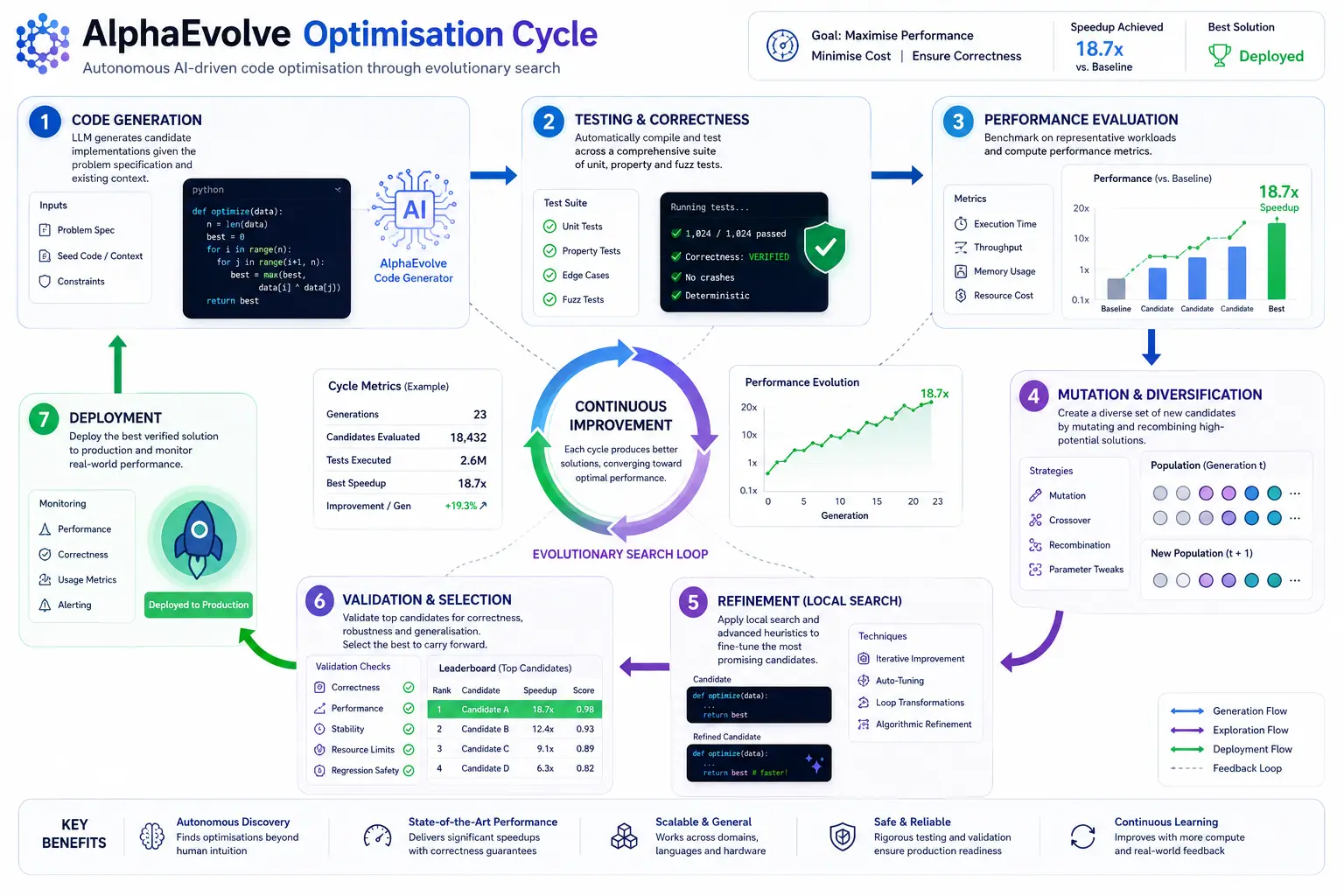
AlphaEvolve is designed to act as an evolutionary programming system. Instead of simply generating code, it continuously tests, evaluates, and refines algorithmic approaches to discover more efficient implementations.
Schrödinger focused AlphaEvolve on improving the Ewald summation process, one of the most computationally intensive components of molecular mechanics simulations.
The original implementation relied heavily on traditional for-loops, which limited performance when processing large molecular datasets.
AlphaEvolve generated an alternative approach by:
Replacing sequential loop operations
Introducing batched implementations
Leveraging parallel batch matrix multiplication
Optimising PyTorch-based computational workflows
The resulting code outperformed previous implementations, including some custom-engineered kernels.
Measuring Success: A Rigorous Evaluation Framework
To ensure the AI-generated code delivered both performance and scientific reliability, Schrödinger implemented a comprehensive evaluation framework.
The company assessed AlphaEvolve-generated solutions using three primary metrics:
Throughput Performance
The main objective was reducing execution time and increasing computational throughput.
Functional Correctness
Every generated algorithm had to pass extensive validation tests, including complex molecular systems and regression testing scenarios.
Success Rate
Researchers measured how many generated programs were both scientifically accurate and faster than the baseline implementation.
This rigorous process ensured that speed improvements did not come at the cost of scientific validity.
Results: 4x Faster Training and Inference
The results were significant.
After AlphaEvolve optimised the Ewald summation algorithm:
Performance scores increased from 7.9 to nearly 30
Program success rates improved from less than 1% to over 60%
MLFF training and inference achieved a 4x overall speed improvement
These gains translate directly into faster scientific discovery cycles.
According to Gabriel Marques, Technical Lead of Machine Learning at Schrödinger, faster MLFF inference enables researchers to explore larger chemical spaces more efficiently and dramatically shortens research and development timelines.
Impact Across Multiple Scientific Fields
The acceleration achieved through AlphaEvolve has implications far beyond computational efficiency.
Drug Discovery
Pharmaceutical researchers can evaluate larger numbers of molecular candidates in shorter timeframes, helping identify potential therapies faster and reducing development cycles.
Catalyst Design
Chemical manufacturers can accelerate the discovery of efficient catalysts, improving industrial processes and reducing research costs.
Materials Science
Researchers developing advanced batteries, semiconductors, and energy-storage technologies can explore new material combinations more rapidly.
The ability to screen molecular candidates in days instead of months could substantially change how scientific organisations approach innovation.
A New Era of AI-Generated Scientific Software
One of the most notable aspects of this project is that AlphaEvolve is not merely assisting scientists, it is actively improving the software infrastructure used to perform scientific research.
This represents a broader trend in artificial intelligence where AI systems increasingly contribute to:
Algorithm discovery
Code optimisation
Scientific computing
Research automation
High-performance computing workflows
Rather than replacing researchers, AI acts as a collaborative partner that helps uncover solutions humans may not easily identify.

What's Next for Schrödinger and AlphaEvolve?
Following the success of this collaboration, Schrödinger plans to expand AlphaEvolve's role into custom GPU kernel optimisation.
The company aims to determine whether AI-generated implementations can outperform even highly specialised human-engineered code. If successful, this could establish a new paradigm where AI continuously improves the computational foundations of scientific research.
As AI systems become increasingly capable of discovering novel algorithms and optimising complex software environments, the boundary between scientific research and software engineering will continue to blur.
The Schrödinger-Google Cloud collaboration provides an early glimpse into a future where AI not only accelerates discovery but also helps build the tools that make discovery possible.
Source: Google Cloud Blog
About the Author