
Google Cloud and Valtech Launch Nexus SDV: AI-Powered Open-Source Platform Secures the Future of Software-Defined Vehicles
Google Cloud and Valtech have unveiled Nexus SDV, an open-source AI-powered platform designed to secure and manage up to 100 million software-defined vehicles. Powered by Gemini AI, it combines cloud-native architecture with defense-in-depth cybersecurity controls.
Xcademia Team

Google Cloud Unveils Nexus SDV to Accelerate Secure Software-Defined Vehicles
The automotive industry is rapidly evolving from traditional connected vehicles to software-defined vehicles (SDVs), cars whose features, capabilities, and security can be continuously updated through software. As artificial intelligence becomes central to modern mobility, Google Cloud and digital engineering company Valtech have introduced Nexus SDV, an open-source, AI-native connected vehicle platform designed to manage the next generation of intelligent vehicles securely.
Nexus SDV combines Google Cloud's AI, security, and cloud infrastructure with Valtech's automotive expertise to create a scalable platform capable of supporting up to 100 million connected vehicles.
AI Becomes the Brain of Software-Defined Vehicles
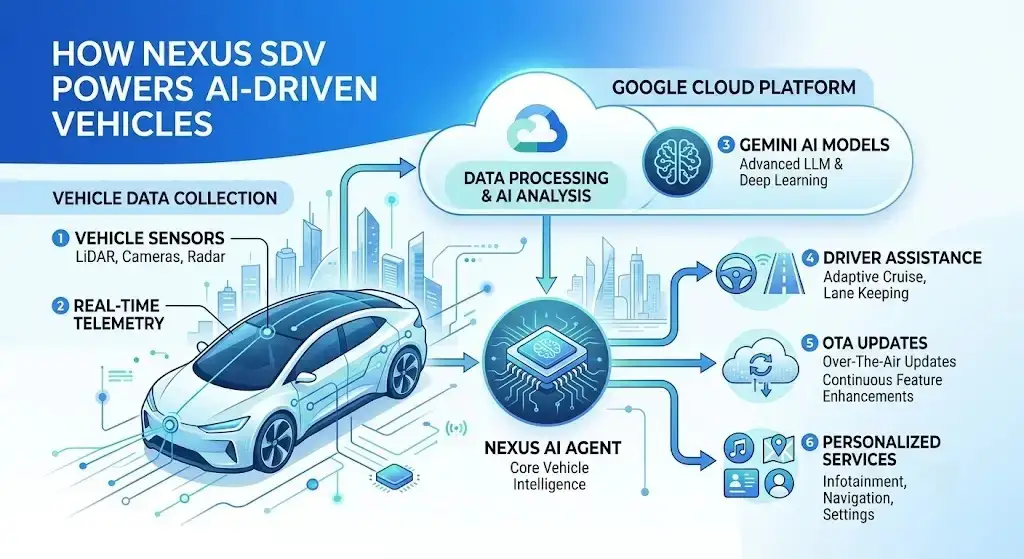
At the heart of Nexus SDV is Nexus AI, powered by Google's Gemini models and the Gemini Enterprise Agent Platform.
Instead of treating vehicles as simple data generators, Nexus AI enables them to become intelligent systems capable of:
Analyzing vehicle telemetry in real time
Delivering proactive driver assistance
Supporting autonomous decision-making
Providing hyper-personalized in-vehicle experiences
Anticipating driver needs using AI agents
This agentic approach allows vehicles to continuously learn from operational data while receiving intelligent software updates through the cloud.
Built for Massive Scale with Lower Operating Costs
One of the major highlights of Nexus SDV is its focus on reducing the Total Cost of Ownership (TCO).
Google Cloud says the platform achieves this by combining:
Arm-based computing infrastructure
Bigtable-optimized storage
Modular cloud-native architecture
Efficient AI processing
These optimizations allow automotive manufacturers to process enormous volumes of vehicle telemetry while reducing infrastructure costs and improving scalability.
The first open-source release also demonstrates how manufacturers can build AI-powered automotive applications without relying on proprietary platforms.
Cloud-Native Architecture Connects Vehicles and the Cloud
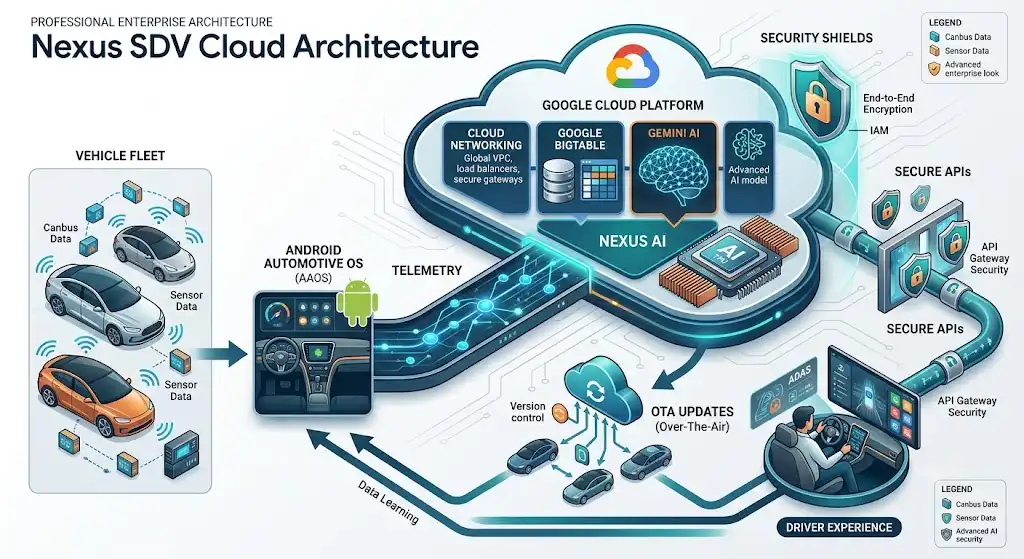
Nexus SDV is deeply integrated with Android Automotive OS (AAOS), enabling seamless communication between vehicles and cloud services.
Its architecture enables:
Continuous telemetry synchronization
Cloud-to-vehicle software updates
Intelligent data processing
Lifecycle management of connected vehicles
Developer-friendly open APIs
This cloud-native foundation allows manufacturers to rapidly deploy new services while maintaining centralized fleet management.
Six Layers of Security Protect Connected Vehicles
Security remains one of the biggest challenges for software-defined vehicles, where millions of connected endpoints constantly exchange sensitive data.
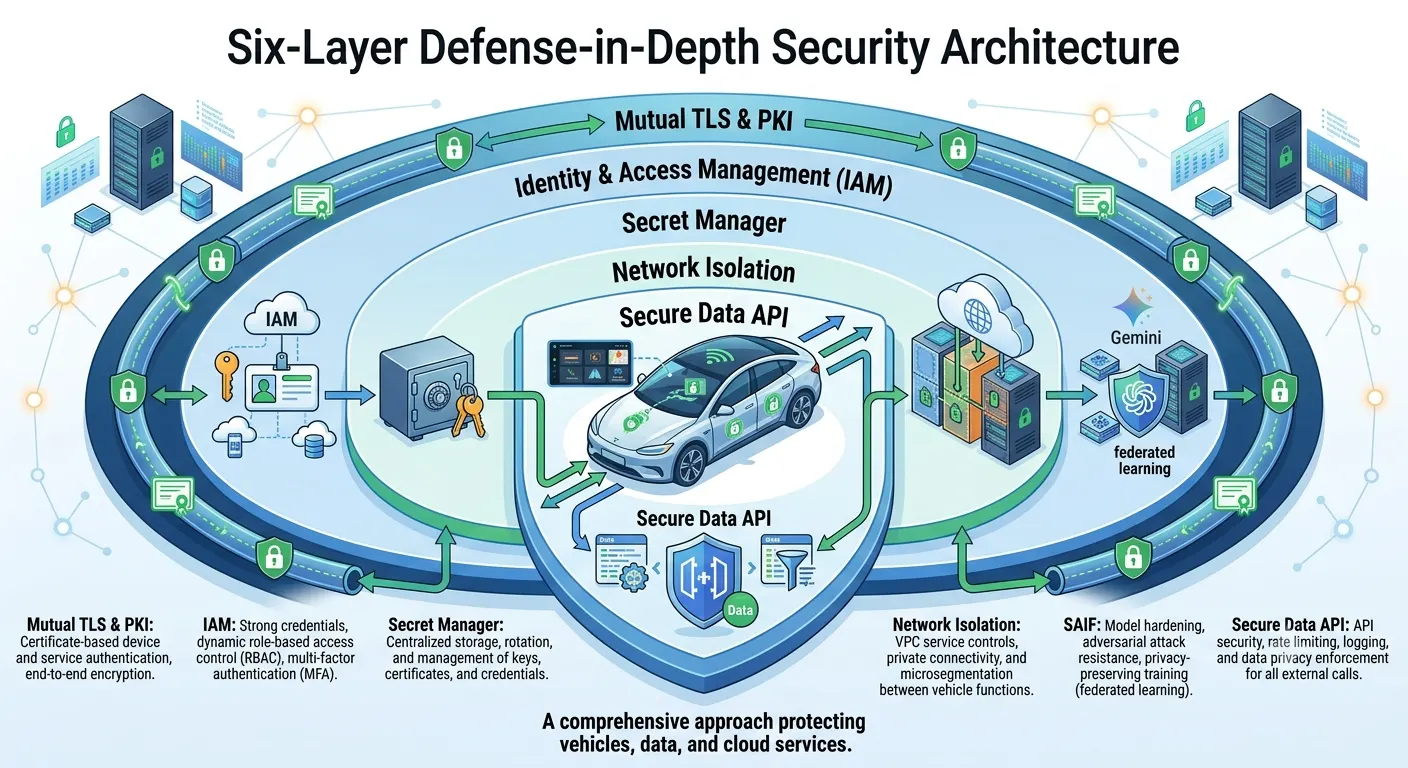
Google Cloud has implemented a defense-in-depth architecture built around six security pillars.
1. Mutual TLS and Public Key Infrastructure
Every vehicle must authenticate itself before exchanging data.
The platform uses:
Mutual TLS (mTLS)
Google Cloud Certificate Authority Service
Certificate validation
Hardware-backed identity verification
This creates a trusted identity for every connected vehicle.
2. Identity and Access Management
Vehicles receive short-lived authentication tokens through:
Keycloak Identity Provider
OpenID Connect (OIDC)
JSON Web Tokens (JWT)
Workload Identity Federation
Google Kubernetes Engine Workload Identity
The platform follows the least-privilege principle, ensuring every service receives only the permissions it requires.
3. Secure Secret Management
Sensitive credentials never reside inside application code.
Instead, Google Cloud Secret Manager securely stores:
Database passwords
Cryptographic keys
API credentials
Signing certificates
Applications retrieve secrets only during runtime, reducing exposure.
4. Network Isolation
Infrastructure protection includes:
Private Google Kubernetes Engine clusters
No public IP exposure
Cloud SQL IAM Authentication
Private Service Connect
Virtual Private Cloud Service Controls
Organization Policy enforcement
This significantly reduces the external attack surface.
5. Secure AI Framework (SAIF)
Google also incorporates its Secure AI Framework (SAIF) to govern AI operations.
Key capabilities include:
AI explainability
Safety controls
Continuous evaluation
Model monitoring
Secure model registries
Enterprise AI governance
These controls help manufacturers deploy AI responsibly while protecting sensitive automotive data.
6. Secure Data API
Rather than allowing applications direct database access, Nexus SDV introduces a secure Data API.
This gateway:
Validates requests
Restricts queries
Controls data access
Filters Bigtable operations
Prevents unauthorized database interactions
The approach minimizes the risk of excessive data exposure while simplifying application development.
Open Source Platform Encourages Industry Innovation
Google Cloud and Valtech are positioning Nexus SDV as an open-source platform to encourage collaboration across the automotive ecosystem.
The modular architecture enables manufacturers to:
Customize deployments
Build proprietary vehicle services
Integrate existing applications
Accelerate software innovation
Reduce vendor lock-in
The platform is designed to support future AI-powered mobility while maintaining enterprise-grade security.
Why Nexus SDV Matters
The transition toward software-defined vehicles is reshaping the automotive industry.
Instead of vehicles receiving updates only during servicing, manufacturers increasingly deliver:
New driving features
Performance improvements
Security patches
AI enhancements
Personalized experiences
As this transformation accelerates, platforms like Nexus SDV aim to provide the scalable infrastructure and security controls needed to support millions of connected vehicles without compromising privacy or safety.
Conclusion
With the launch of Nexus SDV, Google Cloud and Valtech are bringing together AI, cloud-native infrastructure, open-source development, and enterprise-grade cybersecurity to support the next generation of software-defined vehicles.
By combining Gemini-powered AI agents, Zero Trust principles, scalable cloud architecture, and comprehensive security controls, Nexus SDV aims to help automakers build smarter, safer, and more cost-efficient connected vehicles capable of evolving throughout their lifecycle.
Source: Google Cloud Blog
About the Author