
Google Launches AlphaEvolve for Everyone on Google Cloud, Bringing AI-Powered Algorithm Discovery to Enterprise Optimization
Google has made AlphaEvolve generally available on Google Cloud, enabling enterprises to use AI-powered algorithm discovery and code optimization. Built on Gemini, it helps solve complex problems across logistics, chip design, AI, finance, genomics, and scientific research.
Xcademia Team

Google Makes AlphaEvolve Generally Available on Google Cloud
Artificial intelligence is entering a new phase where it is no longer limited to helping developers write code. Instead, it is beginning to discover entirely new algorithms and optimize software in ways that would be nearly impossible through traditional engineering alone.
Google has officially announced the general availability (GA) of AlphaEvolve, making its advanced AI-powered optimization platform accessible to organizations worldwide through the Gemini Enterprise Agent Platform on Google Cloud.
Originally introduced as a private preview, AlphaEvolve has evolved from a research initiative into an enterprise-ready AI system capable of discovering better algorithms, improving existing code, and solving optimization challenges across multiple industries.
From supply chain optimization and semiconductor design to genomics, scientific computing, financial modeling, and AI infrastructure, AlphaEvolve is already demonstrating measurable business impact.
The launch represents another major milestone in Google's vision of transforming AI from a productivity assistant into a discovery engine capable of expanding human innovation.
What Is AlphaEvolve?
AlphaEvolve is an AI-powered code optimization and algorithm discovery agent built on top of Google's Gemini models.
Unlike traditional coding assistants that generate code based on prompts, AlphaEvolve continuously searches through enormous numbers of possible algorithmic variations to discover solutions that outperform existing implementations.
Rather than suggesting small improvements, the system can redesign significant portions of software while respecting performance requirements and operational constraints.
Its primary goal is simple:
Find better algorithms than humans might reasonably discover through manual experimentation.
This makes AlphaEvolve particularly valuable for problems where millions of possible implementations exist.
Examples include:
Supply chain optimization
Route planning
Financial forecasting
Semiconductor design
GPU optimization
Machine learning training
Scientific simulations
Quantum computing
Genomics
High Performance Computing (HPC)
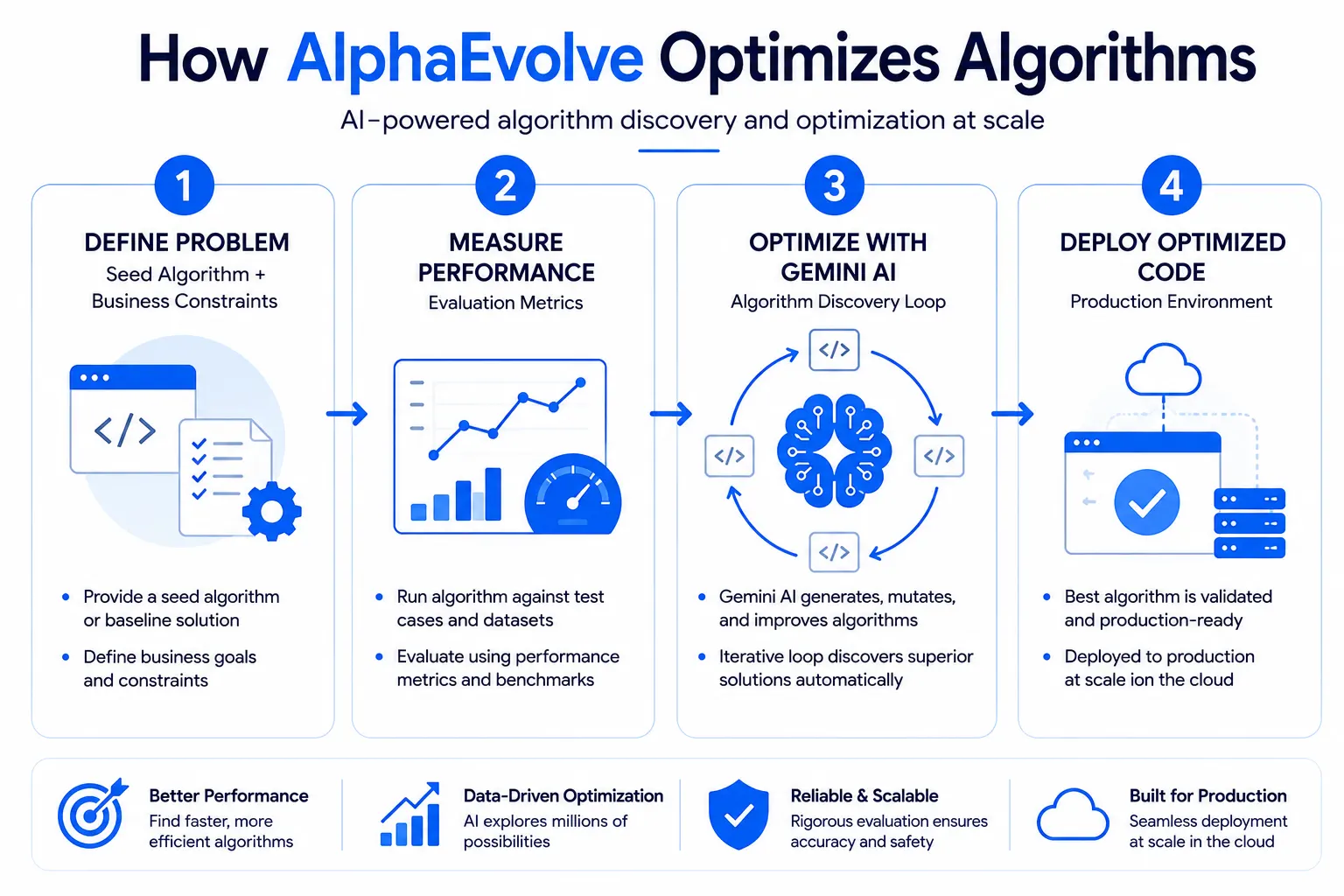
The Four-Step Optimization Process
Google designed AlphaEvolve around a structured optimization workflow.
1. Define
Developers provide:
Existing code
Baseline algorithm
Business objectives
Technical constraints
Additional domain knowledge
This establishes the starting point for AI exploration.
2. Measure
Organizations define an evaluation function that scores candidate algorithms.
Typical evaluation metrics include:
Accuracy
Runtime
Latency
Cost
Memory usage
Reliability
Operational constraints
This objective scoring system allows AlphaEvolve to determine which generated solutions are superior.
3. Optimize
The AI agent repeatedly generates new algorithmic candidates.
Each candidate is automatically evaluated.
Poor solutions are discarded.
Successful solutions become the foundation for further optimization.
This evolutionary process enables AlphaEvolve to explore software designs far beyond what manual development could realistically achieve.
4. Apply
Once optimization completes, organizations can directly deploy the improved algorithm into production environments.
The optimized code becomes part of live business systems while engineers continue reviewing and validating results.
Real-World Enterprise Success Stories
Google revealed that AlphaEvolve has already been tested across numerous enterprise environments.
The diversity of industries demonstrates that optimization challenges exist almost everywhere.
Below are some of the most notable deployments.
BASF
Building a Digital Twin for Global Supply Chains
Chemical giant BASF used AlphaEvolve to build a sophisticated digital twin capable of modeling its highly complex supply network.
Previous deterministic models had failed.
AlphaEvolve successfully captured both system behavior and human operational decisions.
The result was a highly accurate, data-driven supply chain model.
Reported improvement:
More than 80% improvement in planning and forecasting models.
Coolblue
Better Demand Forecasting
E-commerce retailer Coolblue used AlphaEvolve to optimize its 28-day demand forecasting pipeline.
Within roughly 200 optimization iterations, AlphaEvolve produced:
Better feature engineering
Improved preprocessing
Enhanced regression model ensembles
Result:
More than 5% reduction in forecasting error (WMAPE)
Improved forecasting translates directly into better inventory management and reduced stock shortages.
FM Logistic
Warehouse routing is already heavily optimized.
Yet AlphaEvolve still managed to produce:
10.4% better routing efficiency
More than 15,000 km reduction in employee travel
Benefits include:
Faster fulfillment
Lower operational costs
Reduced fleet wear
Better employee working conditions
Infineon
Semiconductor manufacturer Infineon is exploring AlphaEvolve for multiple chip development stages.
Initial experiments indicate strong potential across:
Surrogate modeling
Silicon optimization
Chip design workflows
JetBrains
Software development company JetBrains applied AlphaEvolve to IDE performance optimization.
Results showed:
15 to 20% performance improvements
Engineers remained responsible for:
Validation
Benchmarking
Release decisions
AI handled the exploration of massive optimization possibilities.
Kinaxis
Supply chain software provider Kinaxis reported:
More than 22% improvement in forecasting metrics
Over 90% runtime reduction
These gains improve enterprise planning speed while maintaining forecasting quality.
Klarna
Financial services company Klarna used AlphaEvolve on one of its largest machine learning training pipelines.
During three weeks:
Nearly 6,000 candidate programs explored
Results:
Doubled throughput
Improved model quality
Maintained strict financial compliance requirements
Kuro Games
Game developer Kuro Games applied AlphaEvolve to backend infrastructure optimization.
The AI successfully improved server-side workloads, allowing engineers to focus more on gameplay innovation.
Oak Ridge National Laboratory
One of the most technically impressive deployments occurred at Oak Ridge National Laboratory.
Running on the Frontier exascale supercomputer, AlphaEvolve optimized GPU kernels through automated generation, compilation, execution, and validation.
Researchers described it as an important step toward AI-assisted scientific software development.
Old Dominion University
Researchers studying biological aging used AlphaEvolve to discover mathematical models explaining mortality rates.
Remarkably, the system independently rediscovered established scientific models without prior knowledge while simultaneously producing new improvements.
PacBio
Genomics company PacBio used AlphaEvolve to enhance DNA sequencing.
Results included:
30% reduction in variant detection errors
Higher sequencing accuracy can improve medical research and disease discovery.
Pebble
Pebble applied AlphaEvolve to GPU inference optimization.
Results:
56% reduction in performance modeling error
This enables more accurate hardware configuration recommendations.
qBraid
Quantum computing startup qBraid used AlphaEvolve to improve quantum error correction.
The AI searched design spaces too large for human researchers to explore manually.
Schrödinger
Drug discovery company Schrödinger reported:
Four times faster molecular simulations
This accelerates pharmaceutical research while reducing development cycles.
Substrate
Semiconductor simulation company Substrate achieved multi-fold runtime improvements in computational lithography.
Larger chip simulations can now be completed significantly faster.
WPP
Global advertising company WPP used AlphaEvolve to optimize campaign prediction models.
Results included:
Up to 10% higher prediction accuracy
Up to 7% better recommendation performance
This demonstrates AlphaEvolve's value beyond traditional engineering applications.
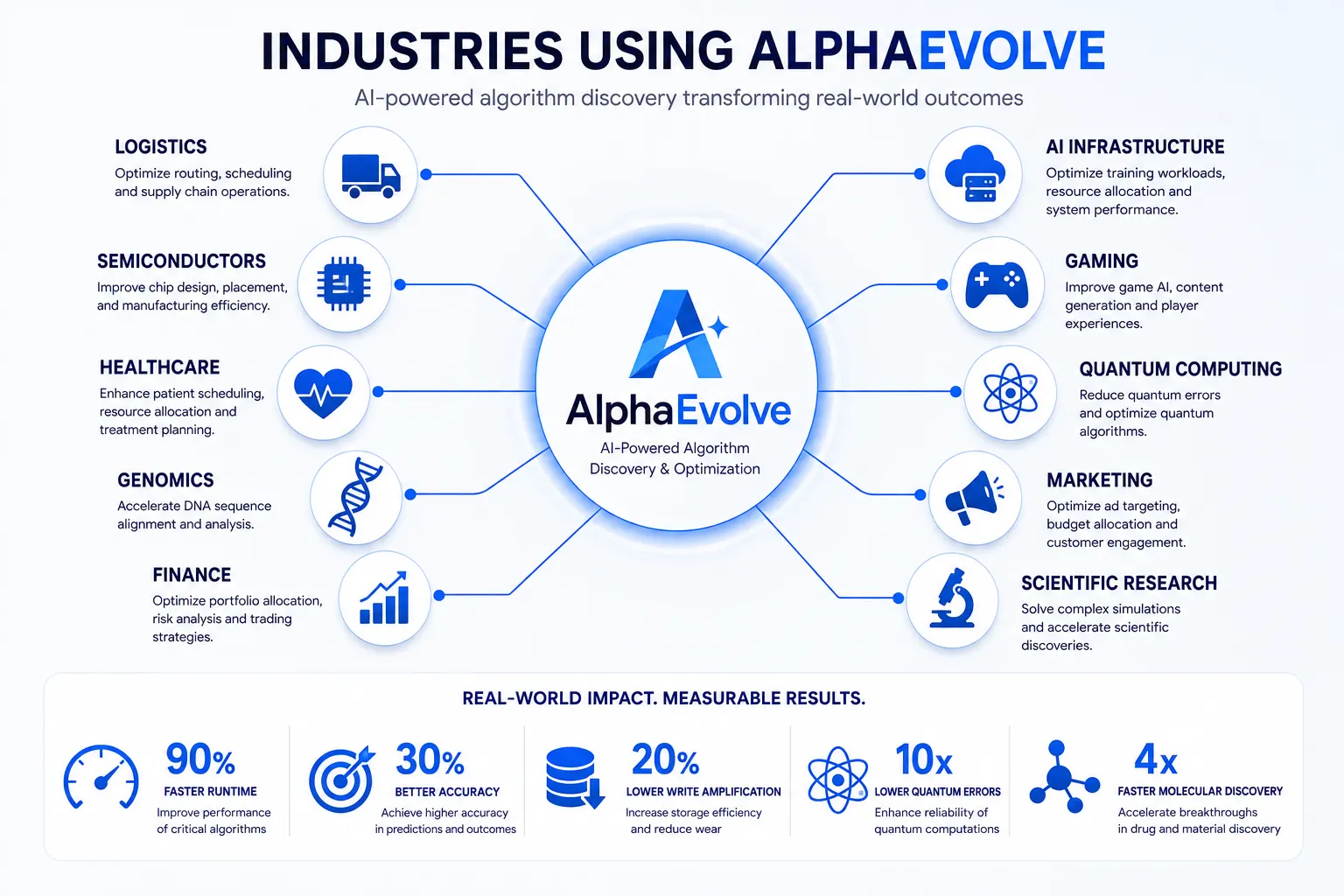
Google Is Using AlphaEvolve Internally
Google emphasized that AlphaEvolve is not merely an experimental research project.
It has become an important internal optimization engine.
According to Google DeepMind, AlphaEvolve has already improved:
TPU Design
Optimized silicon layouts for future Tensor Processing Units.
Google Spanner
Reduced write amplification by:
20%
Storage Optimization
Lowered software storage requirements by:
Nearly 9%
Natural Disaster Prediction
Improved prediction accuracy across:
20 disaster risk categories
Approximately 5% higher predictive accuracy
Quantum Computing
Discovered quantum circuits delivering:
10 times lower error rates
These internal deployments demonstrate that AlphaEvolve is already contributing to Google's own infrastructure before broader customer adoption.
From Productivity Assistant to Discovery Engine
Pushmeet Kohli, Chief Scientist at Google Cloud and Vice President of Science at Google DeepMind, described AlphaEvolve as a major evolution in artificial intelligence.
Rather than simply accelerating software development, AI is now becoming capable of discovering entirely new computational approaches.
This shift could fundamentally change research and engineering across industries.
Instead of replacing engineers, AlphaEvolve expands the search space humans can realistically explore.
The final decisions remain with developers.
Getting Started with AlphaEvolve
Google has designed AlphaEvolve to require only two primary inputs.
1. Seed Program
Developers provide the existing implementation.
Specific sections of code can be marked for optimization.
2. Evaluation Script
Organizations create a deterministic evaluation program that:
Compiles candidate solutions
Executes tests
Scores results
Returns measurable performance metrics
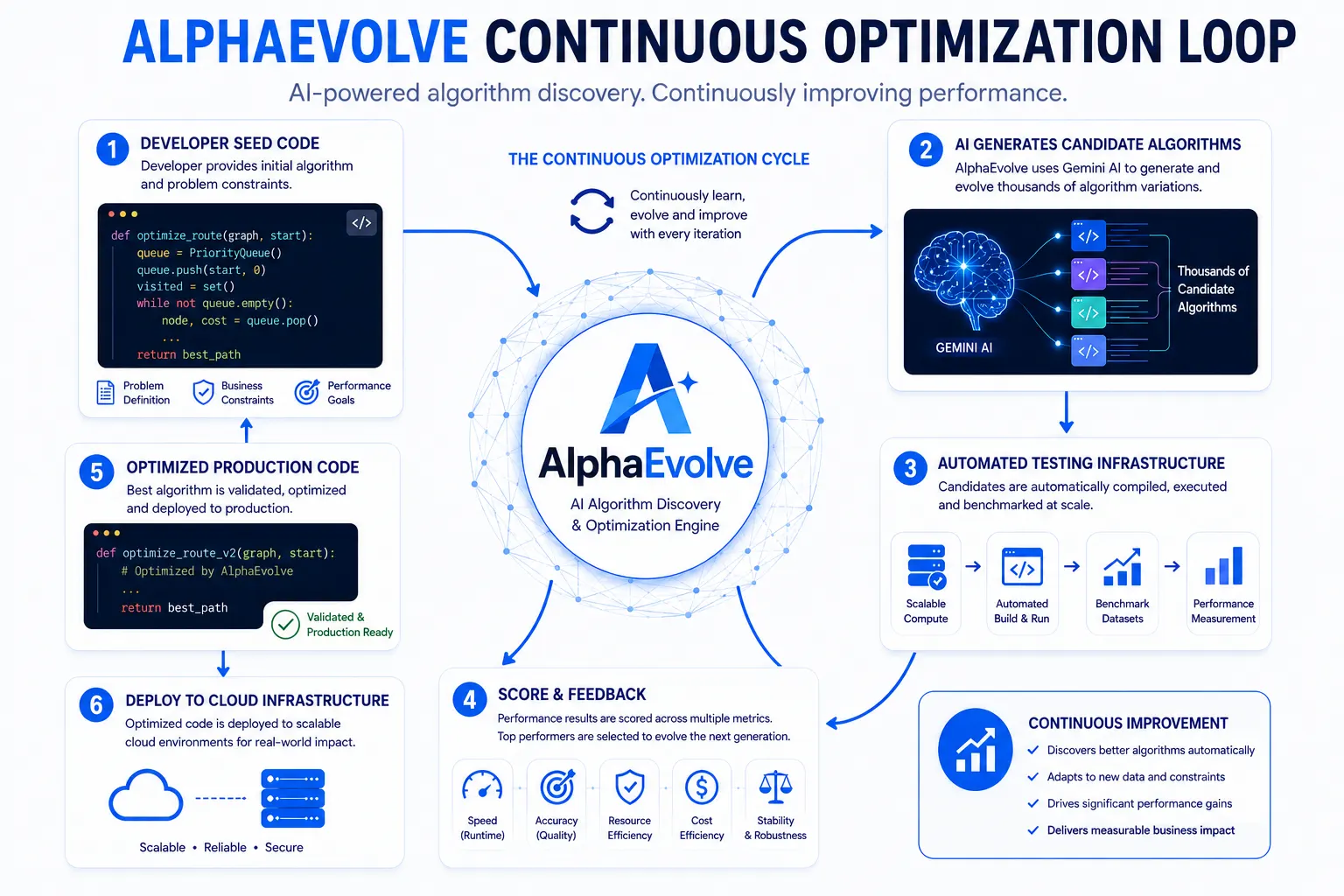
The optimization cycle operates continuously:
AlphaEvolve proposes new code.
Client infrastructure evaluates it.
Scores return to AlphaEvolve.
Better algorithms continue evolving.
This iterative feedback loop allows organizations to discover increasingly optimized solutions over time.
Why This Matters
Optimization has traditionally required years of specialized expertise, manual experimentation, and extensive trial and error.
AlphaEvolve introduces a fundamentally different approach.
Rather than asking engineers to manually search for better implementations, it allows AI to autonomously explore vast computational possibilities while humans define objectives and validate outcomes.
The breadth of early customer deployments suggests that this technology is not limited to one industry. Whether improving warehouse logistics, accelerating AI model training, designing semiconductors, optimizing quantum circuits, enhancing scientific simulations, or refining marketing models, AlphaEvolve has demonstrated measurable improvements across a remarkably diverse set of domains.
Its availability through the Gemini Enterprise Agent Platform also lowers the barrier for organizations looking to incorporate AI-driven algorithm optimization into existing workflows.
As enterprise AI continues to evolve, tools like AlphaEvolve signal a shift from AI as a coding assistant toward AI as an active partner in scientific discovery, engineering innovation, and large-scale optimization. Organizations willing to embrace this new paradigm may unlock performance gains that were previously beyond the reach of conventional software development methods.
Source: Google Cloud Blog
About the Author