Zero Trust Architecture: What It Actually Takes to Implement in a Real Organisation
Zero Trust is often presented as a cybersecurity product, but real implementation is far more complex. Learn how organisations build Zero Trust architectures through identity, access management, segmentation, governance, and continuous verification across modern enterprise environments.
The Incident That Changed the Conversation
In May 2021, the Colonial Pipeline ransomware attack disrupted fuel distribution across the eastern United States and triggered widespread concern regarding critical infrastructure security. While the incident became synonymous with ransomware risk, the most important lesson was not the malware itself. It was how the attackers gained access.
According to publicly reported information, access was obtained through a compromised VPN account that lacked multi-factor authentication. There was no sophisticated industrial control system exploit, no advanced zero-day attack, and no highly specialised offensive capability. A single compromised identity became the entry point into a critical environment.
The incident highlighted a reality that cybersecurity professionals had been discussing for years. Security architectures built around trusted internal networks were becoming increasingly vulnerable in environments where users, applications, devices, and infrastructure no longer resided inside clearly defined boundaries. The traditional assumption that being inside the network implied trust was becoming increasingly difficult to justify.
The question was no longer whether a user was inside the network perimeter.
The question was whether that user, device, application, and session should be trusted at all.
This shift in thinking sits at the heart of Zero Trust.
The most important security boundary in modern organisations is no longer the network. It is the decision-making process that determines who receives access to what, when, and under which conditions.
Why Traditional Security Models Are Struggling
For decades, enterprise security operated around a relatively straightforward assumption. Users worked from corporate offices, applications resided inside corporate data centres, servers were physically owned and managed by the organisation, and business systems operated within clearly defined network boundaries. Security teams focused on protecting that perimeter because it represented the primary point of exposure to external threats.
Firewalls separated trusted internal environments from untrusted external networks. Once users entered the network, they were often granted broad access to applications and resources based largely on their location. The model was practical because it reflected how organisations operated.
The environment it was designed to protect no longer exists.
Cloud computing moved applications beyond traditional network boundaries. Software-as-a-Service platforms placed business-critical systems on infrastructure owned by third parties. Hybrid working transformed homes, hotels, airports, and public networks into normal operating environments. Mobile devices became primary business tools. Suppliers gained direct access to internal systems. Artificial intelligence platforms introduced entirely new integration pathways.
Over time, the perimeter gradually disappeared.
Organisations found themselves protecting environments that no longer had a clearly defined edge. Security architectures designed around network location became increasingly difficult to manage because users, devices, and applications were now distributed across multiple environments simultaneously.
Zero Trust emerged as a response to this reality.
What Zero Trust Actually Means
One of the most common misconceptions about Zero Trust is that it means trusting nothing. This interpretation is inaccurate because organisations cannot function without trust. Employees require access to systems, applications must communicate with each other, suppliers require connectivity, and business processes depend on information sharing.
Zero Trust does not eliminate trust.
It changes how trust is granted.
Traditional security models often assume trust after initial authentication. Once a user successfully logs in, access decisions frequently rely on that initial validation. Zero Trust challenges this assumption by treating trust as something that must be continuously earned and continuously validated.
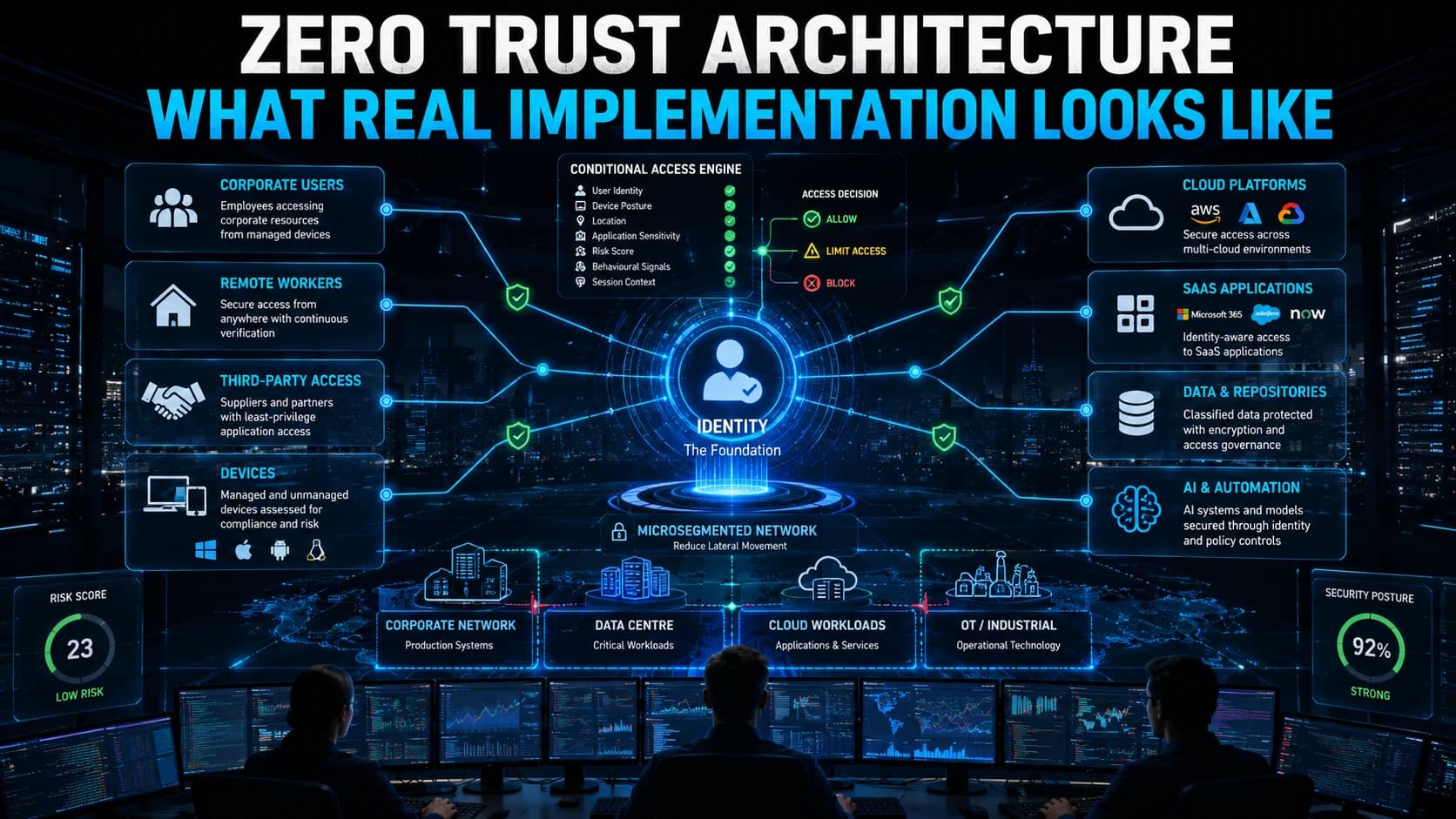
Every access request is evaluated using multiple contextual factors. These may include identity, device posture, location, behavioural indicators, application sensitivity, session risk, access history, and data classification. Trust becomes dynamic rather than permanent. Access becomes conditional rather than assumed. Verification becomes continuous rather than occasional.
The objective is not to make access more difficult. The objective is to make security decisions more intelligent.
Three principles underpin most mature Zero Trust architectures:
Verify Explicitly
Every access request should be authenticated and authorised using all available context rather than relying on assumptions about network location.
Use Least Privilege Access
Users, applications, and services should receive only the permissions required to perform specific tasks.
Assume Breach
Security architecture should be designed on the assumption that compromise may already exist somewhere within the environment.
Zero Trust is not about distrusting people. It is about removing assumptions from security decision-making.
What Zero Trust Is Not
A common mistake is treating Zero Trust as a product category.
It is not.
Organisations frequently assume that purchasing a new identity platform, deploying multi-factor authentication, implementing a Zero Trust Network Access solution, or adopting a cloud security platform means they have implemented Zero Trust.
These technologies are important.
None of them are Zero Trust on their own.
Microsoft Entra ID, Okta, Zscaler, Netskope, CrowdStrike, Microsoft Defender, Illumio, and similar platforms can all contribute to a Zero Trust strategy. However, they remain technologies supporting an architectural model rather than the model itself.
This distinction matters because organisations that approach Zero Trust as a technology deployment often focus on tool implementation rather than architectural outcomes. The result is frequently a collection of security technologies that fail to fundamentally change how trust decisions are made.
Zero Trust is an operating model.
The technologies support the model.
They are not the model itself.
The Five Foundations of Zero Trust
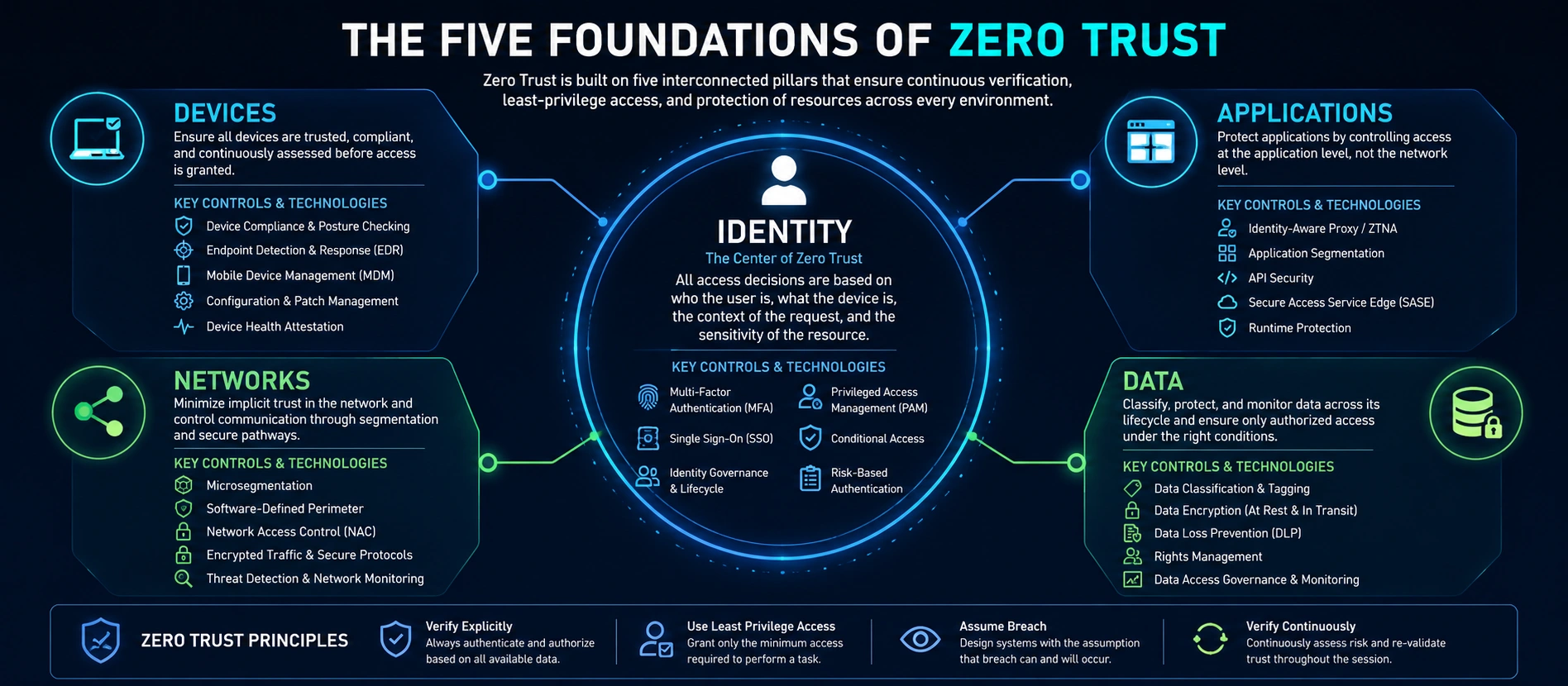
Although implementation approaches vary across industries and organisations, most mature Zero Trust programmes focus on five foundational areas.
Identity
Identity sits at the centre of modern Zero Trust architecture. Users, administrators, contractors, suppliers, service accounts, APIs, applications, and workloads all require identities that can be authenticated, governed, and monitored. Multi-factor authentication, conditional access, privileged access management, identity governance, and Single Sign-On form the foundation of most Zero Trust initiatives because every access decision begins with identity.
Devices
A trusted user operating from a compromised device still represents significant risk. Modern Zero Trust environments therefore evaluate device health continuously before granting access. Factors such as patch status, encryption, endpoint protection, compliance posture, and configuration health increasingly influence access decisions.
Applications
Traditional architectures often expose entire network segments to users who only require access to a small number of applications. Zero Trust shifts the focus towards protecting applications directly. Users receive access to specific applications rather than broad network connectivity, reducing attack surface and limiting opportunities for lateral movement.
Networks
Networks remain important but their role changes significantly. Rather than acting as primary trust boundaries, they become mechanisms for segmentation, monitoring, and traffic control. Microsegmentation helps restrict unnecessary communication paths and reduces the impact of compromise by limiting attacker movement.
Data
Ultimately, security programmes exist to protect information. Data classification, encryption, rights management, monitoring, and governance become essential components of a mature Zero Trust strategy. The objective is ensuring sensitive information remains protected regardless of where it resides or how it is accessed.
What Real Implementation Looks Like
One of the biggest misconceptions surrounding Zero Trust is the belief that implementation occurs through a single project. In reality, most organisations implement Zero Trust gradually over multiple years.
Identity controls are usually strengthened first because identity represents the foundation upon which most other controls depend. Multi-factor authentication becomes mandatory. Single Sign-On adoption expands. Privileged access management programmes mature. Conditional access policies become increasingly sophisticated.
Device management capabilities then improve. Organisations gain greater visibility into endpoint health, compliance status, and security posture. Access decisions begin incorporating both user identity and device trustworthiness.
Application access models evolve over time. Legacy VPN architectures are progressively replaced by application-centric access approaches. Users gain access to specific resources rather than broad network connectivity. Segmentation initiatives begin reducing unnecessary trust relationships across the environment.
Monitoring capabilities expand. Governance processes mature. Asset inventories become more accurate. Access reviews become routine. Security operations teams gain greater visibility into user behaviour and access patterns.
The journey is incremental rather than revolutionary.
Most mature implementations require years rather than months.
Organisations do not become Zero Trust overnight. They become progressively less dependent on implicit trust.
Why Many Zero Trust Programmes Fail
Technology rarely causes Zero Trust initiatives to fail.
People do.
Employees resist additional authentication requirements. Application owners resist access restrictions. Business units challenge implementation timelines. Suppliers struggle to meet new security expectations. Executives question investment priorities. Security teams themselves often require new skills, processes, and operating models.
Successful Zero Trust programmes therefore depend as much on governance, stakeholder engagement, communication, and organisational change management as they do on technology.
Many initiatives fail because organisations underestimate the scale of cultural change required. They focus heavily on tools while paying insufficient attention to business processes, user experience, and organisational adoption.
Zero Trust affects how people work.
That reality cannot be ignored.
Most Zero Trust failures occur long before technology is deployed. They begin when organisations underestimate the organisational change required.
Why Zero Trust Is Becoming a Business Requirement
The conversation around Zero Trust has changed significantly over the past decade. When the concept first emerged, many organisations viewed it as an ambitious security model suitable primarily for highly regulated sectors, government agencies, or large technology companies with mature security capabilities.
That is no longer the case.
Cloud adoption has dissolved traditional network boundaries. Hybrid working has extended access beyond corporate offices. Third-party suppliers require deeper integration with internal systems. Artificial intelligence platforms increasingly process sensitive information. Modern organisations operate across environments fundamentally different from those traditional perimeter security was designed to protect.
At the same time, attackers have adapted.
Many of the most damaging breaches in recent years have relied not on sophisticated malware but on compromised credentials, excessive privileges, weak identity controls, poor segmentation, and unrestricted lateral movement after initial access.
These are precisely the risks Zero Trust seeks to address.
The organisations achieving the greatest success are not attempting to implement every control simultaneously. They are taking structured, risk-based approaches that align security improvements with business priorities. They strengthen identity controls, reduce unnecessary access, segment critical systems, improve visibility, and continuously verify trust decisions.
Most importantly, they recognise that Zero Trust is not a technology deployment.
It is an operating model for managing trust in modern digital environments.
Technology supports the model.
Governance enables the model.
People operate the model.
The Future of Enterprise Security
As digital transformation continues to accelerate, the assumptions that once supported traditional security architecture continue to weaken. Cloud platforms, SaaS applications, hybrid working models, supplier ecosystems, artificial intelligence systems, and identity-based attacks are reshaping how organisations operate and how attackers gain access.
Against this backdrop, Zero Trust is increasingly becoming less of a cybersecurity initiative and more of a business resilience strategy.
The question is no longer whether organisations should move towards Zero Trust principles.
The question is how quickly they can reduce dependence on implicit trust before those assumptions become their greatest security vulnerability.
The organisations building the most resilient security architectures today are not rebuilding the perimeter.
They are redesigning how trust is established, verified, monitored, and enforced across the enterprise.
Zero Trust is not an attempt to restore a security model that no longer exists.
It is an acknowledgement that modern organisations no longer have a perimeter to defend.
They have trust decisions to manage.
And managing those decisions effectively is rapidly becoming one of the most important cybersecurity capabilities of the modern enterprise.
Ready to go deeper?
Professional Training
Hands-on, mentor-led training aligned with industry certifications.
About the Author
Sharper every day
Daily tutorials, analysis, and career playbooks across all 12 Xcademia disciplines, straight to your inbox. No spam.