Best AI Courses for Working Professionals in 2026
A practical 2026 guide to the best AI courses for working professionals across finance, legal, healthcare, marketing, security, and leadership.
Not for developers. Not for researchers. For everyone else.
Most AI course guides are written for one of two people: the software developer who wants to build AI systems, or the data scientist who wants to train machine learning models. If you are neither of those things, if you are a project manager, a finance director, a marketing lead, a compliance officer, a nurse, a lawyer, or any other working professional whose job is not to build AI but to work alongside it, most of what has been written is not for you.
In 2026, AI literacy is no longer optional for professionals in any sector. The question is not whether AI will affect your work. It already has. The question is whether you have the structured understanding to use it effectively, evaluate it critically, and stay ahead of the colleagues who are already compounding their advantage with it.
The biggest mistake professionals make with AI training is choosing courses designed for technologists when what they actually need is courses designed for practitioners in their discipline. The skills are different. The application is different. The ROI is different.
Before You Choose: Three Questions That Matter
Not all AI courses are created equal, and the volume of AI training content produced since 2023 has made the quality gap between good programmes and performative ones genuinely difficult to navigate. Before you invest time and money, answer three questions.
(1) Is it built for your role or for a generic audience?
A prompt engineering course built for marketing professionals is a fundamentally different product from one built for software developers, even if both use the same terminology. The examples, the application context, the failure modes, and the career outcomes are all different. A course that does not know who you are cannot effectively serve where you are going.
(2) Does it focus on application or just concepts?
Understanding what a large language model is does not make you capable of using one professionally. Application-focused training gives you practised skills with real tools against realistic scenarios in your domain. Concept-focused training gives you vocabulary. Both have value. At this stage of AI adoption, application is the priority.
(3) Does it have evidence of outcomes?
The best AI training programmes for professionals produce something tangible: a workflow you have rebuilt, a process you have improved, a capability you can demonstrate. If the course ends with a certificate of completion and nothing you can show for it, interrogate whether it has genuinely transferred capability or just transferred information.
AI training that does not change how you work on Monday morning is not training. It is a consumption. The courses worth your time are the ones that produce a different version of your professional practice.
The Courses Worth Your Time in 2026
What follows is an honest, structured guide to the AI training landscape for working professionals. It covers the category each course serves, who it is genuinely built for, what it actually develops, and what you will be able to do differently after completing it.
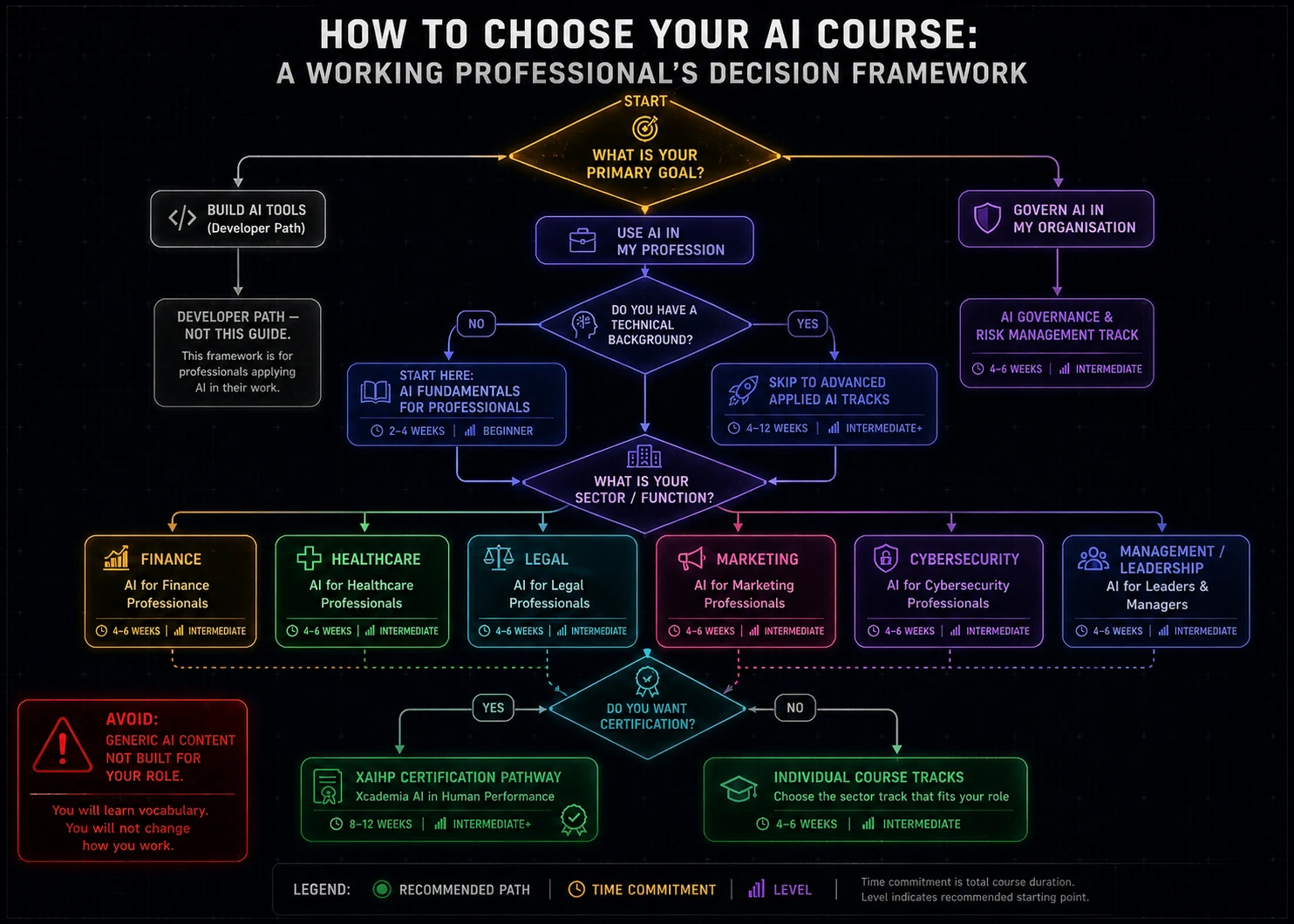
This is not a ranked list. There is no single best AI course for all professionals. The right course depends entirely on your role, your sector, and what you need to be able to do. The structure below is designed to help you locate your category and make an informed decision within it.
Category 1: AI Foundations for Non-Technical Professionals
If you have no AI background and need to build a working understanding before applying it, this is where you start. Not coding. Not mathematics. Concepts, vocabulary, decision-making frameworks, and practical familiarization.
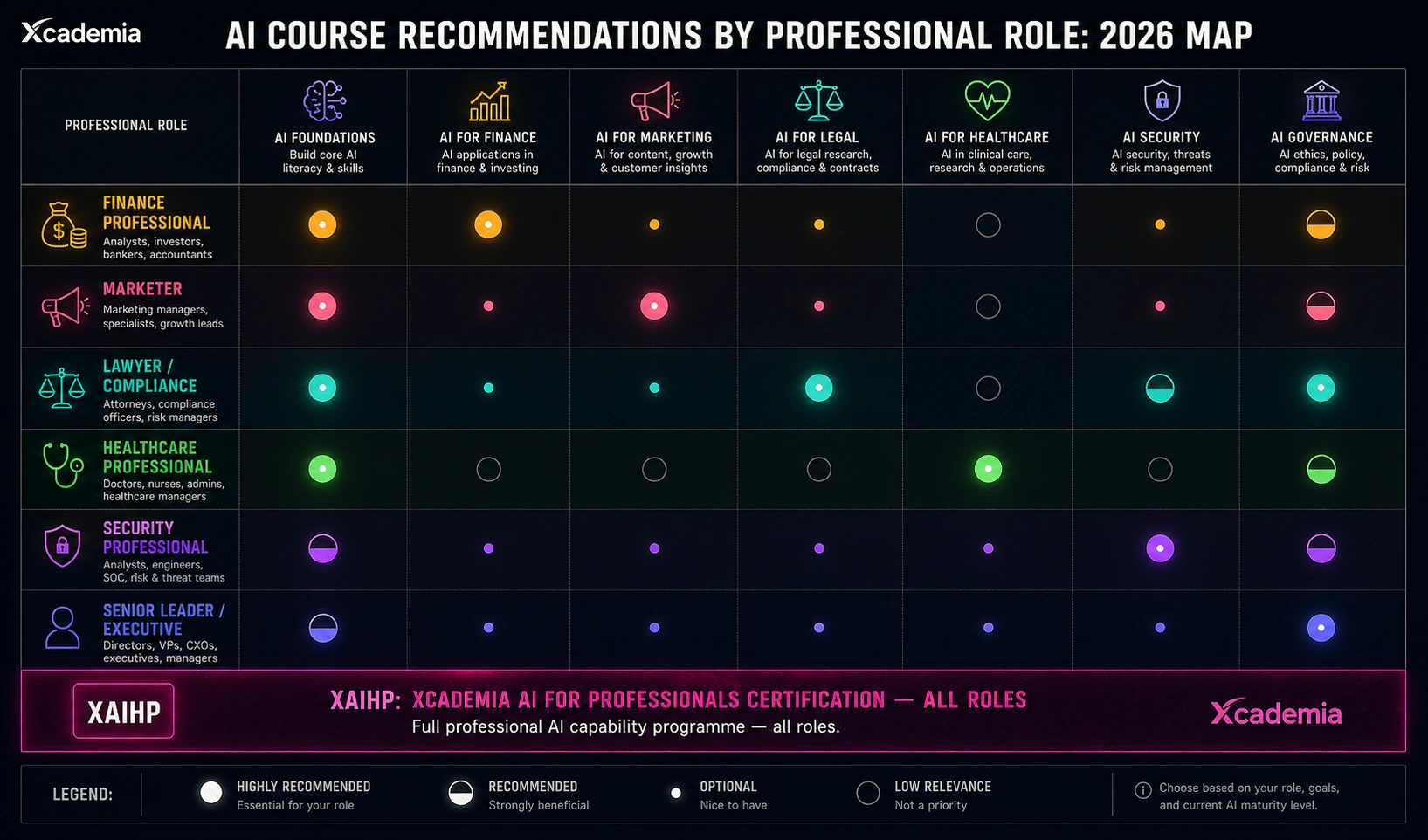
01 | Generative AI for Business Professionals FOUNDATION WHO: Managers, team leads, consultants, and senior individual contributors in any non-technical role who need to use AI tools confidently and evaluate AI outputs critically. COVERS: What generative AI is and how it works at a non-technical level. Prompt design for professional tasks: writing, analysis, research, decision support. Recognising and managing AI failure modes. Evaluating AI vendor claims. Integrating AI tools into existing workflows without disruption. OUTCOME: You use AI tools purposefully and productively. You can distinguish good AI output from confident-sounding wrong output. You have rebuilt at least one workflow using AI assistance. |
02 | AI Literacy: Understanding the Technology Transforming Your Industry FOUNDATION WHO: Executives, board members, and senior leaders who need strategic AI literacy without technical depth. C-suite, directors, and senior managers. COVERS: The AI landscape: what is real, what is hype, and how to tell the difference. AI's impact on your specific sector. Governance, risk, and ethical considerations at leadership level. How to evaluate AI investment proposals. The questions every leader should be asking their AI vendors. OUTCOME: You lead AI-related decisions from an informed position. You can challenge vendor claims, set realistic expectations, and ask the right questions of your technical teams. |
Category 2: Applied AI for Specific Professions
These courses take AI capability and apply it directly within a professional domain. The examples are from your sector. The tools are the ones you will actually use. The outcomes are specific to your role.
03 | AI for Finance and Accounting Professionals PRACTITIONER WHO: Finance managers, FP&A analysts, accountants, CFOs, and finance business partners who need to apply AI to financial workflows. COVERS: AI-assisted financial modelling and scenario analysis. Automated reporting and variance analysis. AI tools for FP&A workflows. Fraud detection patterns and AI-assisted monitoring. Regulatory implications of AI in financial reporting. Prompt engineering for financial analysis tasks. OUTCOME: You have rebuilt a reporting or analysis workflow using AI tools. You can evaluate AI-generated financial outputs for accuracy and reliability. You understand where AI adds genuine value and where human judgement is non-negotiable. |
04 | AI for Marketing and Communications Professionals PRACTITIONER WHO: Marketing managers, content leads, brand directors, copywriters, social media managers, and communications professionals. COVERS: Generative AI for content creation, campaign ideation, and personalisation at scale. AI-assisted audience research and segmentation. Prompt engineering for marketing copy and creative briefs. AI tools for SEO, paid media, and email automation. Brand voice consistency in AI-generated content. AI content quality evaluation and editing. OUTCOME: You have integrated AI tools into your content and campaign production workflow. You produce higher volume, higher quality output in significantly less time. You understand the authenticity and IP risks of AI-generated content. |
05 | AI for Legal and Compliance Professionals PRACTITIONER WHO: Lawyers, paralegals, compliance officers, risk managers, and legal operations professionals. COVERS: AI-assisted contract review and drafting. Legal research augmentation with AI tools. Document summarisation for due diligence. Compliance monitoring using AI pattern recognition. The hallucination risk in legal AI: where verification is non-negotiable. Data protection and confidentiality considerations in legal AI use. OUTCOME: You have applied AI to at least one legal or compliance workflow. You can critically evaluate AI-generated legal content for accuracy and reliability. You understand the professional responsibility implications of AI use in legal practice. |
06 | AI for Healthcare and Clinical Professionals PRACTITIONER WHO: Clinicians, nurses, healthcare managers, medical administrators, and allied health professionals. COVERS: AI in clinical decision support: what it can and cannot do. AI-assisted documentation and administrative burden reduction. Understanding AI diagnostic tools: how to evaluate claims and limitations. Patient communication and AI. Healthcare data and AI governance. Regulatory and ethical frameworks for AI in clinical settings. OUTCOME: You have a working understanding of where AI can reduce administrative burden in clinical settings. You can evaluate AI clinical tool claims critically. You understand the governance and safety requirements for AI use in healthcare. |
Category 3: AI Skills for Cybersecurity Professionals
Cybersecurity is the sector where AI proficiency is most urgently needed from both directions: understanding how AI is being used to attack, and knowing how to use AI to defend.
07 | AI Security: Defending AI Systems and Using AI for Defence SENIOR WHO: Security analysts, SOC professionals, security architects, and GRC leads who need to understand AI-specific threats and AI-enabled defensive tools. COVERS: AI-powered attack techniques: what they are and how they work. Adversarial machine learning and how it undermines AI-based security tools. Detecting AI-generated phishing, deepfakes, and synthetic content. Using AI for threat detection, anomaly monitoring, and incident response augmentation. AI governance and risk for security teams. OUTCOME: You can assess AI-specific risks in your organisation's security posture. You can evaluate AI security tools critically. You understand what threat actors are doing with AI and how to adapt your defensive strategy. |
Category 4: AI Governance, Ethics, and Responsible Deployment
As AI embeds into organisational operations, the professionals who understand how to govern it responsibly are in acute demand. This is not a technical role. It is a leadership and governance role.
08 | AI Governance for Business Leaders SENIOR WHO: Risk managers, compliance directors, legal counsel, board members, and senior leaders responsible for AI oversight and policy. COVERS: The global AI regulatory landscape: EU AI Act, UK AI framework, and emerging international standards. Building an AI governance framework for your organisation. AI risk assessment methodologies. Data governance and AI. Ethical AI principles in practice. Accountability structures for AI decision-making. OUTCOME: You can build or evaluate an AI governance framework for your organisation. You understand your regulatory obligations under emerging AI legislation. You can set meaningful AI policies that your organisation can actually follow. |
09 | XAIHP: Xcademia AI for Professionals Certification XCADEMIA ORIGINAL WHO: Professionals in any sector who want a structured, practitioner-assessed AI capability programme with verifiable certification. Suitable for individuals at Practitioner to Senior career stage who want to demonstrate genuine AI literacy. COVERS: Covers the full professional AI capability spectrum: generative AI principles and applications, prompt engineering for professional tasks, AI workflow integration, AI governance and responsible use, sector-specific AI application, AI output evaluation and quality control, and applied project work demonstrating real capability. OUTCOME: A verifiable Xcademia certification demonstrating practitioner-level AI capability. Assessed by a senior Xcademia practitioner. No MCQ exam. Portfolio of applied work produced during the programme. Verifiable at xcademia.com/verify. |
What to Look for in Any AI Training Provider
The AI training market has expanded faster than quality assurance has kept pace. These are the signals that distinguish genuine professional development from content dressed as training.
Domain-first delivery: Instructors with domain expertise, not just AI expertise. An AI course for lawyers taught by a lawyer who uses AI is a different product from the same course taught by an AI engineer who has read about legal work.
Hands-on application: Applied scenarios using tools you will actually use in your role. Not demonstrations. Not theoretical examples. Hands-on practice with realistic professional contexts.
Failure mode coverage: Explicit coverage of AI failure modes, hallucination risks, and when not to use AI. Any course that only shows you what AI can do without teaching you where it fails is incomplete and potentially dangerous.
Evidenced outcomes: A tangible output you can reference after the programme: a rebuilt workflow, a policy document, a process analysis, a portfolio piece. Not just a certificate.
Governance context: Structured coverage of governance and professional responsibility. In every regulated profession, understanding your obligations around AI use is not optional.
The best AI training for working professionals looks less like a university lecture and more like a guided practitioner session: real tools, real scenarios, real feedback, real outputs. If you leave the room with only notes, the programme did not go far enough.
The Right Time to Start
There is a version of this decision that many professionals are still having: whether now is the right time to invest in AI training or whether to wait until the technology settles.
That decision has a cost. Every month spent waiting is a month in which colleagues who are engaging with this technology are compounding an advantage. The models being used today are not the ceiling; they are the floor. The capability gap between professionals who are building structured AI literacy now and those who are waiting will be wider in twelve months than it is today, not narrower.
The professionals who will lead their organisations through the next five years of AI adoption are being built right now, in the training rooms and practitioner sessions where people are doing the work of integrating this technology into real professional practice.
Every professional who says "I will look at AI when it settles down" is making a career decision. The technology will not settle. The professionals who wait for certainty before acting will find the gap has moved too far to close quickly.
Ready to go deeper?
Professional Training
Hands-on, mentor-led training aligned with industry certifications.
About the Author
Sharper every day
Daily tutorials, analysis, and career playbooks across all 12 Xcademia disciplines, straight to your inbox. No spam.