
What Is Generative AI? A Plain-English Guide
Generative AI is transforming how professionals work, create, and decide. This plain-English guide explains what it is, how it works, what it can and cannot do, and why AI literacy is now essential for using it effectively, critically, and responsibly.
What Is Generative AI?
A Plain-English Guide for Professionals
In late 2022, a piece of software answered a question better than most humans in the room. Not a simple question. A complex legal question. A medical question. A question about strategy. It wrote the answer in clear, fluent prose. It explained its reasoning. It did it in seconds.
That was the moment the professional world had to start paying attention to generative AI. Not because it was perfect. It was not. But because the gap between what it could do and what most professionals expected it to do was so wide that it forced a reappraisal.
If you are a professional who has been meaning to understand this technology properly and has not yet found a clear, jargon-free explanation, this is that article. No mathematics. No research papers. No assumption that you know what a parameter is.
Generative AI is not a chatbot. It is not a search engine. It is not magic. Understanding what it actually is changes how you evaluate it, use it, and protect yourself from its limitations. Let Us Start With What Generative AI Is Not
Before the definition, the corrections. Most people approaching generative AI for the first time carry one of three misconceptions, and each one distorts how they engage with the technology.
It is not a database
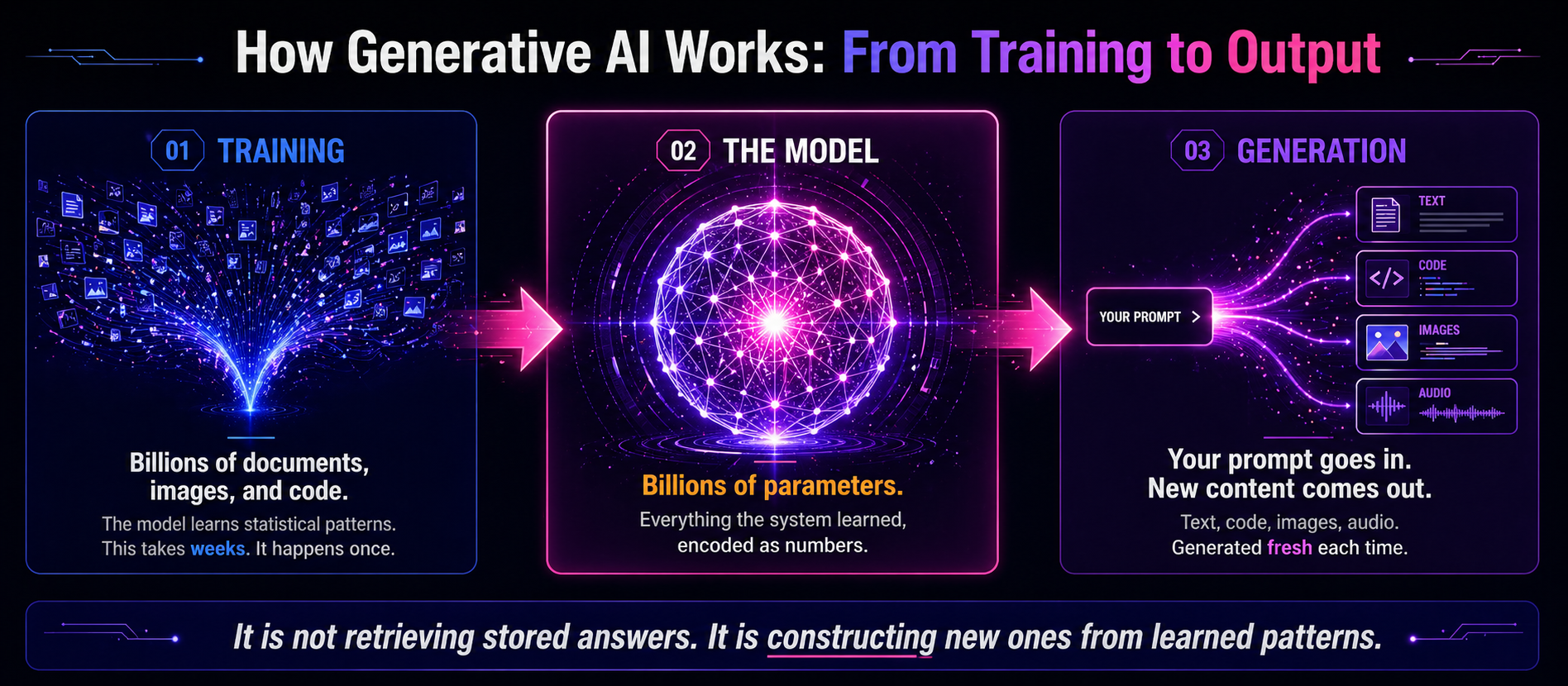
A database stores information and retrieves it when you query it. Generative AI does not retrieve stored answers. It generates new responses based on patterns learned during training. This is why it can answer questions about things that have never been asked before, and also why it can be confidently wrong. It is not looking something up. It is constructing an answer.
It is not thinking
Generative AI does not reason, understand, or think in any meaningful sense. It predicts. Given an input, it calculates what output is most likely to be appropriate based on patterns in its training data. It is extraordinarily good at this prediction task. It is not doing anything that resembles human cognition.
It is not a replacement for expertise
Generative AI produces outputs that look like the work of experts. That appearance of expertise is the source of both its usefulness and its danger. It can generate a legal clause that looks correct and is subtly wrong. It can produce a financial analysis that sounds rigorous and contains an error in its reasoning. The output always needs evaluation by someone who knows the subject.
So What Is It?
Generative AI is a category of artificial intelligence model that creates new content — text, images, code, audio, video, or other structured data — by learning patterns from vast amounts of existing content.
The key word is generative. Unlike traditional AI systems that classify, sort, or predict using fixed rules, generative AI produces original outputs that did not exist before the request was made.
How it learns
During a training process, a generative AI model is exposed to enormous quantities of data: billions of documents, images, code repositories, conversations, and more. Through this exposure, the model learns statistical relationships — what kinds of words tend to follow other words, what kinds of images tend to contain certain features, what code patterns tend to solve certain problems.
This training process requires extraordinary computational resources and takes weeks or months. The result is a model: a mathematical structure containing billions of parameters that encode everything the system has learned.
How it generates
When you give a generative AI model an input, called a prompt, it uses those learned patterns to calculate the most probable and appropriate output. For a language model, this means predicting, word by word, what response best matches the context of your request. The result is text that reads as if a human wrote it, because it was assembled using patterns learned from human-written text.
This is not magic. It is sophisticated pattern matching at a scale and speed that no human could replicate.
The Models That Matter: A Plain-English Map
Generative AI is not one thing. It is a family of model types, each built for a different kind of output. Understanding which model does what removes most of the confusion that professionals encounter when trying to apply this technology.
Large Language Models (LLMs)
These are the most widely deployed generative AI systems in professional settings. GPT-4, Claude, Gemini, and Llama are all large language models. They are trained primarily on text and produce text outputs: answers, summaries, drafts, analyses, code, and more. When most professionals talk about AI in the workplace, they are talking about LLMs.
Image generation models
Models like DALL-E, Midjourney, and Stable Diffusion generate images from text descriptions. They learned from billions of images and their associated captions. You describe what you want; the model constructs a novel image matching that description. These are transforming creative, marketing, and design workflows.
Code generation models
GitHub Copilot and similar tools are trained specifically on code repositories. They generate, complete, and explain code. They are accelerating software development significantly, allowing developers to write first drafts of functions in seconds rather than minutes.
Multimodal models
The frontier of generative AI is multimodal: models that can take in and produce multiple types of content simultaneously. A multimodal model can read an image, understand the text in it, and respond in natural language. It can take a voice input and produce a written analysis. The boundary between content types is dissolving.
The models that exist today are not the ceiling. They are the floor. The professional implications of models two or three generations ahead are not yet imaginable. What Generative AI Can Do for Professionals Right Now
The gap between what generative AI can do and what most professionals are using it for is significant. The following is not a list of futuristic capabilities. These are things that work today, in professional settings, when applied by someone who understands how to use them.
Writing and communication
First drafts of reports, proposals, briefings, and presentations
Summarising long documents into executive-level outputs
Translating technical content into language a non-technical audience can act on
Structuring arguments and identifying gaps in reasoning
Analysis and research
Synthesising information from multiple sources into structured summaries
Identifying patterns and themes across large bodies of text
Generating hypotheses and testing them against provided data
Drafting questions for research, interviews, or stakeholder engagement
Code and technical work
Writing first drafts of scripts, functions, and automation routines
Debugging and explaining existing code
Translating between programming languages
Generating test cases and documentation
Decision support
Scenario modelling: given these assumptions, what are the likely outcomes?
Risk identification: what have we not considered?
Comparative analysis: here are three options, evaluate them against these criteria
Generative AI does not replace the professional's judgement. It accelerates the work that precedes the judgement. The human still makes the call. 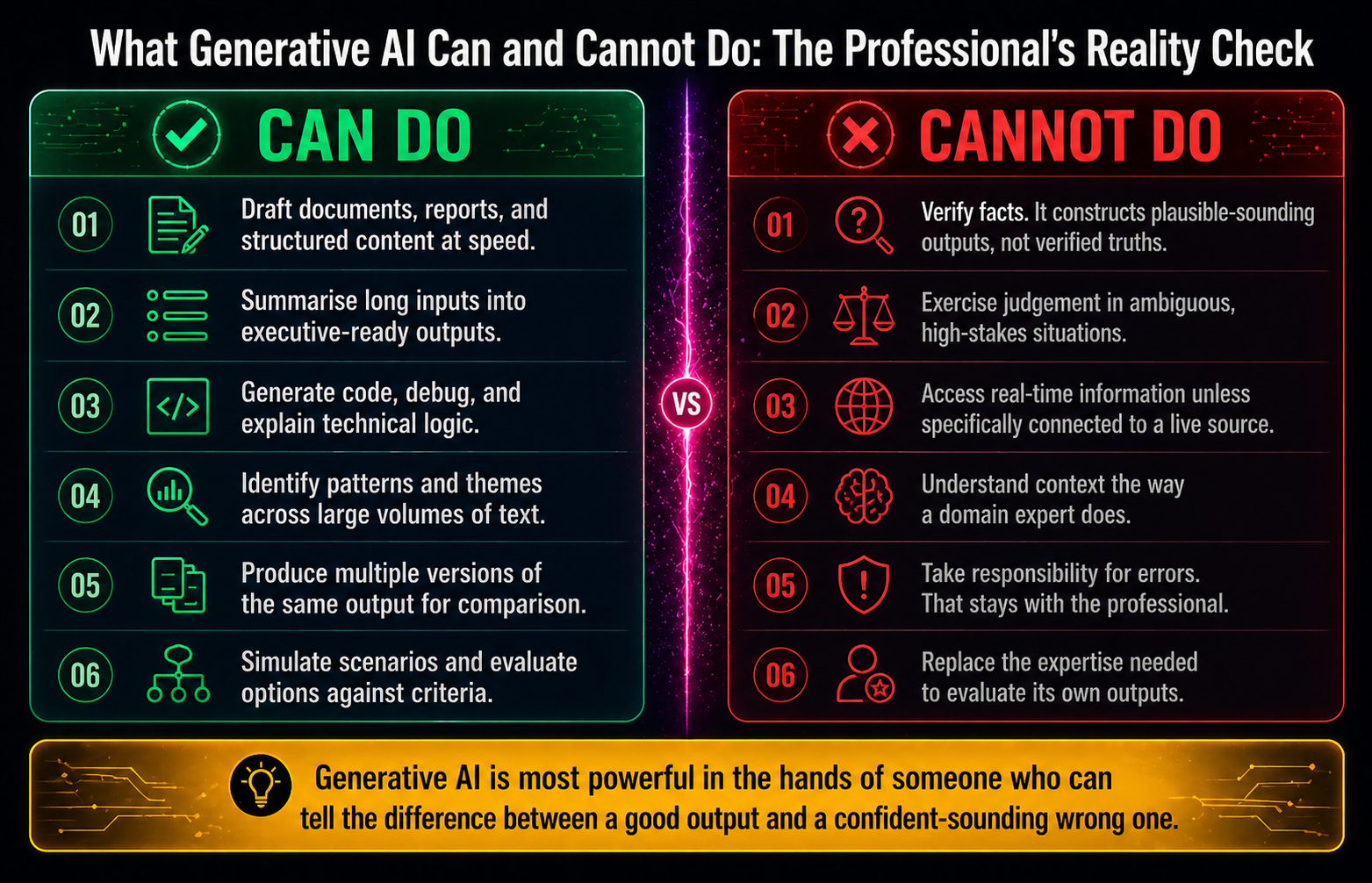
Why Every Professional Needs to Understand This Now
You do not need to build AI systems. You do not need to write code. You do not need to understand the mathematics of neural networks. But you do need to understand what this technology is capable of, what it is not capable of, and what it means for the work you do and the sector you operate in.
72% of enterprises actively deploying AI by 2025 (McKinsey Global Survey) | 4x productivity gain reported by professionals using AI effectively vs not | 1 in 3 professional tasks significantly automatable by current LLMs (MIT/Stanford research) |
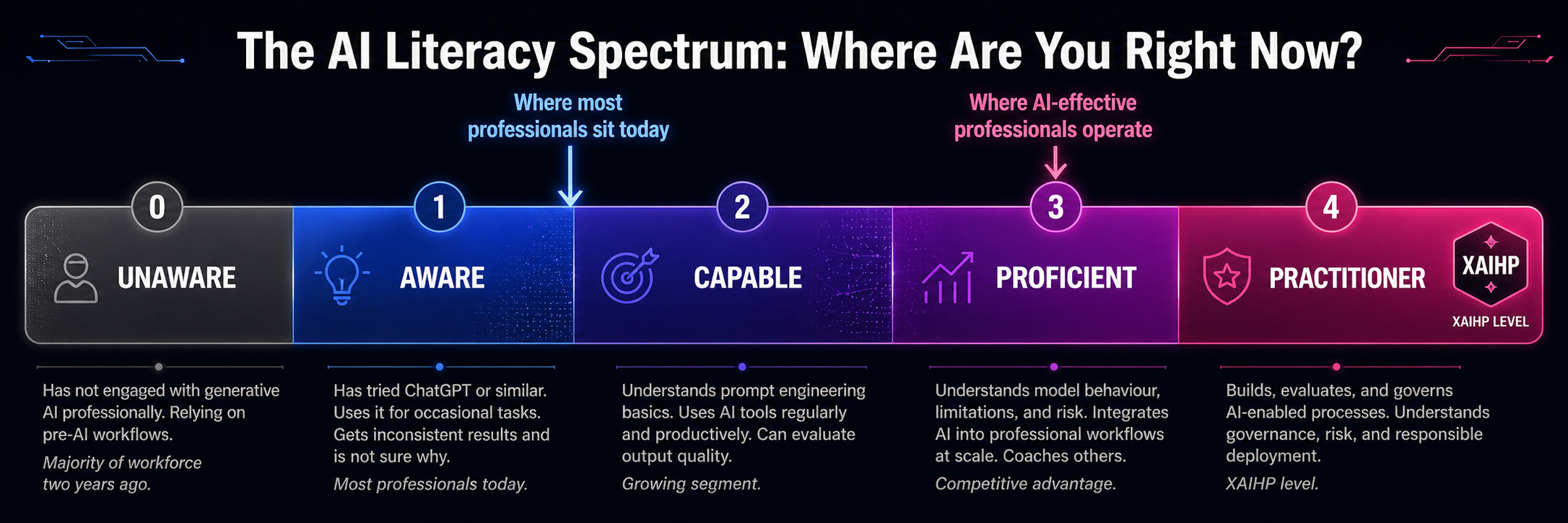
The professionals who are struggling with generative AI share a common characteristic. They are using the tools without understanding the principles. They get inconsistent results and cannot diagnose why. They accept outputs without the framework to evaluate whether they are correct.
The professionals who are thriving share a different characteristic. They understand what the models are doing well enough to direct them precisely. They know when to trust the output and when to challenge it. They use AI to do in two hours what previously took two days, and they use the time saved to do the work that the model cannot.
AI literacy is not about knowing how to use a chatbot. It is about understanding the technology well enough to direct it, evaluate its outputs, and know its limits. That is a professional skill with a real market value. The Risk of Not Understanding It
There is a professional risk to misunderstanding generative AI in either direction.
Overestimating it
The professional who treats AI output as authoritative without evaluation is the one who submits the hallucinated legal citation, the incorrect financial figure, the subtly wrong technical specification. The AI produced something that looked correct. The professional did not have the foundation to catch the error. The consequences are theirs to carry.
Underestimating it
The professional who dismisses generative AI as a gimmick or a threat and refuses to engage with it is building a capability gap in real time. Every month they delay, the colleagues who are using these tools effectively are compounding their advantage. This is not a technology that will plateau and wait. The models being deployed today are the least capable versions that will ever exist.
The professionals who will lead in the next decade are the ones who learned to use these tools precisely, not the ones who used them blindly or avoided them entirely.
The Sector-by-Sector Reality
Generative AI is not arriving uniformly. It is hitting different sectors at different speeds and in different ways. Understanding where your sector sits is the starting point for understanding what you need to do.
Financial services
Document processing, regulatory reporting, client communication, fraud narrative analysis, and investment research synthesis are all active use cases. Compliance teams are using AI to monitor communications. The risk is in unsupervised AI output entering regulated processes without appropriate review.
Legal and professional services
Contract drafting, due diligence summarisation, legal research, and document review are being transformed. The billable hour model is under pressure in ways that have not been seen since the arrival of word processing. Firms that integrate effectively will compress turnaround times significantly.
Healthcare
Clinical documentation, patient communication, medical literature synthesis, and administrative processing are significant early application areas. The regulatory and liability environment means adoption is cautious, but the pressure from administrative burden is making AI integration a near-term operational necessity.
Technology and engineering
Code generation, technical documentation, system design support, and testing are already standard in many engineering organisations. The productivity gains for developers using AI coding tools are among the most empirically documented effects of generative AI deployment to date.
Marketing and communications
Content creation, campaign ideation, audience segmentation, and personalisation at scale are active use cases. The creative industries are navigating the intellectual property and authenticity questions that commercial AI deployment raises.
Building Genuine AI Literacy
Understanding generative AI at a conceptual level is the starting point. It is not the destination.
The professionals who use these tools most effectively have invested in structured learning that goes beyond experimentation. They understand prompt engineering: how to frame requests to get reliable, high-quality outputs. They understand the failure modes: when AI is likely to hallucinate, when it is likely to be confidently wrong, when its outputs need the most rigorous scrutiny.
They understand the governance questions: who is responsible for AI-generated outputs in their organisation, what review processes are appropriate, what regulatory frameworks apply to AI use in their sector.
And they understand the strategic dimension: not just how to use the tools, but how to evaluate which tools to use, how to assess AI vendor claims critically, and how to build AI-capable teams.
AI literacy at this level is not a nice-to-have. It is a professional competency with a measurable impact on performance, career trajectory, and organisational effectiveness. The Bottom Line
Generative AI is a category of AI that creates new content by learning patterns from existing content. It is not thinking. It is not retrieving. It is constructing, word by word, image by image, line of code by line of code, based on what the model has learned is most likely to be appropriate.
It is already transforming professional work across every sector. The professionals who understand it precisely will use it to compound their advantage. The ones who engage with it uncritically will carry the errors it produces. The ones who avoid it will watch the gap grow.
The question is not whether generative AI is relevant to your work. It is. The question is whether you understand it well enough to use it effectively, evaluate it rigorously, and govern it responsibly.
The professional who understands this technology is not threatened by it. They are amplified by it. Ready to go deeper?
Professional Training
Hands-on, mentor-led training aligned with industry certifications.
About the Author
Get weekly insights
Fresh articles on cybersecurity, AI, and leadership delivered to your inbox.