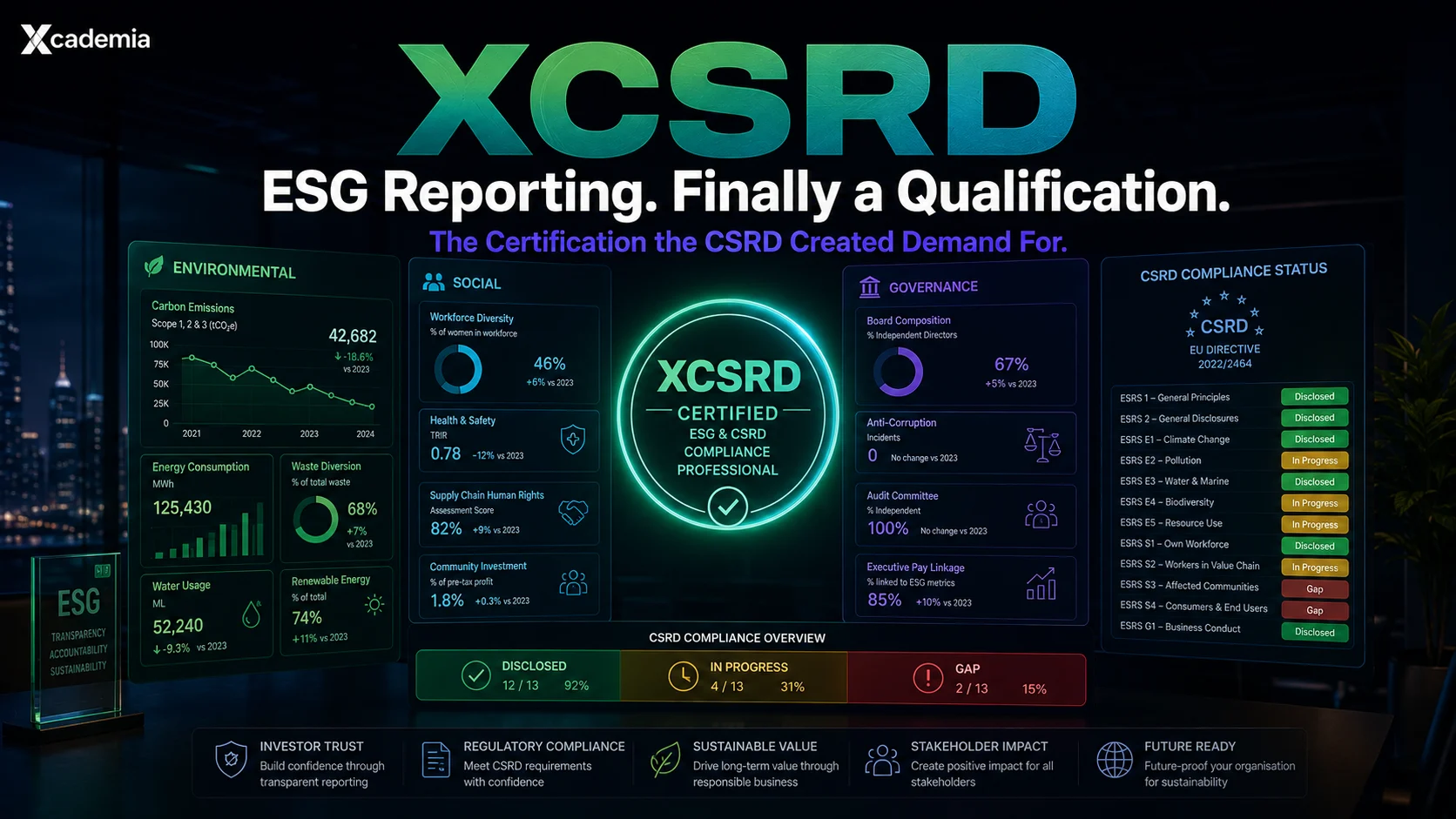
XCSRD
The Corporate Sustainability Reporting Directive created a major compliance skills gap with no dedicated practitioner pathway. XCSRD covers ESRS disclosure, double materiality assessment, value chain reporting, and assurance readiness for the new ESG reporting era.
The ESG and CSRD Compliance Certification Nobody Else Has Built Yet
The Corporate Sustainability Reporting Directive came into force for large listed EU companies in January 2024. In 2025 it extended to large non-listed companies. In 2026 it reaches small and medium-sized listed companies and, through supply chain obligations, effectively touches every significant organisation that supplies EU-regulated entities. The CSRD has created, overnight, a category of compliance professional that barely existed three years ago.
The challenge is that there is no established certification pathway for CSRD compliance practitioners. The people currently doing this work are GDPR specialists who have pivoted, sustainability consultants who have learned accounting, and accountants who have learned sustainability. None of them were trained specifically for the CSRD. None of them hold a recognised qualification in CSRD compliance practice.
XCSRD is Xcademia's answer to that gap.
The CSRD created a compliance obligation that affected companies are scrambling to meet. The skills required to meet it: non-financial reporting standards (ESRS), double materiality assessment, value chain data collection, audit readiness, and board-level ESG governance. These are not skills any existing certification programme specifically develops. XCSRD was built for this moment.
What the CSRD Actually Requires
Understanding the scope of the CSRD is the starting point for understanding why XCSRD exists.
European Sustainability Reporting Standards (ESRS)
The CSRD requires in-scope companies to report against the European Sustainability Reporting Standards, a set of sector-agnostic and sector-specific reporting standards published by EFRAG. The cross-cutting ESRS standards cover general requirements, general disclosures, climate change, pollution, water and marine resources, biodiversity and ecosystems, resource use and circular economy, workforce, workers in the value chain, affected communities, consumers, and business conduct.
Each standard has specific disclosure requirements: qualitative narrative disclosures and quantitative data points. The volume of required disclosure is substantially greater than voluntary ESG reporting under GRI or SASB frameworks. For the first time, sustainability disclosure is regulated, mandated, and subject to third-party verification.
Double materiality assessment
The CSRD requires companies to conduct a double materiality assessment: assessing both financial materiality (how sustainability factors affect the company's financial performance) and impact materiality (how the company's activities affect people and the environment). This dual assessment is a significant analytical exercise that requires specific methodology, stakeholder engagement, and documentation.
Value chain disclosure
The CSRD requires disclosure not just of the company's own activities but of significant sustainability impacts, risks, and opportunities across the value chain: upstream suppliers and downstream customers and users. This makes the CSRD a supply chain obligation as much as a reporting obligation.
Assurance requirements
CSRD sustainability reports require limited assurance from an independent auditor, transitioning to reasonable assurance as the framework matures. This is the first time non-financial reporting in the EU has carried mandatory audit requirements, creating demand for CSRD-competent auditors and internal audit professionals.
The CSRD is not a voluntary ESG reporting initiative that companies can approach at their own pace. It is a legal obligation with penalties for non-compliance and mandatory external assurance. The organisations that treat it as an enhanced version of their existing sustainability report are the ones that will fail their first assurance review.
Why No Existing Certification Covers This
GRI and SASB certifications
The Global Reporting Initiative and SASB have established reporting frameworks and associated training programmes. GRI has a broad practitioner community. However, the ESRS standards that the CSRD requires disclosure against are distinct from GRI and SASB frameworks, with different requirements, different scope boundaries, and different materiality assessment methodology. GRI training prepares practitioners for voluntary GRI reporting, not CSRD compliance.
TCFD and climate-focused certifications
The Task Force on Climate-related Financial Disclosures underpins climate disclosure requirements within CSRD, but CSRD scope extends far beyond climate into all E, S, and G dimensions. TCFD-focused qualifications address one component of a much larger compliance obligation.
Accounting and audit qualifications
ACCA, ICAEW, and CIMA have sustainability reporting elements in their curricula. None specifically address CSRD compliance methodology: double materiality assessment, ESRS disclosure requirements, value chain data collection architecture, and the operational process of building a CSRD-compliant reporting cycle.
The result is a market where every organisation subject to CSRD is trying to build capability from scratch, with professionals who have adjacent skills but no specific CSRD training pathway to follow.
The compliance professional who specifically knows how to conduct a double materiality assessment, map disclosures against ESRS requirements, build a data collection process for value chain information, and prepare a report for limited assurance review is in a different category from the one with general ESG knowledge. XCSRD creates and validates that specific capability.
What XCSRD Covers Across Four Days
XCSRD is Xcademia's Corporate Sustainability Reporting Directive compliance practitioner certification. Four instructor-led days. Practitioner-assessed capstone.
Day 1: The CSRD Framework and Regulatory Context
CSRD scope and timeline: Which companies are in scope, when, and what the phased implementation means for supply chain obligations
European Sustainability Reporting Standards (ESRS): The full structure of cross-cutting and topical standards, disclosure requirements, and data points
CSRD vs voluntary frameworks: How CSRD relates to GRI, SASB, TCFD, and UN SDGs, and how existing voluntary reporting can be leveraged
Governance requirements: Board oversight of sustainability, management accountability structures, audit committee involvement
Day 2: Double Materiality Assessment
Double materiality methodology: Understanding and applying the EFRAG guidance on impact materiality and financial materiality
Stakeholder engagement: Who to engage, how to document the process, how to use stakeholder input in the materiality assessment
Materiality matrix construction: Ranking impacts, risks, and opportunities, applying thresholds, documenting the assessment
Practical exercise: Conduct a double materiality assessment for a realistic sector scenario
Day 3: Disclosure Implementation and Data Collection
ESRS disclosure mapping: Mapping a company's activities and impacts against the required ESRS disclosures
Data architecture for CSRD: What data is required, where it lives in the organisation, how to build collection processes for value chain data
Quantitative data points: Understanding the specific metrics required under each ESRS, data quality requirements, estimation methodologies where primary data is not available
Value chain data collection: Supplier engagement strategies, contractual requirements, data aggregation approaches
Day 4: Assurance Readiness and Capstone
Limited assurance requirements: What auditors look for, documentation standards, evidence requirements for each disclosure
Internal controls for sustainability reporting: Control frameworks applied to non-financial data
CSRD report structure and quality: How to structure the sustainability statement, disclosure quality criteria, common errors that fail assurance
Capstone: Produce a CSRD compliance readiness assessment for a realistic organisation, including a double materiality assessment output, a disclosure gap analysis against applicable ESRS, a value chain data collection plan, and an assurance readiness roadmap
The capstone assessment
The XCSRD capstone places candidates as CSRD compliance lead for a realistic mid-market manufacturing organisation with EU operations. They must produce all four capstone deliverables against a realistic company profile and present their readiness assessment to a simulated board sustainability committee. Assessed by a senior Xcademia ESG and sustainability reporting practitioner. Verifiable at xcademia.com/verify.
The XCSRD capstone produces a set of deliverables that the professional can use in their actual work immediately. The double materiality assessment methodology learned here is the same methodology required for real CSRD compliance. The practice is the job.
Who Needs XCSRD
The demand is coming from three directions simultaneously.
From in-scope organisations
Finance directors, sustainability managers, heads of ESG, and internal audit leads at companies subject to CSRD need practitioners who can design and implement the reporting process. These organisations are hiring actively and the supply of specifically-qualified CSRD practitioners is close to zero in 2026.
From professional services firms
The Big Four and mid-market accounting and advisory firms are building CSRD service lines rapidly. They need practitioners with specific CSRD methodology knowledge to deliver client engagements. KPMG, Deloitte, PwC, and EY are all active in this space and all facing the same supply shortage.
From supply chain adjacent organisations
Non-EU companies that supply CSRD-affected EU entities are receiving supplier questionnaires and data requests under the value chain disclosure requirements. Procurement, sustainability, and finance professionals at these organisations need to understand what is being asked of them and how to respond.
XCSRD is the certification for all three groups. The professional who holds it is the one who can do the work rather than describe how it should be done.
The CSRD compliance market is forming right now. The professionals who build this specialism in 2026 are the ones who will be in demand as every in-scope organisation reaches the same realisation at the same time: they need someone who actually knows how to do this. XCSRD was built for that moment.
The Uncontested Position
XCSRD is Xcademia's Phase 4 certification: uncontested territory. There is no equivalent practitioner certification for CSRD compliance from any other awarding body at this stage of the regulation's development. The professionals who complete XCSRD in 2026 hold a credential in a space that has no competitors and genuine, urgent demand.
The market for CSRD compliance expertise is not a future opportunity. It is a present-tense emergency for thousands of organisations that need to be compliant now and do not have the capability to achieve it. XCSRD addresses that gap directly.
The cert gets you in the room. In a room with no other qualified professionals, the cert is the room.
Build CSRD Compliance Capability With XCSRD XCSRD: four instructor-led days covering the full CSRD framework, double materiality assessment, ESRS disclosure implementation, value chain data collection, and assurance readiness. Practitioner-assessed capstone. No MCQ. No renewal. The CSRD compliance certification built for the moment the regulation created. Verifiable at xcademia.com/verify. Explore XCSRD |
|---|
Ready to go deeper?
Professional Training
Hands-on, mentor-led training aligned with industry certifications.
About the Author
Sharper every day
Daily tutorials, analysis, and career playbooks across all 12 Xcademia disciplines, straight to your inbox. No spam.