ITIL 4 vs XITSM
ITIL 4 teaches the language of IT service management. XITSM assesses whether you can apply it in the real world. Compare framework knowledge, operational capability, assessment methods, and career value for ITSM professionals in 2026.
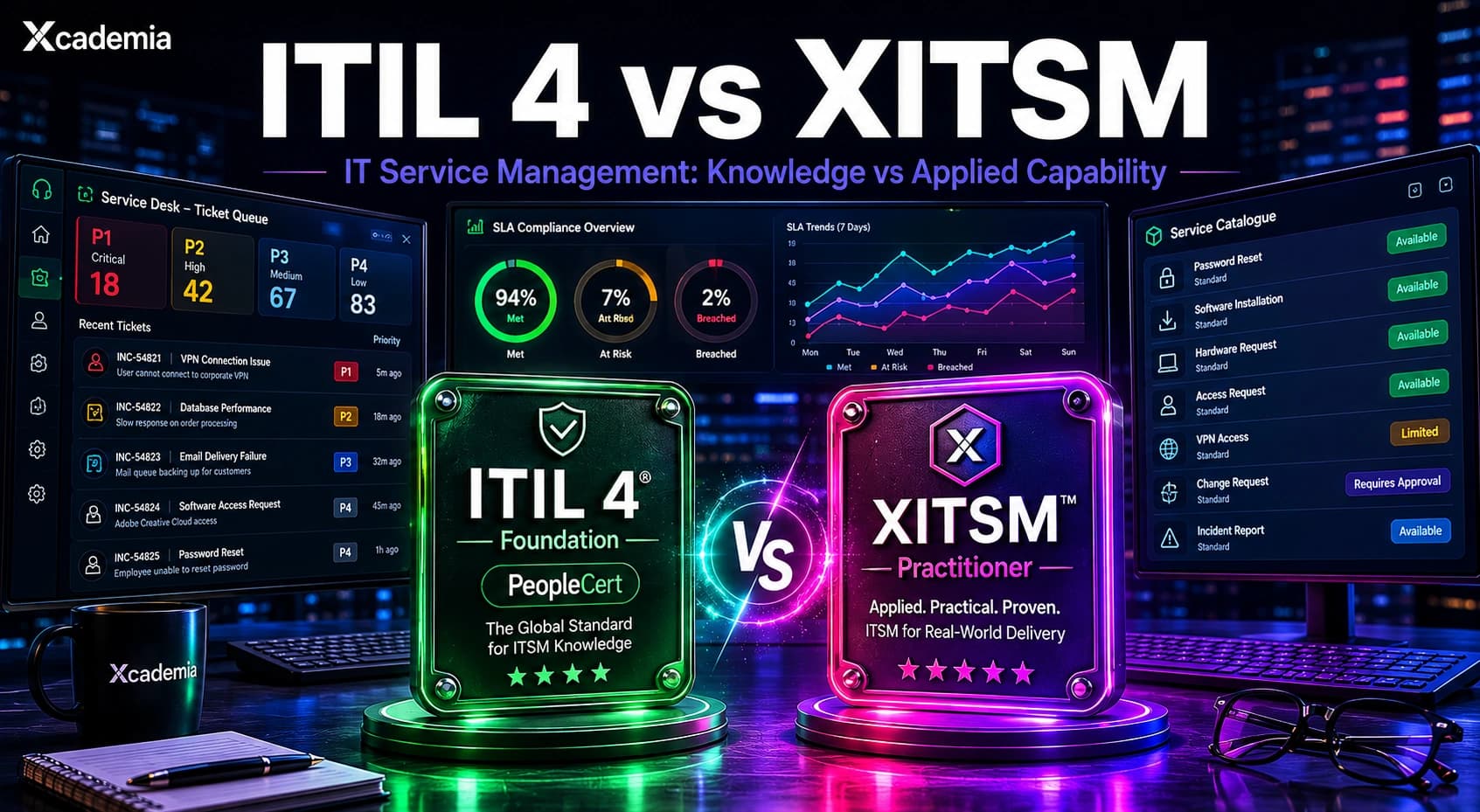
IT Service Management Certification: Knowledge vs Applied Capability
ITIL is the most widely recognised IT service management framework in the world. ITIL 4 Foundation is the entry-level examination that confirms understanding of the ITIL service value system, the four dimensions of service management, and the guiding principles that underpin good ITSM practice. It has been taken by millions of professionals across every sector and geography.
XITSM is Xcademia's IT Service Management practitioner certification. Five instructor-led days. Practitioner-assessed. Built for the professional who needs to design, implement, and improve IT service management in a real organisation rather than pass an examination about how it should work.
ITIL Foundation is the most widely held ITSM credential in the world. It tells the employer that the professional understands the ITIL framework. XITSM tells the employer that the professional has designed a service catalogue, managed SLAs under pressure, and run a CSI initiative under assessment conditions. Both have value. They are not the same value.
What ITIL 4 Is and What It Tests
ITIL 4 updated the ITIL framework significantly from v3 to incorporate agile, DevOps, and lean thinking alongside the traditional service lifecycle model. The four dimensions of service management (organisations and people, information and technology, partners and suppliers, value streams and processes) and the service value chain provide a more flexible and modern foundation than the prescriptive lifecycle stages of ITIL v3.
ITIL 4 Foundation is a 40-question multiple choice examination over 60 minutes. It tests whether candidates understand the key concepts, terminology, and principles of ITIL 4. The Practitioner level (formerly Managing Professional and Strategic Leader streams) provides deeper coverage across specific practice areas.
Where ITIL 4 delivers genuine value
Universal recognition: ITIL Foundation is listed in more ITSM job specifications than any other credential globally. It is the baseline that many employers assume
Framework literacy: ITIL 4 provides a common vocabulary for ITSM discussion that is genuinely useful for professionals working across organisations and suppliers
Modern coverage: ITIL 4 addresses agile and DevOps integration in a way that v3 did not, making it more relevant to modern IT delivery models
Career baseline: For professionals entering ITSM or moving into ITSM-adjacent roles, Foundation provides the framework understanding that more senior roles build on
The honest gap
ITIL Foundation is a 40-question MCQ examination that can be passed with focused preparation in a few days. It tests whether you can identify the correct ITIL term or concept from multiple choice options. It does not test whether you can design a service level agreement for a realistic service, build a service catalogue that business stakeholders will actually use, manage a P1 incident to resolution, or run a continual service improvement initiative that produces measurable outcomes.
ITIL Practitioner stream qualifications go further, but they remain examination-based. The gap between ITSM examination knowledge and ITSM operational capability is where XITSM sits.
ITIL Foundation is genuinely useful as a shared language and framework baseline. The ITSM professional who cannot do anything with that framework beyond pass an examination about it has a credential without a skill. XITSM develops and assesses the skill. Competitor pricing correct at time of publication.
What XITSM Covers and How It Is Assessed
XITSM is Xcademia's IT Service Management practitioner certification. Five instructor-led days. No multiple choice examination.
Programme scope
Service design in practice: Designing services that meet business requirements, building service level requirements from stakeholder needs, translating requirements into operational service level targets
Service catalogue management: Building and maintaining a service catalogue that serves both technical and business audiences, structuring services and request types, integration with self-service portals
SLA and OLA management: Drafting SLAs that are measurable, realistic, and meaningful, operational level agreements with internal teams, underpinning contracts with external suppliers
Incident management applied: Incident classification, prioritisation, escalation, and resolution workflows, P1 and P2 major incident management, post-incident review and problem management integration
Problem management: Reactive and proactive problem management, root cause analysis methodology, known error database management, problem-to-change integration
Change and release management: Change classification (standard, normal, emergency), CAB management, release planning and execution, integration with DevOps CI/CD pipelines
ServiceNow and JIRA Service Management lab exercises: Practical configuration of the platforms that most organisations actually use for ITSM
Continual service improvement: CSI register management, running improvement initiatives, measuring and reporting ITSM performance against defined KPIs
Security management as IT service: Integrating security incident management, vulnerability management, and access management within the ITSM framework
The capstone
The XITSM capstone presents candidates with a realistic ITSM improvement scenario: a mid-market technology organisation whose ITSM function is underperforming, high P1 incident rate, SLA breaches, a service catalogue that nobody uses, and a change process that development teams are bypassing. Candidates must produce an ITSM improvement roadmap, redesign the service catalogue for one critical service domain, draft SLA and OLA templates, and present their approach to a simulated IT leadership committee. Assessed by a senior Xcademia ITSM practitioner. Verifiable at xcademia.com/verify.
The XITSM capstone is the ITSM improvement engagement that IT service managers are asked to lead in practice. Not a description of how it should be done. An actual improvement plan for a broken ITSM function, presented to a challenging leadership audience.
FULL COMPARISON MATRIX
ITIL 4 (PeopleCert) | XITSM (Xcademia) | |
|---|---|---|
Awarding body | PeopleCert / Axelos | Xcademia |
Assessment format | 40 MCQ, 60 minutes (Foundation); 80 MCQ, 90 min (Practitioner) | Practitioner capstone, mentor sign-off |
Duration | Foundation: 2-3 days. Practitioner: 3 days. | 5 intensive instructor-led days |
Exam cost | Foundation ~£285 / Practitioner ~£395 | Included in £3,595 |
Renewal | None for Foundation. Practitioner every 3 years. | No renewal required |
Focus | IT service lifecycle, service management concepts | Applied IT service management: design, implement, improve |
Tooling practice | Conceptual only | ServiceNow and JIRA Service Management lab exercises |
IT-security integration | Introduced in ITIL 4 guiding principles | Security management as IT service integration throughout |
Market recognition | Very strong globally. Near-universal employer recognition. | UK and UAE, growing |
What it proves | ITSM framework knowledge across ITIL lifecycle | Applied ITSM capability: service design, SLA management, CSI |
The ITIL vs XITSM Decision
The decision between ITIL and XITSM is not an either/or for most professionals. They answer different questions.
ITIL Foundation answers: does this professional understand the ITSM framework and speak the ITIL language? This question matters for market access. Most ITSM job specifications list ITIL Foundation as a requirement. Having it removes a barrier. Not having it puts you at a disadvantage in shortlisting even when you have superior applied capability.
XITSM answers: can this professional design, implement, and improve an ITSM function under assessment conditions? This question matters for role performance. The ITSM manager who has been assessed on their ability to run an improvement initiative is a different candidate from the one who has only been assessed on their ability to describe one.
ITIL 4 best for market access and framework baseline:
ITIL Foundation is the credential that most ITSM employers look for as a baseline. Pursue it for the market access function and for the shared framework vocabulary it provides. Prepare properly rather than just passing; the framework is genuinely useful.
XITSM best for applied ITSM capability evidence:
XITSM develops and assesses the applied ITSM capability that ITIL describes in its framework. Service design, SLA management, incident management, change governance, and CSI under assessment conditions. Five days. Practitioner-assessed. No MCQ. No renewal. Verifiable at xcademia.com/verify.
The ITSM Career Context
IT service management as a discipline sits at the intersection of IT operations and business relationship management. The ITSM professional who can design a service catalogue that business stakeholders actually use, manage an SLA regime that IT operations teams can realistically meet, and run improvement initiatives that produce measurable outcomes is valuable in every sector that runs IT services.
The growing integration of security into ITSM — security incidents managed through the same processes as IT incidents, vulnerability management tracked through the same service management tooling, access management requests processed through the service catalogue — makes ITSM capability increasingly relevant for security professionals managing hybrid IT and security operations functions.
ITIL gets you in the ITSM room. XITSM proves you can improve the service management function that is already running. For the ITSM professional who wants to be the one who leads the improvement programme rather than the one who studies how improvement programmes work, the path is clear.
Prepare for ITIL 4 and Build Applied ITSM Capability With Xcademia Xcademia delivers ITIL 4 Foundation and Practitioner preparation alongside XITSM. Build the market access credential and the applied capability credential together. Instructor-led. Practitioner-taught. Verifiable at xcademia.com/verify. Explore ITIL 4 Preparation and XITSM |
|---|
Ready to go deeper?
Professional Training
Hands-on, mentor-led training aligned with industry certifications.
About the Author
Sharper every day
Daily tutorials, analysis, and career playbooks across all 12 Xcademia disciplines, straight to your inbox. No spam.