How to Use AI Tools to Conduct a More Efficient Risk Assessment
AI is transforming risk assessment workflows. This guide explains how governance, risk, compliance, and cybersecurity professionals can use AI to review documentation, identify risks, analyse controls, develop treatment plans, and produce reports more efficiently without sacrificing rigour.
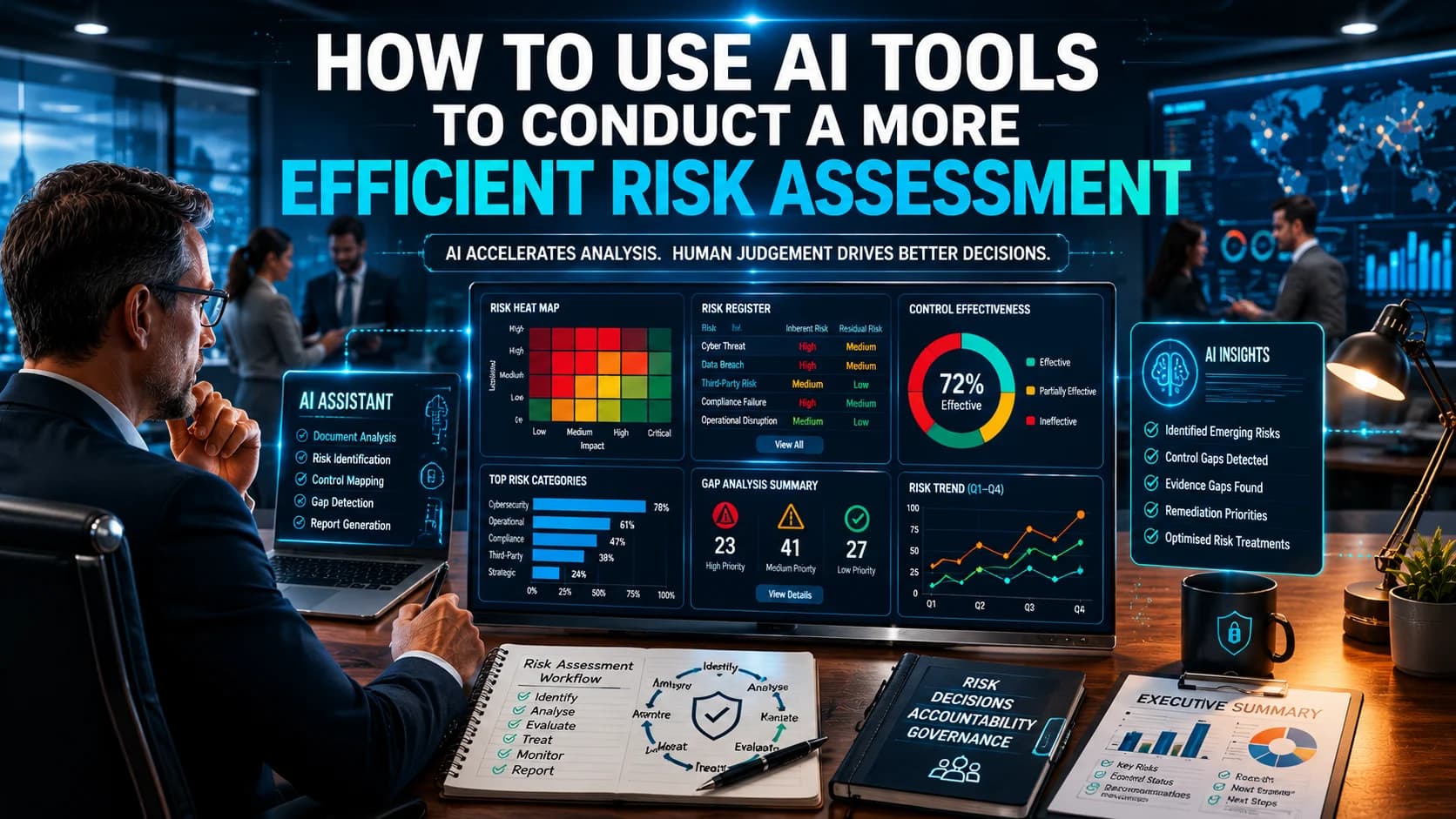
A Practical Workflow for Governance and Risk Professionals
Modern organisations generate more risk-related information than governance teams can realistically analyse manually.
Every cloud migration, supplier onboarding exercise, AI deployment, regulatory change, audit finding, digital transformation programme, and technology implementation introduces information that must be reviewed, assessed, documented, communicated, and monitored. The volume continues to increase. The time available to evaluate it does not.
This is creating a growing challenge for governance, risk, compliance, cybersecurity, audit, and assurance professionals. The issue is no longer understanding risk. The issue is processing enough information quickly enough to support business decisions.
A typical risk assessment may involve supplier contracts, architecture diagrams, audit reports, policies, stakeholder interviews, regulatory requirements, asset inventories, business impact assessments, and operational documentation. Reviewing and organising this information manually can consume a significant proportion of the assessment effort before meaningful analysis even begins.
Artificial intelligence is increasingly being used to address that challenge. Not by replacing risk professionals. Not by making decisions on their behalf. But by helping them review documentation, identify patterns, organise findings, develop structured outputs, and prepare reports more efficiently.
Used correctly, AI becomes a force multiplier for governance teams. Used incorrectly, it introduces new governance risks of its own.
The most successful governance teams are not asking whether AI should be used within risk assessment activities. They are asking where AI can create efficiency without weakening assurance quality, evidence validation, or governance oversight. The answer lies in understanding which parts of the assessment process benefit from automation and which parts require human judgement.
The greatest value of AI in risk management is not automation. It is amplification. The technology accelerates documentation review, information analysis, evidence organisation, and reporting activities while leaving accountability, judgement, and decision-making exactly where they belong: with the practitioner. Organisations that understand this distinction will achieve faster assessments without compromising governance discipline.
Before You Start: What You Need
The workflow assumes the practitioner already has the information required to conduct a meaningful assessment.
These inputs remain analyst work. They cannot be substituted by AI.
Before involving any AI tool, you should have:
A clearly defined assessment scope
Business objectives relevant to the assessment
Applicable regulatory obligations
Existing policies and procedures
Control documentation
Architecture or process information
Stakeholder interview notes
Asset inventories where appropriate
Existing audit findings or assessment reports
A defined risk methodology
If these inputs are incomplete, the assessment will be unreliable regardless of how sophisticated the AI tool may be.
One of the most common mistakes in AI-assisted governance work is attempting to use AI to compensate for missing evidence or weak inputs.
The result is often a faster assessment.
It is rarely a better one.
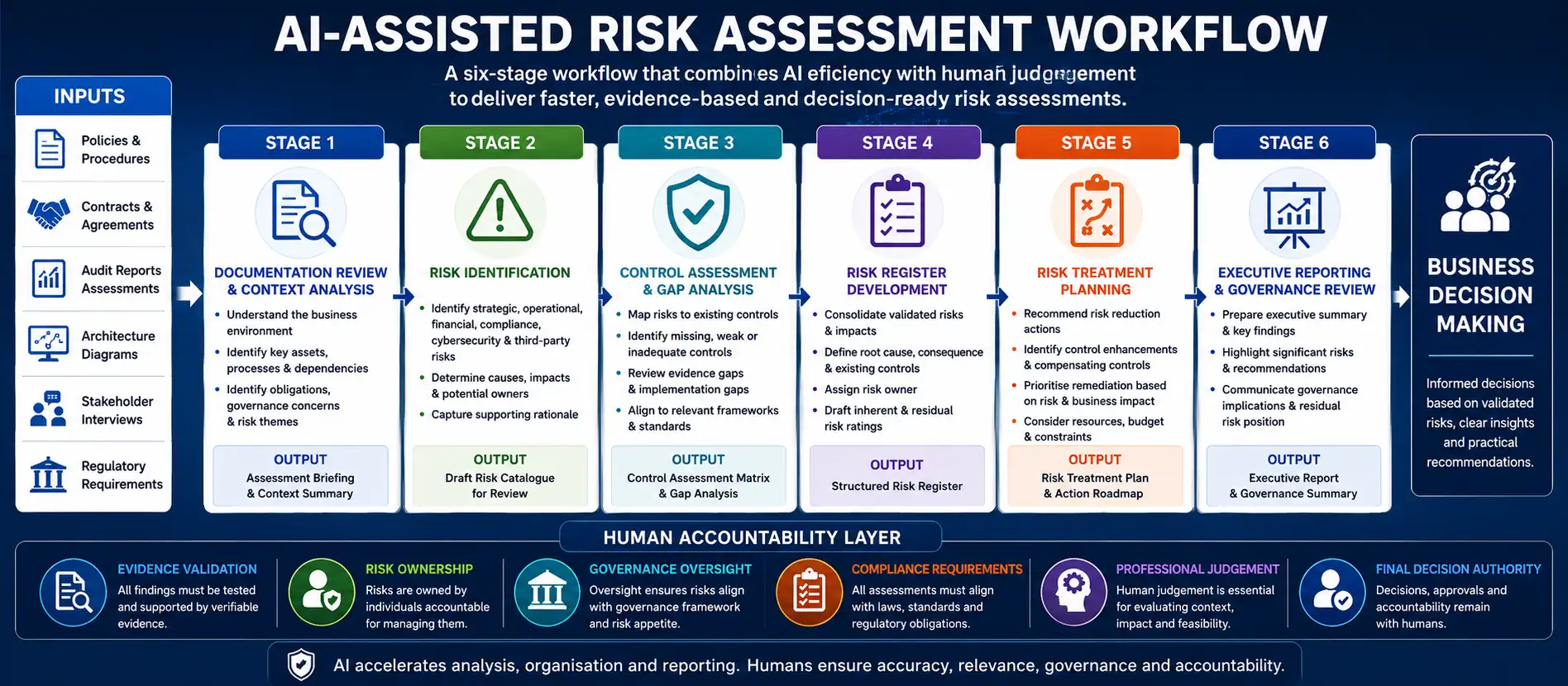
The Six-Stage Workflow
Stage 1: Documentation Review and Context Analysis
Suggested AI Workflow: Claude, ChatGPT Enterprise, or Microsoft Copilot
Purpose
Every effective risk assessment begins with understanding the environment being assessed.
This often requires reviewing policies, standards, contracts, supplier questionnaires, architecture diagrams, audit reports, business requirements, and regulatory obligations spread across multiple departments.
Prompt Approach
Provide relevant documentation and request identification of:
Critical business processes
Key assets and dependencies
Regulatory obligations
Governance concerns
Potential risk themes
Areas requiring further investigation
Output
The result is a structured assessment briefing document highlighting the areas most likely to require deeper analysis.
Rather than spending hours reviewing information manually, practitioners can begin with a consolidated understanding of the environment and focus their effort where it creates the greatest value.
Stage 2: Risk Identification
Suggested AI Workflow: Claude or ChatGPT
Purpose
Once the assessment context has been established, potential risks can be identified more efficiently.
Prompt Approach
Provide:
Assessment objectives
Stakeholder notes
Business context
Operational information
Supporting documentation
Request identification of:
Strategic risks
Operational risks
Cybersecurity risks
Privacy risks
Compliance risks
Third-party risks
For each risk, request:
Description
Potential causes
Business impacts
Suggested ownership
Supporting rationale
Output
A draft catalogue of potential risks for professional review.
The AI identifies possibilities.
The practitioner determines relevance.
Every identified risk should be validated before inclusion in the final assessment.
Stage 3: Control Assessment and Gap Analysis
Suggested AI Workflow: Claude, ChatGPT, or Microsoft Copilot
Purpose
Identifying risks alone provides limited value.
The next stage is understanding whether existing controls adequately address those risks.
Prompt Approach
Provide:
Identified risks
Existing controls
Policies and procedures
Applicable frameworks
Examples include:
ISO 31000
ISO 27001
NIST Cybersecurity Framework
CIS Controls
Internal governance standards
Request mapping between risks and controls while identifying:
Missing controls
Weak controls
Evidence deficiencies
Potential implementation gaps
Areas requiring validation
Output
A preliminary control assessment matrix highlighting potential weaknesses and areas requiring investigation.
AI can suggest where a control may be weak or absent. It cannot determine whether that control is operating effectively. That conclusion requires evidence review and professional assessment.
Stage 4: Risk Register Development
Suggested AI Workflow: Claude or ChatGPT
Purpose
The risk register remains one of the most important outputs of any assessment.
It is also one of the most time-consuming documents to create.
Prompt Approach
Provide:
Validated risks
Supporting evidence
Organisational context
Risk criteria
Request structured entries containing:
Risk statement
Root cause
Consequence
Existing controls
Risk owner
Draft inherent risk rating
Draft residual risk rating
Output
A professionally structured risk register produced in a fraction of the time normally required.
Consistency improves.
Documentation effort decreases.
Risk ratings remain the responsibility of the practitioner.
Stage 5: Risk Treatment Planning
Suggested AI Workflow: Claude or ChatGPT
Purpose
Risk identification is only valuable if it leads to action.
Risk treatment planning converts assessment findings into practical improvements.
Prompt Approach
Provide:
Confirmed risks
Existing controls
Business priorities
Regulatory obligations
Budget considerations
Resource constraints
Request recommendations for:
Risk reduction activities
Governance improvements
Control enhancements
Compensating controls
Remediation priorities
Output
A draft treatment roadmap linking recommended actions directly to identified risks.
Stakeholders can evaluate options more efficiently while retaining full ownership of final treatment decisions.
Stage 6: Executive Reporting and Governance Review
Suggested AI Workflow: Microsoft Copilot, Claude, or ChatGPT
Purpose
Many assessments fail not because the analysis is weak but because the findings are communicated poorly.
Executives require clarity rather than technical detail.
Prompt Approach
Provide:
Validated findings
Confirmed risks
Treatment recommendations
Governance observations
Request preparation of:
Executive summary
Assessment overview
Significant risks
Key findings
Recommended actions
Governance implications
Residual risk position
Output
A structured executive report ready for practitioner review and approval.
The AI drafts.
The practitioner signs.
The Rules That Protect Assessment Integrity
AI-assisted risk assessments introduce their own governance risks.
The controls that protect assessment integrity are therefore just as important as the tools being used.
Every Risk Must Trace Back to Evidence
AI-generated risks that cannot be linked to evidence are not findings.
They are hypotheses.
Every identified risk should be traceable to supporting documentation, interviews, observations, incidents, or control evidence.
Risk Ratings Require Human Judgement
AI cannot determine organisational risk appetite, commercial priorities, stakeholder tolerance, regulatory expectations, or strategic objectives.
Risk ratings should always be assigned by qualified practitioners.
Control Effectiveness Must Be Verified
Documentation does not prove implementation.
Evidence does.
A policy stating that a control exists is not evidence that the control is operating effectively.
Recommendations Require Feasibility Review
AI-generated treatment plans do not understand budgets, resource limitations, organisational politics, or implementation realities.
Recommendations should always be reviewed for practicality before approval.
Sensitive Information Must Be Protected
Confidential assessments, client information, regulated data, and commercially sensitive material should only be processed within approved enterprise AI environments.
Every risk assessment ultimately carries the practitioner's signature. Accountability cannot be delegated to an AI tool.
The Future of Risk Assessment
The volume of information facing governance teams will continue to increase.
Organisations are managing larger digital ecosystems than ever before. Cloud platforms, AI systems, third-party suppliers, regulatory obligations, cybersecurity requirements, and interconnected business processes are all increasing simultaneously. The volume of information requiring governance oversight continues to grow, while business expectations for rapid decision-making continue to accelerate.
The challenge is no longer obtaining information. The challenge is turning information into decisions quickly enough to influence outcomes.
This is where AI-assisted workflows create value. Their purpose is not to replace expertise but to ensure that expertise is applied where it creates the greatest organisational benefit. By reducing the time spent on administrative and documentation-intensive activities, AI enables practitioners to focus on analysis, stakeholder engagement, evidence validation, and decision support.
AI is highly effective at analysing large volumes of information, identifying patterns, organising evidence, and producing structured outputs. However, it cannot determine organisational risk appetite, assess business trade-offs, accept risk on behalf of management, or exercise professional judgement. Those responsibilities remain with governance professionals, business leaders, and risk owners. As organisations become increasingly dependent on technology-driven decision-making, these human capabilities become more important rather than less.
The future of risk management belongs neither to professionals who reject AI nor to those who trust it blindly. It belongs to practitioners who understand how to combine AI efficiency with human judgement, governance discipline, evidence-based decision-making, and organisational context. Those who master both will be able to deliver faster assessments, stronger assurance outcomes, and more informed business decisions.
Ready to go deeper?
Professional Training
Hands-on, mentor-led training aligned with industry certifications.
About the Author
Sharper every day
Daily tutorials, analysis, and career playbooks across all 12 Xcademia disciplines, straight to your inbox. No spam.