How to Use AI Tools to Automate Your Security Reports
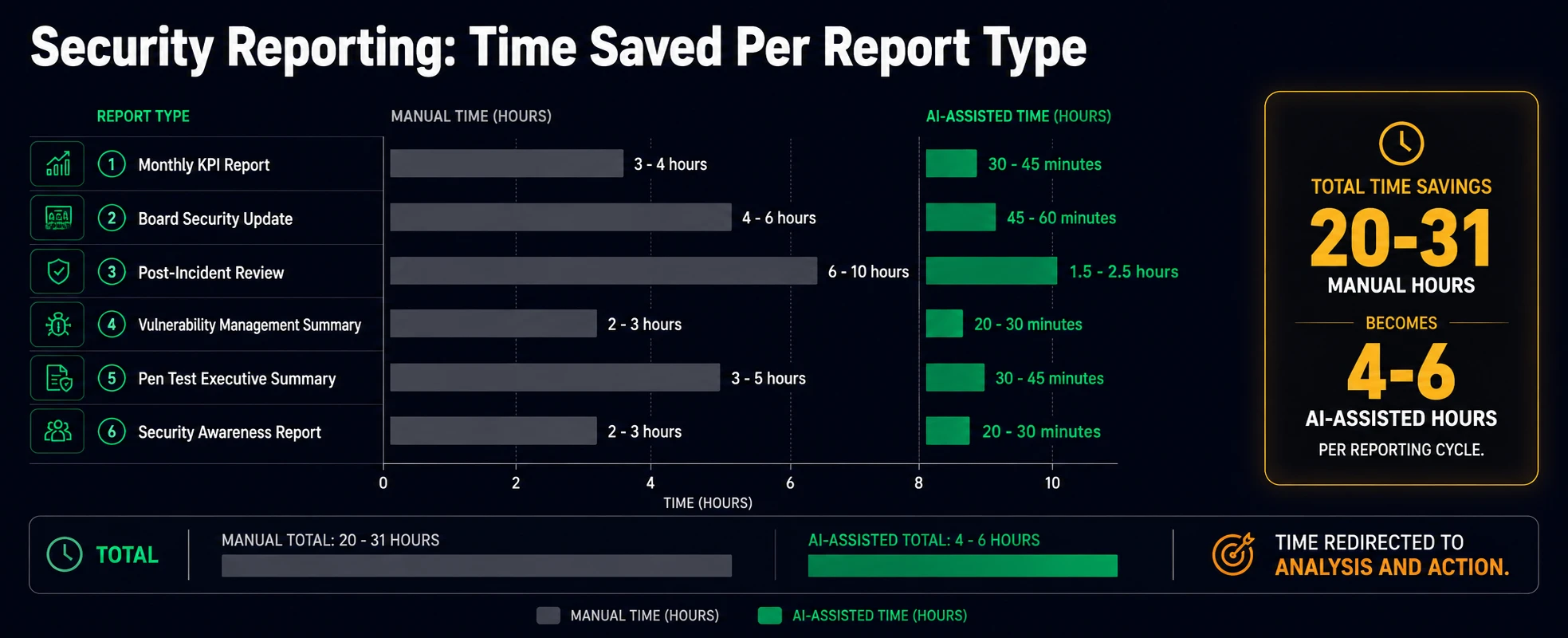
Security professionals spend too much time writing reports and not enough time reducing risk. This practical guide shows how AI can automate six common security reports, cutting reporting time by 70-80% while preserving quality, accuracy, and analyst oversight.
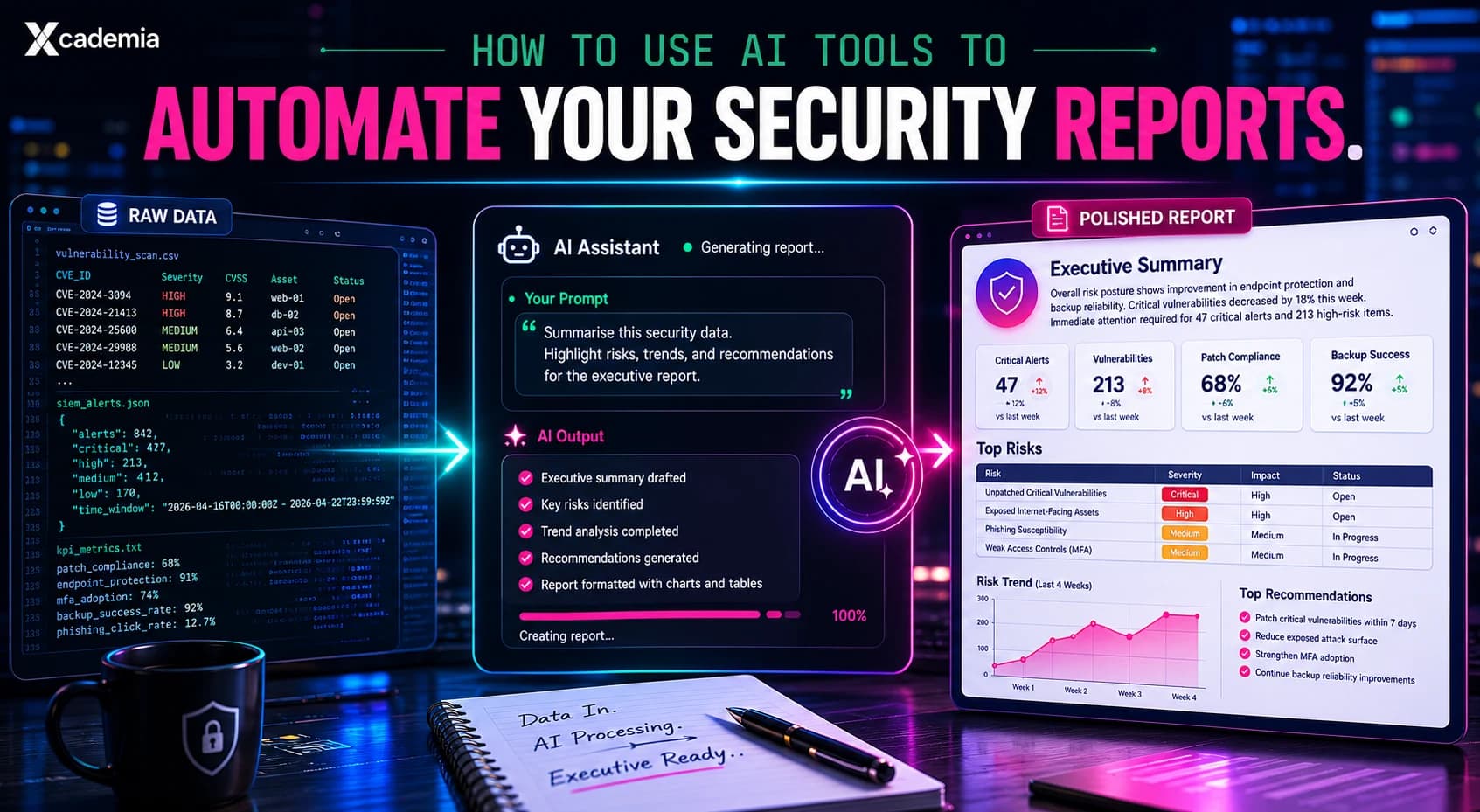
A practical workflow for security professionals who spend too much time writing and not enough time acting on findings.
Security professionals spend a disproportionate amount of time writing reports. The monthly KPI report. The board security update. The post-incident review. The vulnerability management summary. The penetration test executive summary. Each one requires the same mechanical work: extract data from multiple sources, structure it into a coherent narrative, translate technical findings into business language, format it consistently, and produce it to the deadline.
AI tools compress the mechanical parts of this process dramatically. The analyst who understands how to use them effectively produces better-structured, better-written reports in a fraction of the time — and spends the time saved on the analytical work that actually requires a human to do it.
This workflow covers six types of security report, with specific prompting approaches for each.
The AI tool in security reporting is the drafter, not the analyst. It produces the structure and language. The security professional provides the data, the interpretation, the judgement about what matters and why, and the final verification. Every report that carries your name should carry your review.
The Six-Report Workflow
(1) Monthly Security KPI Report
Claude with structured metric inputs
PROMPT APPROACH: Compile your metrics for the month as a structured list: total vulnerabilities by severity (open and closed), phishing simulation click rate, mean-time-to-detect and respond, patch compliance percentage, security training completion rate, and any significant incidents. Instruct: "You are a CISO writing a monthly security KPI report for an internal audience of IT leadership and department heads. Using the following metrics, write: a one-paragraph overall security posture summary comparing this month to last, a commentary on each metric explaining what the number means and whether it is trending in the right direction, and a forward-looking priorities section for next month. British English. No bullet points in the narrative. Confident, professional tone."
OUTPUT: A draft monthly KPI report narrative ready for review and data verification. Validate every number against source data before distributing.rrative ready for review and data verification. Validate every number against source data before distributing.
(2) Board Security Update
Claude with CISO brief notes and top risks
PROMPT APPROACH: Provide: the two or three most significant security developments in the past quarter, the current top risk (with business impact stated), any notable incidents or near-misses, and the key investment or programme decision the board needs to make. Instruct: "You are a CISO writing a board paper security update. Write: a one-paragraph security overview in business risk language (no technical jargon), three to four key points each with a business risk statement and recommended action, and a closing paragraph on the direction of the security programme. The board audience is non-technical. Translate every technical concept into financial or operational risk terms. Avoid the words 'cyber' and 'hacker'."
OUTPUT: A board-ready security update draft. Review for accuracy, tone, and strategic alignment before presenting. The board paper is the most consequential document the CISO produces; review it carefully.
(3) Post-Incident Review Report
Claude with incident timeline and root cause notes
PROMPT APPROACH: After completing the incident investigation, compile: the incident timeline (chronological events with timestamps), the root cause analysis findings, the immediate containment actions taken, and the proposed remediation actions. Instruct: "You are writing a post-incident review report for a security incident. Using the following incident timeline and findings, write: an executive summary (what happened, what the impact was, how it was resolved), a detailed incident timeline in chronological format, a root cause analysis section identifying contributing factors, and a lessons-learned and remediation section with specific action items, owners, and timelines. Write in past tense. Formal, factual tone."
OUTPUT: A structured PIR draft. Verify the timeline accuracy against logs before distributing. Root cause statements require analyst verification; the AI drafts the language, not the analysis.
(4) Vulnerability Management Summary
Claude with VM dashboard data export
PROMPT APPROACH: Export your vulnerability management dashboard data as a structured summary: total open vulnerabilities by severity, MTTR by severity this period vs last period, top five critical findings with asset criticality, SLA compliance rate, and notable new critical vulnerabilities discovered. Instruct: "You are writing a monthly vulnerability management summary for a security leadership audience. Using the following data, write: a risk posture headline (is the environment improving or worsening?), a commentary on MTTR trends, a section on the top priority findings that require escalation, and a forward-looking remediation plan summary. Translate severity ratings into business risk language where relevant."
OUTPUT: A VM summary draft that translates raw vulnerability data into risk narrative. Verify all metrics against source data. MTTR calculations require particular care.
(5) Penetration Test Executive Summary
Claude with structured finding list and scope summary
PROMPT APPROACH: After completing the technical pen test report, provide: the scope and objectives, the number of findings by severity, the two or three most critical findings with their business impact, and the overall security posture assessment. Instruct: "You are writing the executive summary of a penetration testing report for a [sector] organisation. Write: a two-paragraph scope and methodology overview in plain English, a risk posture assessment suitable for a CISO or CFO audience, a section covering the three most critical findings with their business risk expressed without technical jargon, and a prioritised remediation recommendation. The executive summary should be readable in five minutes by someone without a technical background."
OUTPUT: An executive summary draft. Verify technical accuracy of all finding descriptions against the detailed technical report. Every statement about a finding must be traceable to confirmed evidence.
(6) Security Awareness Programme Report
Claude with phishing simulation and training data
PROMPT APPROACH: Provide: phishing simulation click rate this period vs last period, phishing report rate, training completion rate by department, any significant outlier departments or teams, and any incidents attributed to human error in the period. Instruct: "You are writing a quarterly security awareness programme report for an HR and management audience. Write: a headline summary of programme effectiveness using the following metrics, a departmental performance comparison in readable narrative form, a section identifying positive trends and areas requiring additional focus, and a recommendation for the next quarter's programme emphasis. Avoid blaming specific individuals or teams. Frame all findings in terms of programme improvement opportunities."
OUTPUT: A security awareness report draft framed constructively for the HR and management audience. Review framing carefully; this report will be read by people whose teams appear in the data.
The Rules That Protect Report Quality
Verify every number against source data before the report is distributed. AI tools cannot access your live systems. They work with the data you provide. If the data you provide is wrong, the report is wrong.
Never use AI to generate the analytical interpretation of a finding. AI can draft the language around an interpretation you have already reached. It cannot replace the analyst's judgement about why a finding matters in the specific organisational context.
Review board and executive documents with particular care. The board paper that contains an error carries the CISO's name. The AI saved you two hours drafting it. Those two hours should include a careful review.
Apply consistent templates. AI-assisted reports are most powerful when they follow a consistent structure that your audience recognises. Define your report templates and instruct the AI to follow them, not to invent its own structure.
Do not paste confidential incident data, personal data, or commercially sensitive information into public AI tools. Use enterprise-approved tools with appropriate data handling for sensitive reports.
The security report that is produced faster but reviewed less carefully is not a better report. The time AI tools save in drafting should be reinvested in review and analytical quality, not in reducing the time the professional spends on the output. Speed without quality is a liability in security reporting.
Build Security Management and Reporting Capability Xcademia's XCISO, XCISM, and XCRISC programmes all include executive reporting and board communication as core capstone components. The security professional who can translate technical findings into board-level business risk language is among the most valuable in the profession. Explore Security Management Programmes | xcademia.com |
|---|
Ready to go deeper?
Professional Training
Hands-on, mentor-led training aligned with industry certifications.
About the Author
Sharper every day
Daily tutorials, analysis, and career playbooks across all 12 Xcademia disciplines, straight to your inbox. No spam.