CASP+ vs XCASP
CASP+ proves advanced security knowledge through performance-based testing. XCASP proves you can design, defend, and communicate security architecture under real assessment conditions. An honest comparison for senior security professionals in 2026.
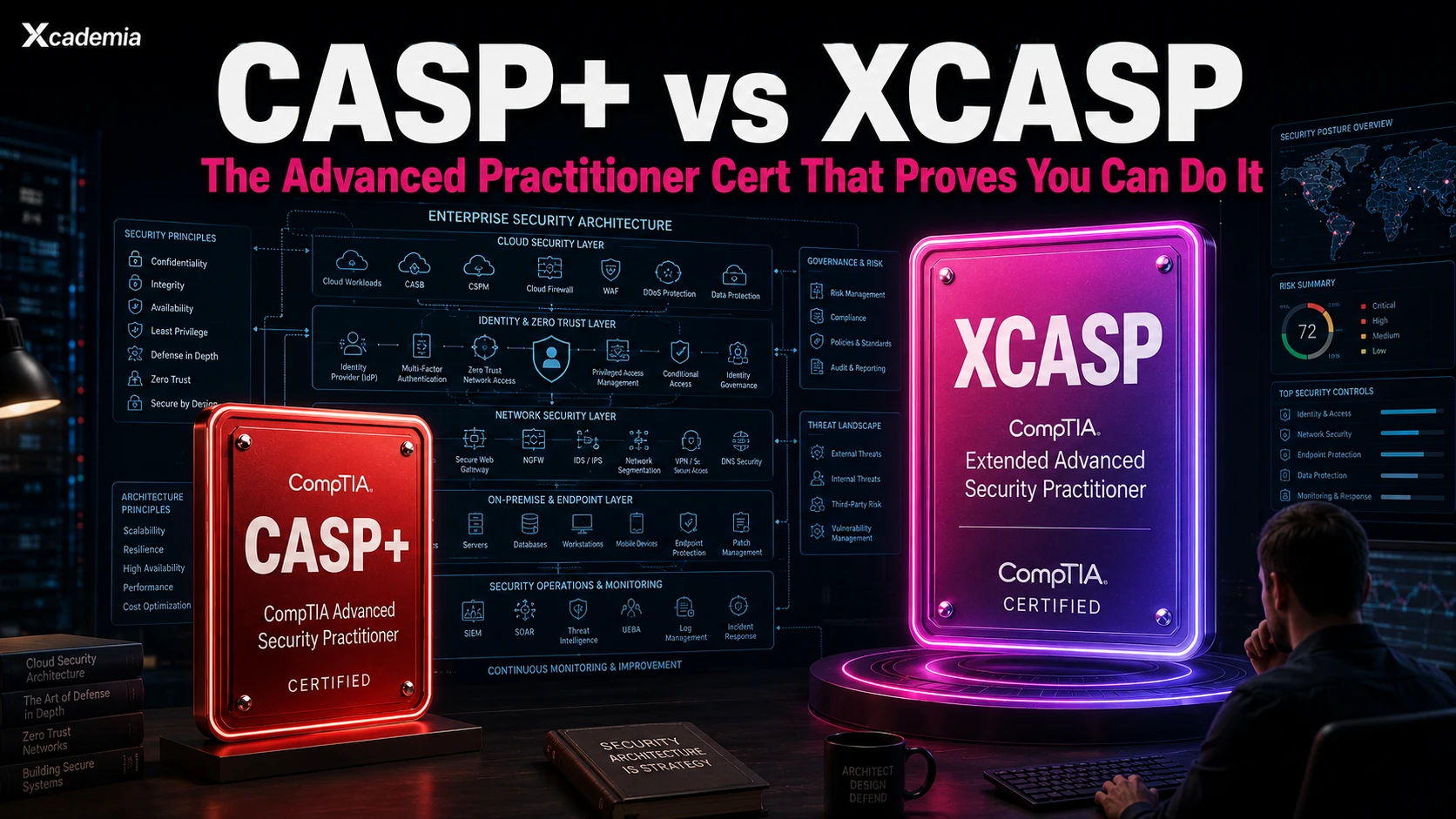
The Advanced Security Practitioner Certification That Proves You Can Do It
CompTIA Advanced Security Practitioner (CASP+) occupies an interesting position in the certification market. It is positioned as a practitioner-level credential for senior security professionals who want to demonstrate technical depth rather than management breadth. It deliberately avoids the management focus of CISSP, instead targeting the security professional who remains deeply hands-on at senior level.
XCASP is Xcademia's Advanced Security Practitioner certification. Five instructor-led days. Practitioner-assessed capstone. Built around the premise that the advanced practitioner credential should require actually demonstrating advanced practice.
Both target the same professional. The question is which one produces the evidence that senior roles actually require.
CASP+ is the certificate that says you have the knowledge. XCASP is the certificate that says you have used it under assessment conditions. For the senior professional whose next employer will be evaluating genuine practitioner capability, the distinction matters.
What CASP+ Is and What It Tests
CompTIA CASP+, now at CAS-005, is CompTIA's highest-level security certification. It is vendor-neutral and positioned above CISSP in CompTIA's framework as a hands-on practitioner credential. The examination includes up to 90 questions across multiple choice and performance-based formats over 165 minutes.
The five CASP+ domains cover security architecture, security operations, security engineering, cryptography and PKI, and identity and access management. The coverage is genuinely broad and technically deep by examination standards. The performance-based items require candidates to complete simulated technical tasks rather than answer purely conceptual questions.
Where CASP+ delivers
DoD 8570 approval: CASP+ is approved at IAT Level III and IAM Level III, making it relevant for US government and defence contractor roles requiring advanced certification
Technical depth: CASP+ goes deeper than CISSP on technical implementation, making it the right credential for professionals who remain hands-on at senior level
Vendor neutral: Covers principles and approaches rather than specific product implementations
Performance-based items: Requires completing simulated tasks, which is more rigorous than pure MCQ
CompTIA ecosystem: Fits naturally in organisations that use the CompTIA certification pathway
The honest gap
CASP+ performance-based items simulate technical tasks in a controlled, defined environment. They test whether you can complete specific tasks in CompTIA's simulation format. They do not test whether you can design a security architecture for a realistic client, defend that architecture under challenge from an executive team, or lead a technical team through an incident under ambiguous real-world conditions.
The performance-based format is a genuine step up from pure MCQ. It remains a simulation designed for certification, not a practitioner assessment designed to evaluate whether the professional can actually do the work.
CASP+ is the most technically rigorous CompTIA certification and a genuinely useful credential for the hands-on practitioner pathway. The performance-based items distinguish it from CISSP. What they do not do is put you in front of a real problem with a real evaluator asking whether your approach actually works. Competitor pricing correct at time of publication.
What XCASP Covers and How It Is Assessed
XCASP is Xcademia's Advanced Security Practitioner certification. Five instructor-led days. No multiple choice examination. Practitioner-assessed capstone delivered over the final day.
Programme scope
Security architecture design: Applying defence-in-depth principles to realistic enterprise architecture scenarios, including hybrid cloud and zero trust environments
Cryptography applied: Not just what cryptographic algorithms are but how to select, implement, and audit cryptographic controls in enterprise deployments
Identity and access management advanced: Federated identity, privileged access management, zero trust identity architecture, beyond-password authentication design
Security engineering for cloud: Designing security controls for AWS, Azure, and GCP environments, including IaC security, container security, and serverless security considerations
Threat modelling at enterprise scale: Applying STRIDE and threat modelling methodologies to complex multi-component architectures
Security operations design: Designing detection logic, SIEM rule development, security metric frameworks, and incident response integration
Risk quantification: Applying FAIR methodology and financial risk frameworks to security investment decisions
Communication to executives: Translating technical security architecture decisions into business risk language for board and executive audiences
The capstone
The XCASP capstone presents candidates with a realistic client scenario: a mid-market organisation undergoing digital transformation, moving to multi-cloud, and facing a specific regulatory compliance requirement. Candidates must produce a security architecture design that addresses the client's risk profile, present the architecture to a simulated executive board including a sceptical CFO asking about ROI, and defend the technical decisions under challenge from a senior technical evaluator.
The capstone is assessed across four dimensions: architectural soundness, risk communication quality, executive presentation effectiveness, and ability to defend decisions under challenge. Assessed by a senior Xcademia practitioner with real security architecture and advisory experience. Verifiable at xcademia.com/verify.
The XCASP capstone is the closest assessment to what a senior security practitioner actually does in a client or leadership context. It is not a simulation of the work. It is the work, conducted under observation.
FULL COMPARISON MATRIX
CASP+ (CompTIA) | XCASP (Xcademia) | |
|---|---|---|
Awarding body | CompTIA | Xcademia |
Assessment format | Max 90 questions (PBQ + MCQ), 165 min | Practitioner capstone, mentor sign-off |
Duration | Self-study (3-6 months) | 5 intensive instructor-led days |
Experience required | 10 years IT, 5+ years security admin recommended | Senior security practitioner context expected |
Exam cost | $509 USD | Included in £3,995 |
Total cost | $700-$1,500 (prep + exam) | £3,995 all inclusive |
Renewal | Every 3 years, 75 CEUs | No renewal required |
DoD 8570 approved | Yes (IAT/IAM Level III) | N/A |
Architecture depth | Strong across enterprise security architecture | Applied security architecture decision-making |
Technical depth | Broad and deep across all domains | Applied, scenario-driven technical assessment |
Market recognition | Strong US enterprise and government | UK and UAE, growing |
What it proves | Advanced security knowledge across CompTIA domains | Senior security practitioner capability under real conditions |
The DoD Conversation
CASP+ is approved under DoD Directive 8570 at IAT Level III and IAM Level III. For professionals targeting US government or defence contractor roles that specifically require a 8570-approved certification at advanced level, CASP+ has a market access function that XCASP does not currently replicate.
XCASP is not seeking DoD 8570 approval. It is designed for the UK and international market where practitioner-assessed credentials are valued more highly than DoD-approved examination-based credentials. For professionals targeting UK enterprise, UAE, European, or non-DoD US commercial roles, the DoD 8570 approval is not a relevant factor.
For professionals targeting DoD-adjacent roles: CASP+ for the DoD access function, XCASP for the practitioner evidence layer. Both belong in the senior security professional's credential portfolio.
The DoD 8570 requirement is specific to US government and defence contractor work. For the majority of senior security professionals outside that market, it is not the primary factor in choosing between CASP+ and XCASP. The primary factor is what each produces in terms of demonstrated capability.
Who Should Choose CASP+
You are targeting US government, DoD, or defence contractor roles where DoD 8570 Level III certification is required or strongly preferred
You are building the CompTIA certification pathway from Security+ through CySA+ to CASP+
You want the most technically demanding CompTIA examination as a credential for senior practitioner roles
Your organisation uses CompTIA certifications as a standard and CASP+ fits the existing framework
ASP+ best for DoD roles and CompTIA pathway completion:
CASP+ is the most rigorous CompTIA certification and a necessary credential for US DoD-adjacent roles. Performance-based items make it more demanding than pure MCQ alternatives. If your market requires DoD 8570 compliance or you are completing the CompTIA pathway, CASP+ is the logical choice.
Who Should Choose XCASP
You are a senior security practitioner in the UK, UAE, or international market who wants a credential demonstrating applied architecture and practitioner capability rather than examination performance
You hold CISSP or CASP+ and want to add a practitioner assessment layer that evidences the applied capability those exams describe
You are targeting CISO or senior security architect roles where the interview will test your ability to design and defend architecture decisions, not recall domain knowledge
You want a five-day intensive programme that covers security architecture, cryptography, IAM, cloud security engineering, threat modelling, and risk quantification at a practitioner depth
XCASP best for Applied senior practitioner evidence:
XCASP assesses the applied practitioner capability that CASP+ describes in its domain framework. Security architecture design, executive presentation, and technical defence under challenge. Five days. Practitioner-assessed. No MCQ. No renewal. Verifiable at xcademia.com/verify.
Where They Fit Together
CASP+ and XCASP answer different questions about the same professional. CASP+ answers: does this person have advanced security knowledge across the CompTIA domain framework? XCASP answers: can this person design and defend a security architecture under real assessment conditions?
For the professional targeting senior roles in markets where both questions are asked, both credentials are additive. The sequence that makes most sense: CISSP or CASP+ for the examination-based credential, then XCASP for the practitioner evidence that neither examination can provide.
The senior security practitioner who can pass CASP+ and present an architecture to a simulated executive board is more credible than the one who can only do one of those things. The cert gets you in the room. The proof gets you the job.
Demonstrate Applied Practitioner Capability With XCASP XCASP: five instructor-led days covering security architecture, cryptography, IAM, cloud security engineering, threat modelling, and risk quantification. Practitioner-assessed architecture presentation capstone. No MCQ. No renewal. Verifiable at xcademia.com/verify. Explore XCASP |
|---|
Ready to go deeper?
Professional Training
Hands-on, mentor-led training aligned with industry certifications.
About the Author
Sharper every day
Daily tutorials, analysis, and career playbooks across all 12 Xcademia disciplines, straight to your inbox. No spam.