Cybersecurity in Financial Services 2026
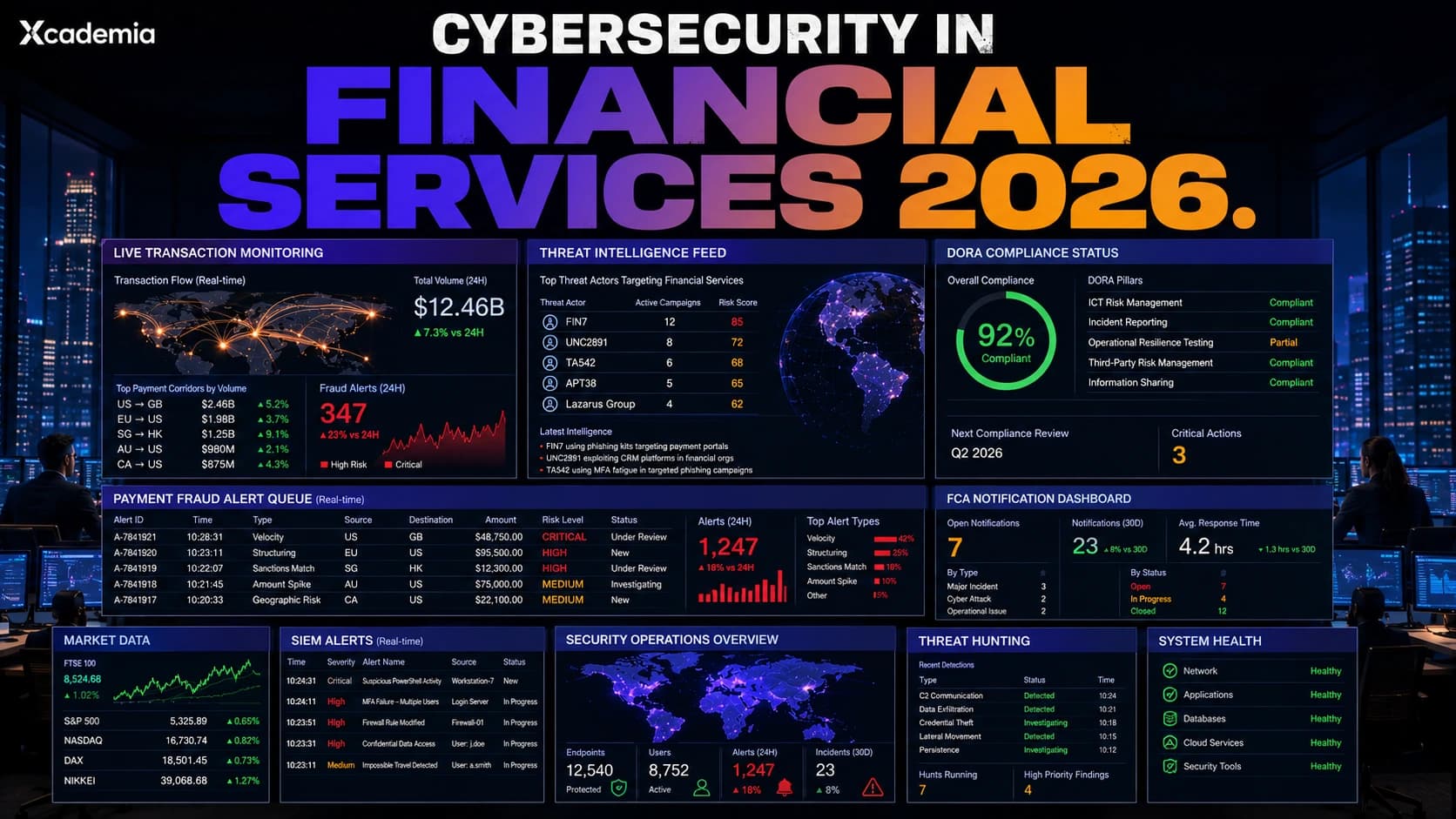
Financial services faces the most complex cybersecurity landscape in 2026. From AI-powered fraud and ransomware to DORA, NIS2, and FCA requirements, this guide explores the threats, regulations, and specialist roles shaping security in banking, fintech, and insurance.
The Threats, the Regulations, and the Professionals Who Navigate Both
Financial services is the most targeted sector for cybercrime globally, and has been for more than a decade. The combination of liquid assets, critical payment infrastructure, vast customer data, and complex interconnected supply chains makes banks, insurers, payment processors, and investment firms uniquely attractive targets. In 2026, the threat landscape is more sophisticated, the regulatory burden is heavier, and the consequences of failure are more severe than at any previous point.
This article maps the current cybersecurity environment in financial services: the specific threats, the regulatory framework, and the career implications for security professionals building or advancing in this sector.
Financial services cybersecurity is not a harder version of general cybersecurity. It is a different discipline. The threats are different, the regulatory obligations are layered and intersecting, the operational constraints are severe, and the consequences of a major incident include not just data loss but systemic contagion risk. The professionals who understand this specificity are significantly more valuable than those who do not.
The Threat Landscape in 2026
Business Email Compromise and payment fraud
BEC remains the highest-volume, highest-value fraud vector against financial institutions and their corporate clients. The introduction of AI-generated deepfake audio and video has elevated BEC from email-based impersonation to voice and video call impersonation of CFOs, payment approvers, and relationship managers. Financial institutions are increasingly investing in voice authentication and callback verification procedures to counter this. The average BEC loss per incident in financial services continues to rise.
Ransomware targeting financial infrastructure
Financial services ransomware attacks in 2026 are increasingly sophisticated in their target selection, dwell time before encryption, and exfiltration approach. Groups targeting financial institutions prioritise the discovery of sensitive client data, regulatory submissions, and M&A information before triggering encryption, using the regulatory and reputational value of the data as a second leverage mechanism alongside the operational disruption of encryption.
Third-party and supply chain risk
The most significant incidents affecting financial institutions in recent years have frequently originated through third parties: technology providers, cloud services, payment processors, and managed service providers. The interconnected nature of financial infrastructure means that a single third-party compromise can cascade across dozens of institutions simultaneously. DORA's third-party risk requirements reflect the systemic importance of this vector.
Insider threat
Financial services has the highest insider threat risk of any sector by dollar value of incidents. The combination of privileged access to liquid assets, client data with market-sensitive value, and the financial pressure that motivates insider misconduct creates a risk profile that technical controls alone cannot fully address. Behavioural analytics, PAM, and robust off-boarding procedures are standard programme components in mature financial services security organisations.
API security in open banking
The expansion of open banking under PSD2 in the EU and the UK has created a new attack surface: the APIs through which third-party providers access customer account data. API authentication weaknesses, rate limiting failures, and data enumeration vulnerabilities represent an emerging and growing attack vector specific to the financial services sector.
The threat actors targeting financial services are not primarily opportunistic. They are organised, patient, and financially motivated at a scale that funds significant capability development. The security professional in financial services is competing against adversaries with substantial resources and specific sector expertise. Generic security capability is insufficient.
The Regulatory Framework in 2026
DORA: Digital Operational Resilience Act
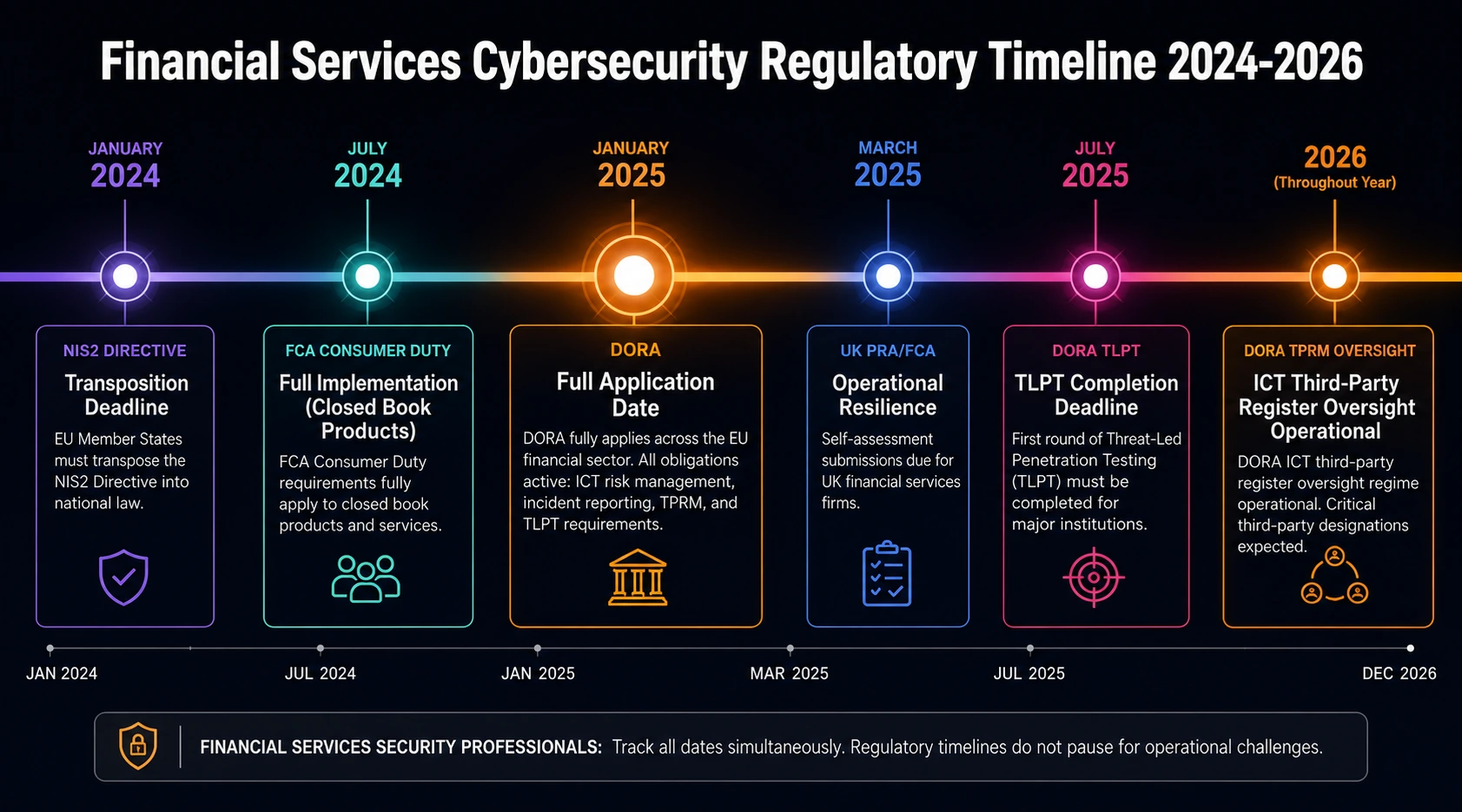
DORA came into full application in January 2025. It applies to all financial entities operating in the EU and to the ICT third-party service providers that serve them. DORA's five pillars- ICT risk management, ICT-related incident reporting, digital operational resilience testing, ICT third-party risk management, and information and intelligence sharing- represent the most comprehensive operational resilience framework ever applied to the financial sector. DORA breach notification requirements are among the most demanding in any regulatory regime: significant incidents must be reported to the relevant supervisory authority within specific timeframes.
UK regulatory framework post-DORA
The UK has developed its own operational resilience framework through the PRA and FCA, with important tolerances for important business services and requirements for self-assessment of resilience. For UK firms with EU operations, DORA applies directly. For UK-only firms, the PRA/FCA framework applies. For security professionals, understanding the differences and the interaction between the two regimes is increasingly important.
FCA Consumer Duty
While not a security regulation, FCA Consumer Duty has security implications. The duty to deliver good outcomes for retail customers includes protecting them from fraud and financial crime that the firm's inadequate security contributes to. Security investment decisions are increasingly framed in Consumer Duty terms: is the firm's current security posture delivering adequate protection for consumer outcomes?
NIS2 for financial market infrastructure
NIS2 Directive applies to financial market infrastructure operators, stock exchanges, central counterparties, payment systems as essential entities with the most stringent obligations. For security professionals in this sub-sector, NIS2 and DORA obligations overlap and interact, creating a complex compliance environment that requires specialist knowledge.
The financial services security professional who understands DORA, UK operational resilience requirements, FCA Consumer Duty implications for security, NIS2, and GDPR simultaneously is a genuinely scarce specialist. Each regulatory regime has specific incident classification, notification timelines, testing requirements, and third-party management obligations. Understanding all of them in their interactions is a career-defining capability.
The Roles Financial Services Is Hiring For
Cyber risk and DORA specialists
The most acute hiring need in financial services cybersecurity in 2026 is for professionals who understand DORA specifically: ICT risk management framework design, incident classification under DORA, TLPT (Threat-Led Penetration Testing) programme management, and third-party ICT risk programme design. These professionals are scarce and command a significant premium.
Financial crime technology
AI-powered transaction monitoring, behavioural analytics for fraud detection, and machine learning approaches to AML alert triage represent a growing specialism at the intersection of financial crime compliance and data science. Professionals who can bridge these disciplines are in high demand across tier-one banks and fintech companies.
Cloud security for financial infrastructure
The migration of financial services workloads to cloud, including regulated data, core banking systems, and payment infrastructure, requires cloud security professionals with financial services regulatory knowledge. DORA imposes specific requirements on cloud service provider risk management. AWS, Azure, and GCP all publish financial services compliance frameworks, but the professionals who can navigate these alongside the regulatory obligations are scarce.
Third-party risk management
DORA's TPRM requirements have created significant demand for third-party risk professionals with financial services sector knowledge. The role of assessing ICT third-party providers, managing concentration risk, and maintaining contractual requirements under DORA is a specialist function that most financial institutions need to build or significantly expand.
Build Financial Services Cybersecurity Capability Xcademia's C3 Cybersecurity and C5 Governance programmes cover DORA compliance, financial services GRC, third-party risk management, and the technical security skills financial institutions require. XCISO, XCISM, XCRISC, and XCSP are all relevant for senior financial services security roles. |
|---|
Ready to go deeper?
Professional Training
Hands-on, mentor-led training aligned with industry certifications.
About the Author
Sharper every day
Daily tutorials, analysis, and career playbooks across all 12 Xcademia disciplines, straight to your inbox. No spam.