CRISC vs XCRISC
CRISC is a globally recognised IS risk credential focused on knowledge of risk and controls. XCRISC is a practitioner-assessed alternative testing real-world FAIR risk analysis, control design, and board reporting. This article compares both for 2026 GRC professionals.
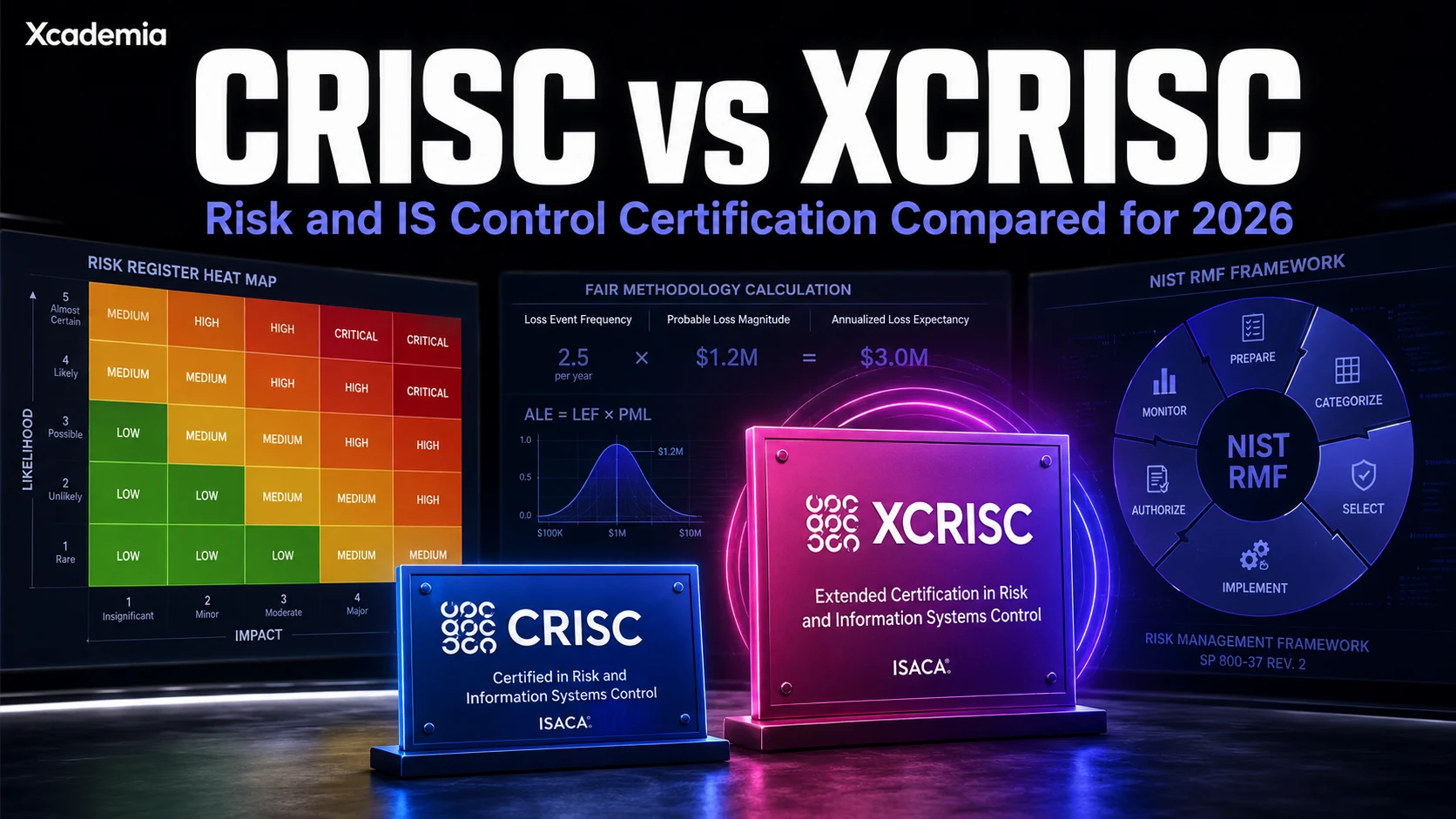
Risk and Information Systems Control Certification Compared for 2026
ISACA's Certified in Risk and Information Systems Control is one of the most specifically targeted credentials in the GRC space. Where CISM covers the IS management programme broadly, CRISC focuses specifically on enterprise IT risk and the design and implementation of IS controls. It is the credential that says: this professional understands not just that controls are needed, but which ones, why, and how to assess whether they are working.
XCRISC is Xcademia's Risk and IS Control Practitioner certification. Five instructor-led days. Practitioner-assessed. Built around the applied risk and control capability that the GRC analyst role demands at mid-to-senior level.
CRISC is unusual in the certification market because it has a specific, clearly defined scope that maps well to a real job function. The GRC analyst who holds CRISC has a credential that is directly relevant to their daily work. The question is whether the examination format provides the evidence of applied capability that the role actually requires.
What CRISC Is and What It Tests
CRISC covers four domains: governance, IT risk assessment, risk response and reporting, and information technology and security. The domain weights reflect the risk-centric nature of the credential, with IT risk assessment carrying the highest weight at 26%, followed by risk response and reporting at 32%.
The examination is 150 multiple choice questions over four hours. Like CISM, it is a four-hour knowledge examination that tests whether candidates understand the concepts across the four domains. Unlike some competing risk certifications, CRISC's questions are scenario-based rather than purely conceptual, which makes them a more accurate test of applied understanding.
Where CRISC genuinely delivers
Specific scope: CRISC maps more directly to the GRC analyst's actual work than broader credentials like CISSP or CISM
Financial services recognition: CRISC is particularly well-recognised in financial services, banking, and insurance where risk management has a long institutional history
ISACA community: The same professional network value that applies to CISM applies to CRISC
Scenario-based questions: The examination format is more applied than pure MCQ, reducing the gap between what is tested and what the job requires
UAE and global recognition: CRISC is well-recognised in the UAE market where ISACA credentials are widely sought
The honest limitation
CRISC is a 150-question scenario-based MCQ examination. The scenarios are more realistic than pure concept questions, but the candidate is still selecting from four options rather than making a real risk decision with incomplete information, competing stakeholder pressures, and real consequences. The examination tests whether you would make the right decision in a structured scenario. It does not test whether you can make the right decision when the risk register has forty open items, the audit is in three weeks, and the CISO wants the board report by Friday.
CRISC is the most relevant certification in the ISACA portfolio for GRC analysts focused on risk management. It is also an examination. The gap between passing CRISC and being able to conduct a FAIR-based quantitative risk assessment for a board, or design a control framework for a new regulatory requirement, is closed by experience not by the credential. Competitor pricing correct at time of publication.
What XCRISC Covers and How It Is Assessed
XCRISC is Xcademia's Risk and IS Control Practitioner certification. Five instructor-led days. No multiple choice examination. Applied risk and control work throughout.
Programme scope
Risk governance and appetite: Designing risk governance frameworks, translating organisational risk appetite into operational risk tolerances, accountability structures for risk decisions
IT risk identification and assessment: Systematic risk identification methodologies, qualitative and quantitative risk assessment approaches, scenario-based risk workshops
FAIR methodology applied: Factor Analysis of Information Risk as a practical tool for quantitative risk assessment, not as a theoretical framework
Control framework design: Mapping risk assessments to control requirements, selecting appropriate control types (preventive, detective, corrective), identifying control gaps
Control testing and effectiveness assessment: Designing control tests, interpreting test results, distinguishing between control design failures and control operating failures
NIST RMF and ISO 31000 applied: Using the risk management frameworks in realistic organisational scenarios, not describing their structure
Risk response design: Risk treatment options applied to realistic scenarios, risk acceptance justification, risk transfer mechanisms
Risk reporting at multiple levels: Technical risk reporting for IT and security teams, operational risk reporting for management, executive and board-level risk communication
Regulatory risk mapping: Mapping an organisation's risk profile against specific regulatory requirements (DORA, NIS2, UK GDPR) and identifying compliance-specific control gaps
The capstone
The XCRISC capstone presents candidates with a realistic risk assessment scenario: a mid-market financial services organisation expanding its cloud footprint, facing a DORA compliance deadline in six months, and with a board that has just experienced a near-miss security incident and is asking difficult questions about the current risk posture. Candidates must conduct a risk assessment using FAIR methodology for two critical scenarios, design a prioritised control framework addressing the identified risks, produce an executive risk report for the board, and present a regulatory gap analysis for DORA. The capstone is assessed by a senior Xcademia GRC practitioner. Verifiable at xcademia.com/verify.
The XCRISC capstone is the risk assessment that the job actually requires. Not the multiple choice version of it. Candidates who pass it have conducted quantitative risk analysis, designed controls, and communicated risk to an executive audience under assessment conditions.
FULL COMPARISON MATRIX
CRISC (ISACA) | XCRISC (Xcademia) | |
|---|---|---|
Awarding body | ISACA | Xcademia |
Assessment format | 150 MCQ, 4 hours | Practitioner capstone, mentor sign-off |
Duration | Self-study (3-6 months) | 5 intensive instructor-led days |
Experience required | 3 years IS risk management (some substitutions) | Risk management practitioner context expected |
Exam cost | $575 USD (member) / $760 USD (non-member) | Included in £4,495 |
Renewal | Every 3 years, 120 CPE + $85 USD/yr maintenance | No renewal required |
Framework coverage | ISACA risk framework, COBIT, NIST | ISACA, ISO 31000, NIST RMF, FAIR applied |
Quantitative risk | Introduced | FAIR methodology applied in exercises |
Control design | Conceptual coverage | Control design and gap analysis in labs |
Market recognition | Strong globally. Very strong UK, UAE, financial services. | UK and UAE, growing rapidly |
What it proves | Risk and IS control knowledge across ISACA framework | Applied risk management and control design under real conditions |
Who Should Choose CRISC
You are targeting GRC, risk management, or IS control roles in financial services, banking, or insurance where CRISC is a specific hiring requirement or widely recognised
You are building the ISACA credential portfolio (CISA, CISM, CRISC) and want the risk management piece of that recognised set
You are in the UAE or Middle East market where ISACA credentials carry strong employer recognition
Your employer will fund CRISC as a named credential for the IS risk management function
CRISC best for risk management market recognition and ISACA portfolio:
CRISC is the most recognised IS risk and control credential globally. In financial services and ISACA-aligned markets, it is the credential the hiring manager knows. Prepare for it properly using real risk scenarios rather than exam pattern drilling.
Who Should Choose XCRISC
You are a GRC analyst or risk manager who wants a practitioner-assessed credential demonstrating applied risk management capability rather than examination knowledge
You have framework knowledge (perhaps through CRISC or CISM study) and want to demonstrate you can apply it in realistic scenarios under assessment conditions
You want five days of intensive applied risk management training: FAIR methodology, control design, regulatory gap analysis, and executive risk communication assessed by a practitioner
You are targeting senior GRC or risk manager roles where the interview will include a case study or scenario exercise, and you want assessed evidence that you have already done that work
XCRISC best for applied risk management and IS control capability:
XCRISC develops and assesses the applied risk management capability that CRISC describes in its domain framework. FAIR quantitative analysis, control framework design, regulatory gap mapping, and board risk communication. Five days. Practitioner-assessed. No MCQ. No renewal. Verifiable at xcademia.com/verify.
The ISACA Triple: CISA, CISM, CRISC
Many GRC professionals working toward senior roles pursue all three core ISACA credentials. CISA for audit and assurance. CISM for IS management programme leadership. CRISC for risk and IS control. Each addresses a different dimension of the GRC function.
The Xcademia GRC practitioner pathway mirrors this structure with applied assessment at each level: XCISM for programme management capability, XCRISC for risk and control capability, and XPRI for data protection and privacy capability. Holding both the ISACA credential and the Xcademia practitioner equivalent provides both the market recognition layer and the applied capability evidence layer.
CRISC tells the employer you know how risk management works. XCRISC tells them you have done it under assessment conditions. For the GRC professional building toward a senior role, both questions need answering. The combination is more credible than either alone.
Demonstrate Applied Risk Management Capability With XCRISC XCRISC: five instructor-led days covering FAIR methodology, control framework design, regulatory gap mapping (DORA, NIS2), and board risk communication. Practitioner-assessed capstone. No MCQ. No renewal. Verifiable at xcademia.com/verify. Explore XCRISC |
|---|
Ready to go deeper?
Professional Training
Hands-on, mentor-led training aligned with industry certifications.
About the Author
Sharper every day
Daily tutorials, analysis, and career playbooks across all 12 Xcademia disciplines, straight to your inbox. No spam.