
WPP Builds Google Cloud Data Platform to Scale AI Marketing
WPP partnered with Google Cloud to build a unified data and platform engineering foundation for AI-powered marketing, cutting creative and strategy time from four weeks to three hours while increasing production efficiency by 70%.
Xcademia Team
Xcademia Research Team

WPP Is Building the Infrastructure Behind AI-Powered Marketing
Marketing agencies operate across fragmented markets, large volumes of data and constantly changing customer behavior. For global agency networks, turning that information into useful insights can be difficult when data is spread across different organizations, systems and workflows.
WPP is addressing that challenge by building a unified data and platform engineering foundation for its AI-powered marketing system, WPP Open.
According to Google Cloud, WPP partnered with Google Cloud to create a centralized data backbone and standardized platform engineering approach designed to make AI-powered marketing workloads easier to deploy, secure and operate.
The engineering challenge was significant.
Before WPP could fully use advanced AI models for marketing insights, it needed a reliable way to ingest, clean, standardize and serve data from hundreds of global agencies.
The company therefore focused not only on AI models, but also on the infrastructure underneath them.
By standardizing data processing, serverless computing and software deployment patterns, WPP says it can now deploy targeted marketing campaigns in days rather than months.
The reported results are significant. WPP reduced creative and strategy time from four weeks to three hours, achieved a 70% gain in production efficiency, increased content volume by 33x, and reported a 2.8x increase in campaign return on investment.
Building a Centralized Data Foundation
A major part of WPP's transformation involved changing how data and workloads were organized across Google Cloud.
Instead of placing each workload into completely separate silos, WPP adopted a service-based project structure for its production environment.
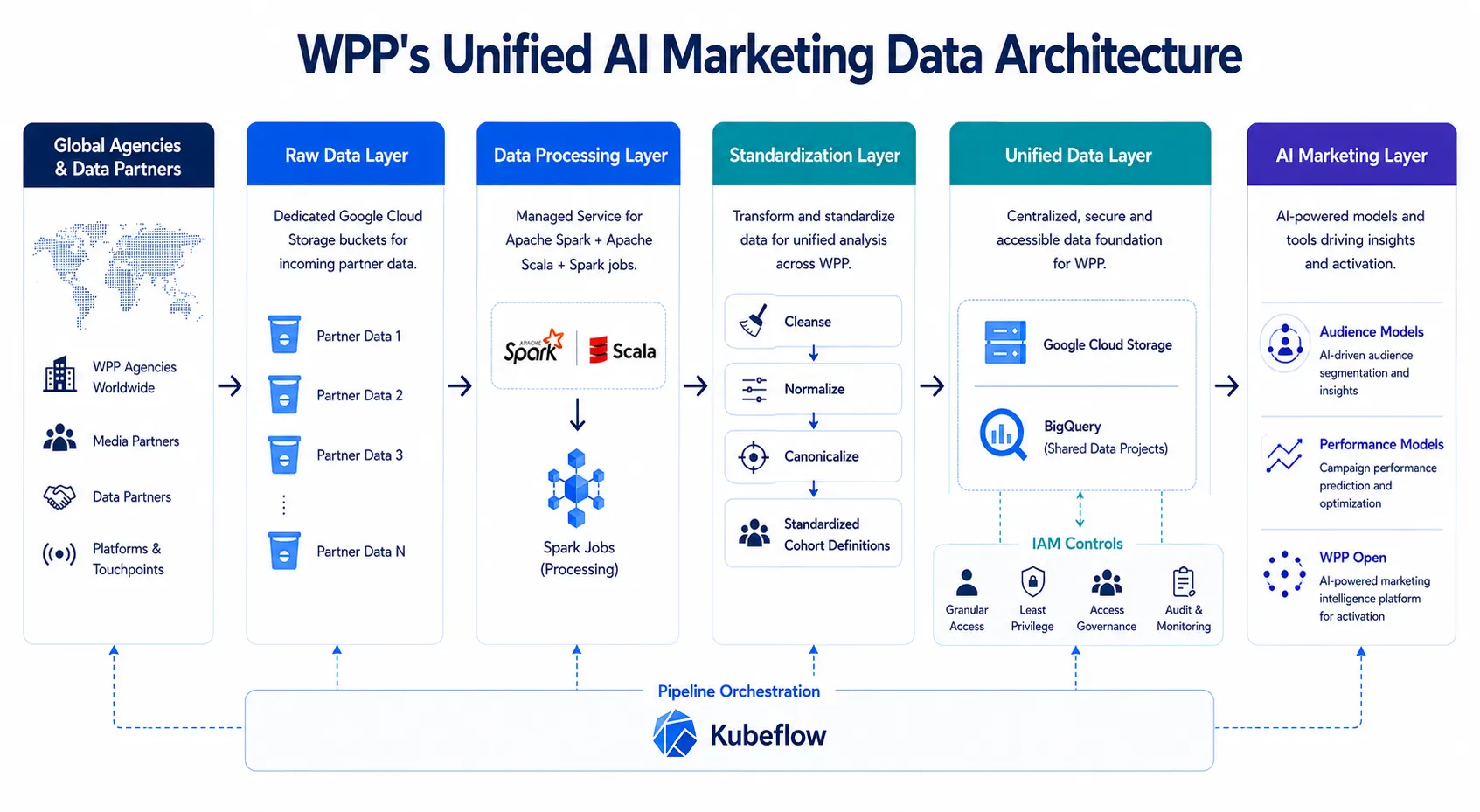
The engineering team centralized Google Cloud Storage and BigQuery into dedicated shared data projects while separating compute and processing workloads into distinct processing projects.
This approach created a more consistent experience for teams working with data.
Rather than having different groups access isolated sources of information, data consumers could work from a unified data foundation.
However, bringing data into shared infrastructure also creates a significant security requirement.
WPP therefore applied Identity and Access Management controls at the individual Google Cloud Storage bucket and BigQuery dataset levels.
This granular approach ensures that teams can access only the information they are authorized to use.
Separating Raw Data From Processed Information
WPP also created dedicated Google Cloud Storage buckets for raw data arriving from various partners.
Keeping raw inputs organized and isolated provides a controlled starting point for downstream processing.
From there, Managed Service for Apache Spark runs custom Apache Scala and Spark jobs that cleanse, normalize and canonicalize the incoming information.
The processed data is transformed into standardized cohort definitions, which become important building blocks for WPP's marketing data framework.
WPP combines this serverless architecture with Kubeflow for pipeline orchestration.
This allowed its data engineering teams to avoid much of the infrastructure management associated with maintaining clusters.
Instead, engineers could concentrate on the transformation logic that prepares data for downstream Google Cloud Storage and BigQuery layers.
Those layers ultimately support WPP's audience and performance AI models.
Standardizing Data Into Unified Cohorts
Once raw information enters WPP's processing environment, its platform converts it into standardized cohort definitions.
These cohorts are based on five key dimensions:
Age
Gender
Geography
Product
Interest
These definitions are not static.
WPP continuously canonicalizes the underlying concepts as marketing requirements and definitions evolve.
The standardized structure allows WPP to join and aggregate information globally without exposing sensitive underlying details or depending on shared identifiers.
This provides an important foundation for large-scale AI applications.
WPP's standardized cohort framework is designed to create a common structure across its fragmented data environment.
Type-Safe Data Processing Improves Traceability
WPP built its core processing engine using type-safe Scala.
According to Google Cloud, the custom framework provides visibility into how information is transformed while supporting source traceability and compliance.
This means curated data can be traced back to its original source.
That capability becomes increasingly important when data is used for enterprise AI.
Data scientists need to understand what information contributes to model outputs, while auditors and governance teams need visibility into how data moves through the system.
WPP is also preparing to transition to Google Cloud Knowledge Catalog for automated enterprise-wide data governance.
The combination of standardized data, source traceability and governance is intended to create a more reliable foundation for AI workloads.
Standardizing the Enterprise Software Lifecycle
Building a reliable data foundation was only one part of WPP's transformation.
The company also needed a consistent way to develop, deploy and operate applications and infrastructure.
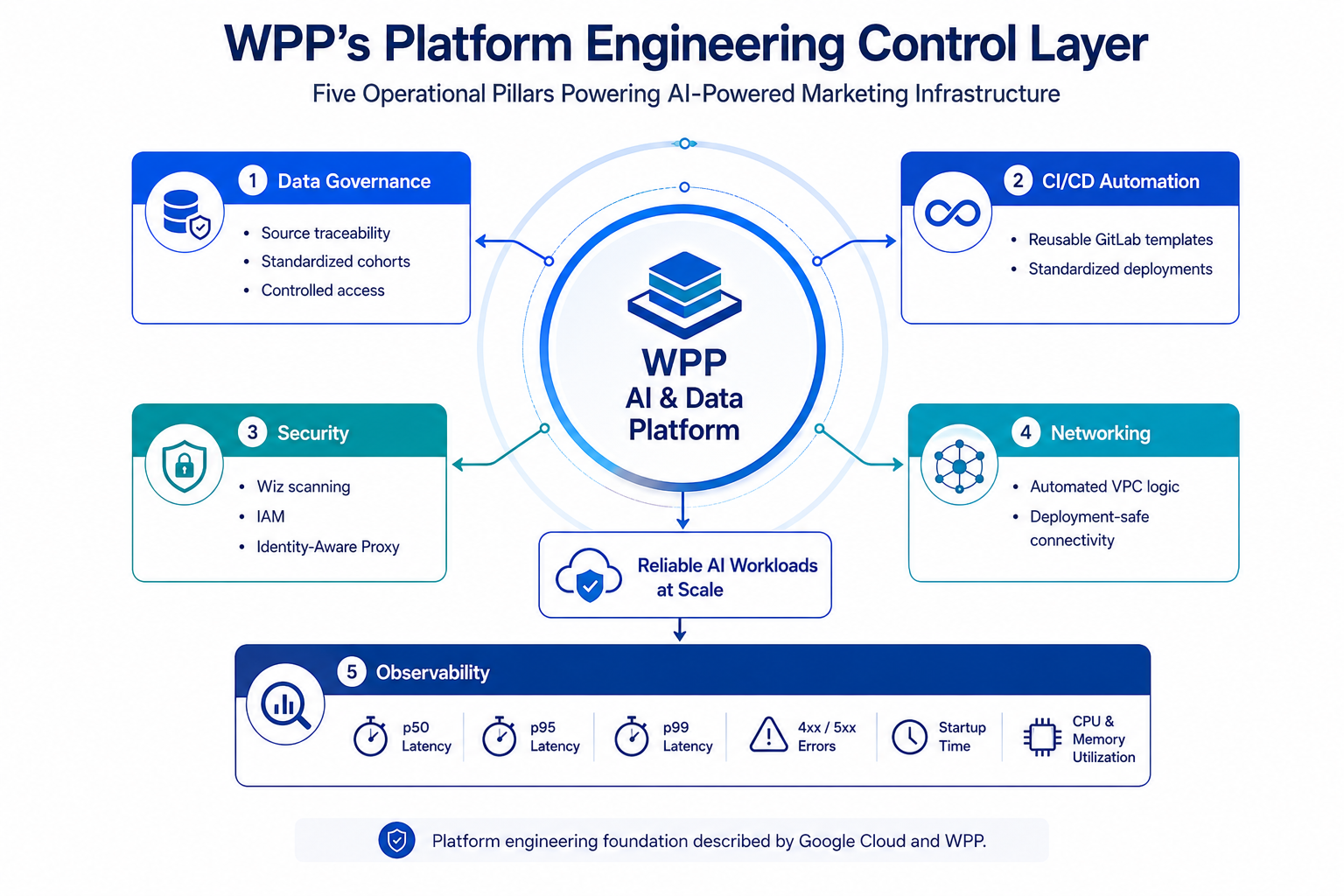
WPP's platform engineering team therefore created a collection of reusable and centralized GitLab CI/CD templates.
These templates reduce the amount of infrastructure and deployment work individual development teams need to manage.
They also help ensure that applications meet corporate security requirements before reaching production.
The template suite includes universal Cloud Run templates for full-stack web applications, batch data processing and scheduled pipelines.
It also includes deployment templates for multi-stage workflows and Cloud Run functions deployment templates for event-driven microservices.
By standardizing these patterns, WPP can give development teams reusable deployment mechanisms instead of requiring each team to build its own approach.
Build Once, Deploy Many
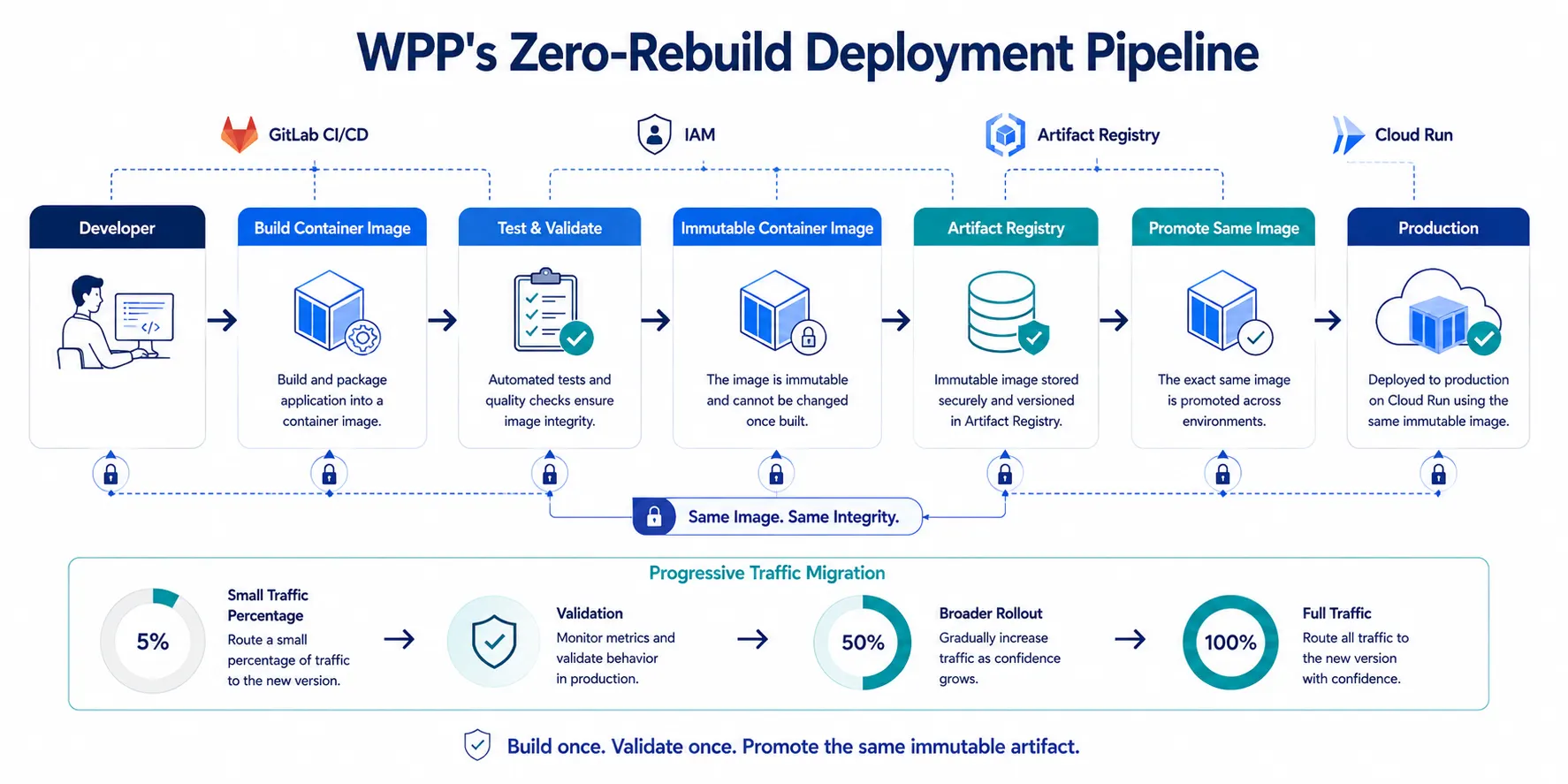
Another important element of WPP's platform engineering strategy is its use of a "build once, deploy many" approach.
Traditionally, rebuilding container images for production can introduce unnecessary risk.
If a production image is rebuilt separately from the development version, there is a possibility that the environments will no longer contain exactly the same software.
That can create configuration drift and unexpected behavior.
WPP addresses this through zero-rebuild promotion.
Developers build and test container images in the development environment.
Once an immutable image has been validated, that same image is promoted directly into production.
The approach maintains consistency between environments because the artifact that was tested is the artifact that reaches production.
WPP also uses cross-project IAM controls and Google Cloud Artifact Registry configurations to support this deployment model.
Progressive Traffic Migration Adds Another Safety Layer
WPP's deployment templates also support progressive traffic migration.
Instead of immediately sending all users to a new application revision, teams can initially route a smaller percentage of traffic to the new version.
If the deployment behaves as expected, traffic can gradually be increased.
This provides teams with an additional opportunity to identify unexpected issues before a complete rollout.
Combined with immutable container images, standardized deployment templates and centralized security controls, the approach creates a more predictable software delivery process.
For an organization operating AI and data workloads at global scale, deployment consistency becomes particularly important.
Security Is Built Into the Platform
WPP treats security as a foundational part of its platform engineering architecture.
The company integrated Wiz security scanning directly into the pre-push stage of its CI/CD pipeline.
The goal is to identify vulnerabilities before code is merged, allowing security checks to become part of the development workflow rather than a separate step performed later.
WPP also uses Google Cloud Identity-Aware Proxy to enforce zero-trust access across internal applications.
This provides another layer of protection around applications and internal resources.
Rather than assuming that users or systems are trusted simply because they are inside a corporate environment, access is controlled based on identity and authorization.
Automating Network Configuration
WPP also standardized networking through reusable templates containing intelligent VPC logic.
According to Google Cloud, the configuration can automatically identify and resolve conflicts between legacy VPC connectors and modern Direct VPC access.
Networking conflicts can otherwise result in deployment failures and additional troubleshooting work.
By incorporating this logic into reusable templates, WPP aims to reduce operational complexity and accelerate application releases.
This is another example of WPP shifting platform engineering from individual manual configuration toward standardized automation.
Measuring Operational Health With Detailed Metrics
A modern AI and data platform also needs strong observability.
WPP's engineering team therefore monitors detailed operational metrics instead of relying only on deployment frequency.
The company tracks request latency across:
p50
p95
p99
It also monitors:
4xx error rates
5xx error rates
Container startup times
CPU utilization
Memory utilization
Monitoring these indicators provides visibility into both application performance and infrastructure health.
Container startup monitoring is particularly useful for identifying cold-start issues in serverless environments.
The broader objective is to ensure that WPP's data pipelines and serverless infrastructure remain highly available as workloads scale.
The Business Impact of WPP's AI Infrastructure
The engineering transformation was designed to support WPP's broader AI-powered marketing strategy.
According to Google Cloud, WPP's ability to operationalize its data and AI stacks produced measurable business results.
The company reports that it reduced creative and strategy time from four weeks to three hours.
That represents a significant change in how quickly marketing teams can move from planning to execution.
WPP also reported a 70% gain in production efficiency.
The company increased its content volume by 33x, indicating that the platform allowed teams to produce significantly more content within the same operational environment.
WPP also reported a 2.8x increase in campaign return on investment.
Together, these figures demonstrate the intended connection between platform engineering and business outcomes.
The AI capabilities themselves are only one part of the equation.
The underlying data foundation, security controls, deployment automation and observability provide the infrastructure required to put those capabilities into production.
The Bigger Lesson for Enterprise AI
WPP's work with Google Cloud demonstrates that operationalizing AI requires more than selecting powerful models. Organizations also need the data foundations, platform automation, security controls and observability required to deploy and manage AI workloads reliably at scale.
For WPP, that meant creating a unified data foundation, standardizing data processing, implementing granular access controls, automating software deployment and establishing detailed operational monitoring.
This approach helped address the fragmentation that previously made it difficult to efficiently and securely use marketing data across the company's global operations. By bringing these capabilities together, WPP created a more consistent foundation for its AI-powered marketing workloads.
The business results reported by WPP highlight the impact of that engineering foundation. The company reduced creative and strategy time from four weeks to three hours, reported a 70% gain in production efficiency, increased content volume by 33x, and achieved a 2.8x increase in campaign return on investment.
The broader takeaway is that enterprise AI is not only an AI-model challenge. It is also a data engineering and platform engineering challenge.
For organizations moving AI from experimentation into production, reliable data pipelines, standardized deployment, security and observability can be just as important as the models themselves.
For WPP, those engineering foundations are helping turn AI-powered marketing into an operational platform that can support faster execution, greater production efficiency and measurable business outcomes.
Source: Google Cloud Blog
About the Author