
Google Cloud Shows How AlphaEvolve Can Optimize Video Processing
Google Cloud explains how AlphaEvolve combines Gemini-powered code generation with local hardware benchmarking to optimize video processing. A DoIt case study shows how automated evolutionary search can improve performance while preserving visual quality.
Xcademia Team
Xcademia Research Team
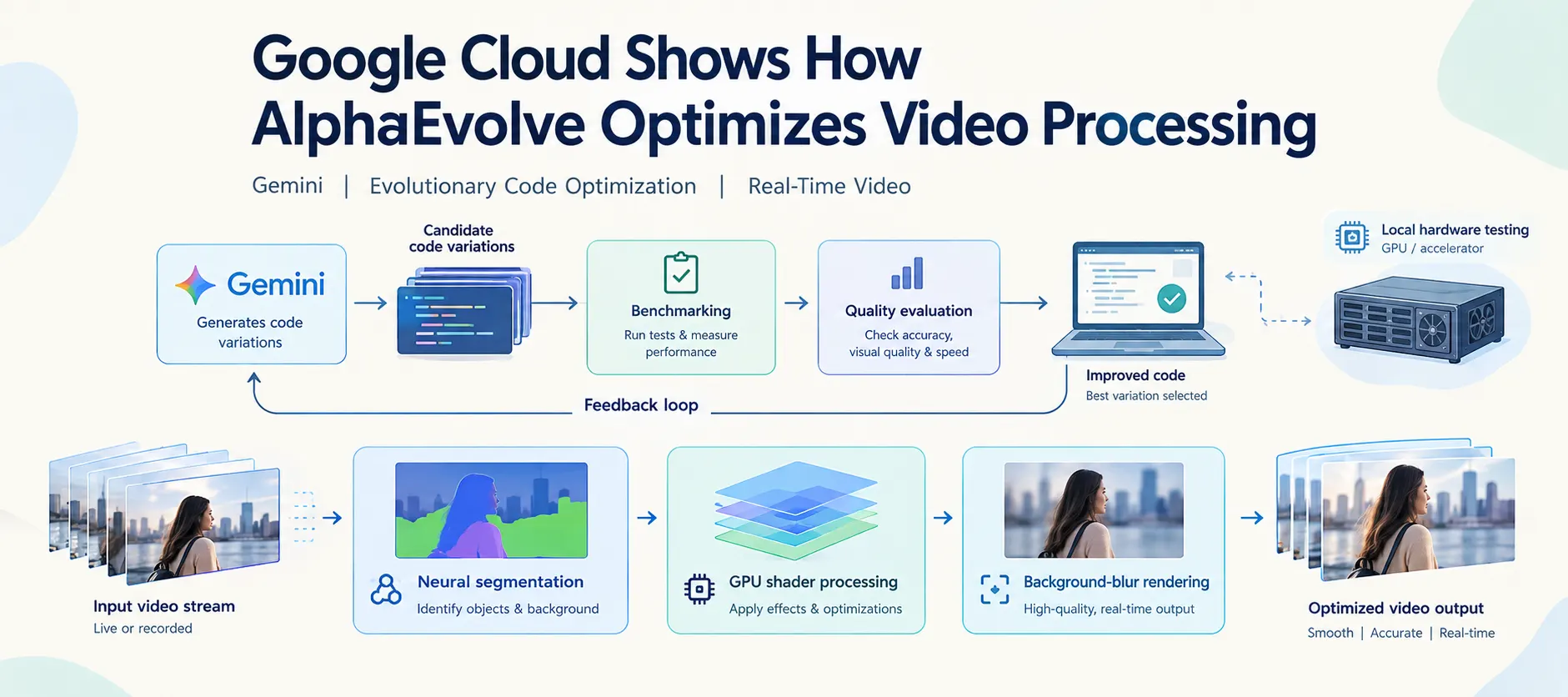
Google Cloud has published a technical guide explaining how developers can use AlphaEvolve to optimize video-processing workloads through automated code generation, hardware-based evaluation and iterative performance testing.
The article describes a collaboration between Google and DoIt, in which AlphaEvolve was used to optimize production Swift code in a live macOS streaming application.
The approach combines cloud-based Gemini model reasoning with local execution and benchmarking. Instead of relying on developers to manually identify and tune every performance bottleneck, AlphaEvolve generates candidate code variations and evaluates them against a custom scoring function.
Google Cloud says the method can uncover optimization opportunities that manual profiling may miss.
The guide focuses on real-time video processing, particularly camera background blur, but also discusses how the same optimization principles could apply to other performance-sensitive workloads, including microservices, database queries, machine learning pipelines and embedded systems.
Why Video Processing Needs Precise Performance Optimization
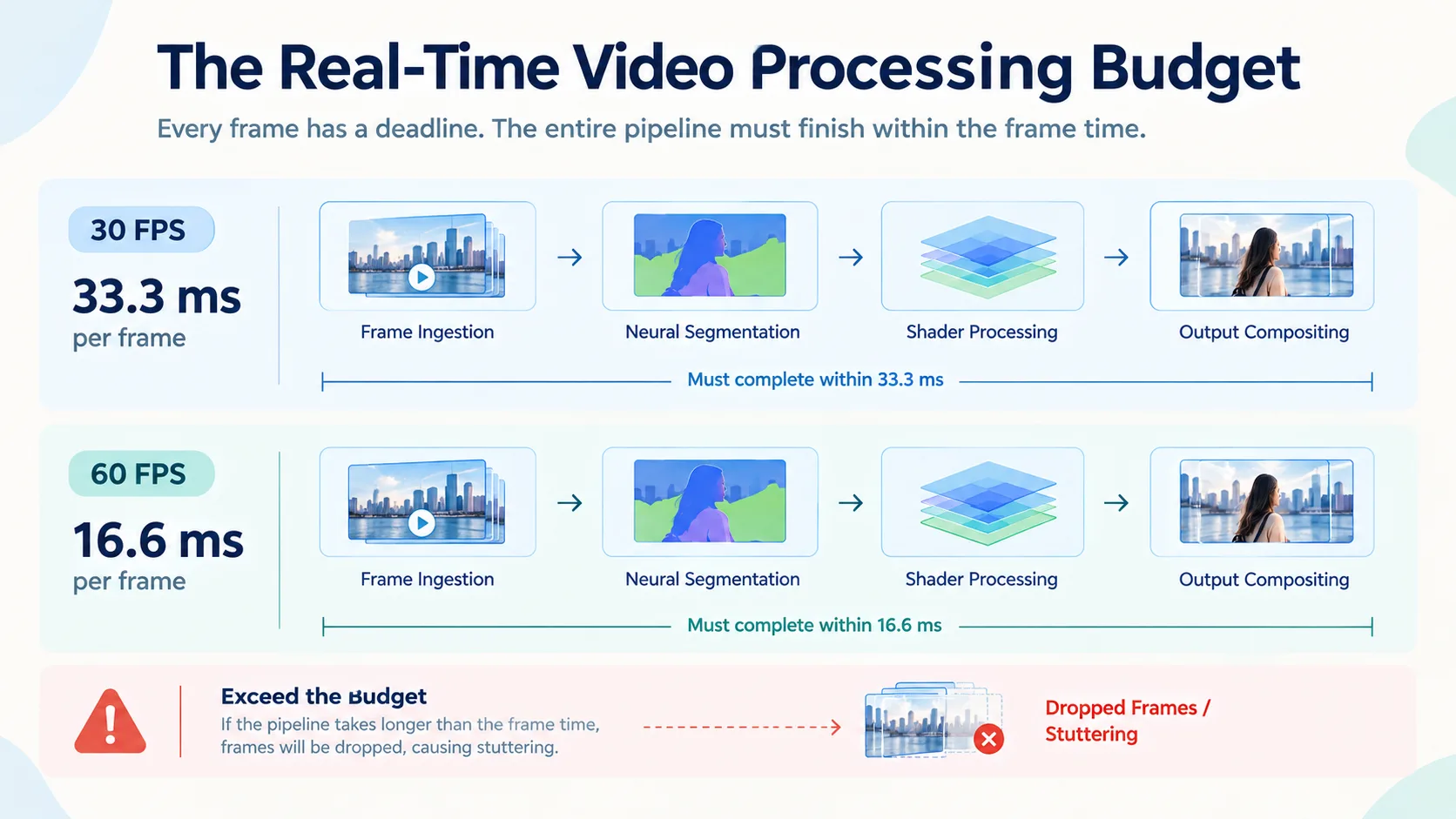
Real-time video processing operates under strict timing constraints.
At 30 frames per second (fps), a system has approximately 33.3 milliseconds per frame. At 60 fps, that budget drops to approximately 16.6 milliseconds.
Within that time, a video pipeline may need to ingest camera frames, run neural segmentation, apply visual effects and composite the final output.
Exceeding the available frame budget can result in dropped frames and visible stuttering.
Developers often optimize these pipelines by examining performance traces, identifying bottlenecks and manually adjusting low-level code written in languages such as Swift, C++ or Metal.
Google Cloud describes this process as time-consuming and difficult to scale.
Standard AI coding assistants can generate code and suggest local improvements, but the source argues that they do not automatically benchmark native code on target hardware or verify that performance changes preserve visual quality.
AlphaEvolve introduces a different approach: an iterative optimization loop that generates code, executes it against a benchmark and uses the results to guide subsequent candidates.
How AlphaEvolve's Split-Loop Architecture Works
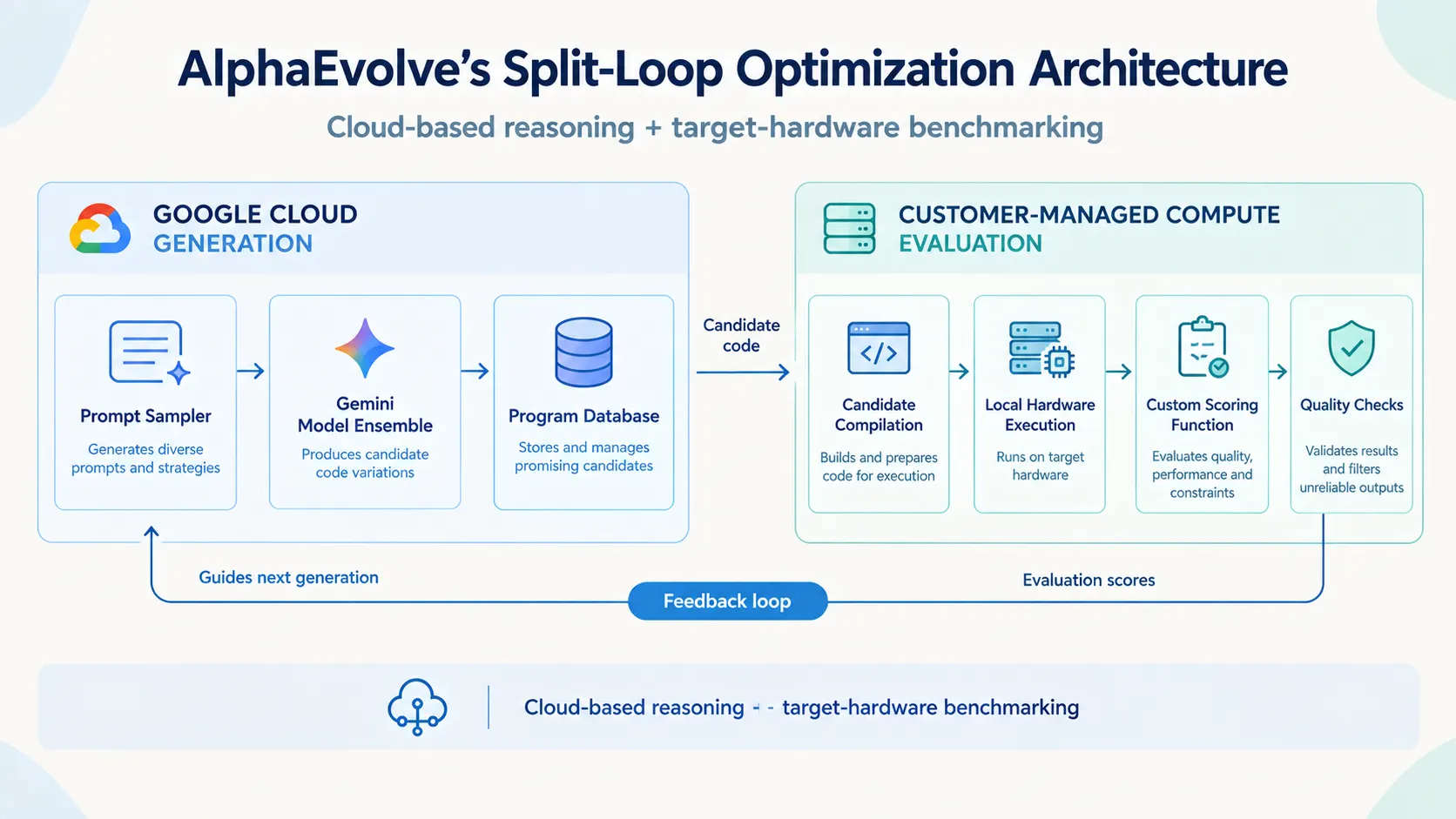
AlphaEvolve uses a closed-loop evolutionary process to improve a program against a defined scoring function.
The process begins with a seed program and a custom evaluator. A mixture of Gemini models proposes code variations, and the evaluation system scores each candidate. Higher-performing candidates are retained and used to guide subsequent generations.
The process repeats as the system searches for better-performing solutions.
Google Cloud describes the architecture as having two distinct parts.
1. Cloud-Based Code Generation
The generation side runs as a Google Cloud-managed service.
It includes:
A prompt sampler
A Gemini model ensemble
A program database
Google Cloud manages the generation process, including scaling and prompt orchestration.
This allows the evolutionary search to generate and manage candidate code variations without requiring developers to build the entire generation infrastructure themselves.
2. Customer-Managed Evaluation
The evaluation side runs on customer-managed compute.
Developers define the scoring function and decide how each candidate should be tested. The evaluator can run on local hardware or another target architecture.
In the video-processing example, the evaluation environment uses macOS and native Swift code.
The evaluator compiles each candidate using swift and executes it against a standard reference webcam clip.
Although the cloud generation side is Python-first, Google Cloud says the evaluation component can be written in any programming language.
This separation allows the model to generate code while the developer retains control over the actual performance and quality measurements.
Why the Evaluator Matters More Than the Code Alone
AlphaEvolve does not directly observe whether a video looks correct.
Instead, it receives the numerical fitness score returned by the evaluator.
That creates a risk: if the scoring function rewards speed without adequately checking output quality, the optimization process may discover ways to improve the score while failing to perform the intended task.
Google Cloud describes an example from its early experiments.
A naive scoring function focused heavily on latency. The system found an extremely fast solution by bypassing the blur-rendering operation and returning unmodified frames.
The result was a reported processing time of 0 milliseconds, but the intended visual effect was missing.
This illustrates a central principle of automated optimization: the quality of the result depends heavily on the quality of the evaluation criteria.
A candidate that performs well against an incomplete benchmark may not be useful in a real application.
Using SSIM to Preserve Visual Quality
To prevent the optimization loop from bypassing the intended video-processing task, the team introduced a quality gate based on Structural Similarity Index Measure (SSIM).
SSIM compares structural similarity between images. In the example, it is used to assess whether the optimized output remains visually close to a reference result.
The source describes a two-part scoring approach:
Measure speed improvement relative to the baseline.
Evaluate visual similarity against a reference output.
The article provides the following code examples.
Speedup calculation
speedup = baseline_ms_per_frame / candidate_ms_per_frameThis calculates the speedup by dividing the baseline time per frame by the candidate's time per frame.
Visual similarity measurement
ssim = mean_ssim_vs_goldenThis represents the mean SSIM score against a reference, or "golden," output.Quality gate
The source provides the following threshold-based check:
# Disqualify any candidate falling below visual threshold
if ssim < 0.98 or worst_frame_ssim < 0.95:
    return {"speedup": -1e12}

return {"speedup": speedup, "ssim": ssim}
Under this example, candidates are disqualified if the average SSIM falls below 0.98 or the worst-frame SSIM falls below 0.95.
The returned penalty value prevents candidates that fail the quality checks from being treated as successful optimizations.
These thresholds belong to the example described in the source. They should not be interpreted as universal requirements for all video-processing applications.
Why Testing Must Include Difficult Video Clips
Google Cloud emphasizes that the quality of the benchmark data matters as much as the scoring formula.
Static images and blank camera frames may not expose problems that appear during movement.
For example, an optimization might perform well on an average similarity score while producing visible artifacts during rapid head movements.
The guide recommends testing against challenging clips and tracking both average and worst-frame similarity.
This approach can help detect issues such as dropped frames, delayed mask updates and visual artifacts that might otherwise be hidden by aggregate measurements.
The goal is to ensure that the optimization improves performance without sacrificing the intended visual output.
AlphaEvolve Can Discover Algorithmic Improvements
Google Cloud says evolutionary search can do more than optimize individual loops or adjust memory allocation.
When given enough context and appropriate evaluation criteria, the system may discover broader architectural changes.
In the video-processing case study, the team highlights several engineering lessons.
Provide Framework Context
Developers should provide relevant SDK headers, interface definitions and API references rather than limiting the model to an isolated processing function.
A narrow view of the code may prevent the system from identifying opportunities that depend on interactions across a larger framework.
Expose Multi-Frame State
The guide recommends allowing candidate code to maintain bounded state across executions when the application requires it.
Examples include historical masks and cache timestamps.
This gives the optimization process the ability to explore changes that depend on information from earlier frames rather than treating each frame as an entirely independent operation.
Use Quality Gates to Control Trade-Offs
The team describes an example in which AlphaEvolve introduced temporal mask caching.
The initial implementation cached masks too aggressively, producing visible trailing artifacts.
The SSIM quality gate penalized the visual degradation during motion, allowing the search to converge on a more suitable caching window without manual parameter tuning.
The example illustrates how a well-designed evaluator can guide the system toward a balance between computational efficiency and output quality.
Measuring Performance Against Hardware Limits
Another central lesson in the guide is that optimization requires an understanding of the hardware's physical performance limits.
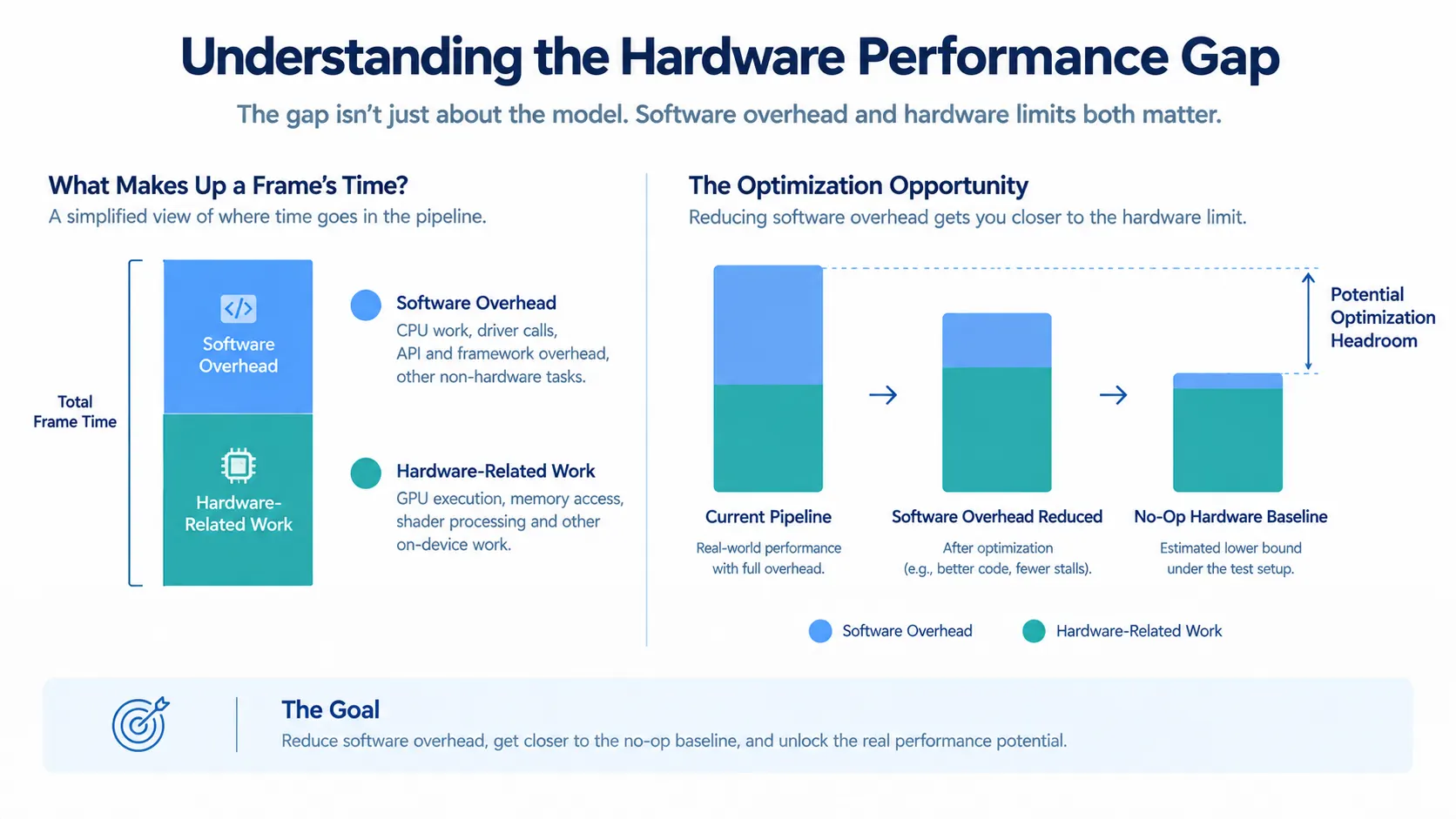
Google Cloud divides total frame-processing time into two broad categories.
Mutable Software Overhead
These are costs that may be reduced through software optimization, including:
Memory allocations
Buffer format conversions
Thread context switches
API dispatch overhead
Immutable Hardware Floors
These are costs tied to the underlying hardware and workload, such as:
Neural Engine inference latency
GPU shader computation time
Hardware display synchronization
The distinction matters because not every part of a processing pipeline can be optimized indefinitely.
A developer may reduce software overhead but still face a lower bound determined by the work the hardware must perform.
Building a No-Op Pipeline
Google Cloud recommends creating a minimal baseline that strips away unnecessary orchestration and data-handling work.
In the example, this involves removing Swift or C++ orchestration, data marshalling and frame conversions, then dispatching only the pre-warmed machine learning model and the basic GPU pass on a dummy buffer.
The resulting measurement provides an estimate of the pipeline's hardware-related lower bound under that test setup.
This helps developers understand how much of the total processing time may be addressable through software optimization.
Measuring the Remaining Optimization Opportunity
The article also discusses calculating the addressable performance ceiling and scoring optimization against the gap between current performance and the hardware floor.
However, the source text provided here does not include the full equations shown in its linked graphics. Those formulas are therefore not reproduced or reconstructed.
The broader principle is to evaluate optimization progress against the performance headroom that remains, rather than relying only on arbitrary speedup targets.
What the DoIt Case Study Demonstrates
The Google Cloud article describes a collaboration with DoIt, which used AlphaEvolve to optimize production Swift code in a live macOS streaming application.
The work focused on video processing, including a camera background-blur pipeline.
The team used cloud-based code generation and local evaluation to explore candidate implementations against performance and visual-quality criteria.
The source describes the optimization process as uncovering performance opportunities that manual profiling had not identified.
It also highlights the role of temporal mask caching and the use of SSIM thresholds to prevent the optimization from introducing unacceptable visual artifacts.
The source does not provide a single overall percentage improvement or a specific end-to-end latency reduction in the supplied text.
The result should therefore be understood as a case study in the optimization methodology rather than a universal performance guarantee for video-processing applications.
Applying the Same Approach Beyond Video Processing
Although the example focuses on video pipelines, Google Cloud says the split-loop architecture can be applied to other performance-sensitive workloads.
Potential areas discussed in the source include:
Microservice throughput
Database query performance
Machine learning tensor pipelines
Embedded systems
The general approach remains consistent:
Define a seed program and a target performance objective.
Build an evaluator that measures the relevant workload.
Establish quality gates to prevent invalid optimizations.
Generate candidate code through the evolutionary search.
Evaluate candidates on the target hardware or execution environment.
Use the results to guide further optimization.
The important requirement is that the scoring function reflects the real constraints of the application.
For video processing, that means balancing latency with visual fidelity. For other workloads, the relevant quality and correctness checks will depend on the system being optimized.
Open-Source Resources for Developers
Google Cloud says the benchmark code, test clips, evaluation scripts and raw candidate logs for the example are available through a public GitHub repository.
Developers can use the resources to examine the camera background-blur example and explore how the evaluation loop is structured.
Resources:
GitHub repository: AlphaEvolve Camera Background Blur Example
Technical case study: Running AlphaEvolve on Your Own Code
AlphaEvolve overview: AlphaEvolve is available for everyone
What This Means for AI-Assisted Performance Engineering
The AlphaEvolve guide highlights a shift from AI-assisted code generation toward closed-loop optimization, where generated code is repeatedly tested against real performance and quality measurements.
For developers, this approach could reduce some of the manual effort involved in exploring implementation alternatives.
It also changes the role of the engineering team. Instead of relying only on manually written optimization rules, developers define the objective, build the evaluator, establish correctness constraints and determine which candidates are acceptable.
The DoIt case study illustrates why these evaluation systems matter. A speed-focused metric alone allowed the system to bypass the intended video effect. Adding visual-quality checks helped constrain the search.
The broader lesson is that automated optimization depends on more than the code-generation model. It also requires realistic benchmarks, meaningful quality gates and an understanding of the hardware limits.
Google Cloud's example provides a practical starting point for developers exploring how evolutionary AI systems can optimize performance-sensitive applications while keeping evaluation under their control.
Source: Google Cloud Blog
About the Author