
How Google Cloud Uses AI to Strengthen Its Own Cybersecurity: Inside the CISO's Playbook
Google Cloud is using AI to transform its own cybersecurity operations, from faster threat detection and vulnerability management to AI-assisted incident response. Here's what security leaders can learn from Google's real-world approach to defending at cloud scale.
Xcademia Team
Xcademia Research Team

Introduction
Artificial Intelligence has rapidly become one of the biggest forces shaping modern cybersecurity. While cybercriminals are using AI to automate attacks, defenders are increasingly deploying the same technology to detect threats, investigate incidents, and strengthen security at unprecedented speed.
Google Cloud recently shared an inside look at how its own security organisation is using AI internally, not as a futuristic experiment, but as a practical capability that improves everyday security operations. According to Google Cloud's leadership, AI is already helping security teams analyse vast amounts of data, identify vulnerabilities faster, support analysts during investigations, and automate repetitive security tasks while keeping experienced humans firmly in control.
The AI Era Has Changed Cybersecurity
Traditional security teams face several growing challenges:
Millions of daily security events
Increasingly sophisticated phishing campaigns
AI-assisted malware development
Faster exploitation of vulnerabilities
Growing cloud infrastructure complexity
Google Cloud believes AI has fundamentally changed both sides of cybersecurity. Attackers now move faster than ever, but defenders can also leverage AI to process enormous datasets, recognise attack patterns, and respond much more quickly than traditional manual methods.
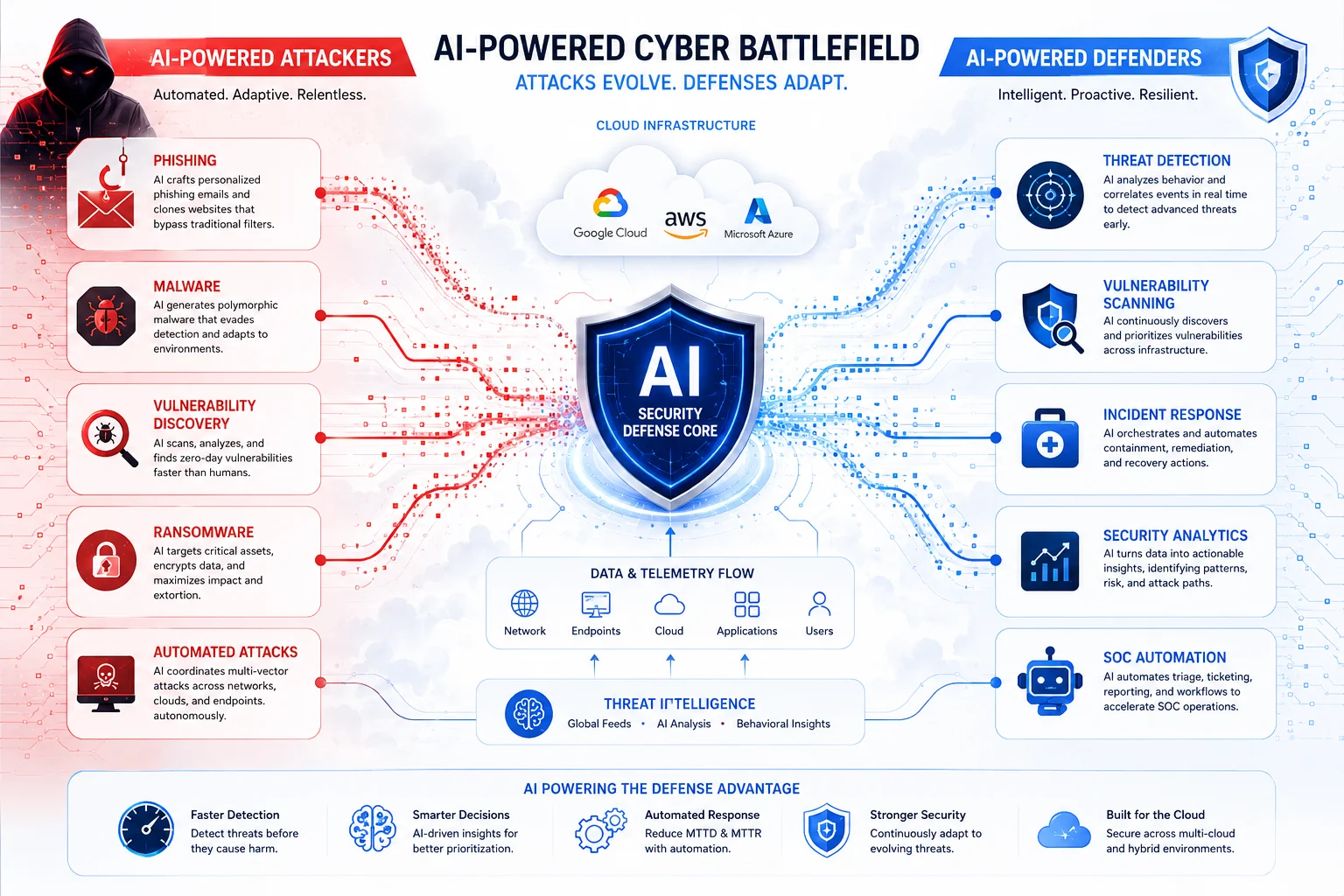
How Google Cloud Uses AI Internally
Rather than replacing security professionals, Google uses AI to amplify the capabilities of its security teams.
Several internal security functions now benefit from AI-assisted workflows.
Faster Threat Detection
Security teams process enormous volumes of telemetry generated across cloud infrastructure.
AI helps by:
Identifying abnormal behaviour
Prioritising high-risk alerts
Detecting emerging attack patterns
Reducing alert fatigue
Highlighting incidents requiring human attention
Instead of manually reviewing thousands of alerts, analysts receive prioritised intelligence that allows them to focus on the most significant threats.
Vulnerability Discovery at Massive Scale
One of Google's most significant observations is how dramatically AI accelerates vulnerability management.
Tasks that previously required months of manual review can now be completed in hours using multiple AI models.
AI assists engineers by:
Analysing source code
Reviewing software configurations
Identifying insecure dependencies
Finding weaknesses across binaries and firmware
Prioritising vulnerabilities based on risk
This allows security teams to spend more time fixing issues instead of simply finding them.
AI-Assisted Security Operations Centre (SOC)
Google is evolving toward an AI-assisted Security Operations Centre where intelligent agents help analysts throughout investigations.
Rather than acting independently, these AI agents support security professionals by:
Triaging alerts
Gathering contextual evidence
Assisting investigations
Automating repetitive workflows
Recommending next actions
Humans remain responsible for validating findings and making final security decisions.
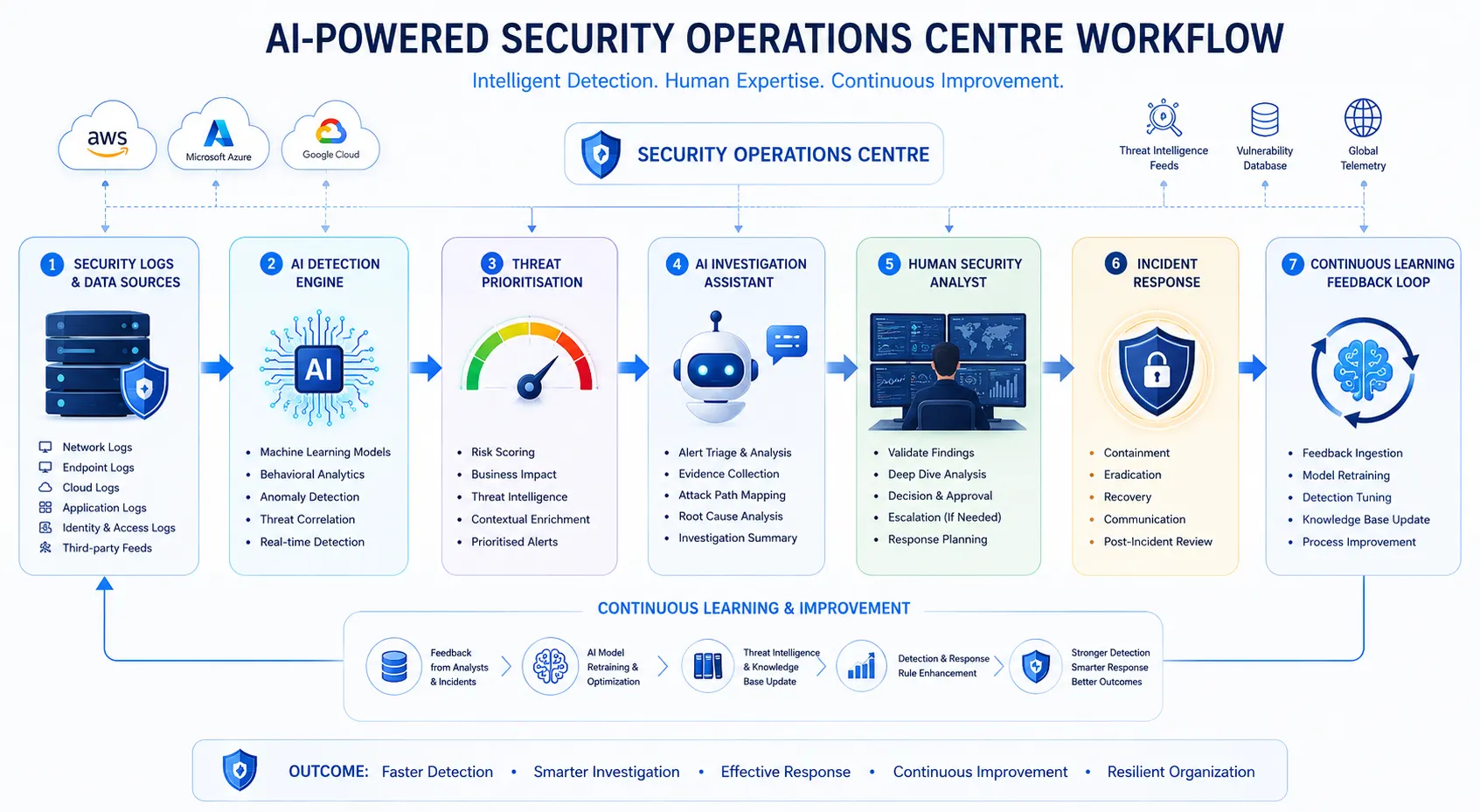
AI Tools and Security Capabilities Google Highlights
Google describes several areas where AI strengthens its internal security operations.
Agentic Security Workflows
Instead of isolated AI tools, Google is developing connected AI agents capable of:
Threat hunting
Alert investigation
Detection engineering
Workflow automation
Context gathering across multiple systems
These agents work alongside analysts rather than replacing them.
Natural Language Security
Security analysts increasingly interact with AI using conversational language.
This allows teams to:
Ask security questions naturally
Retrieve investigation results quickly
Build repeatable workflows
Save effective prompts
Share successful investigation methods across teams
Natural language interfaces help reduce operational complexity while improving analyst productivity.
Integration with Existing Security Platforms
A key theme is interoperability.
Rather than replacing existing infrastructure, Google's AI capabilities integrate with:
Security monitoring platforms
Threat intelligence services
Identity and Access Management (IAM)
Logging systems
Third-party security tools
This enables organisations to enhance existing investments instead of rebuilding security operations from scratch.
Insights from Google's Security Leadership
Google Cloud leaders consistently emphasise one important principle:
AI Should Augment Humans-Not Replace Them
According to Google's security leadership, the most effective approach combines:
AI speed
Human judgement
Security expertise
Organisational context
While AI excels at processing massive datasets and identifying patterns, experienced analysts remain essential for:
Risk assessment
Business context
Incident decisions
Strategic planning
Security governance
This "human-in-the-loop" approach helps organisations gain AI's advantages without sacrificing oversight.
Practical Lessons for Every Organisation
Google's experience offers several takeaways for organisations of all sizes.
Start with High-Volume Tasks
AI delivers the greatest value when automating repetitive work such as:
Alert triage
Log analysis
Vulnerability identification
Security reporting
Keep Human Oversight
Security decisions involving business risk should continue to involve experienced analysts.
AI should recommend, not automatically decide, high-impact actions.
Build Around Existing Security Investments
Instead of replacing mature security platforms, organisations should integrate AI into existing workflows.
Protect AI Systems Too
Google also stresses the importance of securing AI itself.
Security teams should consider risks such as:
Prompt injection
Data poisoning
Identity controls
Logging and monitoring
Policy enforcement
AI systems require the same rigorous security controls applied to traditional infrastructure.
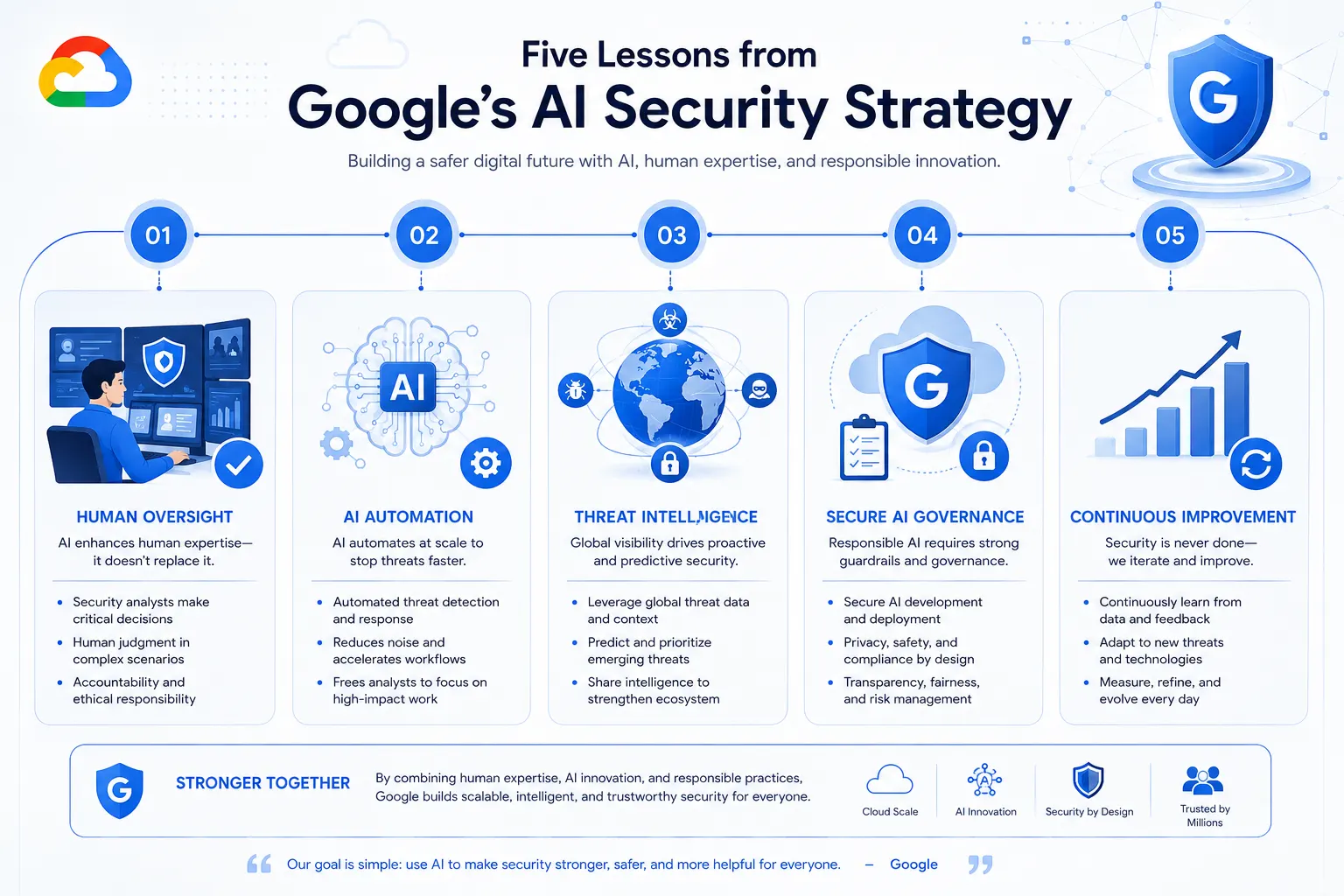
The Future of AI in Cybersecurity
Google sees AI becoming increasingly central to cyber defence.
Future security operations are expected to include:
More autonomous threat investigations
Faster vulnerability remediation
AI-powered threat hunting
Enhanced detection engineering
Greater collaboration between humans and intelligent agents
Even as automation increases, Google maintains that expert security professionals will remain at the centre of decision-making, ensuring AI is used responsibly and effectively.
Final Thoughts
Google Cloud's internal adoption of AI demonstrates that modern cybersecurity is no longer about choosing between humans and machines. Instead, it is about combining AI's speed and analytical capabilities with the judgement, experience, and contextual understanding of skilled security professionals.
By focusing on automation where it adds value, maintaining human oversight, and integrating AI into existing security operations, organisations can strengthen their cyber resilience while preparing for an increasingly AI-driven threat landscape.
As attackers continue to evolve, the organisations best positioned for the future will be those that use AI not simply as another technology, but as a trusted partner in building smarter, faster, and more adaptive cyber defences.
About the Author