
Google Cloud Unveils 13 Hands-On Demos for Building Enterprise AI Agents with Gemini
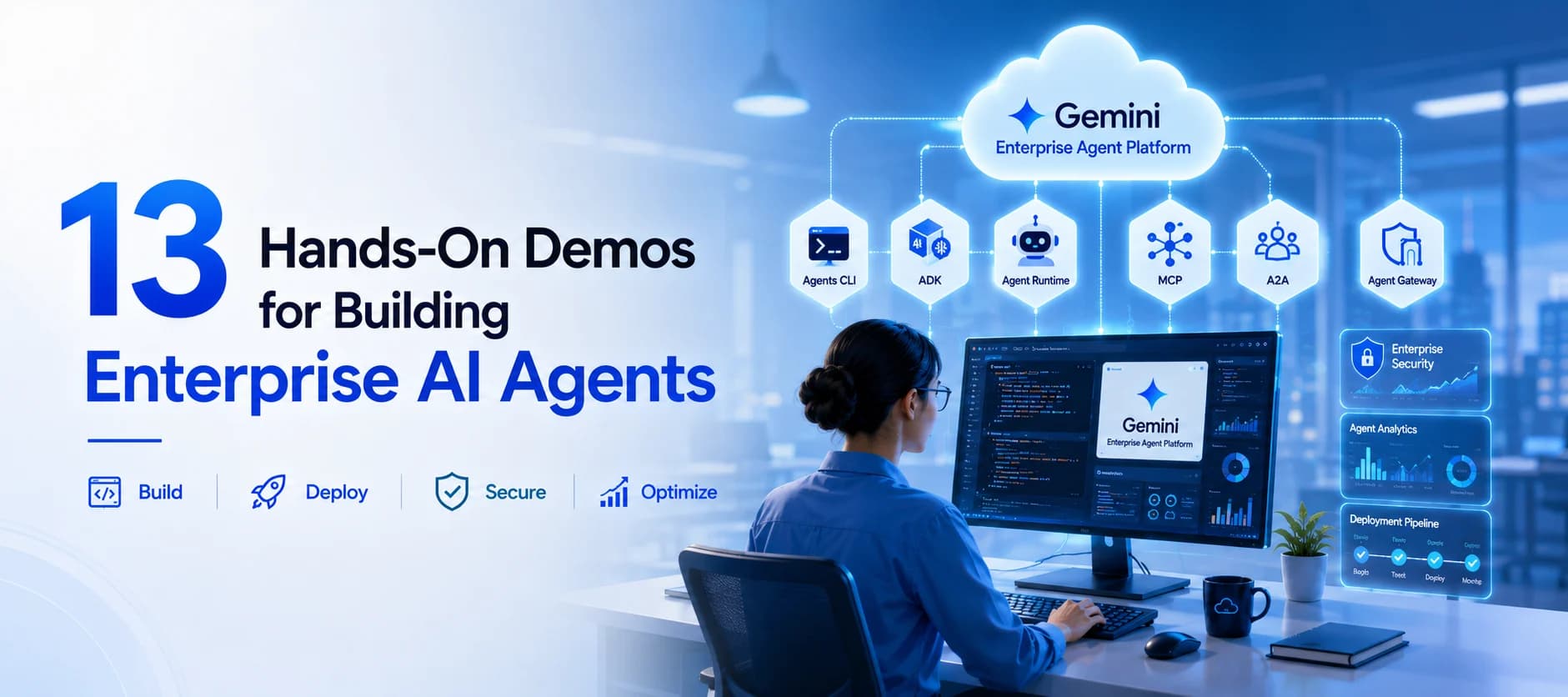
Google Cloud has unveiled 13 hands-on demos for the Gemini Enterprise Agent Platform, giving developers a complete roadmap to build, deploy, secure, govern, and optimize enterprise AI agents using ADK, Agent Runtime, MCP, A2A, and Agents CLI.
Xcademia Team
Xcademia Research Team
Google Cloud's Roadmap for Building Production-Ready AI Agents
Google Cloud has taken another major step in advancing enterprise AI by releasing 13 hands-on demonstrations for its Gemini Enterprise Agent Platform. Rather than introducing new products, the company is giving developers practical learning resources that demonstrate how to build, deploy, manage, and optimize production-ready AI agents from start to finish.
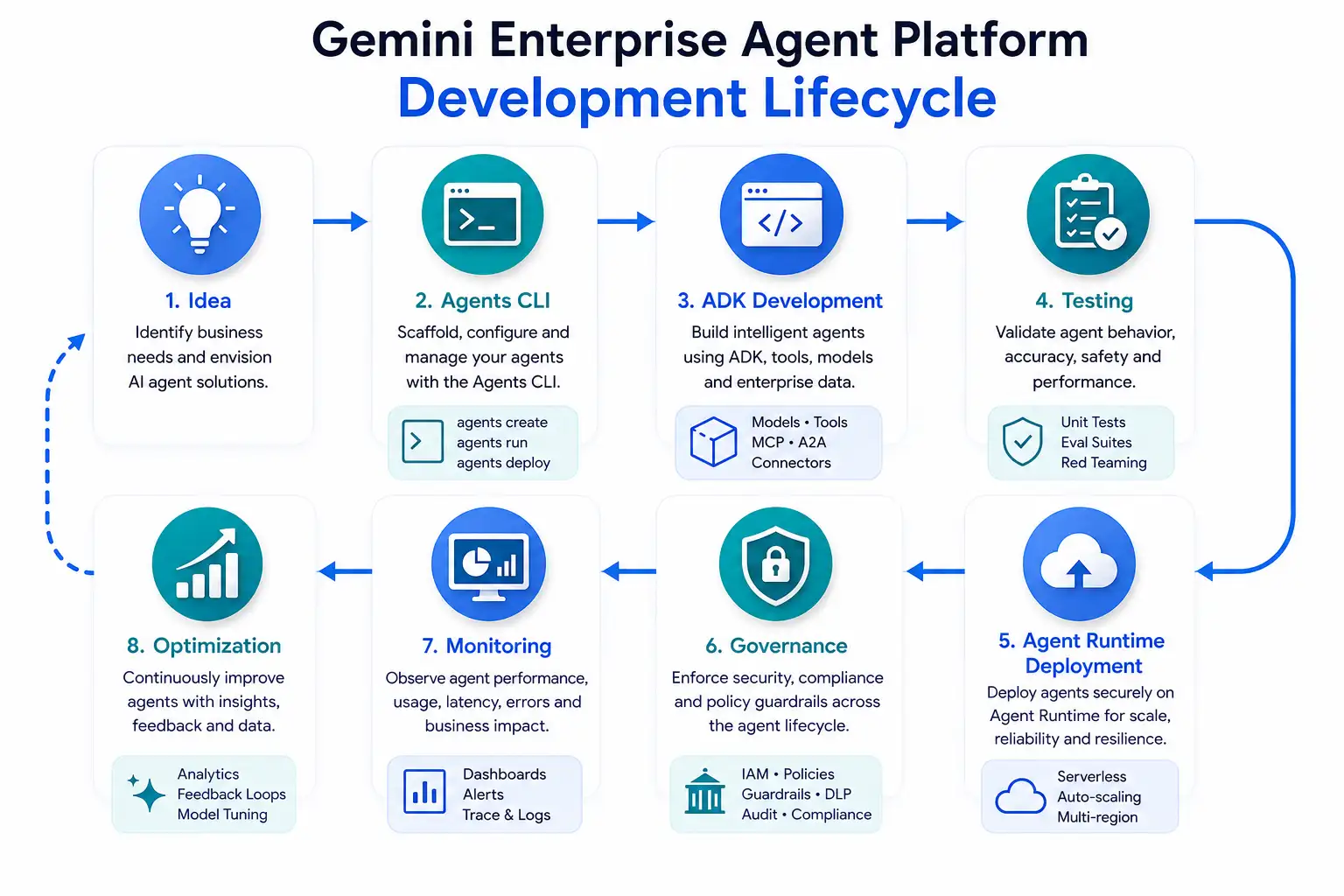
The tutorials cover the complete enterprise AI development lifecycle. Developers begin by creating a simple conversational assistant and gradually progress toward sophisticated multi-agent systems capable of handling long-running business workflows, accessing enterprise data securely, enforcing governance policies, and continuously improving performance through automated evaluation.
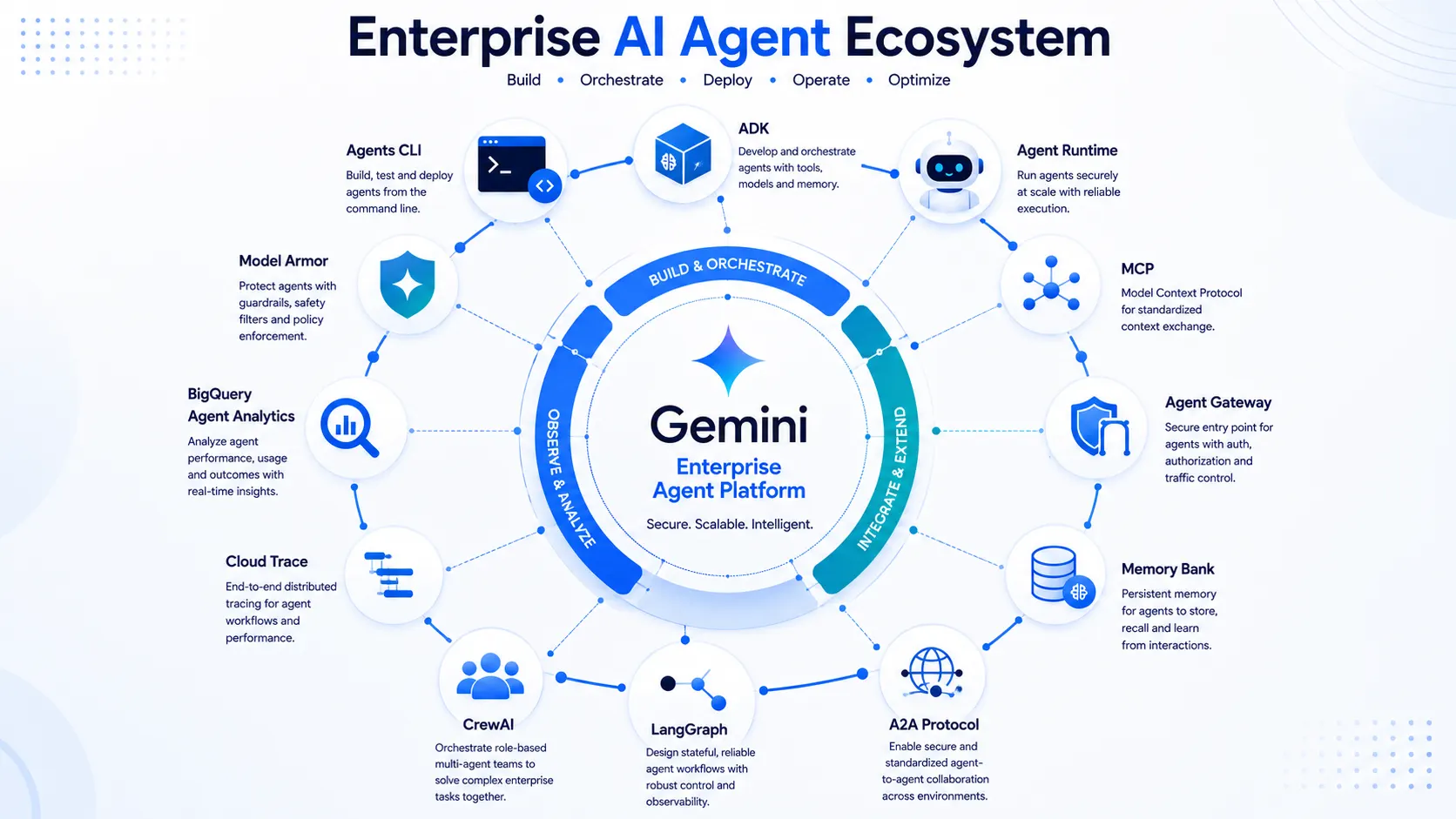
The announcement builds on the Gemini Enterprise Agent Platform introduced earlier this year, which combines the Agent Development Kit (ADK), Agents CLI, Agent Runtime, Model Context Protocol (MCP), Agent Gateway, and Agent-to-Agent (A2A) communication into a unified platform for enterprise AI development.
Instead of treating these technologies as separate products, Google demonstrates how they work together as a complete ecosystem for building enterprise-grade AI applications.
Simplifying Enterprise AI Development
One of the biggest highlights is the introduction of Agents CLI, a developer tool designed to eliminate much of the manual work traditionally involved in AI application development.
After installing Agents CLI into a preferred coding assistant, such as Claude Code, Codex, Antigravity, or another supported environment, developers gain access to built-in capabilities that understand both ADK and the Gemini Enterprise Agent Platform. Rather than manually configuring projects or writing deployment scripts, developers simply describe the AI agent they want to build in plain English. The coding assistant then generates project scaffolding, configures the necessary components, prepares deployments, performs evaluations, and enables monitoring without requiring developers to leave their editor.
This workflow dramatically shortens development time while lowering the learning curve for teams that are new to enterprise AI development.
Building AI Agents
The first four demonstrations introduce developers to the foundations of AI agent development using Google's code-first Agent Development Kit.
(1) Build Your First AI Agent with ADK
The ADK Foundation tutorial serves as the ideal starting point for developers who are new to the platform. It walks through the complete setup process, beginning with configuring the development environment and progressing to building a Gemini-powered conversational assistant. Developers learn how to configure agent settings, test conversations through both a command-line interface and a browser-based application, and understand the core architecture behind Google's enterprise AI platform.
Rather than overwhelming newcomers with advanced enterprise features, the tutorial establishes the fundamental concepts required before tackling more complex production scenarios.
(2) Creating an Intelligent Expense Approval Agent
The second demonstration introduces one of the most realistic enterprise examples in the collection: an AI-powered corporate expense approval system.
Built using ADK 2.0's graph-based workflow API, the agent automatically approves smaller expense claims while routing larger requests through multiple layers of security and compliance checks. Sensitive information is protected through automatic PII redaction before reaching the language model, prompt injection attempts are filtered, and Gemini performs compliance analysis before the workflow pauses for a human reviewer to make the final decision.
Google also demonstrates how the workflow integrates with FastAPI, responds to Pub/Sub events, and measures quality using an LLM-as-a-judge evaluation framework. Together, these capabilities show how enterprise AI can automate repetitive work while maintaining human oversight for business-critical decisions.
(3) Connecting AI Agents to Enterprise Data
Intelligent agents become significantly more valuable when they can securely access enterprise information.
Google addresses this through a dedicated tutorial covering the Model Context Protocol (MCP), an open standard designed to simplify communication between AI agents and enterprise systems.
Developers learn how to create reusable MCP tools that enable Gemini-powered agents to query BigQuery datasets, search organizational documents, retrieve information from APIs, and interact with numerous business services using a standardized interface. Because MCP is an open protocol, organizations are not locked into a single framework, allowing the same integrations to be reused across multiple AI ecosystems.
This interoperability makes MCP one of the most strategically important technologies featured throughout the demonstrations.
(4) Building Dynamic AI Interfaces
Modern AI applications require more than conversational responses. They also need interfaces that help users visualize information and interact naturally with business workflows.
Google demonstrates this capability through its Agent-to-UI (A2UI) tutorial, where AI agents dynamically generate complete user interfaces while conversations evolve.
Instead of returning static text, the agent creates responsive dashboards, charts, layouts, forms, and interactive menus based on each user's request. As conversations continue, the interface updates automatically, allowing applications to present information in the most useful format at any given moment.
This approach moves beyond traditional chatbot experiences and opens the door to highly adaptive enterprise applications powered entirely by AI.
Preparing AI Agents for Production
Building a successful prototype is only the beginning. Enterprise deployments require scalability, persistent memory, reliable infrastructure, and operational resilience.
The next collection of demonstrations focuses on helping organizations move from experimental AI projects to production-ready systems capable of supporting real business operations.
Developers are introduced to Agent Runtime, Google's managed execution environment that automatically handles infrastructure management, session persistence, scaling, and operational monitoring. Rather than worrying about backend complexity, engineering teams can concentrate on improving business logic while the platform manages the underlying cloud services.
Another tutorial demonstrates how Memory Bank allows AI agents to remember user preferences across multiple sessions. This persistent memory enables more personalized experiences while reducing repetitive interactions for users who regularly work with enterprise AI assistants.
Google also explores long-running business workflows that extend beyond a single conversation. Using an employee onboarding coordinator as an example, developers learn architectural patterns that allow AI agents to pause execution, preserve their current state, survive infrastructure restarts, and resume work days or even weeks later without losing context.
These demonstrations highlight an important shift in enterprise AI. Rather than viewing AI agents as simple conversational assistants, Google positions them as long-term business participants capable of managing ongoing operational processes.
Deploying AI Agents to Production with Agents CLI
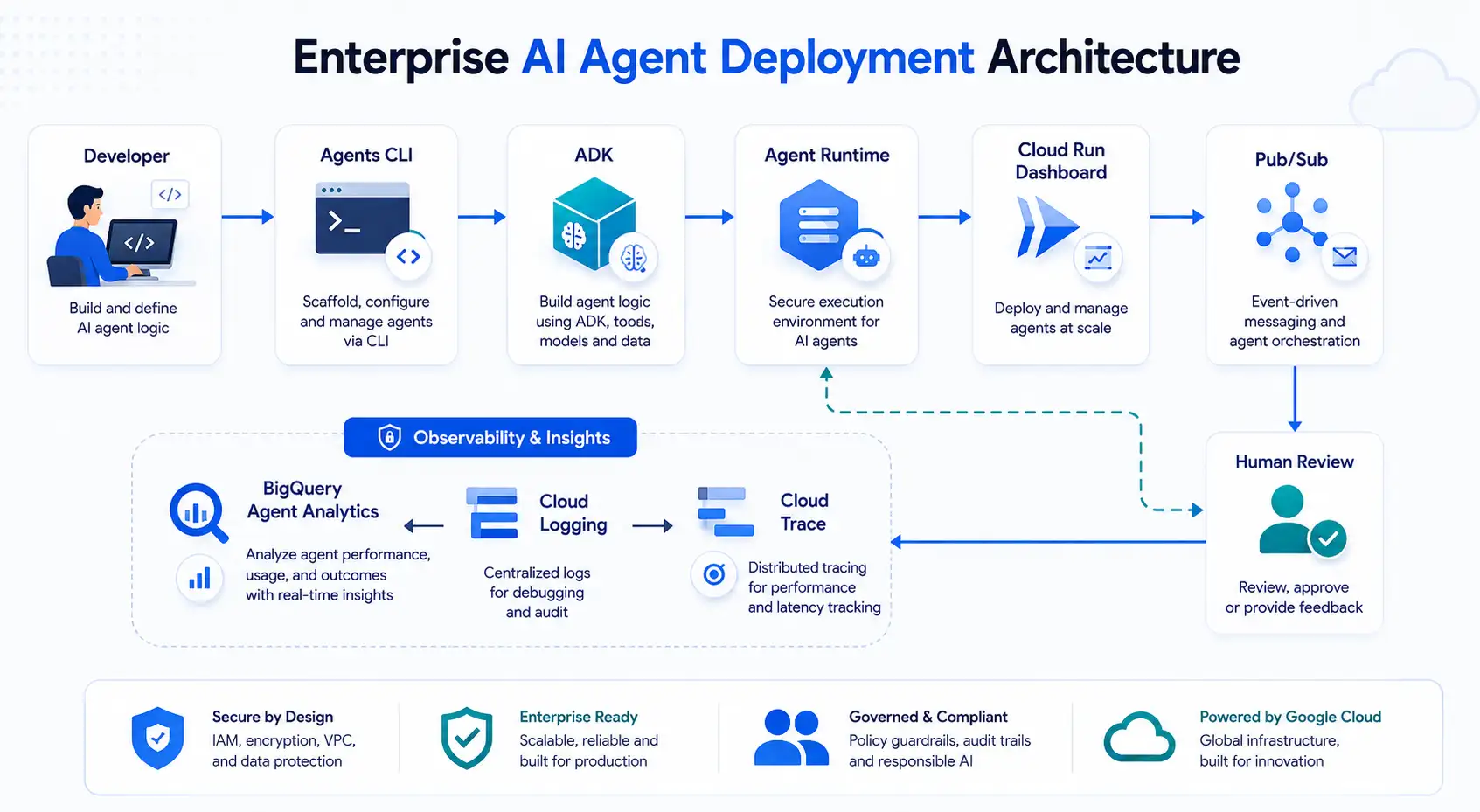
Once an AI agent has been developed and tested, the next challenge is deploying it into a production environment that can support enterprise workloads. Google addresses this through a dedicated tutorial that demonstrates how the earlier expense approval agent can be deployed using Agents CLI and Agent Runtime.
The deployment process is designed to be as automated as possible. Developers can scaffold deployment configurations, validate them through a dry run, and publish the application with minimal manual intervention. Once deployed, the platform automatically integrates with Cloud Logging, Cloud Trace, BigQuery Agent Analytics, and Agent Registry. This means organizations immediately gain visibility into application performance, operational metrics, and runtime behavior without spending additional time configuring monitoring tools.
Another important benefit is discoverability. Newly deployed agents are automatically registered within the organization, making it easier for development teams to locate, reuse, and manage AI services across different departments.
Completing the Enterprise Experience
Google's final scaling tutorial focuses on building a complete user-facing application rather than simply deploying backend services.
In this demonstration, developers create a management dashboard hosted on Cloud Run that connects securely to Agent Runtime through an authenticated Pub/Sub pipeline. Managers can monitor running workflows, review pending approval requests, and resume human-in-the-loop sessions directly from a web browser.
The tutorial illustrates how enterprise AI systems require more than intelligent models. They also need secure interfaces, reliable communication channels, and operational dashboards that allow employees to supervise automated processes. By combining these components, Google presents a practical blueprint for building production-ready enterprise AI applications.
Governance and Security Built Into the Platform
As organizations deploy larger numbers of AI agents, governance becomes just as important as model performance. Google dedicates the next set of demonstrations to showing how enterprise AI can remain secure throughout its lifecycle.
The first tutorial introduces a secure development workflow that integrates security practices from the earliest stages of coding. Developers learn how to combine test-driven development with STRIDE threat modeling, Semgrep code scanning, and PreToolUse policy enforcement. To demonstrate the effectiveness of these controls, the tutorial intentionally introduces a hardcoded API key into the application. Automated security checks immediately identify the vulnerability, prevent unsafe execution, and guide developers toward a secure implementation.
By embedding security directly into the development workflow, Google encourages organizations to treat AI applications with the same rigor as traditional enterprise software.
Securing Runtime Access with Agent Gateway
Google extends this security model beyond development by introducing Agent Gateway, a centralized governance layer for AI agents running in production.
Every deployed agent receives its own identity, allowing organizations to apply authentication and authorization policies consistently. Communication between services is protected using mutual TLS, while Identity-Aware Proxy and Identity and Access Management ensure that only approved services and users can access sensitive resources.
The platform also incorporates Model Armor, which analyzes prompts and responses to identify prompt injection attempts and potential data leakage before information reaches the language model. Together, these capabilities create multiple layers of protection that help organizations deploy AI systems with greater confidence while meeting enterprise security requirements.
Optimizing AI Agents After Deployment
Launching an AI application is only the beginning of its lifecycle. Enterprise teams must continually evaluate performance, identify weaknesses, and improve response quality as business requirements evolve.
Google's optimization tutorials introduce a structured evaluation framework designed to make this process repeatable.
Developers begin by preparing evaluation datasets using production traces, manually created examples, or synthetic scenarios. The platform then runs inference across these datasets before Google's adaptive AutoRaters assess the quality of each response. Once evaluations are complete, developers can analyze recurring failure patterns and apply targeted improvements to prompts, workflows, or agent logic.
According to Google, these AutoRaters are based on evaluation methodologies developed in partnership with Google DeepMind and reflect many of the same principles used internally to evaluate Google's own AI models and production agents.
This continuous evaluation cycle allows organizations to improve AI quality while reducing the risk of introducing unintended regressions.
Multi-Agent Collaboration Across Programming Languages
Large enterprises rarely standardize on a single programming language or development framework. Recognizing this reality, Google demonstrates how multiple AI agents developed by different teams can collaborate within the same workflow.
One example combines a Python-based agent that extracts contract terms using Gemini with a Go-based agent responsible for validating those terms against organizational policies. Communication between the two services takes place through the Agent-to-Agent (A2A) protocol, allowing independently developed agents to work together without requiring extensive custom integrations.
This interoperability makes it easier for organizations to preserve existing technology investments while expanding AI capabilities across different departments.
Orchestrating Multiple AI Frameworks
The final demonstration showcases one of the most advanced architectures in the collection.
Rather than relying on a single framework, Google illustrates how ADK, LangGraph, CrewAI, and the A2A protocol can operate together within the same enterprise workflow. In this architecture, an ADK-based control system coordinates planning activities, LangGraph manages stateful workflows, and CrewAI agents execute specialized tasks. If any stage encounters an issue, the orchestration layer automatically replans the workflow to keep business operations moving.
This demonstration reflects the growing importance of interoperability as organizations increasingly deploy AI solutions developed by multiple teams using different technologies.
Why These Demonstrations Matter for Enterprises
The tutorials highlight several important changes in enterprise AI adoption:
AI agents are moving from experiments to production systems capable of managing real business processes.
Interoperability is becoming essential as organizations combine multiple frameworks, models, and agent architectures.
Building the Future of Enterprise AI Agents
Google's latest collection of demonstrations represents more than a set of technical tutorials. Together, the 13 examples provide organizations with a practical roadmap for moving from AI experimentation to production-ready enterprise solutions.
By bringing together development tools, deployment infrastructure, security controls, governance capabilities, and continuous evaluation workflows, the Gemini Enterprise Agent Platform shows how modern AI systems can be built to operate reliably at scale.
The demonstrations highlight a shift in how businesses approach artificial intelligence. AI agents are no longer limited to simple conversational experiences. They are evolving into intelligent systems capable of managing complex workflows, accessing enterprise data, collaborating with other agents, and supporting human decision-making across organizations.
As enterprises continue adopting agentic AI, platforms that combine flexibility, security, and operational control will play a critical role in determining how successfully organizations scale these technologies. Google's Gemini Enterprise Agent Platform offers developers and businesses a foundation for building the next generation of secure, scalable, and intelligent AI-powered applications.
Source: Google Cloud Blog
About the Author