XMRE: Xcademia Malware Reverse Engineering Practitioner
Malware reverse engineering turns unknown code into actionable intelligence. XMRE covers static and dynamic analysis, debugging, unpacking, ATT&CK mapping, and YARA development, culminating in a practitioner-assessed capstone on a real malware sample.
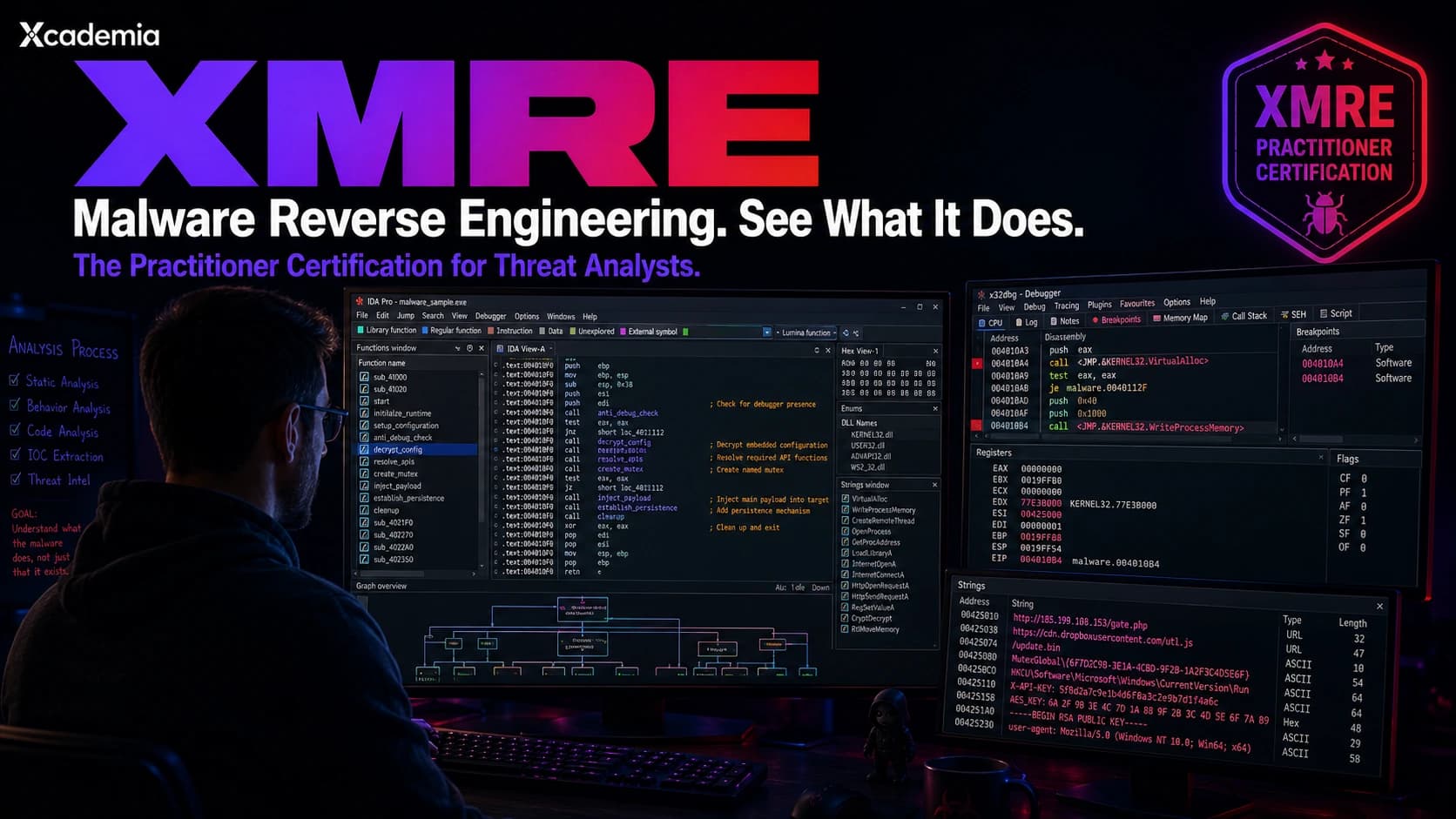
Malware Reverse Engineering: The Practitioner Certification for Threat Analysts
Malware reverse engineering is the discipline of taking a malicious executable, understanding what it does at the code level, extracting indicators of compromise, identifying evasion techniques, and producing intelligence that enables defenders to detect and block the threat. It is one of the most technically demanding skills in offensive and defensive security. It is also one of the most valuable.
The DFIR analyst who can reverse engineer malware found during an incident does not need to wait for an external vendor to tell them what the malware did. The threat intelligence analyst who can analyse new malware samples produces richer, faster intelligence than the one who depends on vendor reports. The detection engineer who understands malware at the code level writes detection logic that catches variants, not just the specific sample they have seen.
XMRE is Xcademia's Malware Reverse Engineering practitioner certification. Six instructor-led days. Practitioner-assessed. Built for security professionals who need to take malware apart.
Malware reverse engineering is not a specialism for dedicated malware analysts only. Any DFIR professional, threat hunter, or detection engineer who has had to wait for someone else to tell them what a piece of malware does has felt the gap that XMRE closes.
What the Existing Options Cover
SANS FOR610: Reverse Engineering Malware
FOR610 is the gold standard malware analysis and reverse engineering course. Six days, covering static and dynamic analysis, disassembly with IDA Pro, debugging with x64dbg, unpacking and deobfuscation, and analysis of specific malware categories. It is excellent. The GREM (GIAC Reverse Engineering Malware) examination is 82 questions open book over two hours.
The gap: FOR610 is priced at approximately $7,000 to $9,000 USD for the course-plus-exam bundle. The GREM examination is open book. Both are indicators of quality but the price point puts this training out of reach for many professionals funding their own development, and the open-book examination format means the assessment is knowledge navigation rather than applied reverse engineering under assessment conditions.
FOR610 is genuinely excellent malware analysis training. The price is genuinely high. XMRE provides comparable applied training at a price that makes self-funded professional development viable, with a practitioner-assessed capstone that requires the candidate to produce a malware analysis report under examination conditions rather than navigate an open-book reference. Competitor pricing correct at time of publication.
What XMRE Covers Across Six Days
Days 1-2: Foundations and Static Analysis
Malware analysis environment setup: Safe dynamic analysis VMs, network isolation, snapshot management, automated sandboxes and their limitations
PE file format deep dive: Understanding the Windows executable format, sections, imports, exports, resources, and what each tells the analyst before execution
Static analysis with strings, FLOSS, and PE tools: Extracting intelligence without executing the sample
Disassembly fundamentals with Ghidra: Reading x86/x64 assembly, understanding common code constructs (loops, conditionals, function calls, API invocations)
Identifying common malware families from static analysis: Recognising packer signatures, common obfuscation patterns, and known family characteristics
Lab: Static analysis of three malware samples to produce an IOC report and a preliminary capability assessment for each without execution
Days 3-4: Dynamic Analysis and Debugging
Dynamic analysis with process monitor, Wireshark, and API Monitor: Observing malware behaviour at runtime
x64dbg and WinDbg debugging: Setting breakpoints, stepping through execution, modifying runtime behaviour to expose hidden functionality
Anti-analysis technique identification and bypass: Detecting anti-debugging, anti-VM, sleep calls, and timing checks, and bypassing them to observe hidden behaviour
Unpacking and deobfuscation: Memory dumping at OEP, manually unpacking common protectors, deobfuscating encoded payloads
API call analysis: Understanding what the malware is doing by watching Windows API calls, process injection, persistence mechanisms, network communication, credential access
Lab: Dynamic analysis and debugging of a packed sample with anti-analysis checks. Unpack, bypass the anti-analysis, and produce a full behavioural analysis report
Days 5-6: Malware Categories, Detection, and Capstone
Ransomware analysis: Encryption key identification, ransom note extraction, C2 communication analysis, recovery potential assessment
Stealers and RATs: Credential theft mechanisms, keylogging implementation, remote access capability mapping
Rootkits and kernel-mode malware: Kernel-mode code analysis concepts, driver analysis, DKOM and hooking technique identification
Writing YARA rules from malware analysis: Translating reverse engineering findings into detection signatures that catch the family, not just the sample
Threat intelligence production from reverse engineering: Extracting IOCs, TTPs mapped to MITRE ATT&CK, and family attribution evidence
Capstone: Full reverse engineering engagement on a realistic malware sample. Candidates must conduct static and dynamic analysis, unpack and deobfuscate, produce a complete capability report with ATT&CK mapping, extract IOCs, and write at least three YARA rules that detect the malware family. Assessed by a senior Xcademia malware and threat analysis practitioner. Verifiable at xcademia.com/verify.
The XMRE capstone is a real unknown malware sample under timed conditions. No hints. No predetermined answers. The practitioner who passes it has demonstrated they can take an unfamiliar piece of malware, understand what it does, and produce intelligence from it. That is the job.
Who Needs XMRE
DFIR analysts who encounter malware during incident response and need to understand it without waiting for vendor analysis
Threat intelligence analysts who need to produce original malware intelligence rather than synthesising vendor reports
Detection engineers who need to understand malware at the code level to write detection logic that catches behaviour rather than just hashes
SOC leads building internal malware analysis capability to reduce dependency on external resources during major incidents
Red teamers who want to understand how blue teams detect implants, informing how they modify their tooling
XMRE VS FOR610 / GREM COMPARISON
FOR610 / GREM (SANS) | XMRE (Xcademia) | |
|---|---|---|
Awarding body | SANS / GIAC | Xcademia |
Course duration | 6 days (FOR610) | 6 intensive instructor-led days |
Assessment | 82 MCQ open book, 2 hours (GREM) | Practitioner capstone: real malware, full report + YARA rules |
Price | ~$7,000-$9,000 USD (course + exam) | £4,495 all-inclusive |
Tools covered | IDA Pro (primary), x64dbg | Ghidra, x64dbg, WinDbg, FLOSS, Wireshark, API Monitor |
YARA rule writing | Introduced | Core capstone output |
ATT&CK mapping | Covered | Required in capstone report |
Market recognition | Very strong globally. GREM well-known. | UK and UAE, growing |
What it proves | Malware analysis knowledge (open book) | Applied reverse engineering capability under real conditions |
Build Applied Malware Reverse Engineering Capability With XMRE XMRE: six instructor-led days covering static analysis, disassembly, dynamic analysis, debugging, anti-analysis bypass, unpacking, and malware category analysis. Practitioner capstone: real unknown sample, full report, ATT&CK mapping, YARA rules. No MCQ. No renewal. Verifiable at xcademia.com/verify. Explore XMRE |
|---|
Ready to go deeper?
Professional Training
Hands-on, mentor-led training aligned with industry certifications.
About the Author
Sharper every day
Daily tutorials, analysis, and career playbooks across all 12 Xcademia disciplines, straight to your inbox. No spam.