XAML
Financial crime has evolved faster than AML training. XAML is Xcademia’s practitioner-focused certification for 2026, covering transaction monitoring, investigations, SAR production, AI-enabled crime, crypto typologies, and operational AML skills traditional qualifications leave underdeveloped.
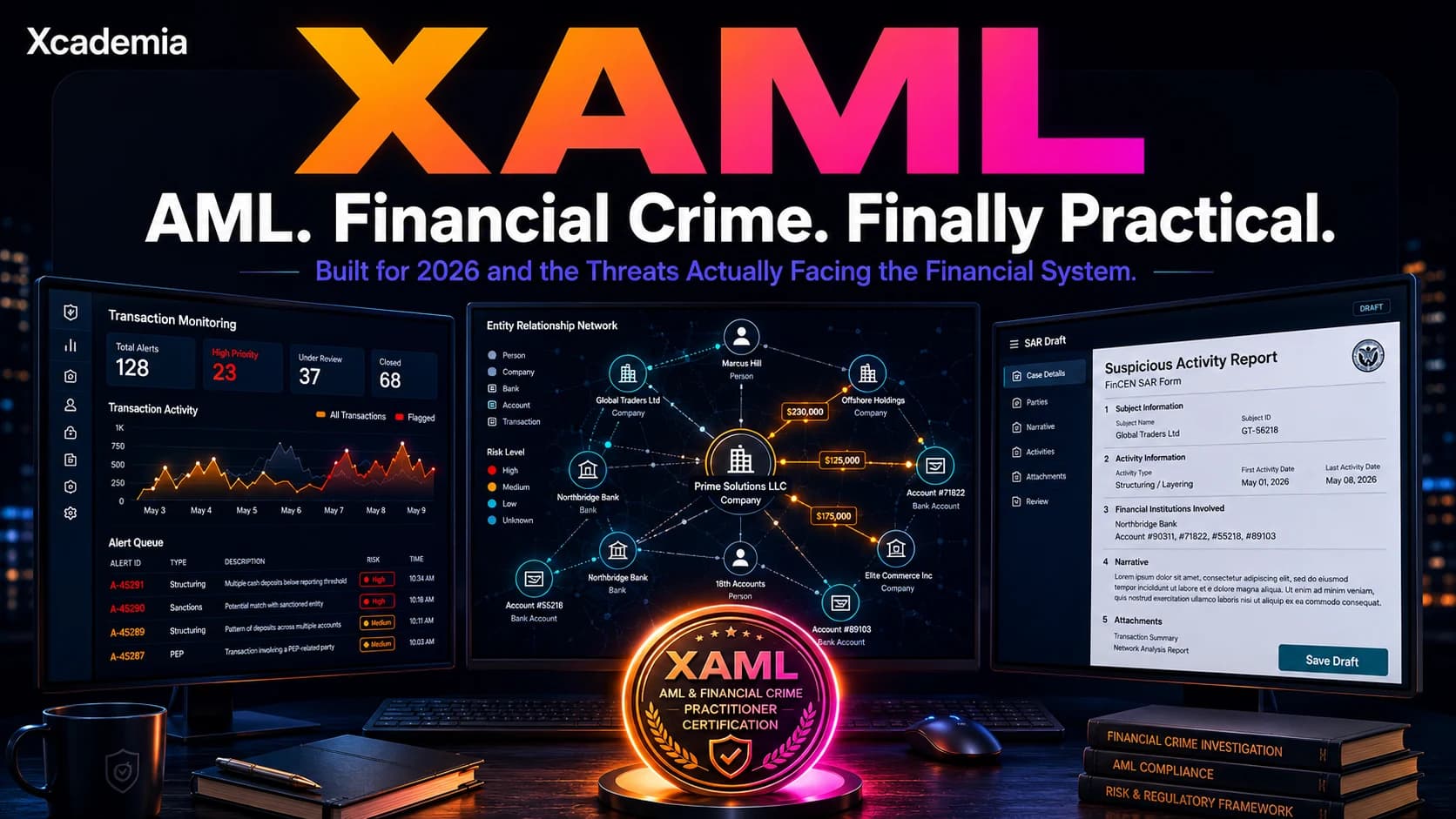
The AML and Financial Crime Practitioner Certification Built for 2026
Financial crime is not a compliance problem. It is an operational problem, an investigative problem, and in 2026, an AI problem. The criminals have automated. The transaction volumes are unprecedented. The typologies are evolving faster than the regulatory guidance. And the people doing this work are still, in many organisations, trained primarily through exam-based qualifications that test knowledge of AML frameworks rather than the practical skills to apply them.
The AML and financial crime profession has a highly developed examination ecosystem: ICA Diploma, ACAMS CAMS, ACFE CFE. These qualifications are valuable. They establish baseline knowledge. What they do not do is develop the applied investigative skills, technology proficiency, and typology awareness that the modern AML professional needs in a role where the threats they face have changed substantially since those examination curricula were developed.
XAML is Xcademia's AML and Financial Crime Practitioner certification. Five instructor-led days. Practitioner-assessed. Built around the threats actually facing the financial system in 2026.
The AML analyst who cannot navigate a transaction monitoring platform, who has never constructed an entity relationship network from transaction data, and who has not practised drafting an SAR in a realistic scenario is not ready for the modern AML role regardless of which examination they hold. XAML addresses the gap between examination knowledge and operational capability.
Why the Existing Qualifications Leave Gaps
ACAMS CAMS
The Certified Anti-Money Laundering Specialist is the most widely recognised AML qualification globally. It covers AML programme management, red flags, investigations, and the regulatory frameworks across major jurisdictions. The examination is multiple choice and case study format. CAMS is genuinely valuable as a knowledge credential and widely required in UK financial services hiring.
The gap: CAMS was designed for programme managers and compliance officers, not for the analyst-level practitioner doing daily transaction monitoring, alert triage, and investigation work. It covers what an AML programme should contain. It does not develop the investigative skills to operate one. The analyst who holds CAMS and has never used a real transaction monitoring platform has a credential that is broader than it is deep for operational work.
ICA Diploma
The International Compliance Association Diploma is a well-structured qualification covering financial crime compliance at depth. The ICA pathway from Certificate to Diploma is one of the most rigorous educational routes in financial crime compliance. The Diploma requires substantial written assignments and demonstrates genuine analytical capability.
The gap: the ICA Diploma is a knowledge and analytical writing qualification. It does not require candidates to conduct a real investigation, use real technology tools, or produce an SAR under assessment conditions. The practical operational skills remain to be developed outside the qualification framework.
ACFE CFE
The Association of Certified Fraud Examiners Certified Fraud Examiner is the most respected fraud investigation credential globally. It covers fraud schemes, legal elements, fraud prevention, and investigation methodology in depth. CFE holders are among the most skilled financial crime investigators in practice.
The gap: CFE scope is broad across all fraud categories and includes significant content on non-financial crime fraud. For AML-specific work, the typology depth for money laundering, terrorist financing, and sanctions evasion specifically is less developed than for general fraud investigation.
The existing qualifications are not bad. They are incomplete for the operational AML professional. CAMS provides the framework knowledge. ICA provides the analytical rigour. XAML provides the applied investigative capability and technology proficiency that both leave underdeveloped. Competitor pricing correct at time of publication.
What XAML Covers Across Five Days
Day 1: Financial Crime Landscape and Regulatory Framework
The 2026 financial crime threat landscape: Typologies evolving in response to regulatory pressure, crypto-enabled layering, AI-generated synthetic identities, trade-based money laundering, and sanctions evasion techniques
Regulatory framework: FATF recommendations, UK POCA, PoCSA, and MLR 2017, EU AMLD6, FinCEN requirements for US-connected entities
Risk-based approach in practice: Calibrating monitoring thresholds, customer risk scoring methodologies, and the difference between a compliant risk-based approach and a paper exercise
Day 2: Transaction Monitoring and Alert Triage
Transaction monitoring platform operation: Working with realistic TM platforms (Actimize, NICE Actimize, Oracle Mantas conceptual context), scenario rule logic, threshold calibration
Alert triage methodology: The alert review process, priority scoring, false positive reduction, escalation thresholds
Typology recognition in transaction data: Recognising structuring, layering, smurfing, round-trip transactions, and unusual velocity patterns from raw transaction data
Lab: Triage a realistic alert queue of 20 alerts using structured methodology. Identify true positives, apply investigation disposition framework
Day 3: Financial Crime Investigation
Investigation methodology: The structured investigation process from initial alert to case disposition
Entity relationship analysis: Building and interpreting entity relationship networks from transaction and KYC data, identifying beneficial ownership, identifying connected accounts
OSINT in financial crime investigations: Using open-source intelligence to corroborate or contradict transaction data analysis
Sanctions screening: SDN list navigation, secondary sanctions risk, correspondent banking sanctions exposure
Lab: Conduct a full investigation into a realistic case covering three connected accounts with suspicious transaction patterns. Produce an investigation summary with entity relationship diagram
Day 4: Suspicious Activity Reporting and Escalation
SAR drafting standards: The elements of an effective SAR, how NCA (UK) and FinCEN (US) use SARs, and what makes a SAR actionable versus what makes it a missed opportunity
The tipping-off offence: What constitutes tipping-off, how to manage customer relationships during an investigation without committing the offence
Escalation frameworks: When to escalate internally, how to document escalation decisions, management of the MLRO function and its relationship with front-line compliance
Lab: Draft an SAR for the Day 3 investigation case. Assessed against NCA quality standards for SAR submissions
Day 5: Emerging Threats and Capstone
AI and machine learning in financial crime: How AI is being used both to commit financial crime (synthetic identity fraud, deepfake KYC bypass) and to detect it (AI-powered TM models, network analytics)
Crypto-asset financial crime: On-chain analysis concepts, mixer and tumbler detection, exchange KYC obligations, NFT-based layering typologies
Trade-based money laundering: TBML typologies, red flags in trade finance documentation, the role of dual-use goods
Capstone: A full case from initial alert through investigation to SAR production for a complex multi-jurisdictional case involving corporate structures, crypto-asset transactions, and sanctions proximity. Assessed by a senior Xcademia financial crime practitioner. Verifiable at xcademia.com/verify.
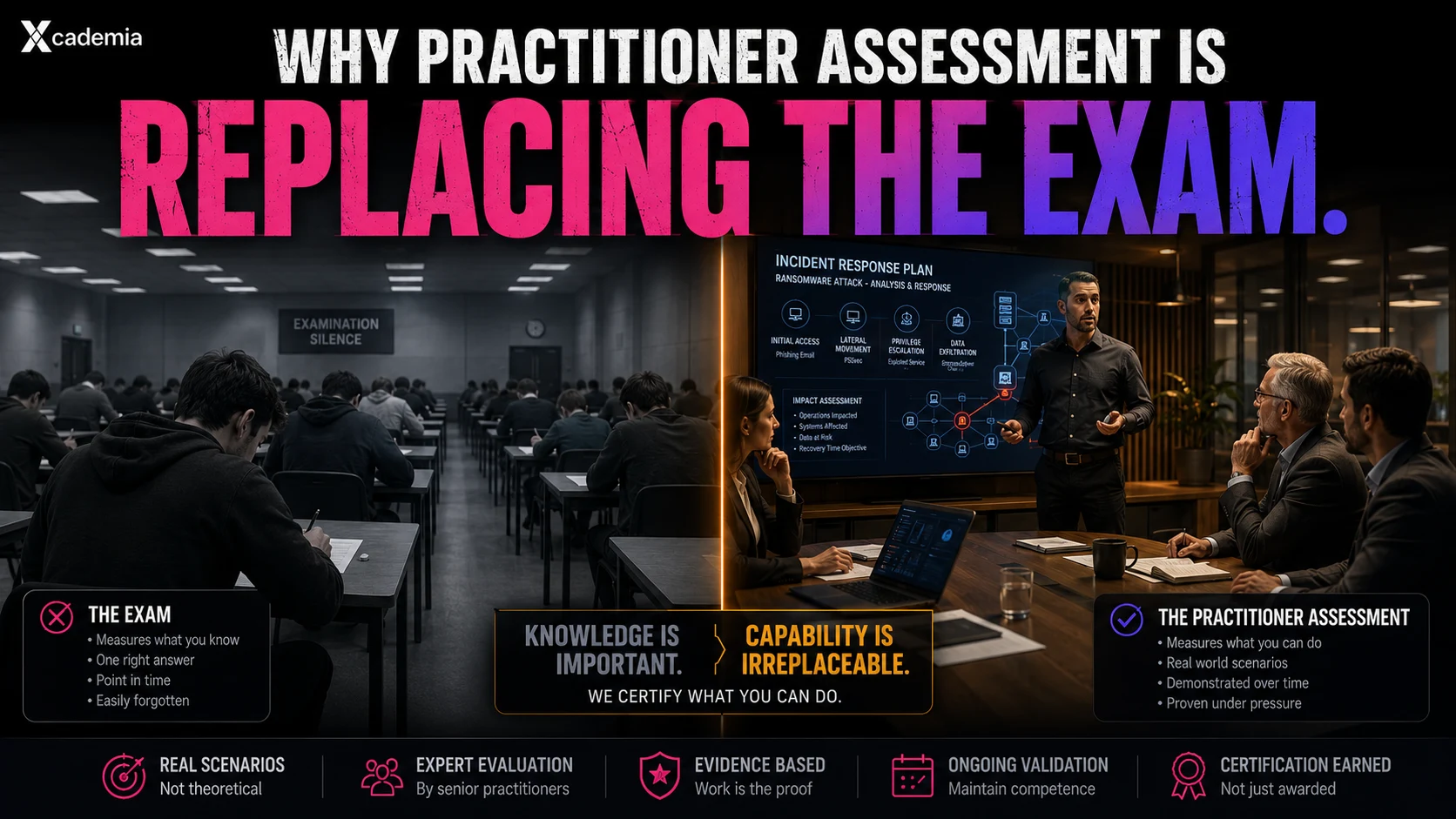
The XAML capstone is a real investigation under timed conditions. Alert triage, entity relationship analysis, OSINT corroboration, and SAR production. The practitioner who passes it has done what the job requires, under assessment conditions, with a practitioner evaluating the quality of the work.
Who Needs XAML
The financial crime professional community spans several distinct functions. XAML is most directly relevant to three of them.
Transaction monitoring analysts: The front-line professionals who triage alerts daily. The investigative skills, typology awareness, and platform proficiency that XAML develops are core to this role and underdeveloped by exam-based AML qualifications.
Financial crime investigators: The professionals who take escalated alerts and conduct in-depth investigations. Entity relationship analysis, OSINT integration, and SAR drafting quality are the differentiating skills this role requires.
MLRO deputies and AML managers: The professionals who manage financial crime programmes and need to understand operational reality alongside the framework knowledge that CAMS or ICA Diploma provides.
The demand for AML professionals in the UK, UAE, and globally is structural. Financial crime regulatory expectations are tightening. AI-enabled financial crime is creating new typologies faster than training programmes are updating. The professional who holds CAMS or ICA alongside XAML is credentialed for the framework and capable in the operation.
The AML market in the UAE is one of the fastest-growing in the world. The UAE's position as a global financial hub, combined with the Central Bank of UAE's increasingly rigorous supervisory expectations under FATF mutual evaluation pressure, has created acute demand for AML practitioners who can operate at the level the regulator now requires.
Build Applied AML and Financial Crime Capability With XAML XAML: five instructor-led days covering the 2026 financial crime threat landscape, transaction monitoring, financial crime investigation, SAR production, and emerging threats including AI-enabled financial crime and crypto-asset typologies. Practitioner-assessed capstone. No MCQ. No renewal. Verifiable at xcademia.com/verify. Explore XAML |
|---|
Ready to go deeper?
Professional Training
Hands-on, mentor-led training aligned with industry certifications.
About the Author
Sharper every day
Daily tutorials, analysis, and career playbooks across all 12 Xcademia disciplines, straight to your inbox. No spam.