XAIG
The EU AI Act created a new compliance profession almost overnight. XAIG is the only practical AI governance certification built specifically around EU AI Act implementation, covering High-Risk AI compliance, GPAI obligations, ISO 42001 integration, and operational governance.
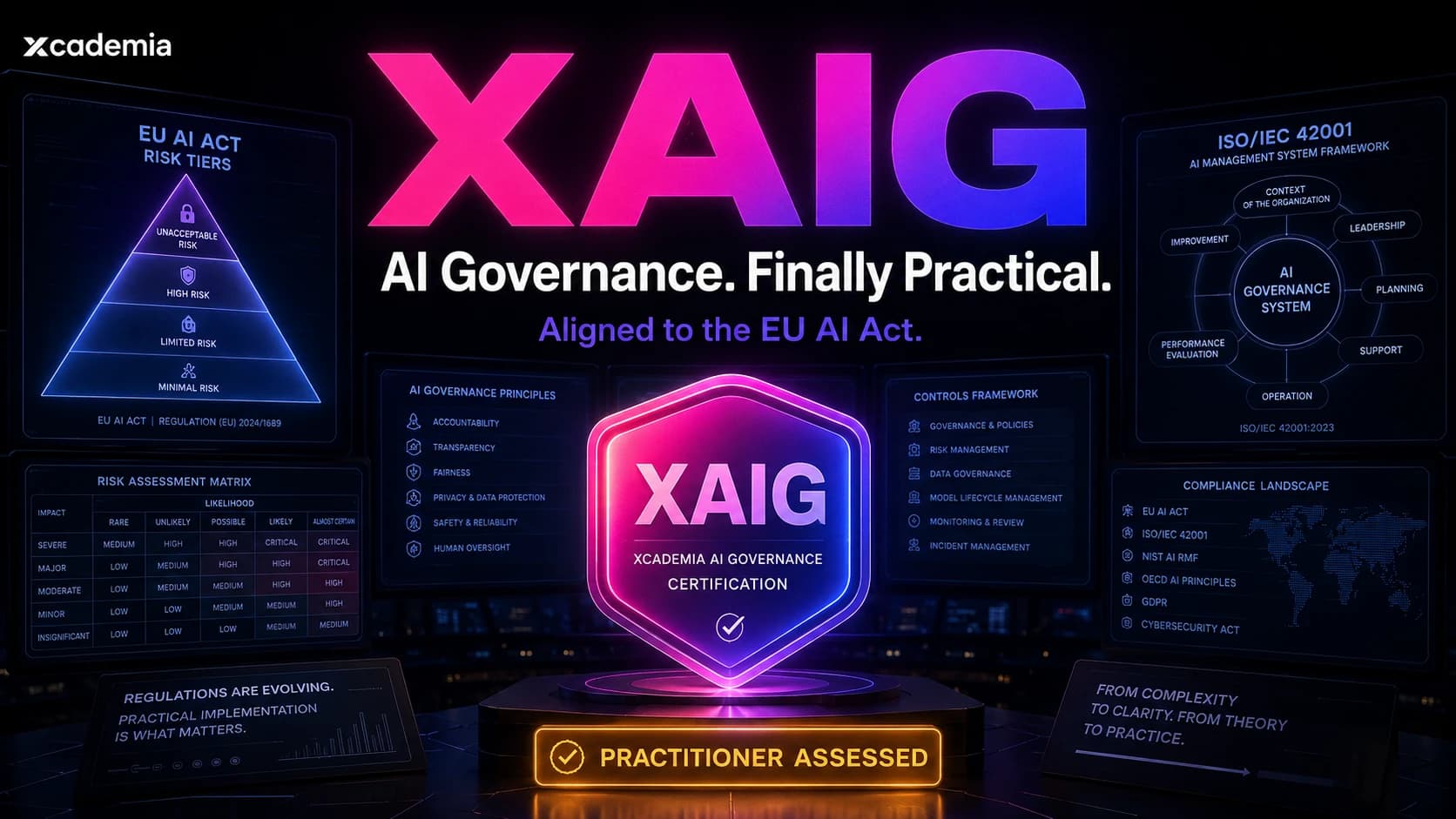
The Only Practical AI Governance Certification Aligned to the EU AI Act
The EU AI Act created a new professional need that did not exist two years ago: someone who can look at an AI system, classify it correctly under the Act's four-tier framework, build the governance and documentation required for its risk tier, and implement the human oversight mechanisms that High-Risk compliance demands.
The organisations that need this capability are not rare edge cases. They are every company using AI in hiring, credit scoring, healthcare decision support, or customer service that serves EU users. They are every company building AI products for the EU market. They are every company running a GPAI model that is accessed by EU customers.
The certifications that existed before the EU AI Act do not squarely address what the Act requires. XAIG was built to close that gap.
The EU AI Act is not a GDPR extension. It has its own risk framework, its own technical requirements, and its own compliance logic. A GDPR practitioner who has not specifically studied the AI Act does not automatically have the skills the Act requires.
What Exists Before XAIG and What It Misses
ISO 42001 Lead Implementer
ISO/IEC 42001 is the international standard for AI management systems, published in 2023. It provides a framework for responsible AI governance analogous to how ISO 27001 provides a framework for information security management. ISO 42001 Lead Implementer certifications, now available from several awarding bodies, teach candidates how to implement an AI management system against the standard.
The limitation is that ISO 42001 was designed before the EU AI Act was finalised. It addresses AI governance in general terms. It does not specifically address the EU AI Act's four-tier risk classification, the specific High-Risk compliance requirements, the GPAI model obligations, or the registration and documentation requirements that the Act imposes. An ISO 42001 Lead Implementer can build an AI management system. They may still not know how to achieve EU AI Act compliance.
Cloud provider AI certifications
AWS, Google Cloud, and Microsoft Azure all offer certifications related to AI services on their platforms. These certifications address how to build, deploy, and manage AI systems within the provider's environment. They do not address regulatory compliance, risk classification under the EU AI Act, or the governance frameworks that the Act requires.
General AI ethics and governance courses
A significant number of online courses and programmes address AI ethics, responsible AI, and AI governance at a conceptual level. They are useful for building awareness and framing the problem. They do not teach the specific legal obligations, technical requirements, and compliance programme design that the EU AI Act imposes.
The gap in the market is not understanding that AI needs governance. Everyone agrees on that. The gap is practical knowledge of how to classify your AI system, what documentation the Act requires, how to design human oversight mechanisms, and how to build an AI governance programme that produces actual compliance rather than the appearance of it.
What XAIG Covers and How It Is Different
XAIG is Xcademia's AI Governance Practitioner certification. Five instructor-led days. Practitioner-assessed capstone. Built specifically around what the EU AI Act requires.
Programme scope
EU AI Act deep dive: The full Act in operational terms, not legal summary. Risk tier classification methodology, obligation mapping by tier, timeline and enforcement structure.
AI system classification in practice: Hands-on classification exercises using real AI system descriptions. How to determine which tier an AI system falls into, including the edge cases and ambiguous scenarios.
ISO 42001 integration: How the ISO 42001 AI management system framework maps to EU AI Act compliance obligations, and how to use one to achieve the other.
High-Risk compliance programme design: Building the risk management system, data governance documentation, technical documentation, and human oversight mechanisms that High-Risk AI requires.
GPAI model obligations: The specific requirements for providers of general-purpose AI models, including foundation model transparency, capability evaluation, and systemic risk assessment.
AI governance framework design: Building an AI governance function within an organisation, including policy development, accountability structures, and ongoing monitoring.
Incident response for AI systems: What to do when an AI system causes harm, how to investigate AI incidents, and what the reporting obligations under the Act are.
Practical compliance tools: Templates, checklists, and documentation frameworks that candidates can use immediately in their organisations.
The capstone assessment
Candidates are given a realistic organisational scenario, a company using AI in a defined operational context, with a portfolio of AI systems at different risk levels. They must classify each system correctly, produce the required compliance documentation for the High-Risk systems, design the human oversight mechanism, draft the board-level AI governance policy, and present their compliance roadmap to a simulated executive audience.
The capstone is assessed by a senior Xcademia practitioner with direct experience implementing AI governance frameworks in regulated organisations. Verifiable at xcademia.com/verify.
XAIG is the only AI governance certification that specifically addresses EU AI Act compliance in practical operational terms, integrates ISO 42001 as a framework tool, and assesses candidates' ability to apply both in realistic organisational scenarios.
ISO 42001 LI | SecAI+ | XAIG (Xcademia) | |
|---|---|---|---|
EU AI Act coverage | Partial (pre-dates Act) | Partial | Full - built around the Act |
ISO 42001 integration | Core focus | Mentioned | Integrated as compliance tool |
Risk classification | Framework methodology | Framework methodology | Practical classification exercises |
High-Risk compliance | General guidance | General guidance | Specific obligation mapping |
GPAI model rules | Not covered | Not covered | Covered in full |
Assessment format | MCQ or written exam | MCQ | Practitioner capstone |
Renewal | Varies | Varies | No renewal required |
Price (approx.) | £1,000-£2,000 | £500-£1,000 | £3,995 all-in |
Who Needs XAIG
The professionals who need this certification are a growing population.
AI governance leads and AI ethics officers being appointed by organisations responding to the EU AI Act and other regulatory developments
Data protection officers and privacy professionals who need to extend their governance expertise into AI-specific regulation
GRC professionals in organisations deploying High-Risk AI systems who need the specific EU AI Act compliance knowledge
Legal and compliance professionals advising on AI Act obligations who need operational understanding beyond legal analysis
Senior security and technology leaders who need to understand the governance framework required for AI systems in their organisations
Consultants and advisers building EU AI Act compliance practices for their clients
XAIG the EU AI Act compliance capability no other cert provides:
XAIG is the only AI governance certification built specifically around EU AI Act compliance in practical operational terms. Five days. Risk classification, High-Risk compliance programme design, GPAI obligations, and board-level AI governance. Practitioner-assessed. No MCQ. Verifiable at xcademia.com/verify.
The Uncontested Position
XAIG operates in territory that no other certification has fully claimed. The EU AI Act is new law. The compliance expertise required to implement it is in acute short supply. The certifications that exist adjacent to this space do not specifically address what the Act requires in operational terms.
For the organisation that needs to achieve EU AI Act compliance by August 2026, the professional who holds XAIG is the one who knows what compliance actually looks like, not just what the legislation says.
The EU AI Act compliance market is forming right now. The professionals who develop this capability in 2026 are the ones who will be in demand as every EU-adjacent organisation reaches the same conclusion about what they need. XAIG is the certification built for that moment.
Build EU AI Act Compliance Capability With XAIG XAIG: five instructor-led days, EU AI Act in full, ISO 42001 integration, High-Risk compliance programme design, GPAI obligations, practitioner capstone. No MCQ. No renewal. The AI governance certification built for what organisations actually need in 2026. Verifiable at xcademia.com/verify. Explore XAIG |
|---|
Ready to go deeper?
Professional Training
Hands-on, mentor-led training aligned with industry certifications.
About the Author
Sharper every day
Daily tutorials, analysis, and career playbooks across all 12 Xcademia disciplines, straight to your inbox. No spam.