Why the CEH Exam No Longer Proves
CEH still opens doors in cybersecurity. But in 2026, employers want proof you can actually perform under real conditions, not just pass a multiple choice exam. This article examines five CEH myths, where the cert still holds value, and why practical capability now matters more than ever.
What Employers Actually Need to Know
The CEH has been the most searched ethical hacking certification on the planet for more than twenty years. It is on job specifications across financial services, government, and technology. It is the first certification most people think of when they think "penetration testing." In the UAE and Middle East, it carries particular weight. EC-Council built a real market.
None of that has changed. What has changed is what employers are actually asking for in interviews and on the job, and whether the CEH examination, in its current multiple choice format, is genuinely preparing candidates for what those roles demand.
This is not an argument that CEH is worthless. It is an argument that the gap between what CEH claims to certify and what employers actually need to verify is wider in 2026 than it has ever been, and that gap has consequences for how you should think about your certification investment.
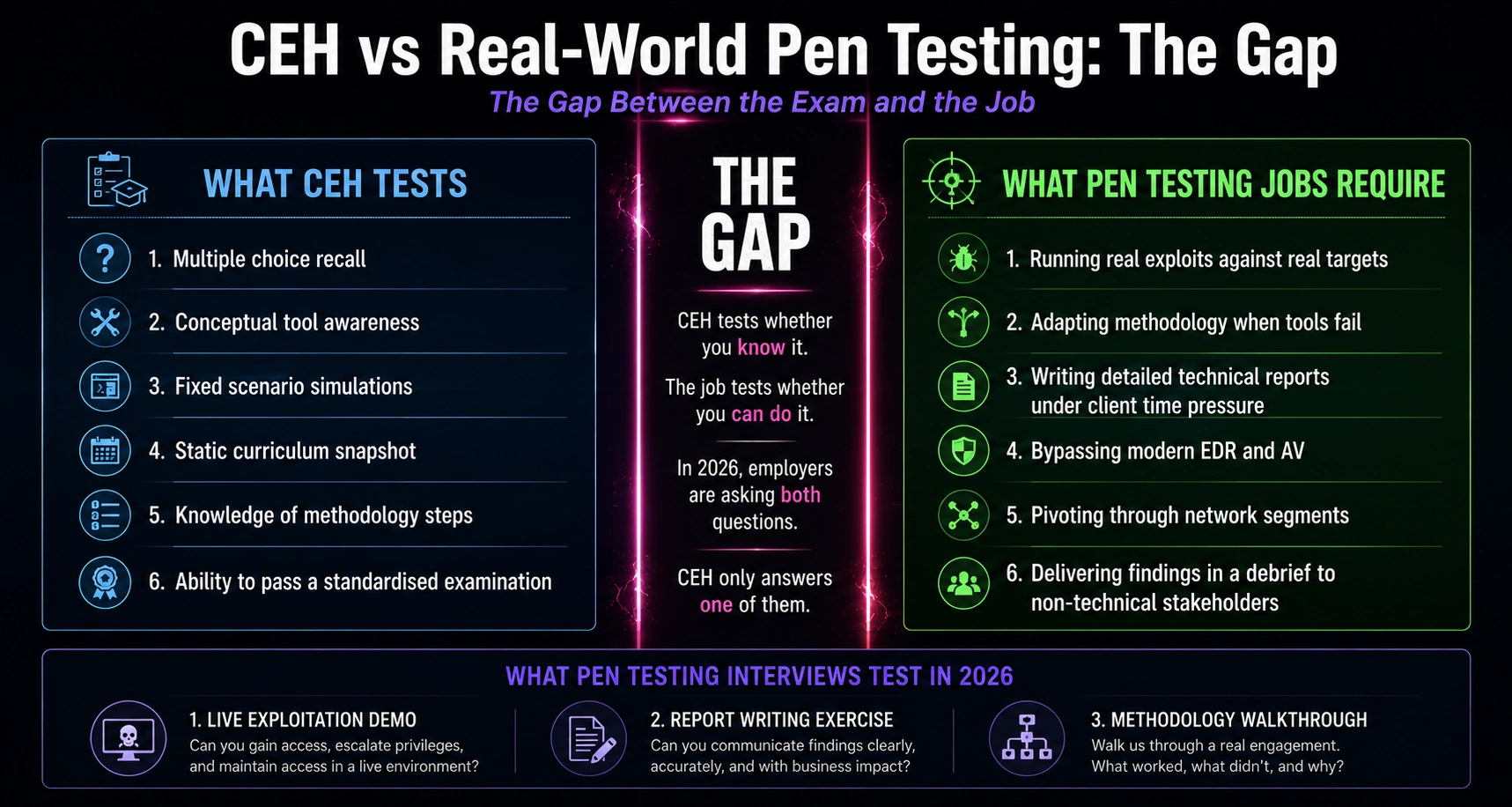
The CEH tells employers you passed a test about hacking. It does not tell them you can hack. The distinction was always present. In 2026, employers are increasingly aware of it.
The Five Myths Worth Examining
These are the assumptions that shape how most professionals approach CEH. Each one deserves honest scrutiny.
MYTH 1: CEH means you can do a penetration test |
|---|
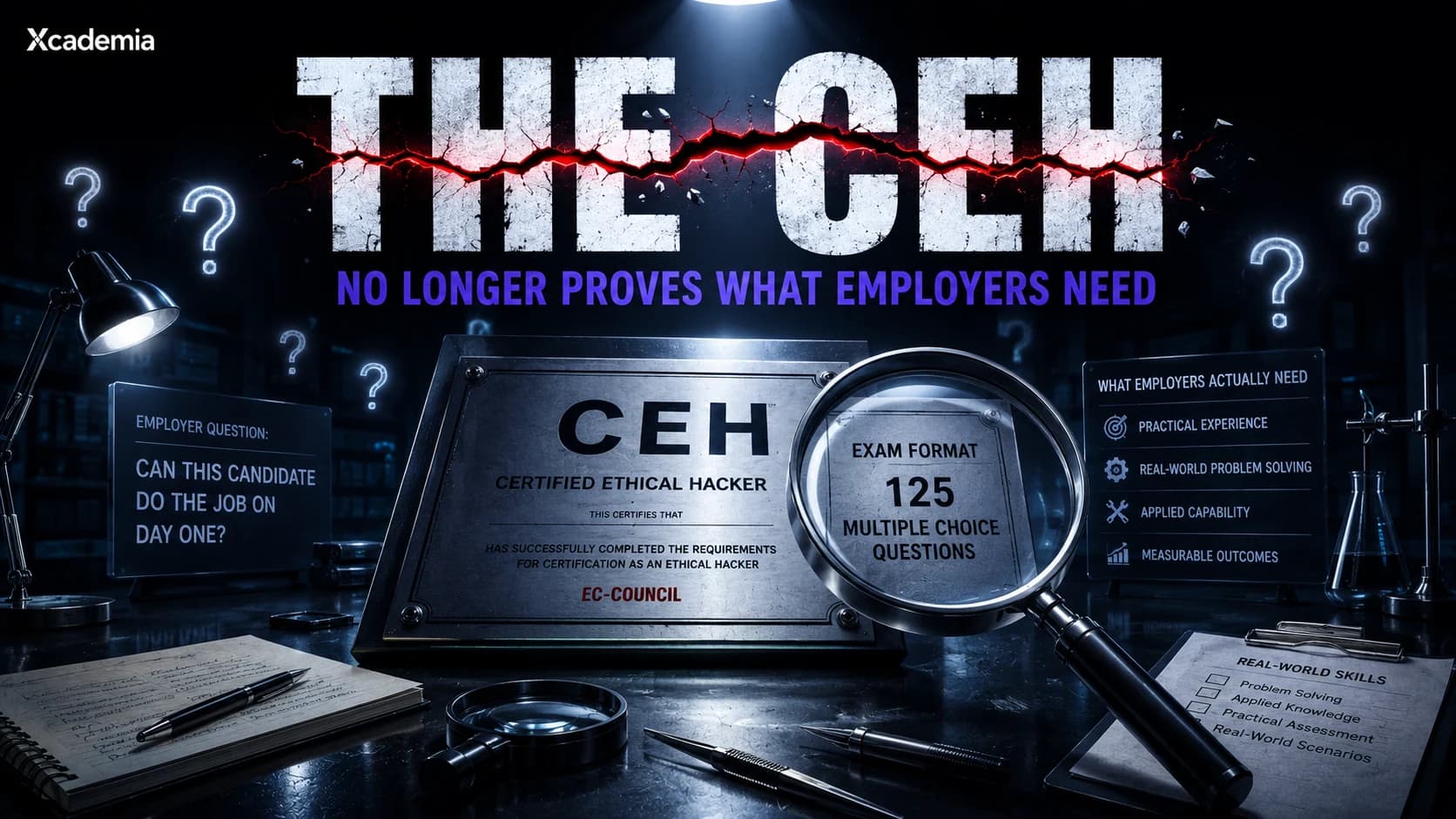
REALITY: CEH v13 consists of 125 multiple choice questions across 20 modules covering hacking concepts, methodology, and tools. The iLabs component, which provides hands-on practice, is an optional add-on purchased separately. Many candidates complete the qualification without significant hands-on lab time. Passing CEH demonstrates you can answer questions about penetration testing. A significant number of CEH holders have never run a real penetration test against a real target. |
MYTH 2: CEH is required for penetration testing roles |
|---|
REALITY: CEH is frequently listed in job specifications as a preferred qualification. It is rarely listed as a mandatory one. The OSCP (OffSec Certified Professional), which requires passing a 24-hour practical examination, is increasingly the credential that serious penetration testing employers actually require. CREST certifications are specifically required for penetration testing in UK government and many financial services environments. CEH is a preference, not a gate, in most markets. |
MYTH 3: CEH covers the tools you will actually use |
|---|
REALITY: The CEH curriculum lists approved tools and covers them at a conceptual level within the examination framework. The practical reality of penetration testing involves a significantly broader and constantly evolving toolset: Metasploit, Burp Suite, BloodHound, Cobalt Strike, custom scripts, and tools that are developed or modified for specific engagements. The CEH toolset snapshot does not keep pace with how offensive security practitioners actually work. This is a structural limitation of any exam-based certification with a fixed curriculum. |
MYTH 4: CEH is the global gold standard for ethical hacking |
|---|
REALITY: CEH is the most widely known ethical hacking certification. That is not the same as the most respected by practitioners. In the offensive security community, OSCP is the credential that signals genuine practical capability. In the UK government and financial sector, CREST CHECK and CREST CRT are the formal requirements. In the SANS ecosystem, GPEN and GXPN carry higher technical credibility. CEH is the most recognised brand in the general market. It is not the most respected credential among the professionals who do the work. |
MYTH 5: Passing CEH demonstrates you understood the material |
|---|
REALITY: At $1,199 USD for the EC-Council exam voucher, a significant preparation and examination industry exists around CEH. Exam dump sites, question banks, and bootcamps specifically designed to teach exam patterns rather than operational skill are widely available. A non-trivial proportion of CEH candidates pass the examination through pattern recognition of question formats rather than deep operational understanding. This is not unique to CEH. It is a structural risk of any high-value examination with a stable question format. |
What Has Not Changed
Before the conclusion, the correction that is equally important.
CEH still opens doors. The brand recognition in the UAE, Middle East, and US enterprise markets is real and durable. Job specifications that list CEH as a preference represent genuine opportunities. The HR screening function of the CEH logo on a CV is still valuable for the professional targeting those markets and those roles.
EC-Council has also invested in making CEH more practical with successive versions. CEH v13 includes AI-powered learning paths, updated modules on cloud hacking, OT security, and AI attack techniques, and stronger emphasis on the iLabs practical component. The direction of travel is positive.
The argument is not that CEH is worthless. The argument is that CEH alone, without practical evidence of capability, is less convincing to employers than it was five years ago. The bar for "proves you can do the job" has risen. CEH does not rise with it automatically.
CEH is a useful first certification for the ethical hacking career path. It is not, on its own, sufficient evidence of penetration testing capability for the employers who are most serious about hiring genuine practitioners.
What This Means for Your Certification Strategy
If you are planning your certification investment in ethical hacking and penetration testing, the honest recommendation in 2026 is a two-layer strategy.
Layer 1: Market recognition
CEH, or a preparation programme aligned with CEH content, covers the market recognition function. It passes the HR filter. It satisfies the job specification that lists CEH as a preference. It provides a structured introduction to ethical hacking methodology. Take this layer seriously rather than treating it as a box to tick. If you understand what CEH covers at a genuine operational level rather than examination pattern level, the credential means something.
Layer 2: Demonstrated capability
The second layer is what separates you in the interview and on the job. This is where XEHP, OSCP, or CREST CRT come in depending on your market. They test whether you can do the work, not whether you can answer questions about it. The professionals who progress fastest in ethical hacking careers are the ones who have both layers, not the ones who have accumulated the most exam-based credentials.
The cert gets you in the room. The proof gets you the job. CEH opens the door. The evidence that you can actually break into systems closes the offer.
Ready to go deeper?
Professional Training
Hands-on, mentor-led training aligned with industry certifications.
About the Author
Sharper every day
Daily tutorials, analysis, and career playbooks across all 12 Xcademia disciplines, straight to your inbox. No spam.