Why Practitioner Assessment Is Replacing the Exam
The examination was designed as a proxy for capability. Somewhere along the way, the proxy became the goal. As employers demand evidence of applied competence and AI passes more exams, practitioner assessment is emerging as the new standard for professional credibility.
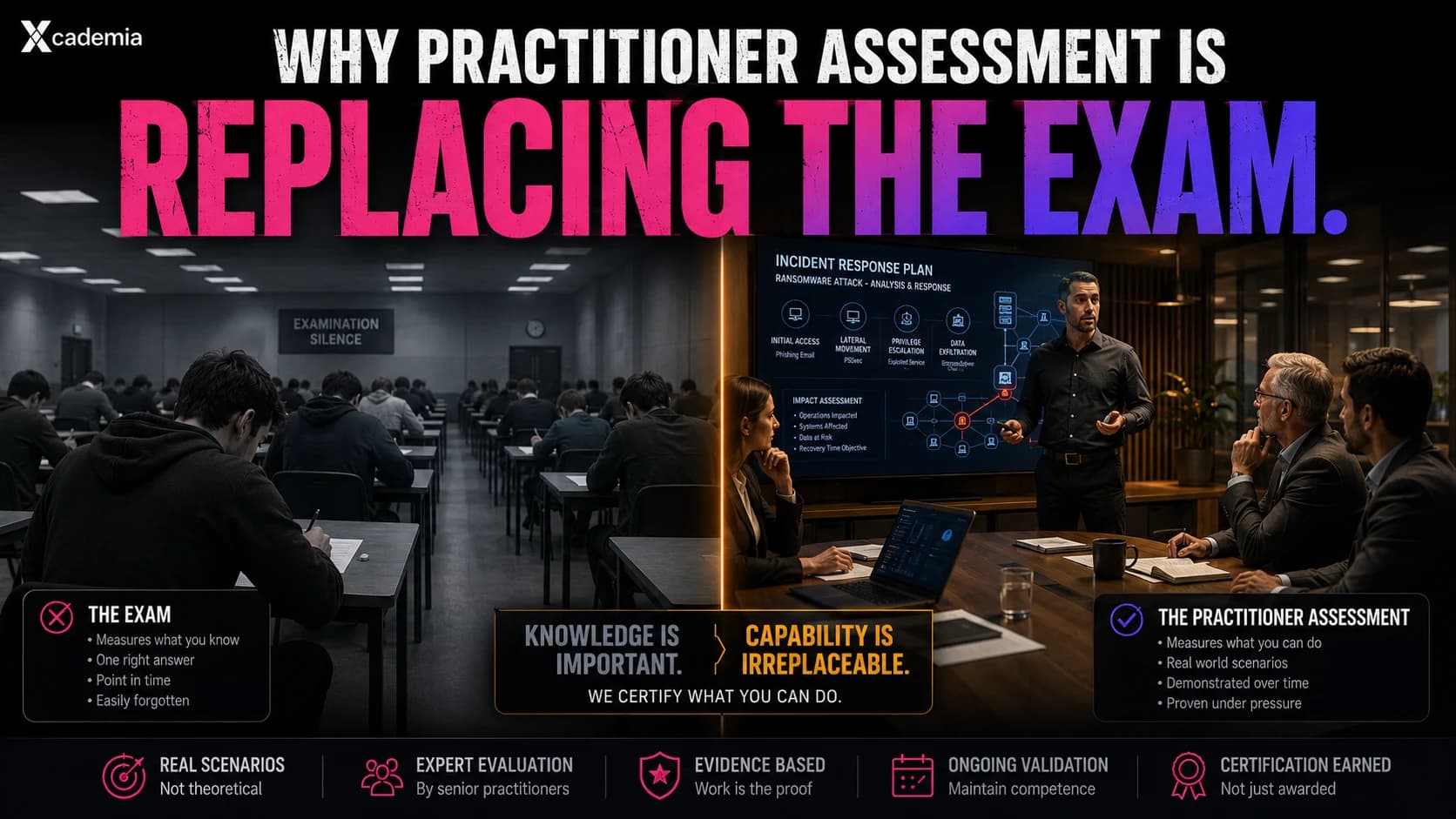
The examination was never supposed to be the destination. Somewhere along the way, the profession forgot that.
For thirty years, the certification industry has operated on a simple premise: if you can answer enough questions about a subject correctly, you know enough about it to do it professionally. This premise is partially true and has produced a generation of professionals who are knowledgeable, credentialled, and in many cases genuinely skilled. It has also produced a separate, partially overlapping category of professionals who are credentialled but cannot do the work that the credential implies.
The examination was never supposed to be the destination. It was designed as a proxy measure, an indicator that correlates with capability when direct assessment of that capability is expensive, time-consuming, or impractical. The correlation held well enough that the proxy became the goal. The certificate became the evidence of competence rather than the indicator of it.
Something is changing.
The employer who has hired CISSP-qualified candidates who cannot conduct a risk assessment is not unusual. The employer who has hired CISM-qualified managers who cannot present a risk posture to a board is not unusual. The employer who has hired PRINCE2 Practitioners who have never actually recovered a failing project is not unusual. The credential confirmed the study. The work was supposed to prove the capability. The gap between the two is what practitioner assessment closes.
What Examinations Test and What They Do Not
This is not an argument against examinations. It is an argument for precision about what they test.
A well-designed examination tests knowledge recall under time pressure, the ability to apply framework concepts to standardised scenarios, and reasoning within a defined domain. These are genuine indicators of the study the candidate has completed and the understanding they have developed. CISSP examinations test whether you understand information security concepts across eight domains. CISM examinations test whether you understand IS management principles. PMP examinations test whether you understand project management frameworks. These are legitimate things to test.
What examinations cannot test is what happens when the framework meets reality. When the risk assessment you are presenting is not a standardised scenario but the actual risk posture of an organisation whose board is impatient, whose budget is constrained, and whose CISO is asking why the numbers look the way they do. When the project you are managing is the one that has just lost its sponsor, gained three new stakeholders with conflicting objectives, and has a delivery date that cannot move. When the penetration test finds something that changes the client's understanding of their own security in a way that the methodology did not anticipate.
Examinations test whether you know what you should do. Practitioner assessment tests whether you can do it.
The knowledge-based examination and the practitioner assessment are not competing claims about what constitutes competence. They are assessing different things. The examination establishes the framework understanding. The practitioner assessment establishes the applied capability. Both have a place. Neither is sufficient alone.
Why the Market Is Shifting
Employer experience
The employers who have hired credentialled professionals who could not perform the role have learned something. They are increasingly asking for evidence of applied capability alongside credentials, portfolio work, case studies, scenario responses in interviews, references that speak to specific outcomes. The credential is no longer assumed to speak for itself. This shift is not anti-credential. It is the market correcting the over-inflation of credential value relative to capability evidence.
The AI pressure
AI tools can pass most professional examinations. They can score in the top percentiles of the bar exam, the CPA examination, and most technology certification examinations. This does not mean AI is a lawyer, an accountant, or a security professional. It means the examination was measuring something that correlates with professional competence without being equivalent to it. An assessment that an AI can pass with a well-crafted prompt is an assessment that may not be measuring the right thing. Practitioner assessment, the kind that requires actual decision-making in a real scenario with an experienced evaluator in the room, is significantly harder to automate away.
Regulatory pressure on professional standards
NIS2, DORA, and the UK FCA's individual accountability regime are all increasing the emphasis on demonstrated competence over credentialled knowledge. Regulators are asking not just whether staff hold qualifications but whether they can perform the roles those qualifications are supposed to prepare them for. The regulatory direction is toward evidence of applied capability, not just evidence of study completion.
The talent shortage premium
In markets with structural talent shortages, cybersecurity, OT security, CSRD compliance, financial crime, the premium for demonstrated applied capability is measurable in salary. Employers who cannot fill roles from the pool of credentialled candidates are paying premiums to professionals who can demonstrate they can do the work. The ability to point to a practitioner assessment alongside a market credential is increasingly a salary differentiator.
The examination tells the employer: this person studied and understood the material. The practitioner assessment tells the employer: this person can apply the material under real conditions with an experienced evaluator watching. In a talent market where the credential pool is insufficient, the second piece of evidence matters more than the first.
What Practitioner Assessment Actually Requires
A practitioner assessment that actually tests applied capability has specific characteristics that distinguish it from an examination dressed up as a scenario exercise.
The scenario is realistic, not sanitised. A real organisation facing a real challenge, with the ambiguity, incomplete information, and competing pressures that characterise real professional work.
The candidate must produce a work product, not select a correct answer. A risk assessment. A project plan. A penetration test report. A threat intelligence brief. A board paper. Something that would be useful in the actual context it represents.
An experienced practitioner evaluates the output. Not a marking scheme that counts correct elements. An evaluator who has done the work and can assess whether the candidate's approach reflects genuine capability.
The assessment has consequences for the credential. Failing the capstone means not holding the credential. The bar is real.
Verification is possible. Employers and clients can confirm the credential was awarded and on what basis.
Xcademia's practitioner certifications are built around these principles. Every X-series certification XEHP, XSOC, XCISO, XPRI, XDATA, XPROJ, and all the others in the 30-cert library, includes a practitioner capstone assessed by a senior Xcademia practitioner with real-world experience in the domain. Not open-book multiple choice. Not peer-marked portfolio. A senior practitioner evaluating whether the candidate can do the work. Verifiable at xcademia.com/verify.
The certificate gets you in the room. The proof gets you the job. Xcademia's positioning is not that examinations are wrong. It is that examinations are incomplete evidence. The practitioner who holds both a recognised market credential and a practitioner-assessed qualification is more credible than the one who holds only one of them.
The Practitioner Economy
We are moving toward a professional economy where demonstrated capability is valued differently from studied knowledge. This is not a new insight; it has always been true that the professional who can do the work is more valuable than the one who can only describe it. What is new is the infrastructure to assess and verify applied capability at scale, outside the traditional apprenticeship models that were the only way to do it before.
Practitioner certifications are that infrastructure. They provide the mechanism to assess, verify, and signal applied capability in a way that market credentials established for knowledge and that experience alone cannot efficiently communicate to a new employer or client.
The month of content you have just read- thirty days of knowledge articles, training intent comparisons, career guides, and technical how-to guides- has been built around one consistent argument: the distinction between knowing and doing is the distinction that matters in professional life, and the certification that closes that gap is the one that has value when the job needs doing.
"The cert gets you in the room.
The proof gets you the job.
At Xcademia, we build both."
What Xcademia Is Building
Xcademia has built thirty practitioner certifications across cybersecurity, cloud, data, governance, finance, project management, and HR. Each one follows the same principle: a structured programme delivered by practitioners, assessed by practitioners, on scenarios that reflect the reality of the role rather than the convenience of the examination format.
The X-Ray capability platform identifies where a professional sits against the capability profile that their target role requires and prescribes the specific development pathway to close the gap. Not a generic learning recommendation. A specific, validated capability gap with a specific, practitioner-assessed pathway to address it.
The Xcademia Institute, incorporated in April 2026, is the personnel certification body that provides independent credentialling for Xcademia practitioner certifications. The separation between programme delivery (Xcademia Ltd) and certification award (Xcademia Institute) follows the ISO/IEC 17024 model for personnel certification bodies, providing the independence and rigour that employer confidence in credentials requires.
This is not the destination. It is the beginning of what Xcademia is building.
Diagnose Your Capability Gap With X-Ray X-Ray is Xcademia's AI-powered capability intelligence platform. It maps your current skills against your target role's capability requirements and prescribes the specific development pathway to close the gap. Not a generic course recommendation. A validated, precise capability gap analysis. Start Your X-Ray |
|---|
Ready to go deeper?
Professional Training
Hands-on, mentor-led training aligned with industry certifications.
About the Author
Sharper every day
Daily tutorials, analysis, and career playbooks across all 12 Xcademia disciplines, straight to your inbox. No spam.