What a GRC Analyst Actually Does
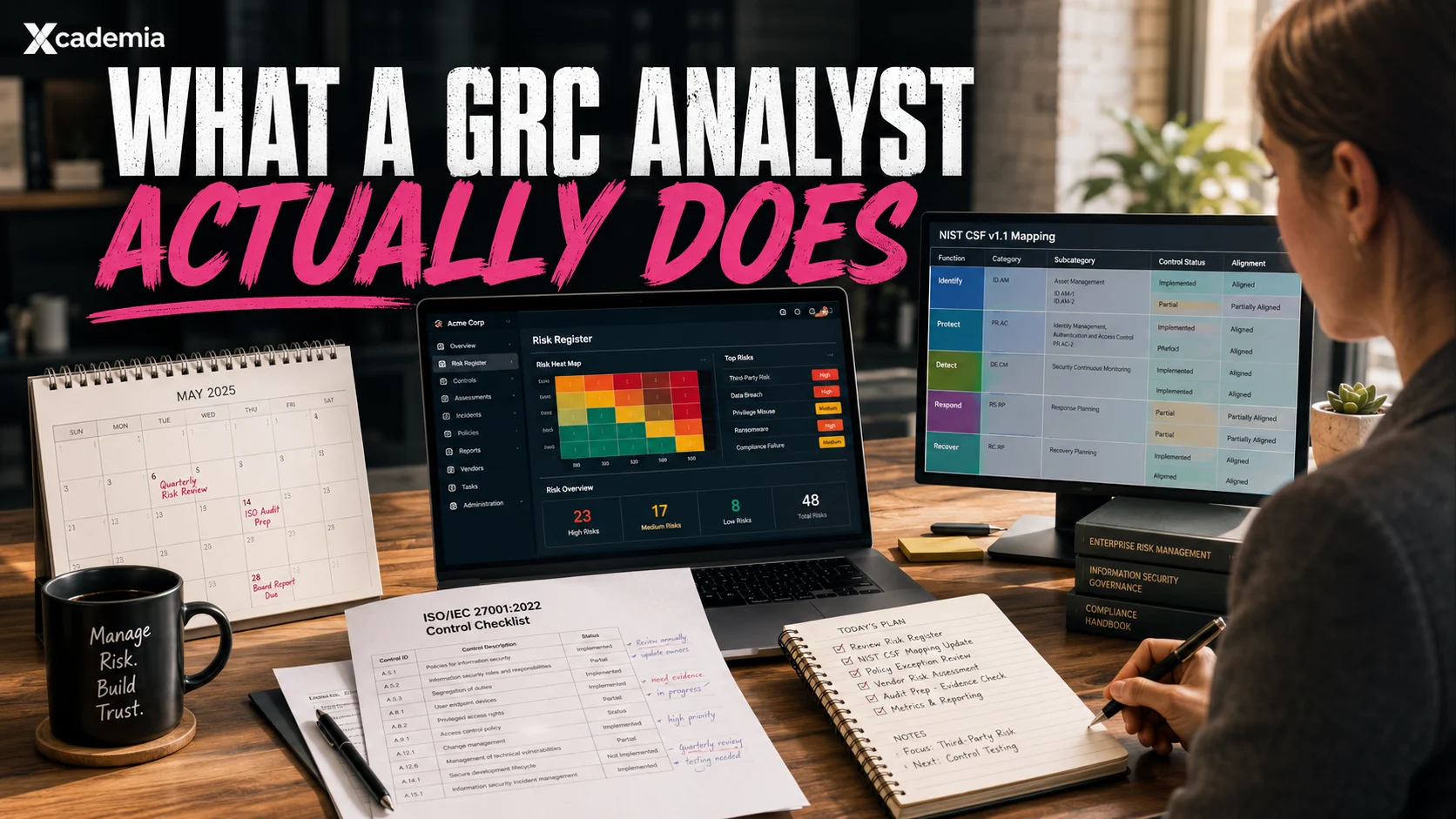
GRC analysts connect security controls, risk, audits, and board reporting into a coherent security programme. This article breaks down the real day-to-day work of a GRC analyst in 2026 across governance, risk management, compliance, vendor reviews, and audit preparation.
Day to day, week to week, and why this is one of the most misunderstood roles in security
GRC is one of the fastest-growing specialisms in cybersecurity and one of the most consistently misunderstood. Ask a technical security professional what a GRC analyst does and you will often hear something vague about policies and audits. Ask someone who does the job and you will hear a specific account of work that is analytical, consequential, and anything but passive.
The misunderstanding matters because it leads professionals to underestimate the role when considering their career options, and it leads organisations to hire for GRC positions without a clear understanding of what they actually need the person to do.
This article is a realistic account of what a GRC analyst does across a working week in a typical financial services, technology, or healthcare organisation in 2026.
GRC is the specialism that makes security programmes legible to organisations. The technical team builds the controls. The GRC analyst builds the framework that tells the organisation which controls it needs, whether they are working, what the gaps mean, and what the board should do about it. Without GRC, security is a collection of technical activities without a coherent programme.
The Three Domains in Practice
GRC stands for Governance, Risk, and Compliance. Each domain is distinct, though they overlap significantly in practice. Understanding what each one means in an analyst's actual work helps clarify the role.
Governance
Governance is about the structures and processes through which the organisation makes decisions about information security. The GRC analyst's governance work includes maintaining the policy library, writing, reviewing, and updating security policies, standards, and procedures. It includes managing the exceptions process when a business unit needs to operate outside a policy requirement, the GRC analyst assesses the risk of the exception and documents the approval. It includes supporting governance committee meetings, preparing papers, tracking action items, maintaining decision logs.
Risk
Risk management is where GRC intersects most directly with the organisation's strategic objectives. The GRC analyst conducts and supports risk assessments: identifying risks, assessing their likelihood and potential impact, identifying existing controls, and recommending additional mitigations. They maintain the risk register, a living document that records the organisation's identified risks, their current status, the controls in place, and the residual risk the organisation is accepting. They produce risk reporting, translating the risk register into formats that different audiences can act on, from technical remediation plans for the IT team to executive summaries for the board.
Compliance
Compliance is the demonstration that the organisation meets its regulatory and contractual obligations. The GRC analyst maps the organisation's controls against the applicable frameworks: ISO 27001, NIST CSF, SOC 2, GDPR, PCI-DSS, or sector-specific requirements. They track gaps where the organisation's current control environment does not satisfy a framework requirement. They manage audit evidence: collecting, organising, and presenting the evidence that demonstrates compliance to internal or external auditors. They manage the audit schedule: coordinating the preparation for regulatory examinations, external audits, and customer security assessments.
The GRC analyst who only does one of these three domains is a policy writer, a risk analyst, or a compliance officer. The one who does all three is a GRC professional in the full sense: someone who can connect a board-level risk appetite statement to a specific control gap and explain the path between them.
A Typical Week
The rhythm of GRC work is shaped by two kinds of activities: ongoing operational work that repeats weekly or monthly, and project work tied to specific events like audits, regulatory changes, or risk assessment cycles. A typical week mixes both.
Monday — Policy Maintenance & Exception Review
The week begins with reviewing policy exception requests submitted by business units seeking to operate outside defined policy requirements.
Each request is carefully assessed by:
Understanding the specific policy requirement
Evaluating why the exception is needed
Reviewing compensating controls already in place
Determining the residual risk if the exception is approved
Based on this evaluation, recommendations are prepared for the policy exception committee.
In the afternoon, focus shifts to policy review. For example, a cloud security standard that has not been updated in over a year is reviewed and revised to align with the organization’s evolving multi-cloud environment.
Tuesday — Risk Register Update & Assessment Interviews
Tuesday is dedicated to maintaining an accurate and up-to-date risk register.
Activities include:
Reviewing existing risks and their current status
Updating likelihood and impact based on new threat intelligence
Adjusting risk ratings based on control changes
In the afternoon, risk assessment interviews are conducted with business unit leaders, especially those implementing new systems or vendor integrations. These discussions provide valuable operational insights, revealing how processes actually function and what controls are effectively in place.
Wednesday — Audit Evidence Collection & Control Testing
With audits approaching, Wednesday focuses on audit readiness.
Key tasks include:
Reviewing the control evidence matrix
Identifying missing or outdated evidence
Coordinating with control owners for documentation
Organizing evidence for the audit pack
Delays in responses from control owners can pose challenges. In such cases, escalations are made to management, and all actions are documented. Regardless of preparedness, audit timelines remain fixed, making timely evidence collection critical.
Thursday — Board Risk Report Preparation
Thursday is focused on preparing risk reports for senior leadership and the board.
The report includes:
A summary of the current risk posture
The top five risks based on impact
Status of remediation efforts
Risks that have exceeded review deadlines
Newly identified risks for the quarter
A key challenge is translating technical risk data into concise, business-friendly language that enables informed decision-making at the executive level.
Friday — Vendor Risk Assessments & Regulatory Horizon Scan
Friday is dedicated to external risk management and regulatory awareness.
Key activities include:
Reviewing vendor security questionnaires
Mapping vendor controls against third-party risk frameworks
Identifying gaps and recommending remediation or risk acceptance
Additionally, regulatory updates are reviewed as part of a horizon scan. For instance, new guidance related to NIS2 implementation or operational resilience updates from regulatory bodies is assessed for impact. Relevant changes are then incorporated into the organization’s compliance framework and regulatory change log.
What Makes a Good GRC Analyst
GRC is one of the few cybersecurity specialisms where breadth matters as much as depth. The GRC analyst who is excellent at one domain but weak in the others is a liability in an audit or a board meeting. The skills that distinguish effective GRC analysts from ineffective ones are consistent across organisations.
Writing quality
GRC analysts write constantly: policies, risk assessments, audit reports, board papers, exception justifications. The quality of this writing directly determines whether the organisation makes good decisions based on GRC outputs. A board risk paper that is unclear produces unclear board decisions. A policy that is ambiguously written will be interpreted inconsistently. Writing is not a soft skill in GRC. It is a primary technical skill.
Framework literacy
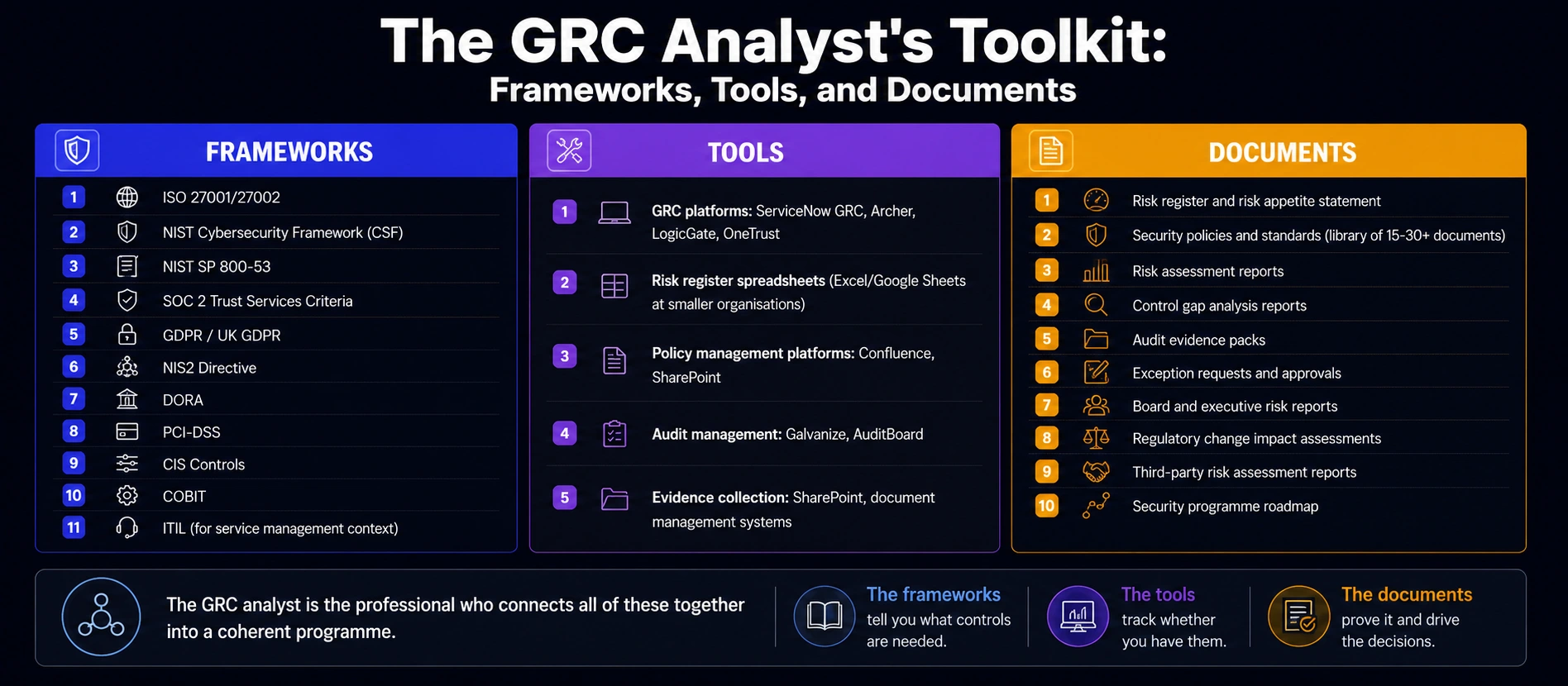
An effective GRC analyst can navigate between frameworks fluidly. ISO 27001 control A.8.20 maps to NIST CSF PR.AC-4. The SOC 2 Trust Services Criterion CC6.1 aligns with ISO 27001 Annex A controls on access management. This framework literacy allows the GRC analyst to avoid duplicating work when an organisation is subject to multiple frameworks, and to explain to auditors from different regimes how the organisation's control environment satisfies each requirement.
Stakeholder management
GRC analysts spend a significant proportion of their time getting information, evidence, and action from people who do not report to them and who often do not consider GRC their priority. The ability to build productive working relationships across the business, to make compliance feel like a shared objective rather than an imposition, and to escalate effectively when it is necessary, is what determines whether a GRC programme is functional or theatrical.
The GRC analyst is not the security police. They are the professional who helps the organisation understand what good security looks like, measure where it currently sits, and plan the path between the two. The organisations with the most effective GRC programmes are the ones where that framing is understood and supported from the top.
The Career Trajectory
GRC as a career path has a clear progression that differs from the technical security path.
GRC Analyst (entry to mid): Policy maintenance, risk register management, audit evidence collection, control gap analysis. Typically 0-4 years.
Senior GRC Analyst / GRC Lead: Full risk assessment ownership, framework mapping leadership, board reporting, team coordination. Typically 3-7 years.
GRC Manager / Head of GRC: Programme strategy, regulatory engagement, CISO advisory, team management, third-party risk programme ownership. Typically 6-12 years.
CISO / Director of Governance: The GRC track is one of the most common routes to CISO level, particularly in regulated industries where governance and compliance accountability is central to the role.
The salary trajectory in GRC reflects the growing regulatory burden that makes GRC expertise scarce. Senior GRC professionals in UK financial services command salaries comparable to senior security engineers. The stereotype of GRC as the lower-paid compliance function is increasingly inaccurate as NIS2, DORA, and escalating ICO enforcement have made GRC capability a strategic asset.
GRC was once considered the less glamorous path compared to technical security. In 2026, with the regulatory burden at its highest point in a generation, experienced GRC professionals are among the most sought-after in the security market. The demand is structural and it is not being met by current supply.
Build Applied GRC Capability With Xcademia Xcademia's GRC pathway covers XCISM (IS management), XCRISC (risk and IS controls), and XPRI (data protection). All instructor-led. All practitioner-assessed. Built for GRC professionals who need to demonstrate applied capability, not just framework knowledge. Explore the GRC Pathway |
|---|
Ready to go deeper?
Professional Training
Hands-on, mentor-led training aligned with industry certifications.
About the Author
Sharper every day
Daily tutorials, analysis, and career playbooks across all 12 Xcademia disciplines, straight to your inbox. No spam.