Cybersecurity Careers in the UK
The UK cybersecurity market has a structural talent shortage that is not slowing down. This 2026 guide breaks down the roles, salaries, certifications, security clearance pathways, and sectors hiring most actively across the UK cybersecurity market.

The Complete 2026 Guide to Roles, Salaries, Certifications, and the Job Market
The UK is one of the most significant cybersecurity employment markets in the world. London is the fourth-largest fintech hub globally. Government digital services are under continuous reform. The NHS is the largest employer in Europe. Defence and intelligence require a continuous pipeline of cleared security professionals. Financial services regulation under the FCA, NIS2 obligations for critical infrastructure, and GDPR compliance requirements across every sector mean demand for qualified security professionals is structural, not cyclical.
The talent gap is real. NCSC and industry bodies have consistently reported that demand outstrips supply across virtually every cybersecurity specialism. That gap creates a market dynamic that is unusual in most professional disciplines: employers compete for candidates rather than the reverse, particularly at mid to senior level.
This guide covers the UK cybersecurity job market as it actually exists in 2026: the roles, the salaries, the certifications that employers actually ask for, the sectors hiring most actively, and the specific characteristics of the UK market that differ from the US, UAE, and European equivalents.
The UK cybersecurity market has a structural talent shortage that is not being resolved at pace. For qualified professionals, that shortage is an opportunity. For organisations, it is a risk. The ones willing to invest in developing talent rather than only recruiting experienced hires are better positioned in both directions.
The UK Regulatory Landscape Driving Demand
Demand for cybersecurity professionals in the UK is substantially shaped by the regulatory obligations that organisations must meet. Understanding the regulatory context explains where the hiring is concentrated and which specialisms are growing fastest.
NIS2 and the Network and Information Systems Regulations
The UK's post-Brexit NIS Regulations, aligned with but distinct from the EU's NIS2 Directive, place specific cybersecurity obligations on operators of essential services: energy, transport, water, health, and digital infrastructure. Compliance requires demonstrable security capability, incident reporting within defined timeframes, and senior-level accountability for security risk. Every regulated sector needs the professionals to implement and maintain that compliance.
UK GDPR and data protection
The UK's post-Brexit data protection framework maintains GDPR-equivalent obligations under the UK GDPR and Data Protection Act 2018. ICO enforcement has increased in scale and visibility. Organisations handling personal data at scale need privacy-competent security teams, creating sustained demand for GRC professionals with data protection specialism.
FCA cybersecurity requirements
The Financial Conduct Authority has progressively strengthened its expectations of regulated firms' cyber resilience. DORA (the EU's Digital Operational Resilience Act) applies to UK financial services firms with EU operations. The combination of FCA expectations and DORA obligations is driving significant investment in cyber resilience capability in UK financial services, one of the largest single sectors for cybersecurity employment.
GovAssure and the NCSC framework
GovAssure is the UK Government's internal assurance framework, requiring all government departments to assess their cybersecurity posture against the NCSC Cyber Assessment Framework. The rollout of GovAssure has created demand for professionals who understand the CAF methodology and can assess, implement, and report against it. This is a specifically UK government skill set that commands a premium in that market.
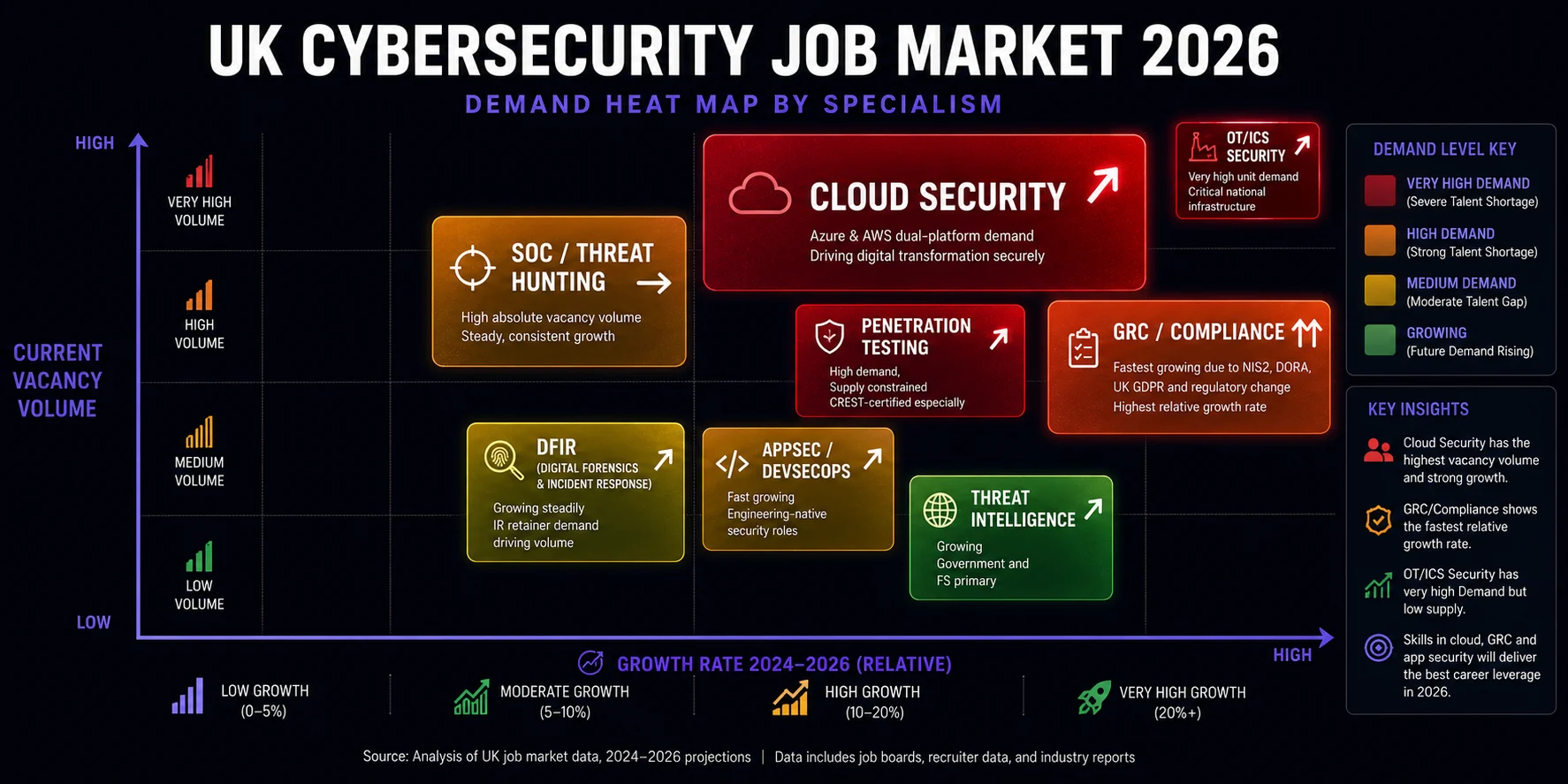
The UK regulatory environment is not slowing down. Every new regulatory obligation creates a new category of compliance professionals needed to meet it. The GRC specialism in the UK is growing faster than almost any other area of cybersecurity employment.
UK Cybersecurity Salaries 2026
These figures reflect the actual UK market in 2026. They are London and South East weighted at the upper end. Regional figures are typically 10-20% lower outside London.
ROLE | ENTRY | MID-LEVEL | SENIOR | DEMAND 2026 |
|---|---|---|---|---|
SOC Analyst L1 | £25,000-£35,000 | £30,000-£45,000 | £40,000-£60,000+ | High. NHS, financial services, MSSP demand. |
Penetration Tester | £30,000-£45,000 | £45,000-£65,000 | £65,000-£95,000+ | Very high. CREST-certified supply shortage. |
Security Engineer | £35,000-£50,000 | £50,000-£70,000 | £70,000-£100,000+ | High. Cloud security especially in demand. |
GRC Analyst | £28,000-£40,000 | £40,000-£58,000 | £58,000-£80,000+ | High. NIS2, DORA, and GDPR compliance wave. |
CISO (SME) | N/A | £80,000-£110,000 | £110,000-£160,000+ | Growing. SME cyber maturity investment rising. |
Cloud Security Architect | £45,000-£60,000 | £60,000-£85,000 | £85,000-£130,000+ | Very high. Multi-cloud security specialism. |
Threat Intelligence Analyst | £32,000-£45,000 | £45,000-£65,000 | £65,000-£90,000+ | Moderate-high. Government and FS primarily. |
DFIR Analyst | £32,000-£48,000 | £48,000-£68,000 | £68,000-£95,000+ | High. IR retainer firms and in-house teams. |
Three observations worth making about these figures.
First, the gap between entry and senior is wider in cybersecurity than in most other professional disciplines. The premium for genuine experience and demonstrated capability is real and significant.
Second, security clearance adds a meaningful premium above these figures. Developed Vetting (DV) cleared professionals in penetration testing and intelligence roles can command significantly above the senior ranges listed.
Third, contract rates in cybersecurity are typically 40-60% above equivalent permanent day rates for equivalent roles. The contracting market in the UK, particularly for London-based or remote work, is active.
The most significant salary driver in the UK cybersecurity market is not the certification held. It is the combination of demonstrated capability, sector experience, and in some roles, security clearance. The professionals who invest in the right combination of these three factors consistently outperform their peers in salary progression.
The Sectors Hiring Most Actively
(A) Financial services
Banks, insurance firms, payment processors, asset managers, and fintechs represent the largest single hiring sector for cybersecurity professionals in the UK. The concentration of financial infrastructure in the City of London and Canary Wharf creates a dense employment market for security engineers, GRC professionals, and threat intelligence analysts. DORA compliance is driving significant new hiring in 2026.
(B) Government and defence
HMRC, NCSC, GCHQ, MOD, and the wider public sector represent a distinct employment market with its own dynamics. Security clearance is often required or strongly preferred. Salaries are constrained by public sector pay frameworks but are supplemented by defined benefit pensions, working conditions, and the nature of the work itself. Demand for GovAssure and CAF-competent professionals is strong.
(C) NHS and healthcare
The NHS Digital Security Operations Centre, NHS England, and individual NHS Trusts represent a significant and growing cybersecurity employment market. WannaCry fundamentally changed the NHS's posture on security investment. The breadth of the NHS estate, its critical nature, and its complex legacy technology environment create demand for security professionals who can operate in constrained and complex environments.
(D) MSSPs and consultancies
Managed Security Service Providers and cybersecurity consultancies represent the fastest entry point for many professionals. MSSP environments provide exposure to a breadth of client environments and attack types that in-house roles rarely match. The learning curve is steep and the hours can be demanding, but the career acceleration for early-career professionals is genuine.
(E) Technology and SaaS
UK-based technology companies, from scale-ups to public companies, are consistently hiring AppSec engineers, security engineers, and cloud security specialists. These roles typically offer competitive salaries, equity or LTIP participation, and flexible working conditions. The demand for people who can embed security into engineering rather than simply audit it is growing faster than any other category.
The Certifications UK Employers Ask For
The UK market has specific certification preferences that differ meaningfully from the US and UAE markets.
(A) Penetration testing
CREST is the dominant body in UK penetration testing. For any government or regulated financial services work, CREST CHECK accreditation is effectively mandatory for the providing organisation, which requires CHECK-certified testers. CREST CRT (Registered Tester) is the entry-level CREST credential. CEH and OSCP are also valued but CREST is the UK-specific standard that appears most frequently in government procurement requirements.
(B) GRC and governance
ISO 27001 Lead Implementer and Lead Auditor are the most requested GRC certifications in UK job specifications. CISM and CISSP appear frequently at manager and above. GDPR practitioner certifications are valued in data protection-focused roles. The NCSC-certified professional scheme is increasingly referenced in government-adjacent roles.
(C) Cloud security
AWS Security Specialty, CCSP, and AZ-500 (Azure Security Engineer) are the most requested cloud security certifications in UK job specifications. The prevalence of Microsoft Azure in UK enterprise and government environments means AZ-500 appears disproportionately in UK job specs compared to US equivalents.
(D) Security operations
CySA+ and CompTIA Security+ are the most frequently listed entry-level credentials in UK SOC job specifications. SIEM platform certifications, particularly for Microsoft Sentinel and Splunk, are increasingly requested as secondary credentials for SOC roles.
The UK market places specific emphasis on CREST for pen testing and ISO 27001 for GRC in a way that distinguishes it from the US and UAE markets. A professional calibrating their certification investment for the UK market should prioritise these alongside the globally recognised credentials.
What the UK Market Values That Others Do Not
Several characteristics of the UK cybersecurity employment market are worth understanding specifically.
(A) Security clearance
The UK's National Security Vetting (NSV) system, offering Baseline Personnel Security Standard (BPSS), Security Check (SC), and Developed Vetting (DV) clearances, creates a distinct tier of employment opportunity. Cleared professionals can access roles at GCHQ, NCSC, MOD, and their contractors that are unavailable to others. SC clearance alone opens a significant additional segment of the market. The process is time-consuming but the career premium is persistent.
(B) CREST for pen testing
CREST-certified testers can access UK government CHECK engagements. This is a specific UK market characteristic that has no direct equivalent in most other markets. For penetration testers targeting the UK government or regulated financial services market, CREST accreditation is the professional standard that cannot be substituted with US or international equivalents.
(C) The London premium
Cybersecurity roles in London command a significant premium over equivalent roles elsewhere in the UK. The concentration of financial services, technology companies, and government functions in and around London creates the highest-density employment market in the UK. Remote and hybrid working has partially distributed this market since 2020, but London-based employers still typically pay above regional equivalents.
(D) The contracting market
The UK has a mature and active professional contracting market. Inside IR35 reforms changed the dynamics in 2021, but the contracting market remains active for senior and specialist cybersecurity professionals. Day rates for CREST-certified penetration testers, experienced incident responders, and cloud security architects are significantly above equivalent permanent day rates.
X-Ray can assess your current cybersecurity capability against the UK market's specific requirements and identify the precise gaps between where you are and where the UK market's most valuable roles require you to be.
Ready to go deeper?
Professional Training
Hands-on, mentor-led training aligned with industry certifications.
About the Author
Sharper every day
Daily tutorials, analysis, and career playbooks across all 12 Xcademia disciplines, straight to your inbox. No spam.