Cybersecurity Careers in the USA
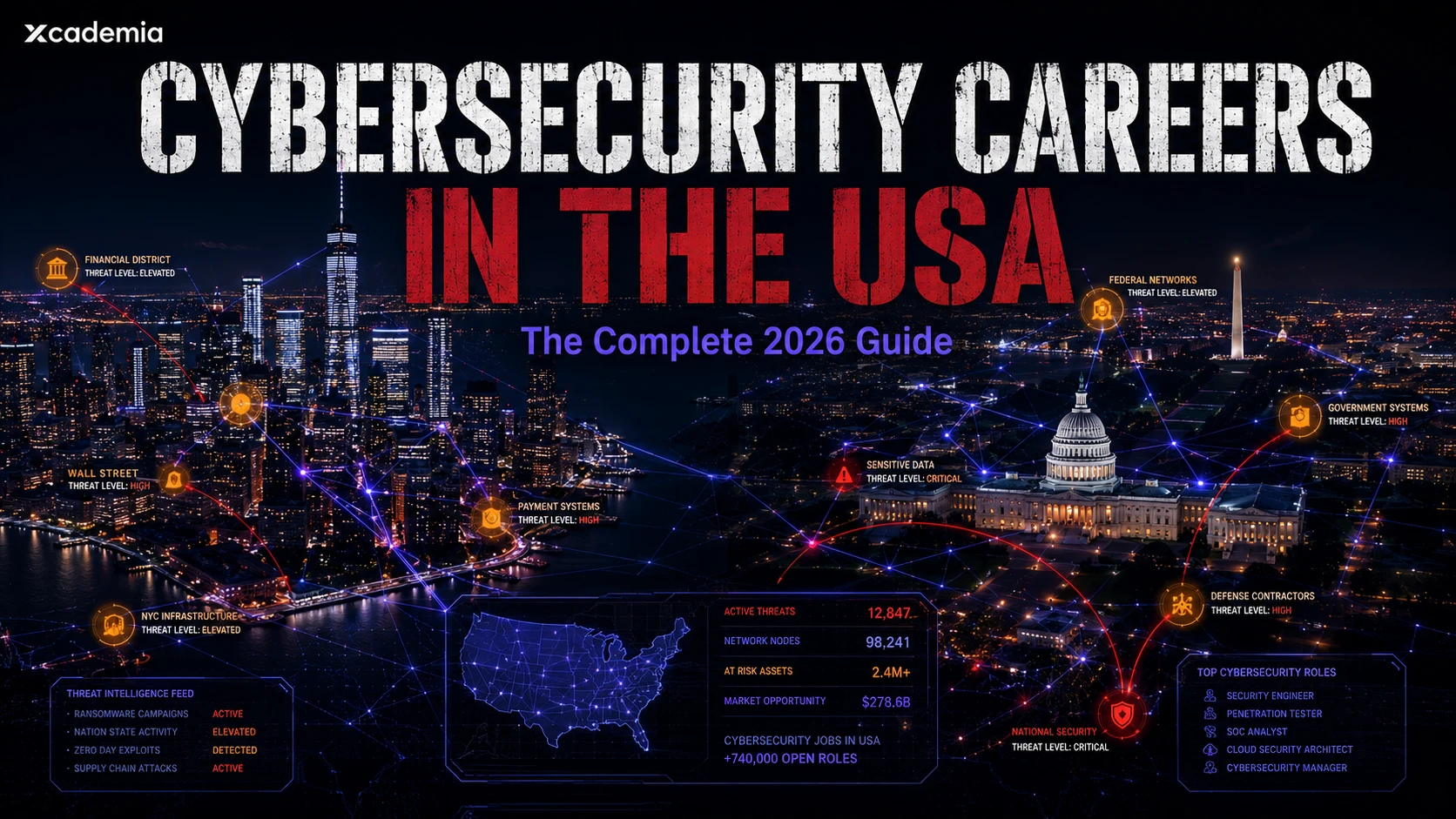
The United States remains the world’s largest cybersecurity job market, with high salaries and strong demand driven by CMMC, FedRAMP, and critical infrastructure regulation. This guide covers roles, salaries, certifications, security clearances, and the top US career hubs in 2026.
The Complete 2026 Guide to Roles, Salaries, Certifications, and the Job Market
The United States is the largest single cybersecurity employment market in the world by a significant margin. The combination of the world's largest financial services sector, the largest technology industry, the most extensive military and intelligence apparatus, and a regulatory environment that increasingly mandates cybersecurity investment creates demand for security professionals at a scale that no other market comes close to matching.
For professionals based in the USA, the market offers unmatched salary levels, geographic breadth, and sector diversity. For international professionals considering the USA, understanding the specific dynamics of the market, including the role of security clearances, the DoD compliance landscape, and the geographic concentration of specific roles, is essential for navigating it effectively.
This guide covers the US cybersecurity employment market as it actually exists in 2026.
The US cybersecurity talent gap is the largest in the world in absolute terms. The demand for qualified professionals is structural, driven by regulatory requirements, threat actor activity, and the scale of digital infrastructure that must be protected. That gap represents genuine opportunity for prepared professionals.
The Regulatory Landscape Driving US Demand
CMMC and the Defence Industrial Base
The Cybersecurity Maturity Model Certification (CMMC) requires organisations in the US Defence Industrial Base to achieve specific cybersecurity maturity levels to maintain Department of Defense contracts. CMMC 2.0, which aligns with NIST SP 800-171 controls, is driving significant investment in cybersecurity capability across thousands of defence contractors. Every defence contractor that needs to maintain DoD business needs qualified professionals to implement and maintain CMMC compliance.
FedRAMP and cloud security
The Federal Risk and Authorization Management Program (FedRAMP) requires cloud service providers seeking federal government contracts to achieve and maintain a standardised security assessment. The complexity and scope of FedRAMP compliance creates demand for cloud security professionals who understand federal security requirements specifically, not just general cloud security.
CISA and critical infrastructure
The Cybersecurity and Infrastructure Security Agency (CISA) has progressively expanded its authority and mandate for critical infrastructure security. The Cyber Incident Reporting for Critical Infrastructure Act (CIRCIA), enacted in 2022 and with reporting rules coming into effect progressively through 2025 and 2026, requires critical infrastructure operators to report significant cyber incidents within defined timeframes. Compliance requires the detection and response capability that feeds those reports.
SEC cybersecurity disclosure rules
The Securities and Exchange Commission's cybersecurity disclosure rules, effective from 2023, require publicly listed companies to disclose material cybersecurity incidents within four business days and to provide annual disclosures about their cybersecurity risk management programmes. These rules have elevated cybersecurity from an IT concern to a board-level disclosure obligation, driving investment in governance, GRC, and CISO-level capability at public companies.
The US regulatory environment is creating demand faster than the education and training system is producing qualified professionals. Every new regulation creates a new category of compliance requirement, and each requirement needs people who can implement and maintain it.
US Cybersecurity Salaries 2026
US cybersecurity salaries are the highest in the world for most roles. These figures reflect national averages. Major metropolitan areas (New York, San Francisco Bay Area, Washington DC, Seattle) typically command a 15-30% premium above these ranges. Remote roles have partially distributed the salary premium geographically since 2020.
ROLE | ENTRY (USD) | MID (USD) | SENIOR (USD) | DEMAND 2026 |
|---|---|---|---|---|
SOC Analyst L1 | $55,000-$75,000 | $75,000-$100,000 | $100,000-$130,000+ | Very high. Volume demand nationwide. |
Penetration Tester | $80,000-$110,000 | $110,000-$150,000 | $150,000-$200,000+ | High. DoD-cleared premium significant. |
Security Engineer | $90,000-$120,000 | $120,000-$160,000 | $160,000-$220,000+ | Very high. Cloud security especially. |
GRC Analyst | $70,000-$95,000 | $95,000-$130,000 | $130,000-$170,000+ | High. CMMC and FedRAMP demand rising. |
Cloud Security Architect | $130,000-$160,000 | $160,000-$200,000 | $200,000-$280,000+ | Very high. Multi-cloud experience premium. |
CISO (Enterprise) | N/A | $200,000-$280,000 | $280,000-$500,000+ | Strong. Board-level accountability rising. |
Threat Intelligence Analyst | $80,000-$105,000 | $105,000-$140,000 | $140,000-$180,000+ | High. Government and FS primarily. |
DFIR Consultant | $100,000-$130,000 | $130,000-$170,000 | $170,000-$240,000+ | Very high. IR retainer firms in demand. |
Three observations about the US salary landscape.
First, security clearances command a premium that can be substantial. Secret clearance adds a meaningful uplift. Top Secret/SCI clearance, required for the most sensitive government and intelligence work, can add $30,000 to $80,000 annually above equivalent non-cleared roles.
Second, the Bay Area and New York salary ceilings are significantly above national figures. A senior cloud security architect in San Francisco may earn $280,000 to $350,000+ including equity, versus $200,000 nationally. The cost of living differential partially offsets this, but compensation at the top of the market remains extraordinary by global standards.
Third, equity is a significant component of total compensation at technology companies. Base salary figures do not capture the full picture for professionals working at publicly listed or late-stage private technology firms.
The US cybersecurity salary premium over the UK and most European markets is real and significant. A mid-level security engineer in New York earning $140,000 is earning roughly double their UK equivalent at comparable career stage. For international professionals with the right credentials and work authorisation, the US market represents a substantial financial opportunity.
The Geographic Concentration of the US Market
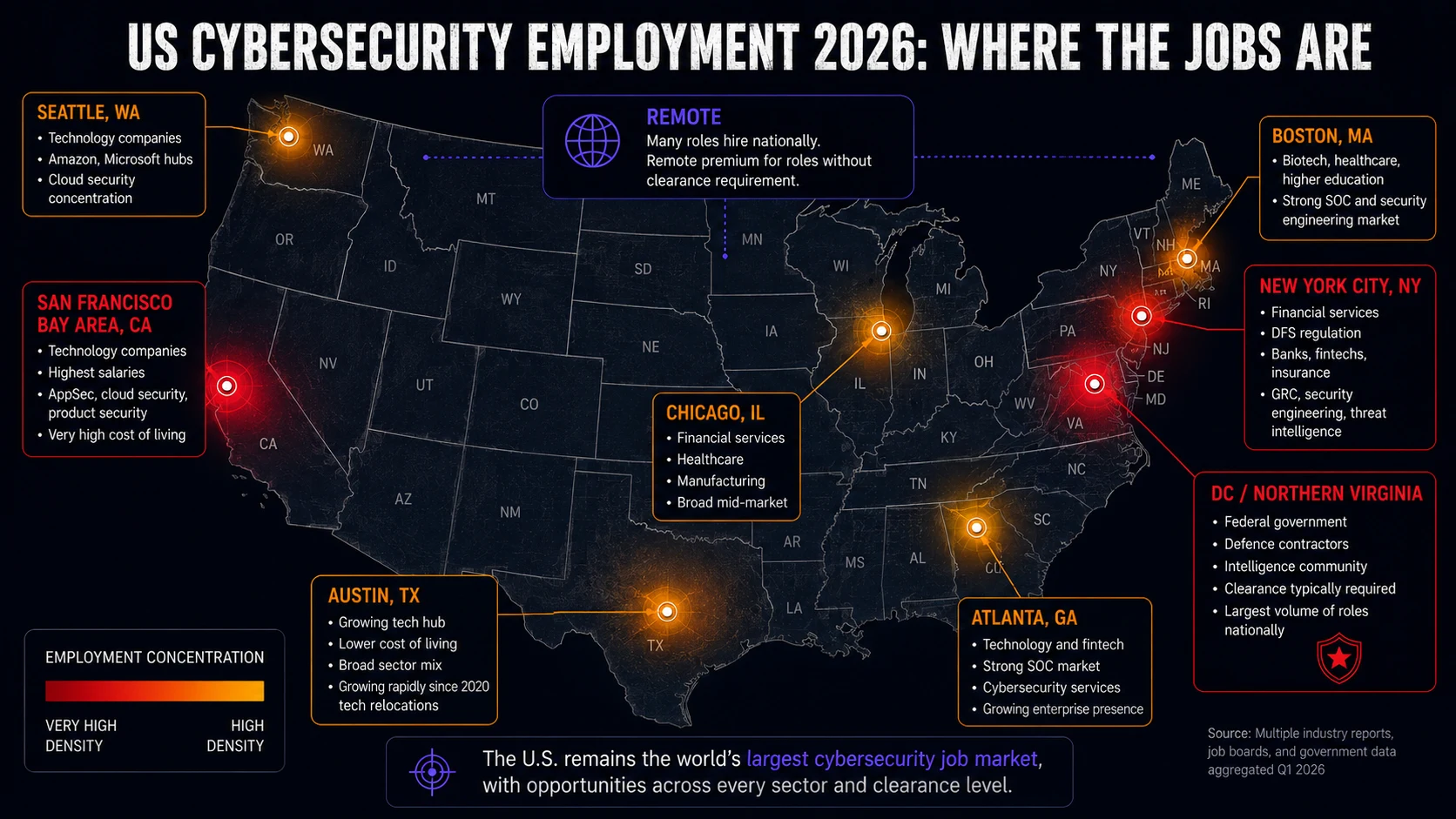
Unlike the UK, where London dominates the cybersecurity employment market overwhelmingly, the US market is more geographically distributed. Understanding which cities and regions dominate which sectors helps professionals target their career search effectively.
(A) Washington DC and Northern Virginia
The largest concentration of cybersecurity employment in the United States, driven by federal government agencies, defence contractors, intelligence community contractors, and the technology companies that serve them. The Northern Virginia corridor hosts more data centres than any comparable geography on earth. Security clearance is widely required. CISA, NSA, CIA, DoD, and their contractor ecosystems dominate this market.
(B) San Francisco Bay Area
The dominant technology sector hub produces the highest compensation in the market. AppSec engineers, cloud security architects, and product security professionals working for major technology companies earn more here than anywhere else in the world. The cost of living is correspondingly extreme. Remote work has partially dispersed the Bay Area talent pool but not the employer concentration.
(C) New York City
Financial services drives the New York cybersecurity market. Banks, asset managers, insurance companies, payment processors, and fintech firms employ large security organisations with specific regulatory requirements under the DFS Cybersecurity Regulation, SEC rules, and financial services frameworks. GRC professionals, security engineers, and threat intelligence analysts are in particular demand.
(D) Austin, Texas
The fastest-growing technology hub in the US has become a significant secondary cybersecurity market. Lower cost of living than Bay Area or New York, a growing technology company presence following relocations from California, and a strong university pipeline make Austin an increasingly attractive market for mid-career professionals.
(E) Remote work
The US cybersecurity market has a mature remote work culture that has persisted post-pandemic for most non-cleared roles. Many employers hire nationally and pay at the higher end of their range regardless of location. This creates genuine geographic flexibility for qualified professionals that is not available in comparable roles in the UK or UAE.
The Security Clearance Premium
The US government and defence contractor market operates on a clearance-based access system that has no equivalent in most other countries. Understanding how clearances work and what they mean for career strategy is essential for any professional targeting the US federal market.
(A) Clearance levels
Public Trust is the baseline level, covering positions with access to sensitive but unclassified information. Secret clearance covers classified information and is required for most defence contractor roles. Top Secret covers more sensitive classified information. Top Secret/SCI (Sensitive Compartmented Information) is required for the most sensitive intelligence and national security work.
(B) How to get cleared
You cannot self-sponsor for a security clearance. Clearances are sponsored by employers who need cleared personnel for specific contracts. The process involves a background investigation conducted by the Defense Counterintelligence and Security Agency (DCSA). Investigation timelines vary from months to over a year for higher-level clearances.
(C) The strategic implication
Cleared professionals can access a significant portion of the US cybersecurity job market that is entirely invisible to non-cleared candidates. The cleared job market operates through different channels, pays a premium, and tends to provide more stable employment due to the ongoing contract relationships. Building a relationship with a cleared employer early in a career creates the pathway to clearance sponsorship.
For international professionals entering the US market, security clearance is generally not accessible due to citizenship requirements for most clearance levels. The civilian commercial market, federal civilian (non-intelligence) roles, and technology company roles do not typically require clearance and are accessible to non-US nationals with appropriate work authorisation.
The Certifications US Employers Ask For
The US market has specific certification preferences that differ from the UK. Understanding these differences helps professionals targeting the US market calibrate their investment.
CompTIA certifications
CompTIA certifications, particularly Security+, CySA+, CASP+, and PenTest+, are more dominant in the US market than anywhere else globally. Security+ is specifically approved under DoD Directive 8570 and is effectively mandatory for many federal and defence contractor roles. The CompTIA pathway from Security+ through CySA+ and CASP+ is a well-established and widely recognised career progression in the US federal and commercial markets.
CISSP
CISSP is the dominant senior security management credential in the US market. It is more universally recognised and required at senior levels in the US than in almost any other market. The combination of five-year experience requirement and the examination challenge means CISSP holders are genuinely respected by peers, not just by HR systems.
SANS/GIAC certifications
SANS certifications carry stronger recognition in the US than in most other markets, particularly in government, defence, and enterprise financial services. GSEC, GCIH, GPEN, and GREM are frequently listed in US federal and defence contractor job specifications. The SANS community and alumni network is particularly strong in the Washington DC corridor.
Cloud certifications
AWS certifications dominate the US cloud market, reflecting AWS's larger market share in the US compared to other regions. The AWS Security Specialty certification is widely valued. Azure certifications are important for Microsoft-adjacent roles and federal government work, where Microsoft Azure Government is widely deployed.
CMMC-related credentials
As CMMC 2.0 implementation has progressed through 2025 and 2026, CMMC assessor and practitioner credentials have become increasingly valuable for professionals working in the defence industrial base. The Certified CMMC Professional (CCP) and Certified CMMC Assessor (CCA) are specifically US defence contractor market credentials with no international equivalent.
The US market places more emphasis on DoD-approved certifications (Security+, CISSP, SANS/GIAC) and less emphasis on CREST compared to the UK. A professional calibrating their certification investment for the US should prioritise accordingly.
Build Your US Cybersecurity Career With Xcademia Xcademia delivers cybersecurity training aligned with US employer expectations. From Security+ and CISSP preparation to practitioner certifications recognised in the US market. Instructor-led. Practitioner-taught. Built for real career outcomes. Available virtually for US-based professionals. |
|---|
Ready to go deeper?
Professional Training
Hands-on, mentor-led training aligned with industry certifications.
About the Author
Sharper every day
Daily tutorials, analysis, and career playbooks across all 12 Xcademia disciplines, straight to your inbox. No spam.