Security+ vs GSEC vs XSEC: The Entry-Level Cybersecurity Cert Comparison for 2026
Security+ gives you global recognition. GSEC gives you deeper technical knowledge. XSEC gives you applied practitioner evidence. This honest 2026 comparison breaks down the strengths, weaknesses, costs, and career value of the three leading entry-level cybersecurity certifications.
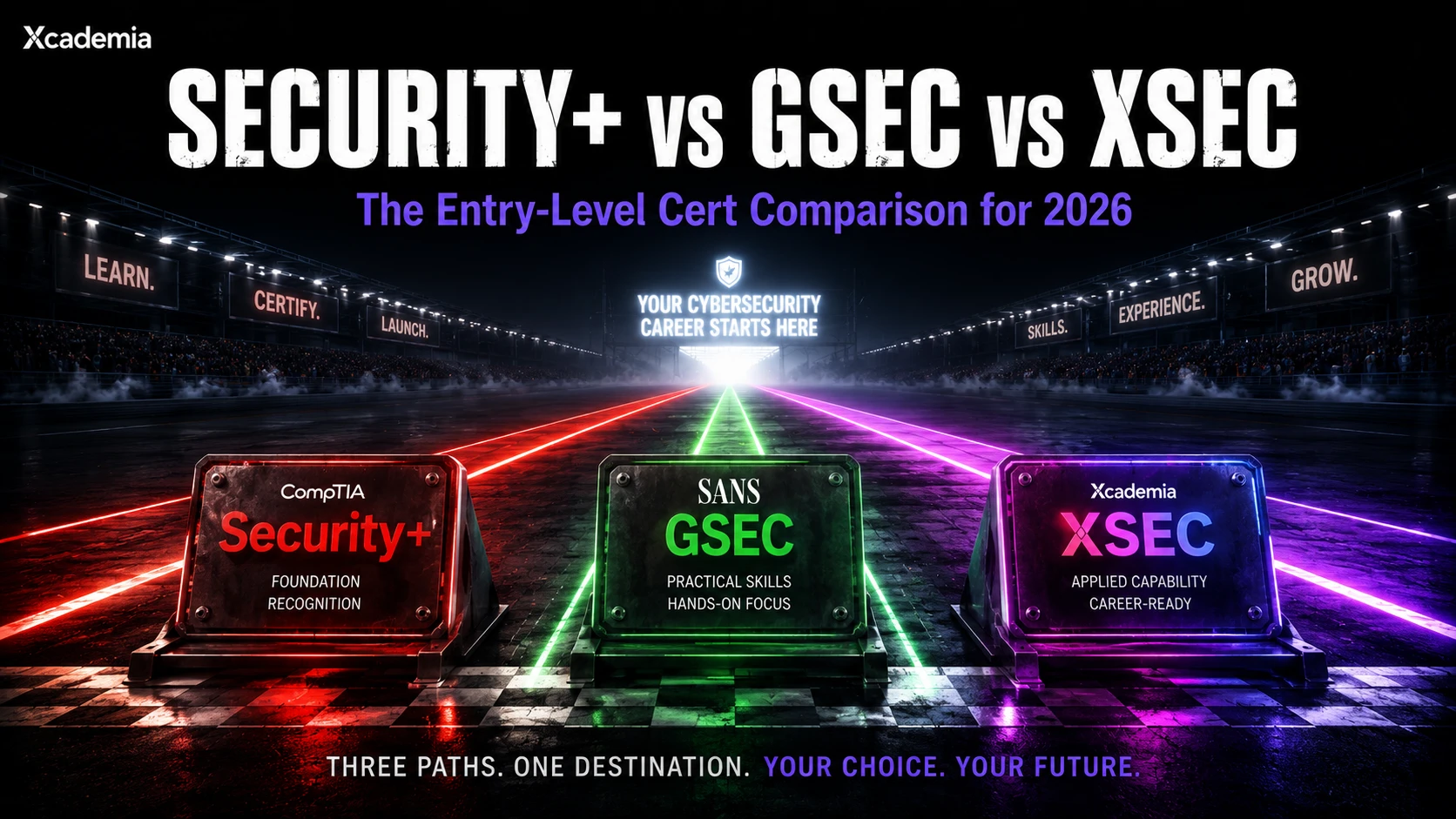
Security+ vs GSEC vs XSEC:
The Entry-Level Cybersecurity Cert Comparison for 2026
Every cybersecurity career starts somewhere. For most professionals, the first credentialing decision is also the most consequential, because it shapes which doors open first, which employers take the application seriously, and how quickly the transition from "wanting to work in security" to "working in security" actually happens.
Three certifications dominate the entry-level conversation in 2026. CompTIA Security+, the global incumbent. GSEC from SANS/GIAC, the technically deeper alternative. And XSEC, Xcademia's practitioner-assessed entry-level certification.
This comparison is honest about what each credential delivers and who should choose it.
The entry-level cert decision is not just about which qualification looks best. It is about which one produces the capability your first employer actually needs you to demonstrate in week one.
Security+: The Global Market Standard
CompTIA Security+ is the most widely deployed entry-level cybersecurity certification on the planet. It is vendor-neutral, globally recognised, and approved under the US Department of Defense Directive 8570 for Information Assurance roles. In the UK, it appears in more job specifications for junior security roles than any other foundation credential.
The current version, SY0-701, covers five domains: general security concepts, threats and vulnerabilities, security architecture, security operations, and programme management and oversight. The exam format includes 90 questions across multiple choice and performance-based items with a 90-minute time limit.
Where Security+ wins
HR recognition: more job specifications include Security+ than any other entry-level cert globally
DoD approval: essential for US government and military-adjacent roles
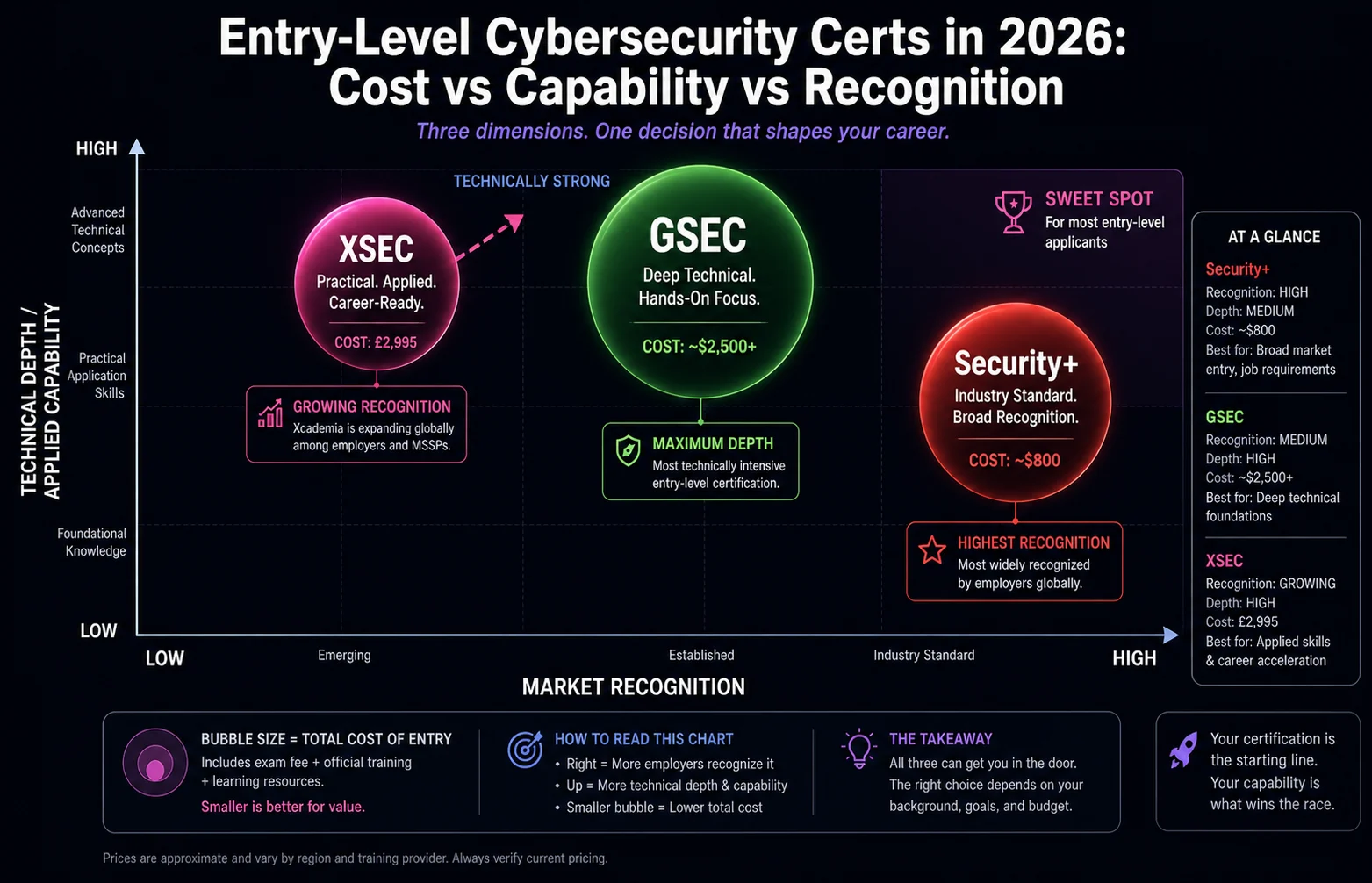
Cost: at $392 USD exam fee, it is significantly cheaper than GSEC
Preparation resources: more study materials, practice exams, and courses available than for any competing cert
Renewal simplicity: 50 continuing education units every three years
Where Security+ falls short
Security+ is broad by design. Covering five domains means covering each one at a surface level. The performance-based items simulate security tasks but in a controlled, predictable format that does not reflect the ambiguity of real security work. An employer interviewing a Security+ holder cannot assume they have ever opened a SIEM, written a detection rule, or worked an actual incident. The cert confirms foundational knowledge. It does not confirm applied capability.
Security+ is the entry point that most employers recognise. It is not the entry point that most employers will find impressive in an interview when you cannot back it up with practical examples.
GSEC: The Deeper Technical Alternative
SANS GIAC Security Essentials, GSEC, is a more technically demanding certification than Security+. It covers a broader range of topics in greater depth: networking, Linux and Windows security, cryptography, incident handling, web application security basics, cloud fundamentals, and more. The exam is 115 questions over three hours and tests detailed technical knowledge rather than broad awareness.
GSEC holders typically have a deeper technical foundation than Security+ holders. Employers who understand the market know this. The problem is that many employers in the UK and globally do not yet have the same recognition for GSEC that they have for Security+.
Where GSEC wins
Technical depth: substantially more rigorous than Security+ in networking, Linux, Windows, and cryptography
SANS reputation: within organisations that use SANS training, GSEC carries significant credibility
Preparation quality: the SANS training courses are among the best available
Better preparation for L2 SOC and junior security engineering roles that need real technical depth
Where GSEC falls short
Cost is the primary barrier. At $849 USD for the exam voucher alone at time of publication, with SANS preparation courses adding thousands more, GSEC represents a significantly higher investment than Security+. For an entry-level professional making the case for employer funding, that price differential is a real conversation.
Recognition is the secondary issue. While GSEC is well known in technical security circles, it appears less frequently in UK job specifications than Security+. An applicant in the UK market holding GSEC but not Security+ may find their credential requires explanation in applications where Security+ would not.
GSEC is the better credential technically. Security+ is the better credential commercially for the UK entry-level market. This tension is real and worth thinking through carefully before you invest. Competitor pricing correct at time of publication.
XSEC: The Practitioner Entry Point
XSEC is Xcademia's Security Essentials practitioner certification. Five instructor-led days. No multiple choice exam. Assessment by a senior Xcademia practitioner.
What XSEC covers
Network security fundamentals: TCP/IP, protocols, traffic analysis, and attack patterns at the network layer
Endpoint security: Windows and Linux hardening, endpoint detection concepts, log analysis
Identity and access management: authentication principles, directory services, privilege management
Threat landscape: understanding threat actors, attack methodologies, and the MITRE ATT&CK framework in practical application
Incident response basics: the IR lifecycle, initial triage, evidence preservation, escalation decisions
Security operations: SIEM navigation, alert triage workflow, basic detection rule concepts
Cryptography applied: not just what encryption is, but how it is implemented and where it fails
What the practitioner assessment looks like
The XSEC capstone presents candidates with a simulated security scenario requiring them to identify indicators of compromise from log data, assess the severity and likely attacker behaviour, and produce a structured initial incident report. The assessment is reviewed by a senior practitioner against defined competency criteria. The credential is verifiable at xcademia.com/verify.
What this produces is something neither Security+ nor GSEC can produce: a professional who can sit in a first interview and describe exactly what they did in their assessment, how they thought about the problem, and what they would do differently. That conversation is what turns an entry-level interview into an offer.
XSEC gives you a story for the interview that Security+ and GSEC cannot. Not "I passed a multiple choice exam." But "I worked through a simulated incident, here is what I found, here is how I analysed it, here is what I reported."
FULL COMPARISON MATRIX
Security+ | GSEC (SANS) | XSEC (Xcademia) | |
|---|---|---|---|
Awarding body | CompTIA | SANS/GIAC | Xcademia |
Assessment format | 90 MCQ + perf-based, 90 mins | 115 MCQ, 3 hours | Practitioner capstone, mentor sign-off |
Duration | Self-study (2-4 months) | Self-study (3-6 months) | 5 instructor-led days |
Experience required | None officially | None officially | No fixed requirement |
Exam cost | $392 USD | $849 USD | Included in programme fee |
Total cost | $600-$1,200 | $1,200-$2,500 | £2,995 all-in |
Renewal | Every 3 years, 50 CEUs | Every 4 years, 36 CPEs | No renewal |
DoD 8570 approved | Yes (IAT Level II) | Yes (GSEC) | N/A |
Market recognition | Very high globally | Strong US/enterprise | UK/UAE, growing |
What it proves | Foundational security knowledge | Broader foundational knowledge | Applied entry-level security practice |
The Honest Verdict
The right first certification depends on your specific situation. Here is the decision made simple.
Security+ | If you need one credential that passes every HR filter in every market, Security+ is it. Pursue it first. The brand recognition at the entry level is unmatched. Back it up with practical experience through a home lab, CTF competitions, and your first role. |
|---|
GSEC | If you are targeting technical security roles in US organisations or companies where SANS is the recognised standard, GSEC provides a stronger technical foundation than Security+. The investment is substantially higher. Make sure the market you are targeting recognises it before committing. |
|---|
XSEC | If you want a first credential that gives you a practitioner evidence portfolio rather than a certificate of recall, XSEC is built for that. Particularly strong for career changers who need to demonstrate applied capability quickly. Five days. No MCQ. Verifiable at xcademia.com/verify. |
|---|
Ready to go deeper?
Professional Training
Hands-on, mentor-led training aligned with industry certifications.
About the Author
Sharper every day
Daily tutorials, analysis, and career playbooks across all 12 Xcademia disciplines, straight to your inbox. No spam.