Is SANS GCIH Worth $9,779?
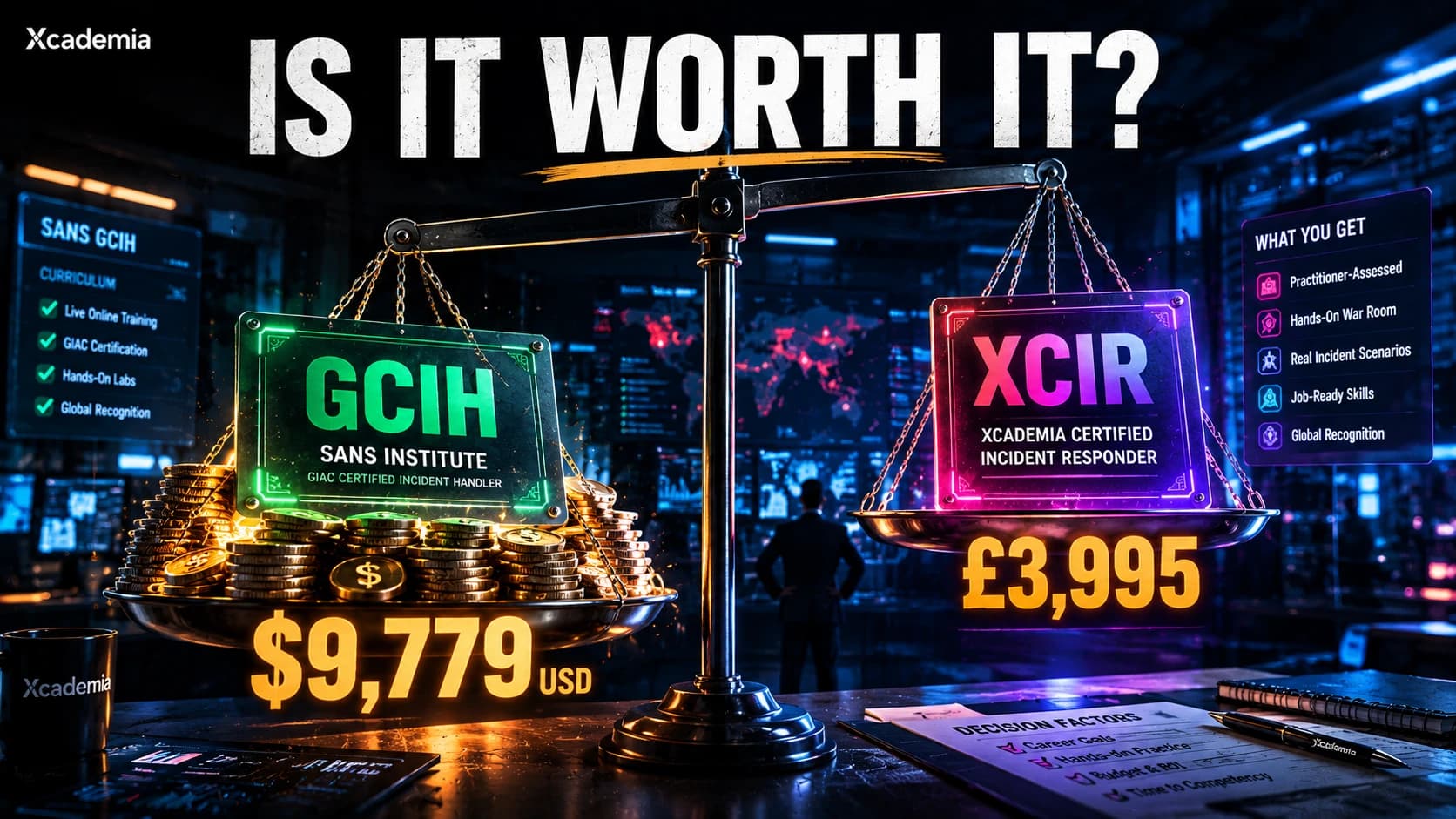
SANS GCIH costs $9,779 USD with the FOR508 bundle. XCIR costs £3,995 all-inclusive. This comparison breaks down what each incident response certification actually delivers, where the price difference comes from, and which path makes more sense for real-world IR capability in 2026.
XCIR at £3,995: The Honest Incident Response Cert Comparison for 2026
$9,779 USD is the price of the SANS FOR508 Advanced Incident Response and Threat Hunting course when bundled with the GCIH examination at time of publication. That figure is not a typo and it is not the worst-case scenario. It is the standard published price for the most widely recognised incident response certification programme in the world.
XCIR, Xcademia's Cyber Incident Response Practitioner certification, is priced at £3,995 all-inclusive. Six instructor-led days. Full practitioner assessment. No additional exam fee. No renewal cost.
This comparison examines whether the SANS price premium is justified, what it actually buys, and who should choose which.
$9,779 is more than the annual training budget of most security teams. When one certification costs that much, the question of whether it is worth it is not pedantic. It is strategic.
What SANS FOR508 and GCIH Actually Deliver
SANS Institute is one of the most respected names in cybersecurity training. FOR508 is their Advanced Incident Response, Threat Hunting, and Digital Forensics course. It is six days of intensive technical instruction covering memory forensics, file system forensics, threat hunting methodology, enterprise response at scale, and lateral movement analysis.
The associated GCIH (GIAC Certified Incident Handler) examination is 106 multiple choice questions, open book, over three hours. The open-book format distinguishes GIAC examinations from most and is genuinely meaningful: rather than testing memory, it tests whether you know where to find the answers and whether you understand the material well enough to apply it.
Where SANS FOR508 and GCIH genuinely excel
Forensics depth: Memory analysis, file system artefact interpretation, and timeline reconstruction are covered at a depth that few other courses match
Threat hunting methodology: FOR508 is one of the best structured threat hunting programmes available anywhere
Enterprise scale: The course specifically addresses IR in large enterprise environments with complex, distributed infrastructure
SANS community: The SANS network of alumni, DFIR professionals, and ongoing training access has genuine career value
Recognition: In US enterprise, government, and defence-adjacent environments, GIAC certifications carry significant weight with serious technical hiring managers
The honest limitations
The GCIH examination itself is open-book multiple choice. It is more rigorous than closed-book exams because of the time pressure and the complexity of questions, but it is still fundamentally a test of whether you can find and apply knowledge rather than a test of whether you can run an actual incident response. Completing FOR508 and passing GCIH does not mean you have commanded a real incident. It means you have excellent conceptual and technical knowledge of how to do so.
The cost is the most significant limitation for most organisations and individuals. At $9,779 for the course-plus-exam bundle, GCIH is inaccessible to a significant proportion of the professionals who would benefit from it. Employer funding is available in some organisations, but many security professionals are funding their own development. At that price point, the question of alternatives is not unreasonable.
SANS training is genuinely excellent. The price is genuinely prohibitive for most. These two things can both be true. Competitor pricing correct at time of publication.
What XCIR Covers and How It Is Assessed
XCIR is Xcademia's Cyber Incident Response Practitioner certification. Six instructor-led days. The programme covers the full incident response lifecycle from a practitioner perspective.
Programme scope
Detection and triage: SIEM navigation, EDR alert analysis, distinguishing real incidents from false positives in realistic environments
Containment decision-making: The monitor-versus-isolate decision framework, short-term and long-term containment approaches
Digital forensics fundamentals: Memory acquisition and analysis, disk forensics, log analysis, artefact identification
Threat actor profiling: Mapping attacker behaviour to MITRE ATT&CK, understanding TTP patterns
Enterprise IR: Active Directory compromise response, cloud incident response, ransomware response playbook execution
Communication and escalation: Executive notification, regulatory notification timelines, external IR firm engagement criteria
Post-incident review: Root cause analysis, detection gap assessment, lessons learned process
The assessment
The XCIR capstone presents candidates with a simulated incident scenario. They must work through detection, triage, containment decision-making, investigation, and post-incident documentation against a realistic attack scenario. The capstone is assessed by a senior Xcademia IR practitioner against professional competency criteria. The credential is verifiable at xcademia.com/verify.
The XCIR capstone tests whether you can actually respond to an incident, not whether you can answer questions about responding to one. The distinction is the entire point of the programme.
FULL COMPARISON MATRIX
GCIH (SANS/GIAC) | XCIR (Xcademia) | |
|---|---|---|
Awarding body | SANS/GIAC | Xcademia |
Assessment format | 106 MCQ, open book, 3 hours | Practitioner capstone, mentor sign-off |
Duration | SANS FOR508 course (6 days) + self-study | 6 intensive instructor-led days |
Experience required | None officially, intermediate recommended | Practitioner pace, IR exposure helpful |
Exam cost | $849 USD (exam voucher alone) | Included in programme fee |
SANS course cost | $9,779 USD (FOR508 course + exam bundle) | N/A- included in £3,995 |
Total investment | $9,779+ USD with SANS training | £3,995 all inclusive |
Renewal | Every 4 years, 36 CPEs | No renewal required |
Tools covered | Autopsy, Volatility, Velociraptor, KAPE | Same plus Splunk, EDR platforms, real SIEM triage |
Market recognition | Very strong US enterprise and government | UK and UAE, growing |
What it proves | Open-book MCQ on IR and forensics concepts | You can command a real incident response from detection to close |
The Price Breakdown in Full
The honest cost comparison requires examining total cost of ownership, not just list price.
Cost Component | GCIH via SANS | XCIR via Xcademia |
|---|---|---|
Training course | $8,930 USD (FOR508 on-site) | £3,995 — included |
Examination | $849 USD (separate voucher) | Included — no exam fee |
Study materials | Included with course | Included — no extras |
iLabs / lab access | Included with course | Included — live lab environment |
Renewal (4-year cycle) | $400-600 USD CPE maintenance | No renewal — no ongoing cost |
TOTAL Year 1 | ~$9,779 USD | £3,995 GBP |
TOTAL over 4 years | ~$10,300-$10,500 USD | £3,995 GBP (unchanged) |
At comparable exchange rates, XCIR represents a saving of well over 60% on the SANS bundle for the first certification cycle. Over a four-year renewal period, that differential only increases.
The question is not whether SANS is worth its price in absolute terms. The quality is undeniable. The question is whether the specific professional in front of you needs what SANS specifically provides, or whether a programme that produces equivalent applied capability at a significantly lower price point is the right investment for where they are now.
Who Should Choose GCIH
You are targeting US enterprise, government, or defence-adjacent IR roles where GIAC certifications are specifically required or carry the highest credibility with technical hiring managers
Your employer is funding the training and the SANS course is within your approved training budget
You want the deepest available forensics and threat hunting training in a structured programme, and cost is secondary to depth
You are working in an organisation with strong SANS alumni culture where the credential carries internal credibility
GCIH Best for US technical market and forensics depth:
GCIH is the most respected incident response credential in US technical and government markets. FOR508 is among the best IR training available anywhere. If your market recognises GIAC and you have access to the budget, the quality justifies the price. If you do not, there are better ways to spend it.
Who Should Choose XCIR
You are based in the UK or UAE and want a practitioner-assessed IR credential that demonstrates operational capability rather than examination knowledge
You are funding your own development and need a high-quality programme at a price that does not require a significant personal financial commitment
Your employer has a constrained training budget and needs strong value per pound invested
You want a six-day intensive programme that tests you under simulated incident conditions with a practitioner sign-off
You already have a foundational certification and want to build specifically demonstrated incident response capability on top of it
XCIR Best for UK/UAE practitioners and budget-conscious development:
XCIR delivers practitioner-assessed incident response capability at less than half the total cost of the GCIH bundle. Six days. Live scenarios. Mentor sign-off. No MCQ. No renewal. Verifiable at xcademia.com/verify. The value case is straightforward.
The Combination Worth Considering
For the professional with access to SANS-level budget: GCIH provides the deepest technical forensics and threat hunting foundation available, and XCIR builds and evidences the operational incident command capability that the GCIH examination does not assess. Together they represent comprehensive IR credentialing.
For the professional without SANS-level budget: XCIR provides the applied IR capability evidence that matters most in interview and in role. Add GCIH when the budget and market opportunity justify the investment.
Incident response capability is built through practice under pressure, not through studying for examinations. The certification that puts you under simulated pressure and has a practitioner evaluate your decisions is the one that builds the capability you actually need.
Ready to go deeper?
Professional Training
Hands-on, mentor-led training aligned with industry certifications.
About the Author
Sharper every day
Daily tutorials, analysis, and career playbooks across all 12 Xcademia disciplines, straight to your inbox. No spam.