How to Study for CISSP in 2026
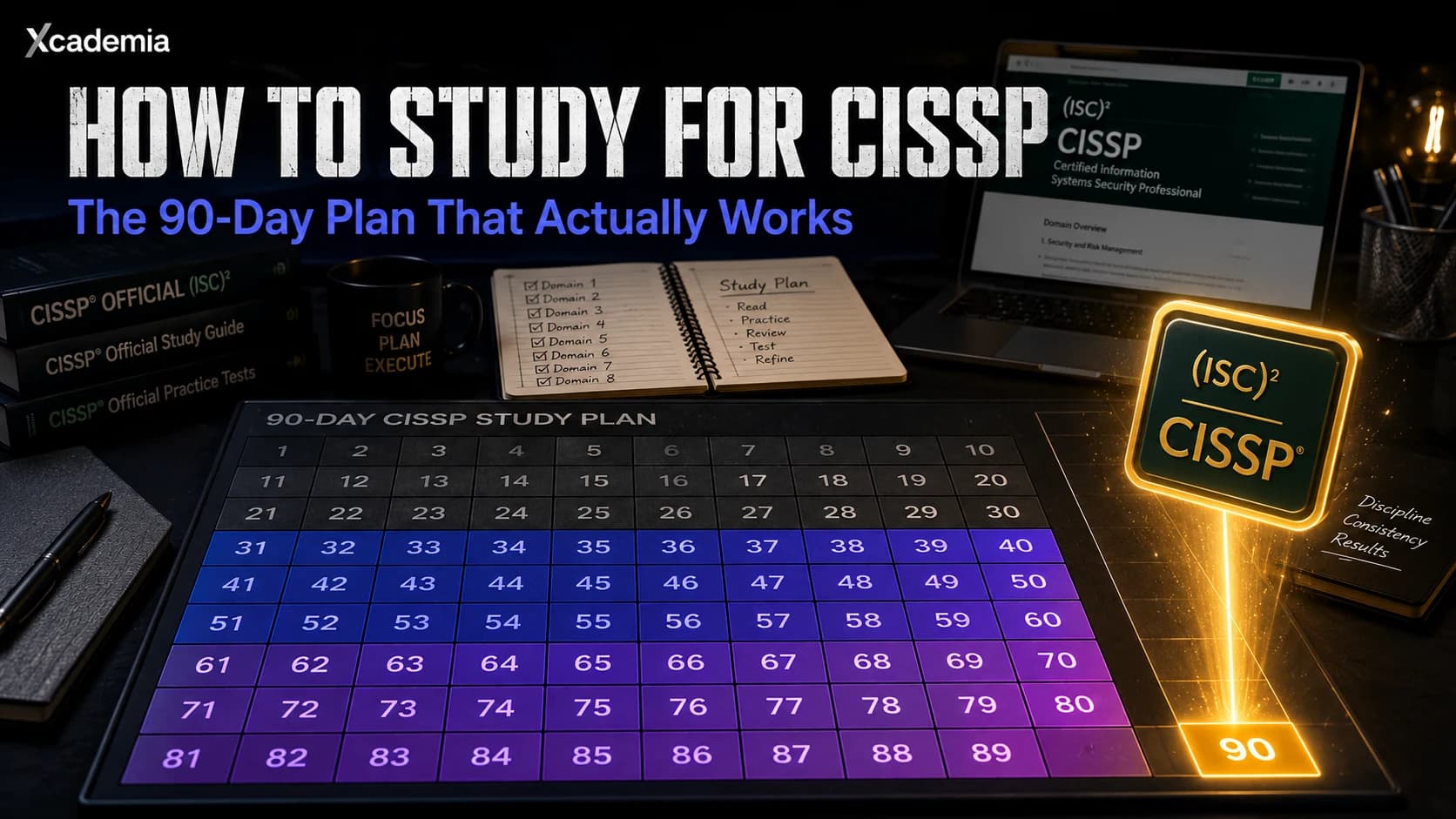
Most CISSP study plans focus on content. The successful ones focus on exam thinking. This practical 90-day CISSP roadmap covers domains, practice strategy, managerial decision-making, and the study structure that helps working professionals pass the CISSP CAT exam in 2026.
The Practical 90-Day Plan That Actually Works
Most CISSP study plans fail for the same reason. They are designed around the content, not around the examination. They tell you how much to read. They do not tell you how to think.
The CISSP is a Computerised Adaptive Test. It adjusts difficulty based on your performance. You can stop at 125 questions or continue to 175. The algorithm is looking for confidence in your decision-making, not coverage of facts. Understanding this changes how you study.
This 90-day plan is built around that reality. It will tell you what to study, when, and how to practise the specific kind of thinking the exam rewards.
The CISSP does not ask what the right answer is. It asks what the best answer is from the perspective of a senior security manager thinking about risk. Most candidates fail not because they lack knowledge but because they are thinking like a technician when they should be thinking like a manager.
Before You Start: What You Actually Need
The official prerequisite is five years of paid work experience in two or more of the eight CISSP domains. If you do not have this, you can sit the exam and become an Associate of ISC2, then complete the experience later.
More practically: you need to be comfortable thinking about security at a programme and governance level, not just at a technical level. Candidates with purely technical backgrounds often struggle because they default to the technically correct answer when the exam wants the managerially correct one.
The one mindset shift that changes everything
Read every CISSP exam question through this lens: "What would a prudent senior security manager do?" Not the most technically thorough option. Not the cheapest option. Not the fastest option. The one that appropriately manages risk, follows due process, and protects the organisation.
When two answers seem equally correct, choose the one that involves communication, policy, governance, or management oversight over the one that involves a technical action. The CISSP rewards the manager's answer.
Every CISSP question has a right answer and a best answer. The exam asks for the best answer. Candidates who have not been briefed on this distinction can know the material perfectly and still fail.
The Eight Domains: What to Know About Each
Sr No | DOMAIN | WEIGHT | STUDY NOTES |
|---|---|---|---|
1 | Security and Risk Management | 15% | Policy, ethics, governance, risk management, BCP, legal. The most conceptually dense domain. Do not rush it. |
2 | Asset Security | 10% | Data classification, ownership, privacy, retention. Relatively concise. Study it alongside Domain 1. |
3 | Security Architecture and Engineering | 13% | Cryptography, security models, vulnerabilities. Heavy on concepts. Draw diagrams for memory models. |
4 | Communication and Network Security | 13% | Network architecture, protocols, attacks. Highest overlap with technical backgrounds. |
5 | Identity and Access Management | 13% | IAM, authentication, federated identity. Practical experience accelerates this domain. |
6 | Security Assessment and Testing | 12% | Audit, testing, metrics. Shorter domain. Study it after Domain 1 when you understand governance context. |
7 | Security Operations | 13% | Incident response, investigations, BCP. Draw on experience. Overlap with XCIR and XDFI knowledge. |
8 | Software Development Security | 11% | SDLC security, AppSec integration. Overlaps with XASE knowledge. |
Domain 1 carries the highest weight and the most conceptual complexity. It is also the one that most technical candidates underestimate. Start here, spend the most time here, and return to it repeatedly throughout the 90 days.
The domains are not independent. Cryptography (Domain 3) informs network security (Domain 4). Access management (Domain 5) appears throughout incident response (Domain 7). Study each domain in isolation first, then build the connections.
The 90-Day Study Plan
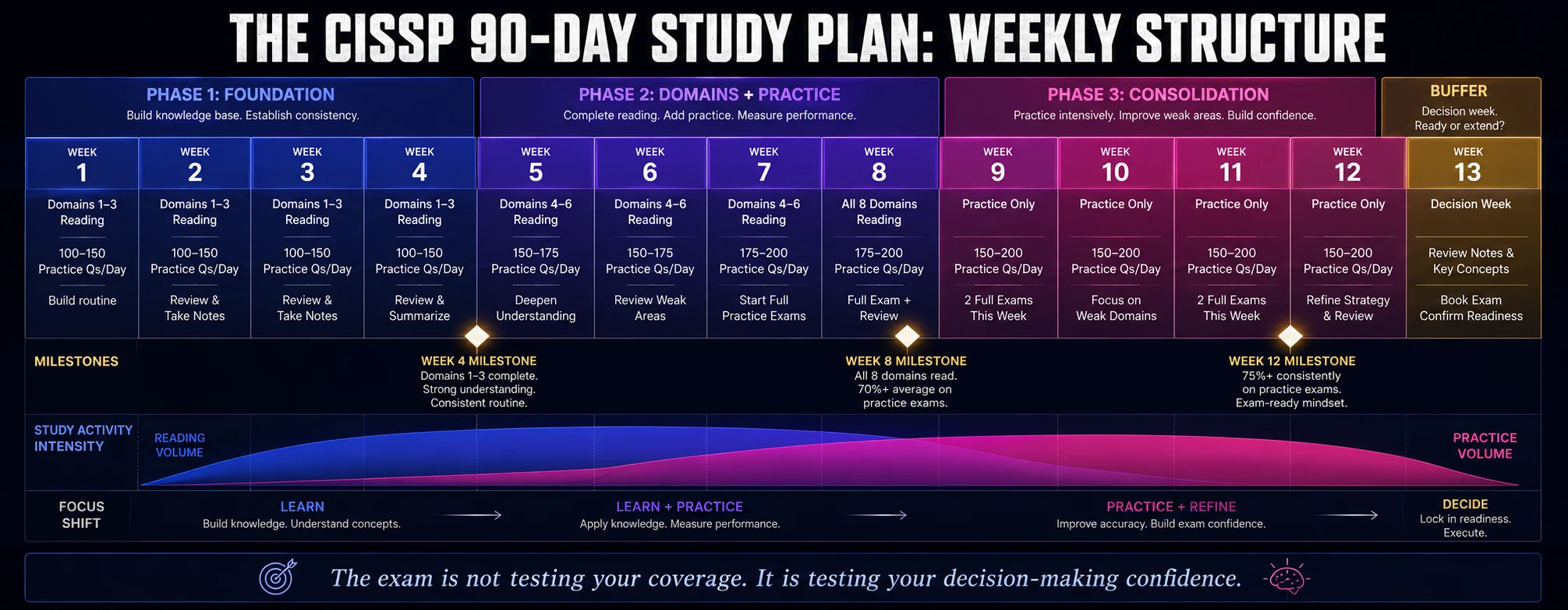
PHASE 1: Foundation and Domain 1-3 Weeks 1-4 |
|---|
DAILY: 1-2 hours reading from the Official ISC2 CISSP Study Guide or Sybex. One chapter minimum. Take notes in your own words, not highlights. WEEKLY: 100-150 practice questions from your chosen question bank (Boson or CCCure recommended). Review every wrong answer and every question you guessed correctly. MILESTONE: You have read all of Domains 1, 2, and 3. You can explain each domain concept to a non-technical colleague without notes. |
PHASE 2: Domains 4-6 and Pattern Recognition Weeks 5-8 |
|---|
DAILY: 1-2 hours reading (Domains 4, 5, 6). Begin increasing practice question volume: 150-200 questions per day in week 7-8. WEEKLY: One full 125-question timed practice exam per week. Review all wrong answers. Track your domain performance and identify your two weakest domains. MILESTONE: All eight domains read. Two weakest domains identified. You are consistently scoring above 70% on full practice exams. |
PHASE 3: Consolidation, Weak Domain Focus, and Exam Simulation Weeks 9-12 |
|---|
DAILY: No new reading. Practice questions only: 150-200 per day. Focused on your weakest domains. WEEKLY: Two full timed practice exams per week. Review every wrong answer. Begin reading explanations even for correct answers to understand why the other options are wrong. MILESTONE: You are consistently scoring 75%+ on full practice exams. You can articulate the managerial rationale for your answers, not just identify the correct option. |
Week 13 is the buffer. If you are consistently scoring above 75% on practice exams, you are ready. If not, extend Phase 3 rather than rushing the examination. The CISSP examination fee is $749 USD. A failed attempt costs the same as a passed one. Use the buffer week honestly.
The Resources That Actually Work
Essential
Official ISC2 CISSP Study Guide (current edition): The authoritative source. Dense but complete.
Sybex CISSP Study Guide (Mike Chapple and James Michael Stewart): Clearer explanations for technical concepts. Use alongside the official guide.
Practice Question Bank: Boson NetSim or CCCure. Volume matters more than the source. Aim for 3,000 practice questions total across the 90 days.
Highly recommended
"CISSP Study Guide" by Adam Gordon: Strong on Domain 1 specifically. Good for the managerial mindset shift.
The official ISC2 podcast and community forums: Hearing how other candidates describe the exam thinking is useful calibration.
Xcademia CISSP preparation programme: Instructor-led coverage of all eight domains with real-world scenario discussion. Builds the applied context that makes practice questions click.
What to avoid
Brain dump sites and exam dumps, the CISSP CAT algorithm makes traditional exam dumps largely ineffective, and using them risks your certification if discovered.
Study groups that focus on covering content rather than practising decision-making.
Reading the same material repeatedly instead of attempting questions and reviewing errors.
The most effective CISSP study resource is not a book. It is a practice question reviewed properly. For every wrong answer, write in your own words why the correct answer is correct and why your answer was wrong. That process builds the exam thinking faster than any volume of reading.
The Day of the Exam
The CISSP CAT begins at 125 questions. You may finish there or continue to 175 depending on how the algorithm evaluates your confidence. You will not know when you stop whether you have passed or failed: the exam ends when either the algorithm has enough confidence in your result or you reach 175 questions.
Several practical points that experienced candidates consistently report.
Read each question twice. The CISSP uses precise language and single words change the meaning significantly.
Apply the "prudent senior manager" lens to every question before selecting an answer.
When stuck between two options, ask: which one involves more management oversight or policy adherence? That is usually the CISSP answer.
Do not over-interpret questions. They mean what they say. Looking for hidden complexity when there is none is a common error.
If you finish at 125, you may have passed or failed. The algorithm cutting out early is not a bad sign.
The candidates who pass CISSP at 125 questions are not luckier or more knowledgeable than those who go to 175. They are more consistently demonstrating the decision-making confidence the algorithm is measuring. That is a trainable skill, not a random outcome.
Ready to go deeper?
Professional Training
Hands-on, mentor-led training aligned with industry certifications.
About the Author
Sharper every day
Daily tutorials, analysis, and career playbooks across all 12 Xcademia disciplines, straight to your inbox. No spam.