GCTI vs XCTI
SANS FOR578 and GCTI are respected CTI credentials, but are they worth $7,000-$9,000 in 2026? This article compares GCTI and XCTI across cost, assessment quality, operational relevance, and what each certification actually proves.
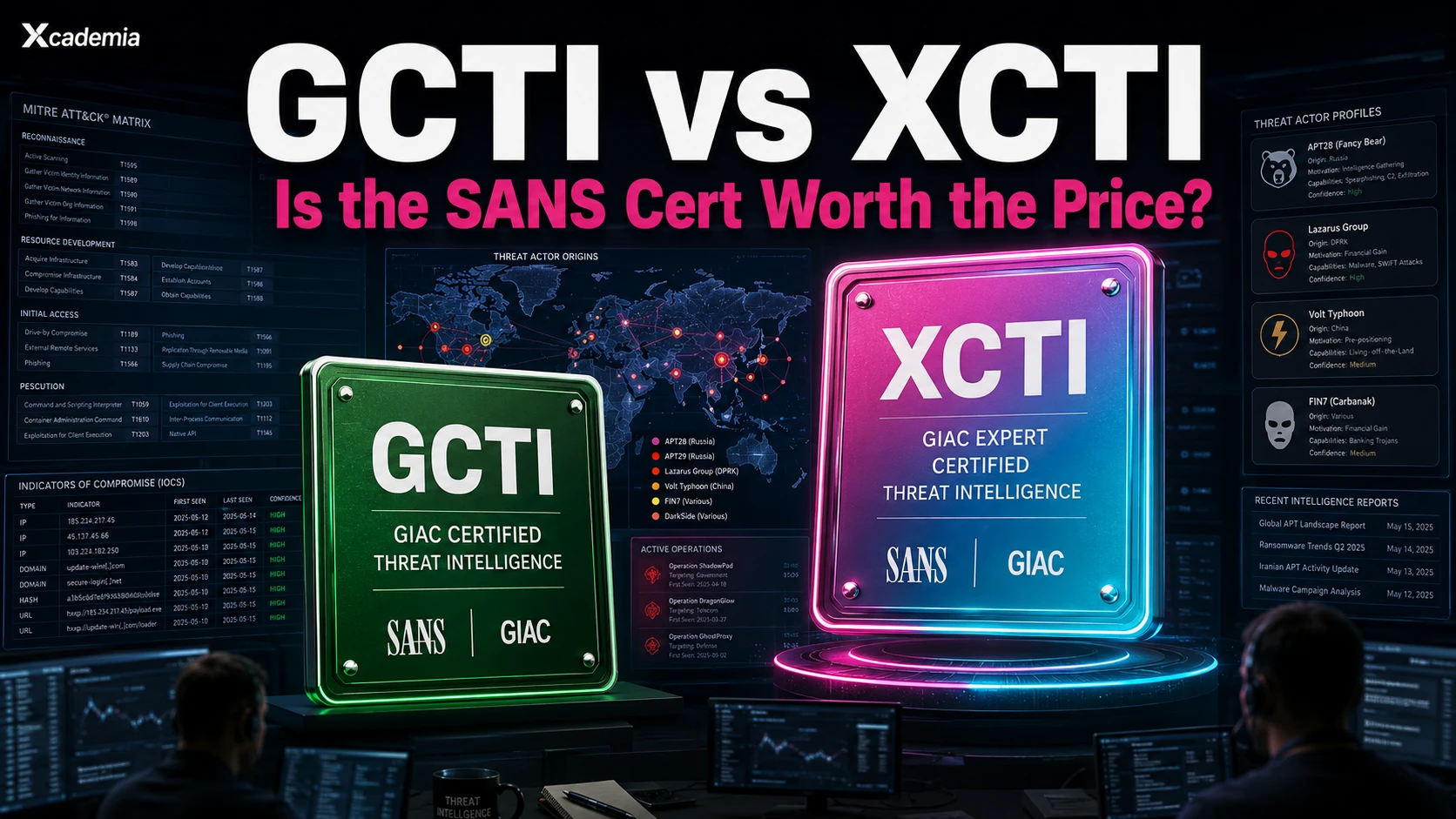
Is the SANS Threat Intelligence Certification Worth the Price in 2026?
SANS FOR578 and the associated GCTI certification is widely regarded as one of the best threat intelligence training programmes available. The course content is genuinely excellent. The question this article asks is not whether the training is good. It is whether the price, which sits between $7,000 and $9,000 USD for the full course-plus-exam bundle, is the right investment for every professional who wants a CTI credential.
XCTI is Xcademia's Cyber Threat Intelligence practitioner certification. Six instructor-led days. Practitioner-assessed. Built around the working methodology of an operational CTI analyst.
This is an honest comparison of both.
Threat intelligence is a discipline where the quality of the analyst matters more than the certification they hold. A CTI professional who produces high-quality, actionable, well-structured intelligence is valuable. The certificate signals the training. The briefs prove the capability.
What SANS FOR578 and GCTI Deliver
FOR578, Cyber Threat Intelligence, is SANS's dedicated CTI course. It is a five-day programme covering the full intelligence lifecycle: planning and direction, collection, processing, analysis, dissemination, and feedback. The course covers structured analytic methods, threat actor profiling, MITRE ATT&CK operationalisation, diamond model and kill chain frameworks, indicator life cycle management, and intelligence sharing standards (STIX/TAXII).
The GCTI examination is 115 questions over three hours, open book. The open-book format distinguishes it from closed-book examinations and makes it a more accurate test of applied knowledge rather than pure memorisation.
Where SANS FOR578 and GCTI genuinely excel
Structured analytic methods coverage is comprehensive, including ACH, devil's advocacy, structured brainstorming, and other SATs applied to CTI scenarios
The MITRE ATT&CK operationalisation is genuinely deep and practically useful
Diamond model and kill chain coverage is thorough and well-integrated with practical exercises
SANS community and alumni network is valuable for ongoing professional development
Recognition in US government, defence, and large enterprise environments is strong
The honest gaps
GCTI is an open-book multiple choice examination. The course is excellent. The examination assesses whether you can navigate your course materials to find the right answer under time pressure. It does not assess whether you can produce a professional threat intelligence brief, manage a full intelligence collection requirement, or brief an executive leadership team on a threat scenario.
The price point is the most significant limitation for most professionals. At $7,000 to $9,000 for the course-plus-exam bundle, GCTI represents a major individual investment or a significant employer budget commitment. For organisations with training budgets that can accommodate this, the quality justifies it. For individuals funding their own development, the question of alternatives is entirely reasonable.
FOR578 is genuinely excellent training. The GCTI examination is more rigorous than most. The price is genuinely high. All three of these things are true simultaneously. Competitor pricing correct at time of publication.
What XCTI Covers and How It Is Assessed
XCTI is Xcademia's Cyber Threat Intelligence Practitioner certification. Six instructor-led days. Practitioner capstone. No multiple choice examination.
Programme scope
Intelligence lifecycle: Planning and direction, collection, processing, analysis, dissemination. Each phase with practical exercises using realistic scenarios.
Collection management: Source types, source reliability assessment, gaps analysis, intelligence requirements documentation
Structured analytic methods: ACH, competing hypotheses, devil's advocacy, key assumptions check applied to CTI-specific scenarios
Threat actor profiling: Building and maintaining comprehensive threat actor profiles, attribution methodology, confidence levels
MITRE ATT&CK operationalisation: Moving from TTP descriptions to detection logic, using ATT&CK Navigator, mapping real-world attacks
Diamond model and kill chain frameworks: Practical application to real campaign analysis, not just conceptual understanding
Intelligence sharing: STIX/TAXII standards, MISP platform operation, sharing community participation
AI-assisted CTI workflows: Integrating AI tools into the intelligence production process for efficiency without compromising integrity
Brief writing and dissemination: Producing intelligence products at strategic, operational, and tactical levels for different audiences
The capstone
The XCTI capstone presents candidates with a realistic intelligence scenario: a threat actor campaign with raw source material, partial IOC data, and fragmentary evidence. Candidates must work through the full intelligence cycle: assess the collection, apply structured analytic methods, produce a complete threat intelligence brief, and present an executive summary. The capstone is assessed by a senior Xcademia CTI practitioner with operational intelligence experience. Verifiable at xcademia.com/verify.
The XCTI capstone assesses whether you can produce the product, not whether you can describe how it should be produced. An intelligence brief under time pressure with realistic ambiguity is a better test of CTI capability than any open-book multiple choice examination.
FULL COMPARISON MATRIX
GCTI (SANS/GIAC) | XCTI (Xcademia) | |
|---|---|---|
Awarding body | SANS/GIAC | Xcademia |
Assessment format | 115 MCQ, open book, 3 hours | Practitioner capstone, mentor sign-off |
Duration | FOR578 course (5 days) + self-study | 6 intensive instructor-led days |
Exam cost | $849 USD (exam voucher) | Included in £3,995 |
WITH SANS course | $7,000-$9,000 USD (FOR578 + exam) | £3,995 all-in |
Renewal | Every 4 years, 36 CPEs | No renewal required |
Structured analytic methods | Partially covered | Full coverage with applied exercises |
MITRE ATT&CK depth | Strong | Strong, with applied threat actor profiling |
Brief writing | Not primary assessment focus | Core capstone deliverable |
Market recognition | Very strong US enterprise and government | UK and UAE, growing |
What it proves | Open-book MCQ on CTI methodology and tools | You can produce an actionable intelligence brief from raw sources |
The Value Calculation
At $7,000 to $9,000 USD for the SANS bundle versus £3,995 for XCTI, the cost differential is substantial. Whether GCTI is worth the premium depends on three questions.
(A) Is the SANS community access valuable to you?
SANS has a genuine alumni and professional community that provides ongoing value beyond the certification. CTI professionals who engage actively with the SANS community, attend SANSFIRE or other events, and use the alumni network for professional development get more value from the GCTI credential than those who sit the exam and move on.
(B) Does your target market specifically recognise GCTI?
In US federal, defence, and large enterprise environments, GCTI recognition is strong and the SANS brand carries weight. For UK and UAE professionals, the recognition differential is narrower. GCTI is known and respected, but not at the premium that would justify $5,000+ over XCTI purely on recognition grounds.
(C) Can you access employer funding?
SANS training is most economically rational when employer-funded. Many organisations have approved SANS as a training provider and will fund FOR578 as a named course. If employer funding is available, GCTI becomes a strong choice. If self-funding, the cost differential is a legitimate factor.
GCTI best for employer-funded development in US/enterprise markets:
GCTI via FOR578 is excellent training and a genuinely respected credential in US enterprise and government CTI roles. If your employer is funding it and you are targeting those markets, it is a strong investment. The training quality is not in question.
XCTI best for practitioners and self-funded UK/UAE professionals:
XCTI delivers operational CTI capability at a price that makes self-funded professional development viable. Six days. Full intelligence lifecycle. AI workflow integration. Practitioner-assessed brief production. No MCQ. No renewal. For the analyst who needs to demonstrate the ability to produce intelligence, not just describe it. Verifiable at xcademia.com/verify.
The Career Context for CTI in 2026
Threat intelligence as a function has matured significantly over the past five years. The roles now exist across a broader range of organisations: MSSPs, financial institutions, healthcare organisations, government agencies, and technology companies. The skills required are specific: structured analytic thinking, source curation discipline, ability to write for multiple audiences, and increasingly, the ability to integrate AI tools into the production workflow without compromising analytical integrity.
The CTI professional who can produce a complete, actionable brief in two hours rather than three days, who can brief a board as effectively as a SOC team, and who has a verifiable credential showing they have done this under assessment conditions, is the professional who advances fastest in this discipline.
The intelligence briefer who is respected is the one whose briefs consistently prove right and whose recommendations are consistently acted on. The credential opens the door. The quality of the product earns the trust. XCTI builds and assesses both.
Ready to go deeper?
Professional Training
Hands-on, mentor-led training aligned with industry certifications.
About the Author
Sharper every day
Daily tutorials, analysis, and career playbooks across all 12 Xcademia disciplines, straight to your inbox. No spam.