Cybersecurity Careers in Dubai and the UAE
Explore cybersecurity careers in Dubai and the UAE for 2026: salaries, top roles, certifications employers value, and how to position for this fast-growing market.
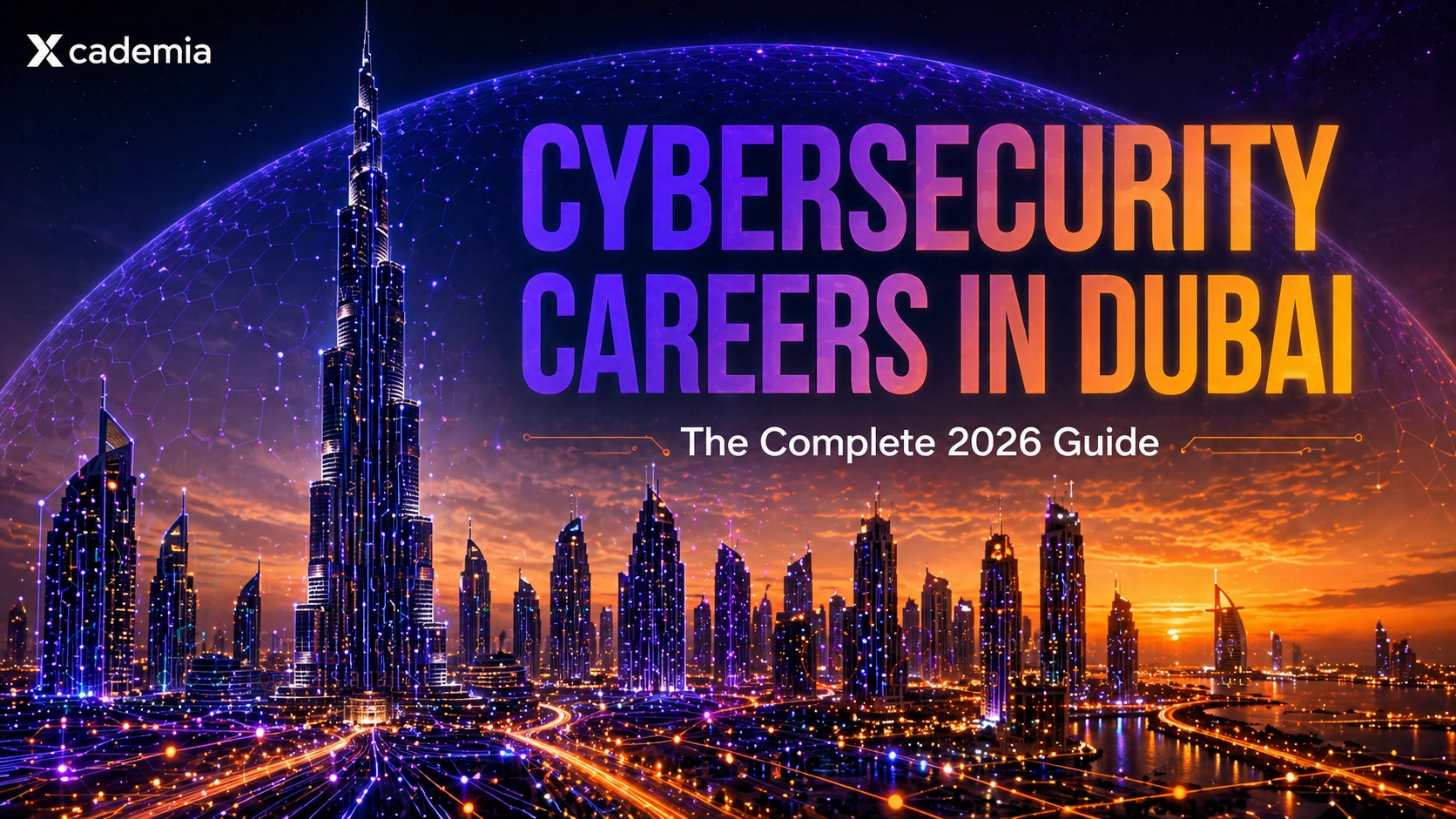
The Complete 2026 Guide
The UAE is not emerging as a cybersecurity market. It has emerged. And in 2026, the gap between the demand for qualified cybersecurity professionals in Dubai and Abu Dhabi and the supply of people who can fill those roles is one of the most significant talent shortfalls in the region.
If you are a cybersecurity professional already working in the UAE and wondering what your next move looks like, this guide will tell you. If you are a professional outside the UAE who is considering whether to make the move, this guide will tell you that too. And if you are at the start of your cybersecurity career and you want to understand where the UAE sits in the global market, you will find that here as well.
No recruitment agency spin. No inflated projections. The market as it actually is.
The UAE has made cybersecurity a strategic national priority. That decision is not abstract. It is visible in hiring volumes, salary levels, and the regulatory frameworks that every organisation operating in the country is now required to navigate.
Why the UAE Cybersecurity Market Is Growing So Fast
Three forces are converging to create the demand conditions that define the UAE market in 2026.
(1) National Cyber Strategy
The UAE National Cybersecurity Strategy has moved from a policy document to an operational mandate. Government entities, critical infrastructure operators, and large enterprises are all under active pressure to demonstrate compliance with the UAE Information Assurance Standards and the frameworks issued by the UAE Cybersecurity Council. That pressure translates directly into headcount requirements.
(2) Financial services and fintech growth
Dubai is building itself as a global financial centre. The Dubai International Financial Centre now hosts hundreds of financial institutions, fintech firms, and investment managers. Every one of them faces regulatory requirements around data protection, operational resilience, and cyber risk management. DIFC has its own data protection regime. ADGM in Abu Dhabi has another. Both require dedicated compliance and security capability.
(3) Smart city infrastructure
Dubai's smart city ambitions are genuine and funded. Connected infrastructure across transportation, utilities, healthcare, and government services creates an attack surface that requires professional defence. The engineers building these systems and the security professionals protecting them are both in demand, and the pipeline of qualified defenders is significantly shorter than the pipeline of infrastructure being built.
AED 25K+ | 40% | 3,500+ | 0% tax |
The Roles the UAE Market Is Hiring For Right Now
The UAE market has distinct characteristics that shape which roles are in highest demand. It is not a mirror of the UK or US market. Understanding the difference matters if you are positioning yourself for it.
Highest demand roles in 2026
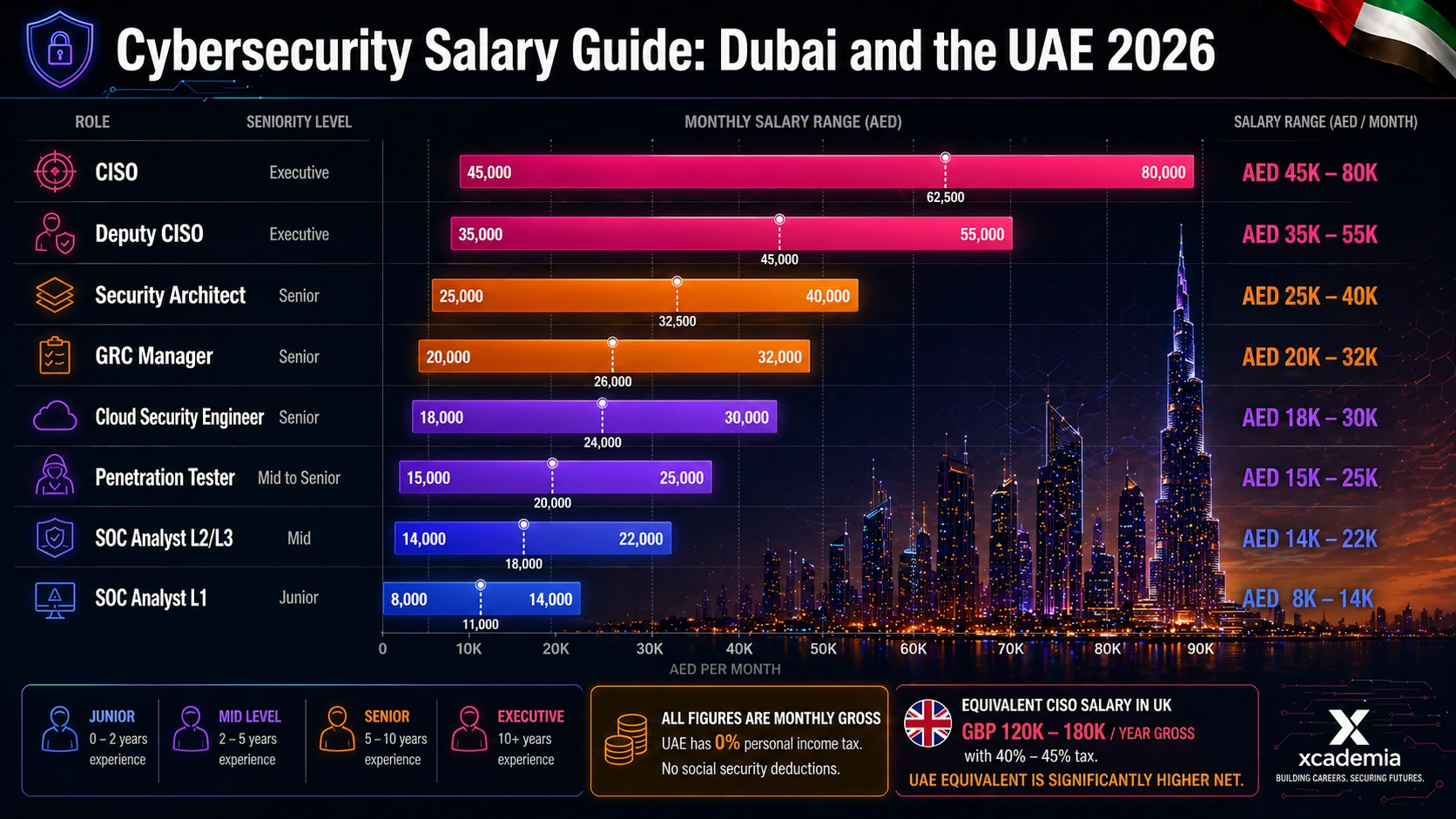
Cloud Security Engineer: AWS and Azure dominate. Multi-cloud security architecture is in demand across financial services, government, and telecoms.
SOC Analyst (L1 to L3): Every large organisation is building or maturing its security operations function. Tier 2 and 3 analysts with threat hunting experience are particularly scarce.
GRC Manager and Consultant: Regulatory compliance with UAE IAS, DIFC DP Law, NIA frameworks, and international standards such as ISO 27001 and NIST is driving significant demand.
CISO and Deputy CISO: The most acute shortage. Experienced security executives with regional regulatory knowledge and board-level communication capability are extremely rare.
Penetration Tester: Demand is growing across financial services, critical infrastructure, and government entities. EC-Council certifications carry strong market recognition here.
Identity and Access Management Specialist: Zero Trust adoption is accelerating. IAM skills across Microsoft Entra, CyberArk, and SailPoint are consistently in demand.
Incident Response Lead: Organisations that have invested in prevention are now investing in response capability. IR experience with Middle East threat actor knowledge is valued.
What Certifications UAE Employers Actually Value
The UAE market has preferences that differ meaningfully from the UK or US. Understanding which credentials carry weight here is essential before you invest time and money in preparation.
Strongest recognition in UAE
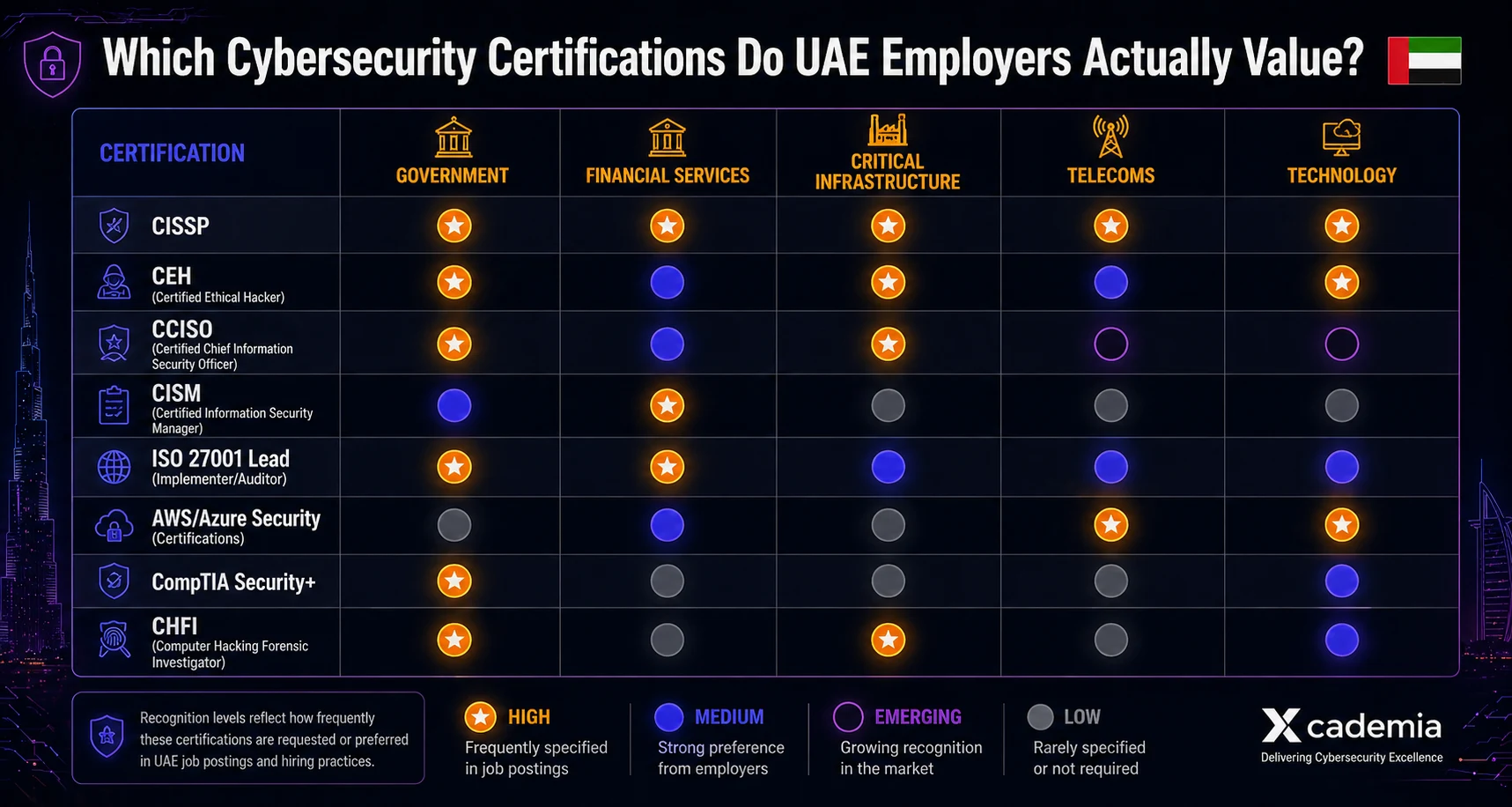
CISSP: The universal senior credential. Recognised across all sectors and all employer types in the UAE.
CEH (Certified Ethical Hacker): Exceptionally strong recognition in the UAE. EC-Council is well established in the region and CEH is frequently listed as a specific requirement in job postings.
CCISO: Strong recognition particularly in enterprise and government sectors. The UAE has a significant population of CCISO holders and the credential carries genuine prestige at executive level.
CISM: Well recognised in financial services and GRC-focused roles. Required or preferred by many DIFC and ADGM entities.
ISO 27001 Lead Implementer and Lead Auditor: Frequently required for GRC roles. UAE regulatory frameworks reference ISO 27001 directly.
CompTIA Security+: Strong at entry level. Widely recognised as a quality baseline across government-aligned employers.
AWS and Azure Security Specialties: Cloud security skills are in acute demand. Vendor certifications carry strong weight alongside security credentials.
EC-Council advantage in this market
It is worth noting explicitly: EC-Council has a stronger presence in the UAE and broader Middle East market than in many Western markets. CEH, CCISO, CHFI, and CySA-equivalent EC-Council tracks are frequently named in job specifications. If you are building your credential stack with the UAE market in mind, EC-Council certifications belong in your plan.
In the UAE market, a CEH and CISSP combination covers the vast majority of technical and management-level job requirements. Add CCISO for executive roles. Add ISO 27001 for GRC.
The Regulatory Landscape You Need to Know
The UAE has developed a layered regulatory environment for cybersecurity and data protection. If you are working in the region or planning to, understanding this landscape is part of your professional value.
(A) UAE FEDERAL FRAMEWORKS:
UAE Cybersecurity Council: National strategy and critical sector oversight.
UAE Information Assurance Standards (IAS): Mandatory controls for government and critical infrastructure entities.
UAE Personal Data Protection Law (PDPL): Federal data protection framework aligned with GDPR principles.
NIA (National Information Assurance): Defence and intelligence sector.
(B) FREEZONE-SPECIFIC FRAMEWORKS:
DIFC Data Protection Law 2020: GDPR-equivalent for DIFC entities. Enforced actively. DPO requirement for many organisations.
ADGM Data Protection Regulations: Abu Dhabi Global Market regime. Similar GDPR-aligned structure.
CBUAE Regulations: Central Bank UAE cybersecurity and operational resilience requirements for licensed financial institutions.
Every large organisation in the UAE is navigating at least two of these frameworks simultaneously. The professionals who understand these frameworks technically and can implement and evidence compliance against them command a significant salary premium.
Living and Working in Dubai as a Cybersecurity Professional
The practical considerations matter. Here is the honest version.
(A) The tax advantage is real
The UAE does not levy personal income tax on salaries. In practical terms, what your contract says you earn is close to what you actually receive. A Dubai salary of AED 25,000 per month (approximately GBP 5,400) is effectively net income. Achieving a similar take-home salary in the UK would typically require a gross annual income of around GBP 90,000. For mid-to-senior cybersecurity professionals, the financial advantage of working in the UAE is significant.
(B) Visa routes for cybersecurity professionals
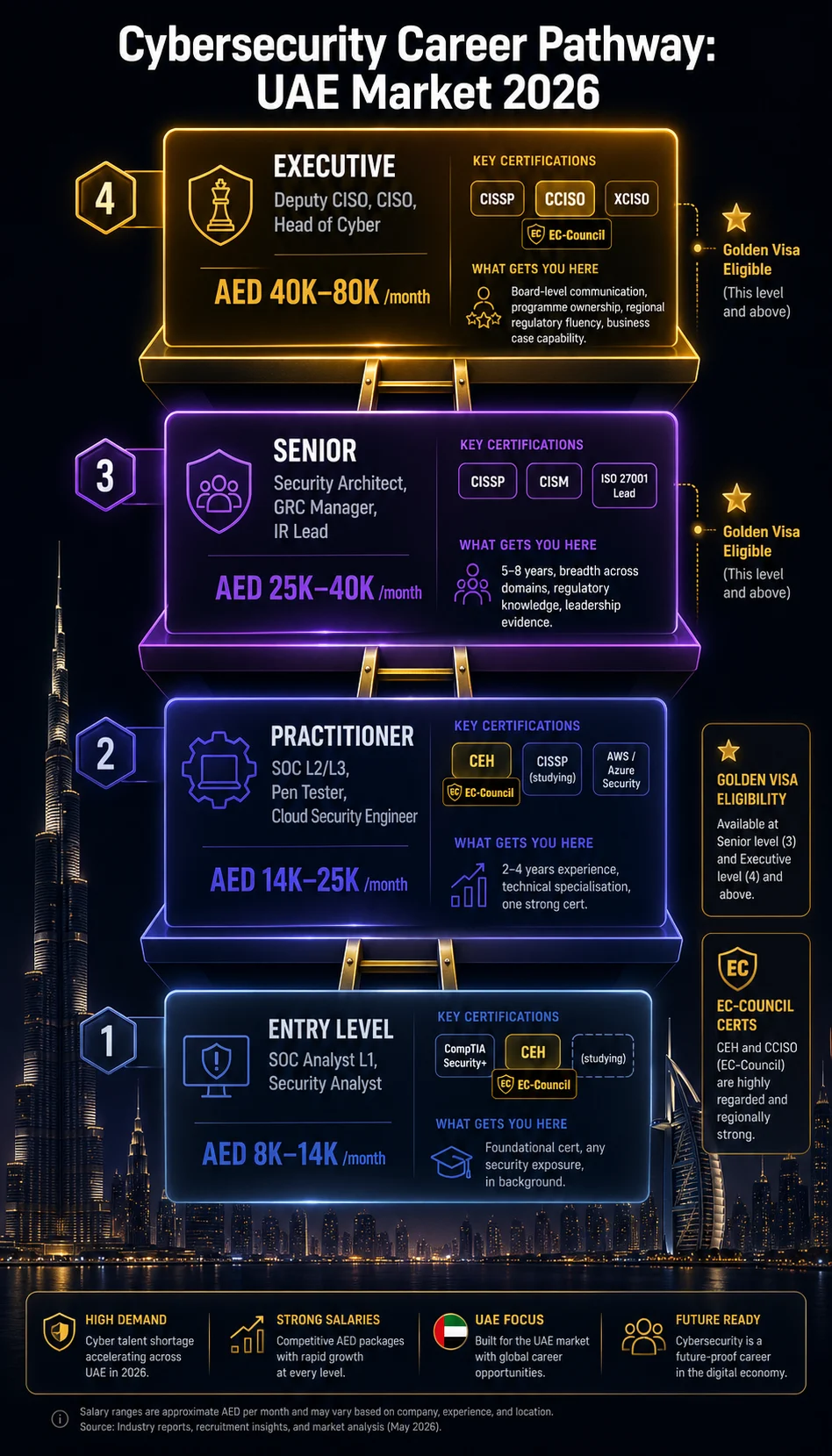
The UAE Golden Visa programme covers skilled professionals in strategic sectors. Cybersecurity is explicitly recognised as a priority field. A Golden Visa provides ten-year residency, the ability to sponsor family members, and removes the historic dependency on employer-sponsored visas that made career changes complex. For senior professionals, this is a significant quality-of-life improvement over the older employment visa model.
(C) The reality of the market
The UAE market rewards demonstrated capability and credentials that the regional market recognises. Professionals who arrive with strong CEH, CISSP, or CCISO credentials and regional regulatory knowledge typically find themselves shortlisted quickly. Professionals who arrive expecting their UK or European experience to speak for itself without local context sometimes find the market slower to respond than anticipated.
Arabic language is not required for the vast majority of cybersecurity roles, particularly in Dubai. English is the working language of the financial services, technology, and multinational sectors that represent the majority of cybersecurity employers.
The professionals who thrive in the UAE cybersecurity market are the ones who understood the regional regulatory environment before they arrived, held credentials the market recognises, and communicated their experience in the language of risk and business, not just technology.
The Employers Worth Knowing
The UAE cybersecurity job market is concentrated across a small number of high-value employer categories. Understanding who the major employers are and what they look for saves considerable time in a job search.
(A) Government and critical national infrastructure
Federal entities, emirate-level government departments, and critical infrastructure operators including ADNOC, ENEC, and Etisalat-aligned organisations represent the most structured and credential-conscious end of the market. Clearance requirements, regulatory compliance expectations, and credential verification are rigorous. These roles pay well and offer long-term stability.
(B) Financial services and fintech
DIFC and ADGM host hundreds of institutions with active security requirements. International banks, regional banks, insurance firms, and a fast-growing fintech sector create continuous demand. DIFC entities in particular apply GDPR-equivalent rigour to data protection compliance.
(C) Big four and consulting
Deloitte, PwC, KPMG, and EY all have significant UAE practices with dedicated cybersecurity advisory teams. These roles offer exposure to multiple clients and sectors, rapid skill development, and strong CV value. Workload is high and hours are demanding.
(D) Managed security service providers
A growing MSSP ecosystem in the UAE offers roles that provide broad exposure across multiple client environments. For practitioners who want to build experience quickly across different industries and threat landscapes, MSSP roles are a strong early-to-mid career choice.
(E) Technology vendors
Microsoft, Palo Alto Networks, CrowdStrike, Cisco, and a growing population of Israeli and US cybersecurity vendors have UAE presence. Pre-sales, solutions engineering, and technical sales roles combine technical depth with commercial exposure and typically offer strong compensation packages.
How to Position Yourself for the UAE Market
The professionals who move into the UAE cybersecurity market most effectively share a consistent profile. It is worth knowing what that profile looks like before you apply.
Hold at least one market-recognised credential. CEH, CISSP, CISM, or ISO 27001 Lead. Preferably two.
Demonstrate awareness of UAE regulatory frameworks. Even a working knowledge of UAE IAS, DIFC DP Law, and PDPL differentiates you immediately from applicants who have not done this research.
Position your experience in risk and business language. UAE hiring managers at senior level are not looking for the most technical candidate. They are looking for the candidate who can translate technical risk into business consequence.
Have CCISO on your roadmap if you are targeting executive roles. It is the credential the UAE executive market knows and respects.
Consider the XCISO pathway if you want to build and evidence applied CISO capability for the UK-regulated organisations operating in the UAE, particularly in DIFC.
Network into the community before you arrive. ISACA UAE, (ISC)2 UAE Chapter, and UAE Cybersecurity Council events are active. Being known before you land matters.
The UAE does not have enough qualified cybersecurity professionals to fill the roles it is creating. The market needs you. The question is whether you are credentialled and positioned to be found.
Ready to go deeper?
Professional Training
Hands-on, mentor-led training aligned with industry certifications.
About the Author
Sharper every day
Daily tutorials, analysis, and career playbooks across all 12 Xcademia disciplines, straight to your inbox. No spam.