CND vs XNDS
CND covers traditional network security fundamentals. XNDS covers the multi-cloud, zero trust, and NDR environments that enterprise networks actually operate in during 2026. This comparison explains which certification best fits modern network and cloud defence careers.
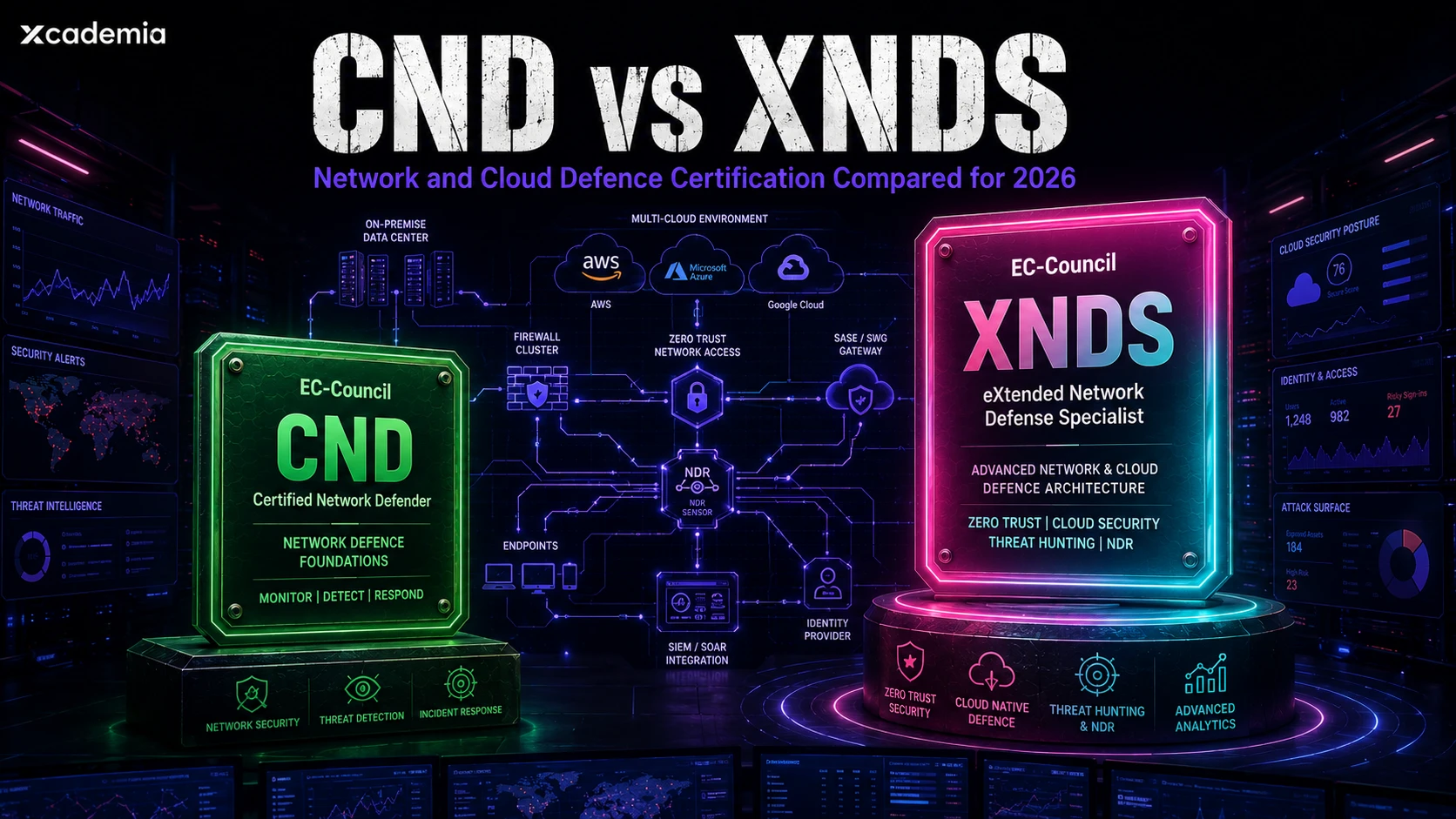
Network and Cloud Defence Certification Compared for 2026
Network defence is not what it was five years ago. The perimeter has dissolved. Workloads have moved to cloud. Identities have become the new perimeter. Zero trust architecture is not a concept in a whitepaper; it is the deployment pattern that serious organisations are building toward.
A network defence certification that was designed for the on-premise perimeter model of 2018 is not the same as one designed for the multi-cloud, zero trust, cloud-native network environment of 2026. The gap between these two eras of network security is where the comparison between CND and XNDS is most revealing.
The network defender of 2026 works in an environment where the firewall is not the primary control. Identity, microsegmentation, network detection and response, and cloud-native security controls are the tools that matter. The certification that covers this environment is the one that prepares the practitioner for actual work.
What CND Is and What It Covers
EC-Council's Certified Network Defender certification is designed for network administrators and security professionals who protect, detect, and respond to network threats. The current version, CND v2, covers network security fundamentals, network traffic analysis, firewall and IDS/IPS management, VPN security, cloud network security basics, and wireless network security.
The examination is 100 multiple choice questions over four hours. The curriculum is comprehensive at a foundational level and covers the breadth of network security topics a network security professional needs to understand.
Where CND delivers value
Broad coverage: CND covers a wide range of network security topics in a single programme
EC-Council ecosystem: For organisations already using EC-Council certifications, CND fits naturally
Accessibility: The examination format and preparation materials are well-documented
UAE recognition: EC-Council certifications are well-known in the UAE and Middle East markets
The honest gap
CND v2's cloud security coverage is introductory. Zero trust architecture receives limited depth. Network Detection and Response (NDR), which has become a primary tool in enterprise network defence, is not covered at operational depth. The certification was designed when on-premise perimeter security was still the dominant model. The curriculum has been updated but the underlying exam framework reflects an earlier era.
CND provides a solid foundational map of network security concepts. For the professional defending a primarily on-premise environment, it covers the relevant ground. For the professional defending a multi-cloud, zero trust architecture, the coverage gaps are significant. Competitor pricing correct at time of publication.
What XNDS Covers and How It Is Assessed
XNDS is Xcademia's Network and Cloud Defence Specialist certification. Six instructor-led days. Practitioner-assessed. Built for the network environment of 2026, not 2018.
Programme scope
Network security fundamentals: TCP/IP at depth, traffic analysis, protocol vulnerabilities, packet inspection and anomaly detection
Firewall and perimeter security: Next-generation firewall configuration, rule optimisation, egress filtering, network segmentation design
Intrusion Detection and Response: IDS/IPS deployment and tuning, reducing false positive rates, alert triage and response workflow
Network Detection and Response (NDR): Modern NDR platform operation, behavioural baseline establishment, lateral movement detection, C2 traffic identification
Zero trust architecture: Implementing zero trust principles in real network environments, identity-aware proxies, microsegmentation, continuous verification
Cloud network security: AWS VPC security, Azure Virtual Network security, network security groups, cloud-native WAF, cloud egress filtering
Multi-cloud network defence: Defending environments that span multiple cloud providers and on-premise infrastructure
Wireless network security: Enterprise wireless architecture, WPA3, rogue AP detection, wireless IDS
VPN and remote access security: Site-to-site and client VPN security, split tunnelling risks, zero trust network access alternatives
Network forensics basics: PCAP analysis for incident response, network artefact collection and preservation
The capstone
The XNDS capstone presents candidates with a realistic network environment under simulated attack. They must identify the attack using NDR and SIEM data, contain the threat through appropriate network controls, implement a remediation that addresses the identified vulnerability, and produce a concise incident report. The assessment is conducted by a senior Xcademia network security practitioner. Verifiable at xcademia.com/verify.
XNDS is built for the network defender who works in a multi-cloud, zero trust environment. The capstone does not ask whether you can configure a firewall. It asks whether you can defend a realistic enterprise network under active attack.
FULL COMPARISON MATRIX
CND v2 (EC-Council) | XNDS (Xcademia) | |
|---|---|---|
Awarding body | EC-Council | Xcademia |
Assessment format | 100 MCQ, 4 hours | Practitioner capstone, mentor sign-off |
Duration | Self-study (2-4 months) | 6 intensive instructor-led days |
Exam cost | $499 USD | Included in £3,995 |
Total cost | $700-$1,500 (prep + exam) | £3,995 all inclusive |
Renewal | Every 3 years, EC-Council credits | No renewal required |
Coverage | Network defence, firewall, IDS/IPS, VPN, cloud basics | Network defence + cloud security + zero trust + NDR |
Zero trust depth | Basic introduction | Zero trust architecture applied in labs |
Cloud network security | Introductory coverage | Cloud-native network defence in depth |
Market recognition | Moderate globally. Growing in UAE. | UK and UAE, growing |
What it proves | Knowledge of network defence concepts | Applied network and cloud defence capability |
The Zero Trust Question
Zero trust is the most significant architectural shift in enterprise network security in a decade. The core principle, never trust, always verify, has moved from a Forrester Research concept to a US Executive Order requirement and a deployment reality for organisations of all sizes.
CND v2 introduces zero trust as a concept. XNDS covers zero trust as an implementation methodology: identity-aware proxies, software-defined perimeters, microsegmentation design, continuous authentication, and the specific controls that constitute a functioning zero trust architecture rather than a policy document.
For the professional whose employers are building toward zero trust, the depth of coverage matters. Understanding zero trust conceptually is not sufficient to implement it. The implementation requires knowledge of specific tools, specific architectural decisions, and the specific failure modes that organisations encounter when zero trust architecture meets real infrastructure.
Zero trust is not a product. It is not a single control. It is an architectural approach that requires changes to network design, identity management, application security, and monitoring strategy simultaneously. The practitioner who can implement it needs more than conceptual familiarity.
Who Should Choose CND
You are targeting network security roles in the UAE or Middle East where EC-Council certifications are widely recognised
You are building foundational network security knowledge and want a comprehensive survey of the domain before specialising
Your organisation operates primarily on-premise and the advanced cloud security coverage of XNDS is not immediately relevant
You need a named EC-Council credential for a specific role or organisation requirement
CND best for EC-Council ecosystem and foundational network security :
CND provides broad coverage of network security fundamentals. Strong in the UAE and EC-Council-aligned markets. If you are building foundational network security knowledge or targeting roles in EC-Council markets, CND provides a solid credential. Build cloud and zero trust capability alongside it.
Who Should Choose XNDS
You defend or are targeting a role defending a multi-cloud or hybrid environment where zero trust, NDR, and cloud-native security controls are the primary tools
You want a practitioner-assessed credential that demonstrates applied network defence capability rather than examination knowledge
You are in the UK or UAE and want a modern network defence credential aligned with how enterprise networks actually operate in 2026
Your current foundational knowledge of network security is solid and you want to develop and evidence applied capability in cloud and zero trust specifically
XNDS best for Applied cloud and zero trust network defence :
XNDS covers the network defence environment of 2026, multi-cloud, zero trust, NDR, and hybrid infrastructure. Six days. Practitioner-assessed capstone under active attack simulation. No MCQ. No renewal. Verifiable at xcademia.com/verify.
The Career Context
Network defence as a specialism is converging with cloud security and identity security in a way that means the traditional boundaries of the role are dissolving. The network security engineer of 2026 needs to understand AWS security groups and Azure NSGs as fluently as they understand on-premise firewall rules. Zero trust network access is increasingly the architecture replacing traditional VPN. NDR is replacing or supplementing traditional IDS/IPS.
The professional who holds CND and has not built cloud and zero trust capability alongside it is working with an increasingly incomplete toolkit. The professional who holds XNDS has been assessed specifically in those modern environments and can demonstrate that capability is real.
The network defender who understands both the traditional perimeter model and the zero trust cloud-native model is significantly more valuable to employers in 2026 than one who understands only the former. The market has not finished making this transition. The professionals who are ahead of it will find themselves in the strongest position as their employers complete it.
Defend Modern Networks With XNDS XNDS: six instructor-led days covering network defence, cloud security, zero trust architecture, NDR, and hybrid environment defence. Practitioner-assessed active attack simulation capstone. No MCQ. No renewal. Built for the network environment of 2026. Verifiable at xcademia.com/verify. Explore XNDS |
|---|
Ready to go deeper?
Professional Training
Hands-on, mentor-led training aligned with industry certifications.
About the Author
Sharper every day
Daily tutorials, analysis, and career playbooks across all 12 Xcademia disciplines, straight to your inbox. No spam.