
CISSP vs CISM vs CCISO: A Practitioner's Honest Comparison for 2026
CISSP, CISM, and CCISO all claim to prepare you for cybersecurity leadership - but they serve very different career paths. A practitioner-led 2026 comparison of the strengths, limitations, and real-world CISO relevance of each, plus where XCISO fits beyond the exam.
CISSP vs CISM vs CCISO:
A Practitioner's Honest Comparison for 2026
If you have spent more than a week in cybersecurity leadership, somebody has asked you: CISSP or CISM? If you have worked in the enterprise security market in the Middle East, the US, or the UK, a third name has probably entered that conversation: CCISO.
These are not the same certification. They are not interchangeable. And the advice you will find online is largely written by people who hold one of them and want to justify their own choice.
This article is different. I hold the CCISO. I work in this space. Here is an honest account of what each certification actually gives you, who it is built for, and what none of them tell you about becoming an effective CISO.
What This Comparison Is Actually About
CISSP, CISM, and CCISO all target senior security professionals. All three carry weight in hiring decisions. All three require years of relevant experience before you can sit them. That is where the similarities end.
The question is not which certification is most prestigious. The question is which one moves the needle for where you are in your career right now, and what role you are actually trying to land or justify.
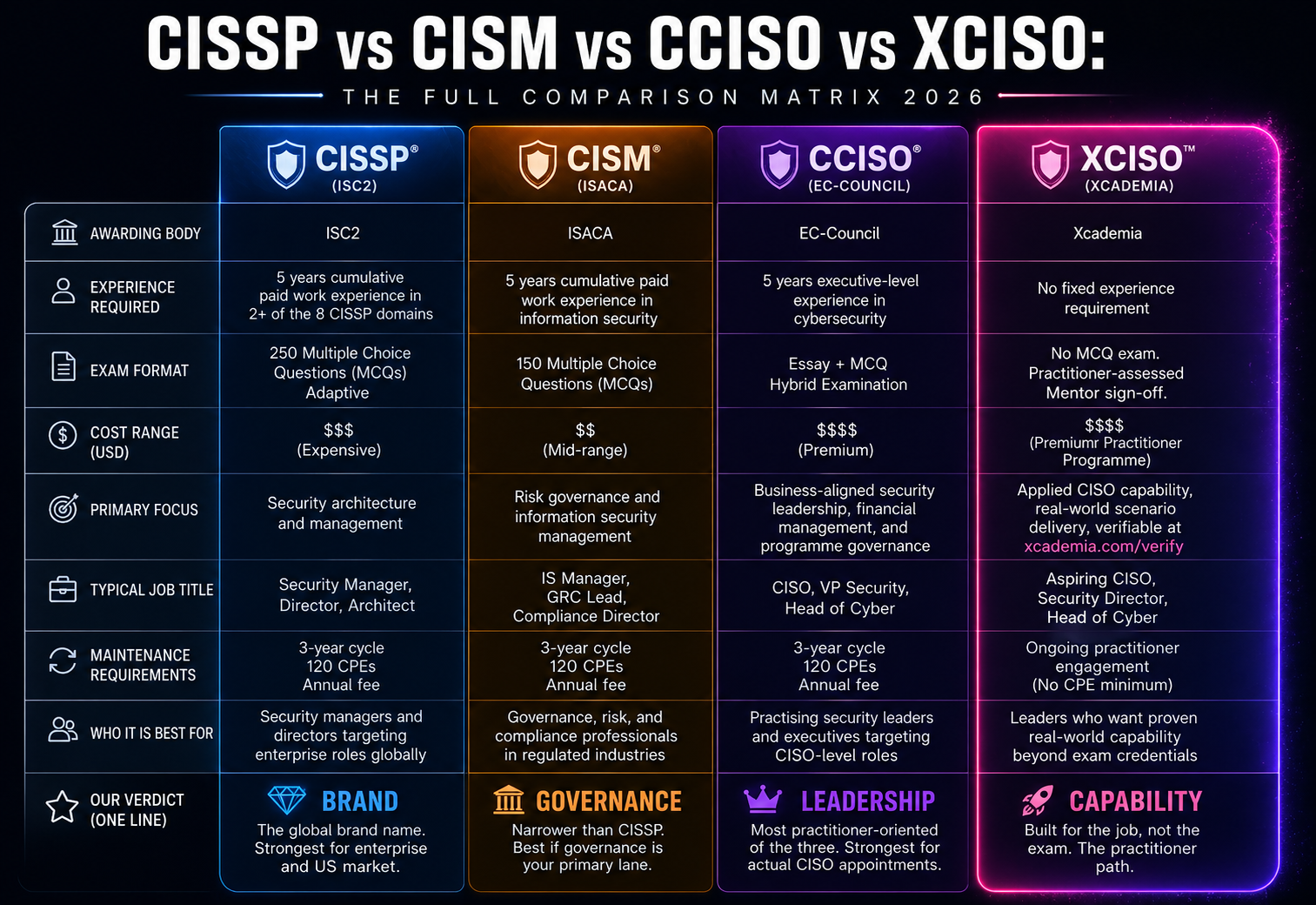
CISSP: The Global Brand Name
The CISSP is the most recognised cybersecurity management certification on the planet. If you are applying for a senior security role in the United States, the United Kingdom, Western Europe, or Australia, a CISSP on your CV will be read and understood by every recruiter and every hiring manager in the room.
That recognition comes at a cost. The CISSP is broad. Across eight domains spanning everything from asset security to software development security, the curriculum covers a vast amount of territory. The depth varies significantly across those domains, and the exam itself, 250 adaptive questions over six hours, tests breadth of knowledge rather than depth of application.
Who CISSP is actually built for
Security managers and directors who need a globally recognised credential
Professionals targeting enterprise roles in US-headquartered organisations
People who want the broadest possible coverage across security disciplines
Careers where the letters after your name matter more than the programme content
What CISSP does not give you
CISSP does not make you a better CISO. It makes you a more hireable candidate. The distinction matters. The exam tests whether you can answer questions about security concepts at a management level. It does not test whether you can build and defend a security budget in a board meeting, manage a major incident under pressure, or navigate the political reality of a security programme inside a large enterprise.
CISSP tells the market you know enough to be trusted with a senior security role. It does not tell the market you have done it. CISM: The Governance Specialist's Credential
The CISM is ISACA's answer to the question: what should a security manager who is primarily concerned with risk, governance, and compliance hold as a credential? The four domains, information security governance, risk management, security programme development, and incident management, are deliberately narrow compared to CISSP.
That narrowness is its strength and its limitation. If your role is primarily GRC-focused, if you are a Head of Information Security whose daily reality is policy, audit readiness, and regulatory compliance, then CISM maps closely to your work.
Who CISM is actually built for
GRC leads and information security managers in compliance-heavy sectors
Professionals in financial services, healthcare, or government where regulatory frameworks dominate
People who hold or are targeting IS Manager rather than full CISO roles
CISSP holders who want a complementary governance credential
What CISM does not give you
CISM does not position you as a CISO. It positions you as a governance professional. If you are aiming for the CISO chair rather than a governance leadership role, CISM alone is unlikely to get you there. Hiring decisions at CISO level look for evidence of programme leadership, financial accountability, and board-level communication - none of which the CISM curriculum addresses in meaningful depth.
CISM is the right credential for the right person. That person is a governance and risk professional, not an aspiring CISO. CCISO: The Most Practitioner-Oriented of the Three
I hold the CCISO. That matters for this section, because the honest truth about CCISO is that it is genuinely more aligned with the realities of the CISO role than either CISSP or CISM, and it is significantly less well known globally.
EC-Council built the CCISO specifically for practitioner CISOs. The five domains - governance, IS management controls, programme management, finance, and strategic planning - map directly to what a CISO is actually accountable for in a large organisation. The assessment format is more rigorous than a pure MCQ exam. The prerequisite experience requirement is specifically executive-level security experience, not just years in the industry.
Who CCISO is actually built for
Practising CISOs who want a credential that reflects what they actually do
Senior security leaders in the Middle East and the US, where CCISO has stronger market recognition
Professionals who want a credential rooted in business and financial accountability, not just technical breadth
EC-Council ecosystem organisations and ATC-aligned businesses
What CCISO does not give you
Recognition in markets where EC-Council is not dominant. In parts of Western Europe and in many UK public sector environments, CCISO is still largely unknown compared to CISSP. You may need to explain what it is. That extra step in a hiring conversation is a real friction point, even when the credential itself is stronger for the actual role.
The other limitation is cost. The total investment in CCISO, including training, examination, and renewal, is substantial. For a credential that still requires explanation in some markets, that investment needs careful consideration.
CCISO is the most honest of the three certifications about what a CISO actually does. Its limitation is geography. Its strength is depth. 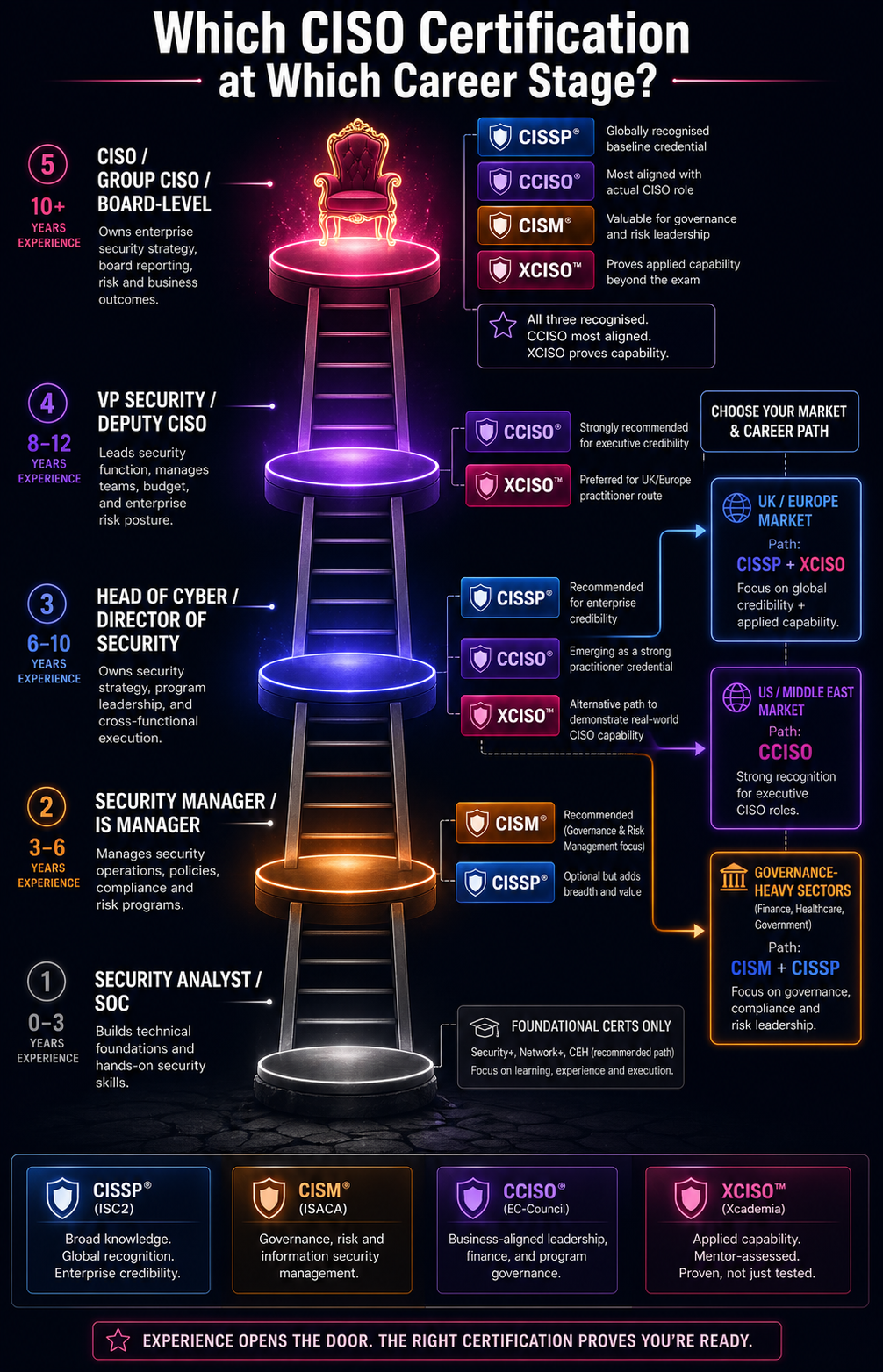
And Then There Is XCISO
Every certification above measures whether you know the right things. None of them measures whether you can do the right things under real conditions.
XCISO is Xcademia's Certification Programme for security executives. It is practitioner-assessed. There is no multiple choice exam. Progression is signed off by a senior Xcademia practitioner who has held the CISO role and can evaluate your work against what the job actually demands.
Assessed by a senior Xcademia practitioner. Verifiable at xcademia.com/verify.
What XCISO covers that the others do not
Board-level communication: presenting risk in financial terms, not technical terms
Security budget ownership: building, defending, and optimising a security investment case
Incident command under real pressure: decision-making when information is incomplete
Supplier and vendor governance: managing third-party risk at programme level
Regulatory navigation: GDPR, NIS2, DORA, and sector-specific frameworks in applied scenarios
Career evidence: a portfolio of outputs that demonstrate capability, not recall
Who XCISO is built for
Security directors and heads of cyber targeting the CISO chair within two to three years
Practising CISOs who want a verifiable UK credential that reflects real applied capability
Professionals in the UK and European market where CCISO is not yet widely recognised
Anyone who has sat a major certification and felt that the exam bore little resemblance to the job
XCISO is not positioned against CISSP, CISM, or CCISO. It is positioned against the gap that all three leave. The gap between knowing and doing. 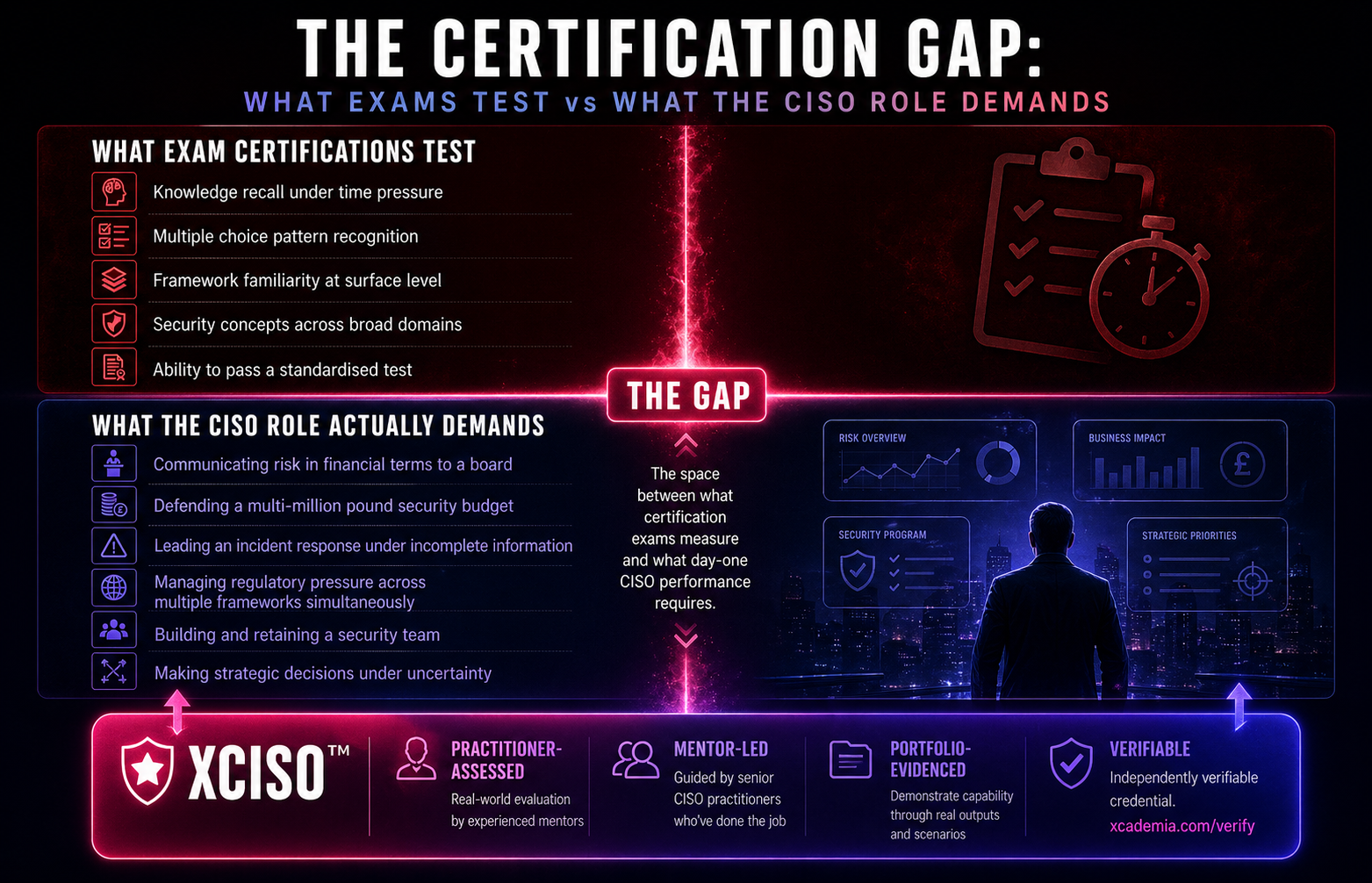
The Verdict: Which One Should You Pursue?
The honest answer depends on three things: where you are in your career, which market you are operating in, and whether you want a credential or a capability.
CISSP Best for: Global recognition | If you are a security manager or director targeting large enterprise roles in the UK, US, or Europe and need a credential that every recruiter immediately recognises, CISSP is your foundation. Pursue it early. Maintain it. It is the market standard. |
CISM Best for: GRC leadership | If your career is governance, risk, and compliance-focused and you are not targeting a full CISO role, CISM maps cleanly to your work. It complements CISSP well. As a standalone credential for CISO aspirations, it is insufficient. |
CCISO Best for: US/ME CISO track | If you are a practising security executive in the US, Middle East, or an EC-Council-aligned organisation and you want the most role-relevant credential available, CCISO is your answer. Expect to explain it in UK and European markets. Worth the investment if you are already operating at executive level. |
XCISO Best for: Applied capability | If you are targeting the CISO chair in the UK or European market and you want a credential that demonstrates what you can do rather than what you can recall, XCISO is built for that moment. Practitioner-assessed. Mentor-led. No MCQ. Verifiable at xcademia.com/verify. |
The Combination That Makes Sense
For most senior security professionals targeting the UK or European CISO market in 2026, the combination that maximises both hirability and real capability looks like this:
CISSP first: establishes your market credibility and opens the doors
XCISO as you approach the CISO chair: builds and evidences the applied capability that CISSP does not address
CCISO if you are operating in US or Middle East enterprise or targeting global CISO roles at scale
CISM if governance and risk is your primary domain and you want ISACA community membership alongside your broader credentials
None of these certifications makes you a CISO. Experience and decisions under pressure make you a CISO. The right credential tells the market you are ready to be trusted with that experience. Ready to go deeper?
Professional Training
Hands-on, mentor-led training aligned with industry certifications.
About the Author
Get weekly insights
Fresh articles on cybersecurity, AI, and leadership delivered to your inbox.