CISM vs XCISM
CISM is the most recognised IS management credential globally. XCISM tests whether you can actually build a security programme, manage risk, lead teams, and present to a board under real assessment conditions. The honest IS management certification comparison for 2026.
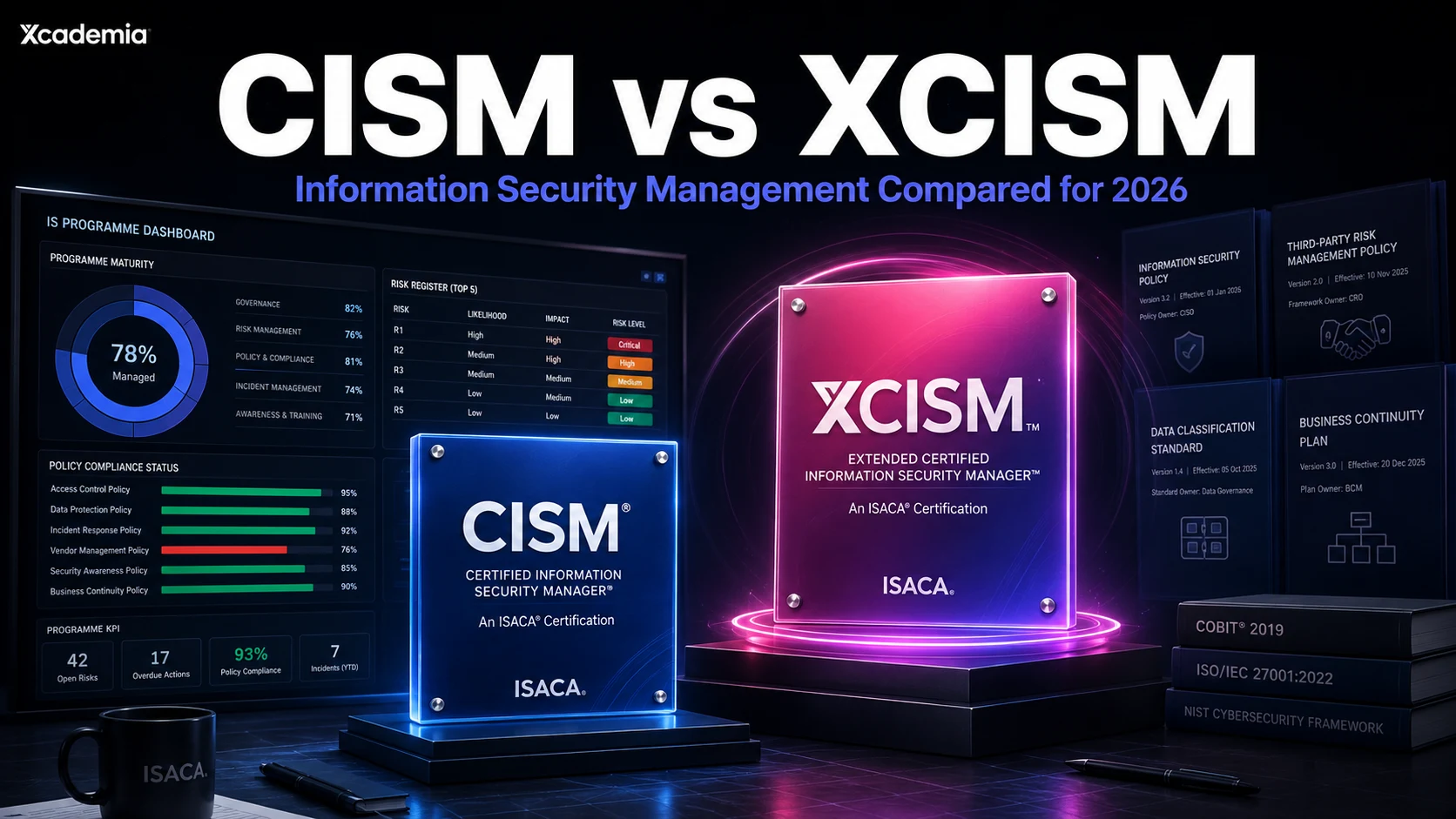
Information Security Management Certification Compared for 2026
CISM is ISACA's Certified Information Security Manager certification, one of the most globally recognised IS management credentials available. Its four domains cover information security governance, information security risk management, information security programme, and incident management. It is respected in every market where mature enterprise security management exists.
XCISM is Xcademia's Information Security Management practitioner certification. Five instructor-led days. Practitioner-assessed. Built around the applied management capability that the IS manager role actually requires, tested under real conditions rather than in a four-hour examination.
This is an honest comparison of both.
CISM and XCISM are closer in their content focus than most cert comparisons on this calendar. Both address IS governance, risk management, programme management, and incident management. The distinction is in how each assesses whether you have the capability to do the work.
What CISM Is and What It Delivers
CISM has been the de facto IS management credential for senior security professionals since its introduction. The examination is 150 multiple choice questions over four hours, covering four domains with specific weightings: information security governance (17%), information risk management (20%), information security programme (33%), and incident management (30%).
ISACA's involvement in the global IS and audit community means CISM holders are part of a professional network with genuine value. ISACA research, frameworks, and community events provide ongoing development context that extends beyond the credential itself.
Where CISM genuinely delivers
Global recognition: CISM is among the top three most recognised IS management credentials worldwide alongside CISSP and CISA
Market access: In large enterprise, financial services, and government environments globally, CISM is a specific credential that hiring managers and HR systems know
ISACA community: The ISACA professional network, local chapters, and ongoing research access have genuine career development value
Domain framework: The four-domain structure maps well to the actual accountability areas of an IS manager role
UAE recognition: CISM is particularly well-recognised in the UAE and Middle East markets where ISACA has a strong presence
The honest limitations
CISM is a 150-question multiple choice examination. A candidate who passes it has demonstrated knowledge of IS management concepts across four domains under examination conditions. They have not been required to build a security programme roadmap, present a risk assessment to a board, design a security awareness programme, manage an information security team through an incident, or make real IS management decisions under ambiguity.
The examination is strong relative to most IS management certifications. It remains an examination. The gap between passing CISM and being an effective IS manager is one that experience closes. For professionals building that experience, XCISM provides an assessment of how far they have come.
CISM is the most recognised IS management credential globally. That recognition is real and durable. It is also, definitionally, an examination credential. The professional who holds it and the professional who holds it and has had their IS management capability assessed under real conditions are different. Competitor pricing correct at time of publication.
What XCISM Covers and How It Is Assessed
XCISM is Xcademia's Information Security Manager practitioner certification. Five instructor-led days. No multiple choice examination.
Programme scope
IS governance design: Building an IS governance framework aligned with the organisation's risk appetite, regulatory context, and strategic objectives. Governance committee structures, policy hierarchy, accountability frameworks.
IS risk management applied: Using risk frameworks (ISO 31000, NIST RMF, FAIR) to conduct real risk assessments. Quantitative vs qualitative risk approaches. Risk acceptance, mitigation, transfer, and avoidance decisions with real trade-offs.
IS programme management: Building and managing a multi-year IS programme. Programme roadmap development, resource planning, metrics framework design, security investment justification.
Security awareness programme design: Building the programme that changes behaviour, not the one that achieves compliance. Programme architecture, measurement methodology, champion network design.
IS team leadership: Managing a security team, developing IS talent, performance frameworks, stakeholder relationships across the business.
Third-party and supply chain risk: Vendor risk management programme design, third-party assessment methodology, contractual security requirements.
Incident management as an IS manager: The IS manager's role in incident response, crisis communication, post-incident review governance, board reporting during and after an incident.
Board and executive communication: Translating IS programme status, risk posture, and investment requirements into language that produces decisions from non-technical executives.
The capstone
The XCISM capstone places candidates in the IS manager role for a realistic organisation facing a specific challenge: a regulatory examination in three months, a recent security incident that revealed programme gaps, and a board that has approved additional budget but wants to see a programme plan before releasing it. Candidates must produce an IS programme roadmap, a risk assessment for the board, a revised security awareness programme design, and present their recommendations to a simulated executive committee. The capstone is assessed by a senior Xcademia IS management practitioner. Verifiable at xcademia.com/verify.
The XCISM capstone is the IS manager's equivalent of a job interview that lasts a full day. It assesses whether you can actually do the work, not whether you can describe how it should be done.
FULL COMPARISON MATRIX
CISM (ISACA) | XCISM (Xcademia) | |
|---|---|---|
Awarding body | ISACA | Xcademia |
Assessment format | 150 MCQ, 4 hours | Practitioner capstone, mentor sign-off |
Duration | Self-study (4-6 months) | 5 intensive instructor-led days |
Experience required | 5 years IS management (some substitutions allowed) | Senior IS/security management context expected |
Exam cost | $575 USD (member) / $760 USD (non-member) | Included in £4,495 |
Renewal | Every 3 years, 120 CPE hours + $85/yr maintenance | No renewal required |
Focus areas | IS governance, risk, programme management, incident mgmt | Applied IS programme leadership, board communication, risk management in practice |
Market recognition | Very strong globally. Strong UK, UAE, US. | UK and UAE, growing rapidly |
What it proves | IS management knowledge across ISACA framework | Applied IS management capability under real assessment conditions |
The Cost Conversation
CISM examination costs $575 USD for ISACA members and $760 USD for non-members at time of publication. The annual maintenance fee is $85 USD per year, with 120 CPE hours required every three years. Over a three-year cycle, the total cost for a non-member including exam, annual maintenance, and reasonable CPE activity sits in the range of £2,000 to £3,500.
XCISM is priced at £4,495 all-inclusive. No annual maintenance. No CPE requirement. No renewal.
The three-year total comparison is closer than the exam-fee-only comparison suggests. For the professional who holds both credentials, the CISM ongoing cost is a real consideration in planning.
The total cost of CISM over three years is meaningfully higher than the exam fee alone. At a ten-year career horizon, the CISM ongoing cost is substantial. XCISM has no ongoing cost. The comparison that matters for career investment planning is the lifecycle cost, not the initial investment.
Who Should Choose CISM
You are targeting senior IS management roles in large enterprise, financial services, or government where CISM is specifically listed or widely recognised
You are building on the ISACA credential family (CISA, CRISC) and CISM completes a recognised IS management portfolio
Your employer will fund CISM as a named credential and you are targeting markets with strong ISACA recognition
You are in the UAE or Middle East market where ISACA credentials carry particularly strong employer recognition
CISM best for global IS management market recognition:
CISM is the most recognised IS management credential globally. If your target employers and markets specifically value or require CISM, it is the right credential to pursue. Prepare thoroughly rather than just passing it, and build XCISM on top for the practitioner evidence layer.
Who Should Choose XCISM
You hold CISSP or CISM and want to add practitioner evidence that demonstrates applied IS management capability beyond what either examination assesses
You are a security engineer or security analyst making the transition to IS management and want a structured programme that develops and assesses the management skills, not just the technical ones
You are targeting roles where you will be assessed on your ability to build a programme, manage a team, and communicate with a board rather than on your exam credentials
You want the IS management credential that requires you to demonstrate the work, not just describe it
XCISM best for applied IS management capability evidence:
XCISM develops and assesses the applied IS management capability that CISM describes in its domain framework. Programme design, risk communication, board presentation, incident governance. Five days. Practitioner-assessed. No MCQ. No renewal. Verifiable at xcademia.com/verify.
The Combination
The IS manager who holds CISM for recognition and XCISM for practitioner evidence is the most credible candidate in the room for senior IS management roles. CISM confirms the domain knowledge. XCISM confirms it has been applied under assessment conditions. Together they answer both questions the employer is asking.
CISM says you know what good IS management looks like. XCISM says you have demonstrated it. The strongest IS management professionals hold credentials that answer both questions.
Demonstrate Applied IS Management Capability With XCISM XCISM: five instructor-led days covering IS governance, risk management applied, programme management, security awareness design, team leadership, and board communication. Practitioner-assessed executive capstone. No MCQ. No renewal. Verifiable at xcademia.com/verify. Explore XCISM |
|---|
Ready to go deeper?
Professional Training
Hands-on, mentor-led training aligned with industry certifications.
About the Author
Sharper every day
Daily tutorials, analysis, and career playbooks across all 12 Xcademia disciplines, straight to your inbox. No spam.