CHFI vs XDFI
CHFI teaches digital forensics methodology. XDFI assesses whether you can conduct a real investigation. An honest 2026 comparison of market recognition, practical DFIR capability, assessment style, and which certification best fits a real forensics career.
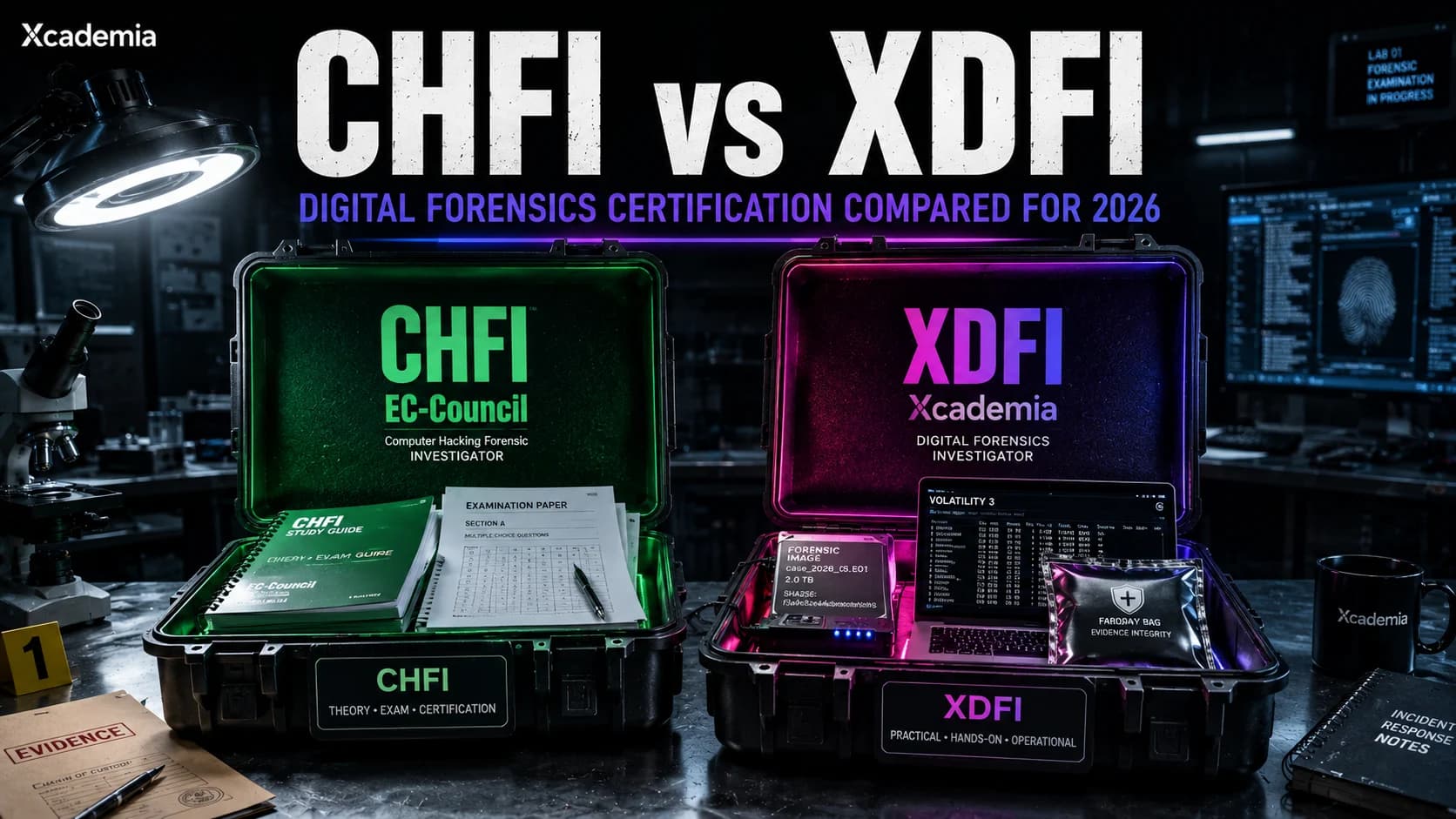
Digital Forensics Certification Compared for 2026
Digital forensics is one of the cybersecurity disciplines where the gap between examination knowledge and operational capability is widest. The skills required to conduct a real forensic investigation, acquire evidence properly, analyse memory and file system artefacts, build a timeline, and produce a report that withstands legal scrutiny, are learned through practice not through multiple choice preparation.
Both CHFI and XDFI are designed for professionals pursuing digital forensics and incident response careers. They address the same professional need. The question is which one better prepares you for the work that need entails.
Digital forensics is perhaps the one cybersecurity discipline where a multiple choice certification most clearly cannot demonstrate the skills the role requires. You cannot learn to examine a memory dump by reading about it. You have to run the tools.
What CHFI Is and What It Covers
EC-Council's Computer Hacking Forensic Investigator certification covers the full digital forensics investigator role across 14 modules. File system forensics, Windows and Linux forensics, network forensics, mobile device forensics, cloud forensics, malware forensics, email forensics, and dark web investigation are all covered at a conceptual level.
The examination is 150 multiple choice questions over four hours. Passing requires a score of approximately 70%. The curriculum references a wide range of forensic tools including Autopsy, FTK, EnCase, Volatility, Wireshark, and others.
Where CHFI genuinely delivers
Breadth: CHFI covers a wider range of forensic domains than most single certifications
Market recognition: Strong in the UAE, Middle East, and US enterprise markets where EC-Council credentials carry weight
Regulatory context: CHFI curriculum addresses the legal and evidentiary framework that forensic investigations operate within
Entry accessibility: The examination format is accessible and preparation materials are well-documented
The honest limitations
CHFI is a conceptual certification. It teaches you what each forensic domain involves and familiarises you with the tools used. It does not put you in front of a real forensic image, ask you to use Volatility to identify a rootkit, or require you to produce a timeline from artefacts and defend it against challenge.
A CHFI holder who has not done significant practical work alongside the examination may find their first real forensic investigation significantly more demanding than their preparation suggested. The certification tells an employer you understand the domain. It does not tell them you can work an investigation.
CHFI is a strong foundational credential for the digital forensics career path. It is most valuable when combined with practical experience. As a standalone indicator of investigative capability, it has the same limitation as every other MCQ certification in a practice-dependent discipline. Competitor pricing correct at time of publication.
What XDFI Covers and How It Is Assessed
XDFI is Xcademia's Digital Forensics Investigator practitioner certification. Seven instructor-led days. Practitioner-assessed capstone. No multiple choice examination.
Programme scope
Evidence acquisition: Forensic imaging procedures, write-blocker use, hash verification and chain of custody documentation
Windows forensics: Registry analysis, prefetch and shimcache artefacts, browser history, LNK files, Volume Shadow Copy investigation
Linux forensics: File system artefacts, bash history, syslog analysis, cron job investigation
Memory forensics: Volatility framework across Windows and Linux, process analysis, network connections, injection detection
Network forensics: Wireshark PCAP analysis, identifying C2 traffic, data exfiltration patterns, protocol anomalies
Cloud forensics: AWS CloudTrail, Azure Activity Log, cloud storage investigation fundamentals
Malware forensics: Static and dynamic analysis basics, IOC extraction, sandbox report interpretation
Timeline construction: Log2timeline/Plaso, super timeline analysis, correlating artefacts across sources
AI-assisted triage: Using AI tools within the investigation workflow to accelerate log analysis and reporting
Report writing: Producing professional forensic investigation reports that meet legal evidentiary standards
The capstone
Candidates receive a forensic image package: a Windows memory dump, a disk image, and a network capture from a simulated incident. They must conduct a full investigation, identify the attack timeline, produce a list of findings with supporting artefacts, and deliver a professional investigation report. The capstone is assessed by a senior Xcademia DFIR practitioner. The credential is verifiable at xcademia.com/verify.
The XDFI capstone is an actual forensic investigation. Not a simulation of what one looks like. The professional who completes it has worked a real case under controlled conditions with a practitioner evaluating the quality of their work.
FULL COMPARISON MATRIX
CHFI v10 (EC-Council) | XDFI (Xcademia) | |
|---|---|---|
Awarding body | EC-Council | Xcademia |
Assessment format | 150 MCQ, 4 hours | Practitioner capstone, mentor sign-off |
Duration | Self-study (3-5 months typical) | 7 intensive instructor-led days |
Experience required | 2 years IT/security recommended | Practitioner pace, IR exposure helpful |
Exam cost | $950 USD (ECC exam) | Included in programme fee |
Total cost | $1,500-$2,500 (prep + exam) | £4,995 all inclusive |
Renewal | Every 3 years, EC-Council credits | No renewal required |
Forensics coverage | Windows, Linux, mobile, network, cloud (conceptual) | Windows, Linux, memory, network, cloud (applied labs) |
Tool depth | Autopsy, FTK, EnCase (conceptual), Volatility basics | Autopsy, Volatility, Wireshark, log analysis platforms, AI-assisted triage |
Market recognition | Strong globally, UAE and US particularly | UK and UAE, growing |
What it proves | You can answer MCQ on digital forensics methodology | You can work a real forensic investigation from acquisition to report |
Who Should Choose CHFI
You are targeting digital forensics roles in the UAE, Middle East, or US enterprise where CHFI is specifically listed as a preferred or required qualification
You need market recognition that passes the HR filter before your application is reviewed
You are building foundational knowledge of digital forensics before moving into operational practice
Your organisation has approved CHFI as a named certification for funding purposes
CHFI best for market recognition and broad forensics foundation:
CHFI covers the widest range of digital forensics domains in a structured programme. EC-Council recognition is strong in the UAE and US. It is the right first credential for the market recognition function. Build applied capability alongside it.
Who Should Choose XDFI
You want a certification that demonstrates you can conduct a real digital forensics investigation rather than one that demonstrates you can answer questions about conducting one
You are targeting DFIR roles in the UK or UAE where practitioner-assessed credentials are increasingly valued
You are already working in incident response or security operations and want to formalise and deepen your forensics capability
You want seven days of intensive hands-on forensics training with real tools against real forensic images
You already have a foundational certification such as CHFI or Security+ and want to add demonstrated operational capability
XDFI best for applied forensics capability and practitioner evidence:
XDFI builds the capability that digital forensics roles actually require: evidence acquisition, memory analysis, timeline construction, and professional reporting. All assessed against a real forensic investigation. Practitioner sign-off. No MCQ. Verifiable at xcademia.com/verify.
The Career Context
Digital forensics as a specialism is increasingly divided into two populations. The first are the investigators who can sit down with a forensic image and a memory dump and tell you what happened, when, and how. The second are the professionals who hold forensic certifications and can describe the methodology accurately but struggle when the tool output does not match the textbook examples.
Employers who are building serious DFIR capability know the difference. The interview for a senior forensics role typically includes a technical exercise: here is a memory dump, what do you find? Here is a PCAP, describe the attacker's activity. The candidates who succeed are the ones who have done this before, not the ones who have studied how it is done.
In digital forensics, the portfolio matters more than the certificate. The investigator who can walk an interviewer through a real investigation they have worked, with specific artefacts and specific findings, is in a different category from the one who can describe what an investigation involves.
Work a Real Forensic Investigation With XDFI XDFI: seven instructor-led days, real forensic images, full Volatility and Autopsy lab environment, practitioner-assessed investigation capstone. No MCQ. Includes AI-assisted triage workflows. Verifiable at xcademia.com/verify. Explore XDFI | xcademia.com |
|---|
Ready to go deeper?
Professional Training
Hands-on, mentor-led training aligned with industry certifications.
About the Author
Sharper every day
Daily tutorials, analysis, and career playbooks across all 12 Xcademia disciplines, straight to your inbox. No spam.