CEH vs XEHP
An honest comparison of CEH and XEHP for 2026: what each certification actually teaches, what they fail to assess, the gap between market recognition and real penetration testing capability, and which path best fits a serious offensive security career.
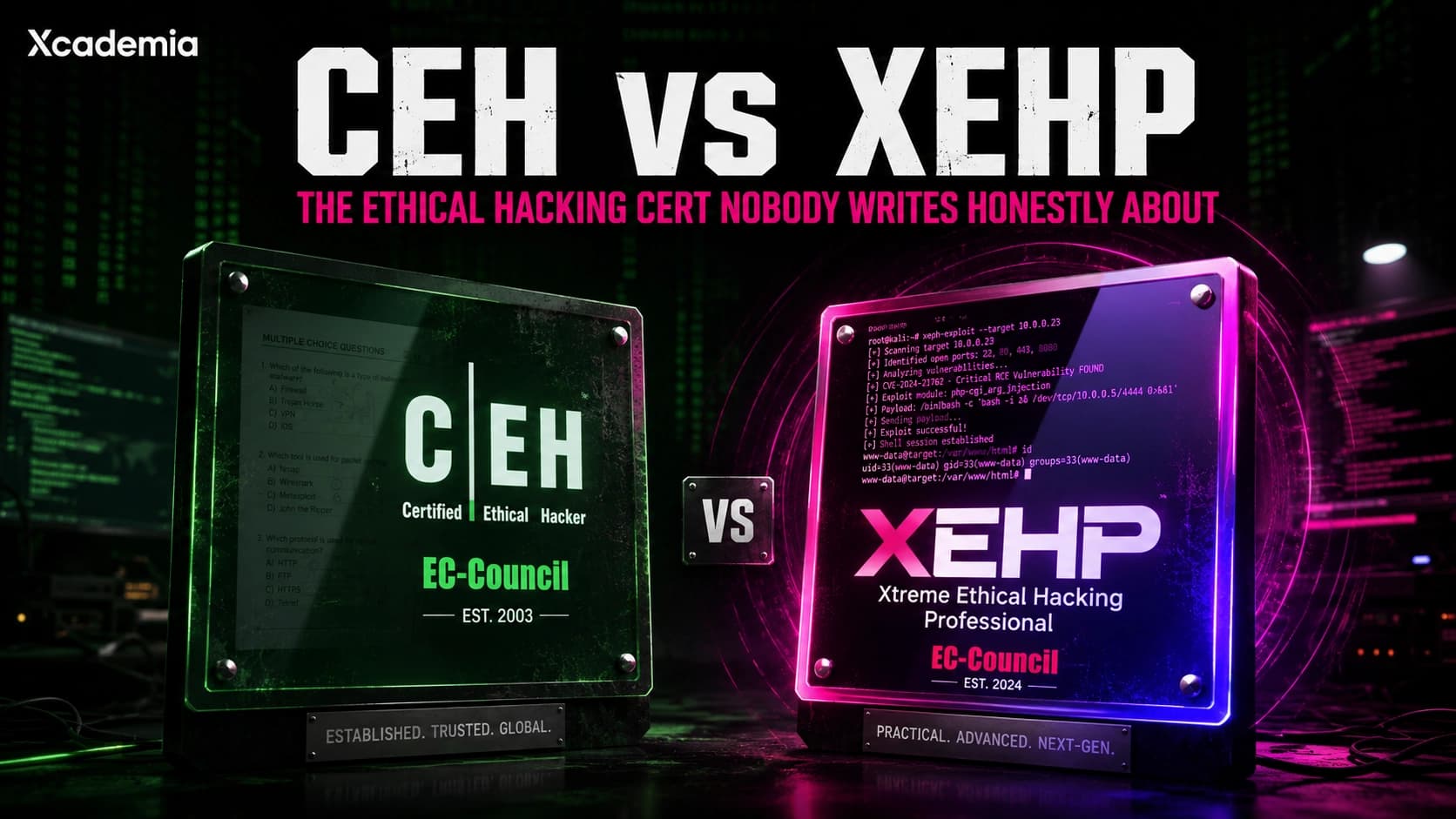
The Ethical Hacking Cert Comparison Nobody Writes Honestly
The CEH remains one of the most widely recognised ethical hacking certifications in the cybersecurity industry, commonly used to validate foundational offensive security knowledge and early-stage practitioner capability. However, industry perception and practical operational value are not always aligned, particularly when measured against the demands of real-world offensive security work.
XEHP is Xcademia's Ethical Hacking Practitioner certification. I was involved in designing what it tests. This comparison is transparent about both credentials and it will not flatter either one unnecessarily.
The CEH market is enormous. There are people who hold CEH and cannot run a basic exploitation workflow. There are also CEH holders who are outstanding penetration testers. The certification is not the differentiator. What you did with the knowledge is.
What CEH Actually Is in 2026
CEH v13 is EC-Council's current iteration of the Certified Ethical Hacker programme. Twenty modules covering the full ethical hacking methodology: reconnaissance, scanning, enumeration, vulnerability analysis, system hacking, malware threats, sniffing, social engineering, denial of service, session hijacking, web server and application attacks, SQL injection, wireless network hacking, mobile platforms, IoT and OT hacking, cloud computing, and cryptography.
The examination is 125 multiple choice questions with a four-hour time limit. A passing score requires approximately 70% depending on the version. The iLabs component provides access to a virtual lab environment for hands-on practice, but it is purchased separately and many candidates complete the certification without it.
What CEH does that matters
Provides a structured, comprehensive map of the ethical hacking methodology from start to finish
Delivers strong market recognition, particularly in UAE, Middle East, US enterprise, and government-adjacent roles
Prepares candidates for the conceptual questions that appear in ethical hacking interviews
Satisfies the "CEH preferred" requirement on a large proportion of penetration testing and security analyst job specifications globally
Version 13 updates cover AI-powered attack techniques, cloud attack surfaces, and OT security, making it more current than previous versions
What CEH does not do
Passing CEH without significant hands-on lab practice does not make you a penetration tester. The examination format rewards broad conceptual knowledge, not the operational ability to chain vulnerabilities, bypass modern defences, pivot through network segments, and produce a client-ready report. These are the skills that actual penetration testing engagements require. The exam tests whether you know what each technique is. It does not test whether you can execute it.
The renewal model also adds ongoing cost. Every three years, 120 EC-Council continuing education credits are required. For professionals who are actively working in the field this is manageable. For those who hold CEH as a credential alongside other work, the maintenance overhead is real.
CEH is the entry ticket to the ethical hacking profession in most markets. It is not the graduation certificate. The professionals who hold it and nothing else are at a disadvantage compared to those who built applied capability on top of it. Competitor pricing correct at time of publication.
What XEHP Is and What It Tests
XEHP is Xcademia's Ethical Hacking Practitioner certification. Ten intensive instructor-led days. No multiple choice exam. Practitioner-assessed capstone. The most comprehensive hands-on ethical hacking programme in the Xcademia portfolio.
The Programme Scope
Reconnaissance: OSINT techniques, passive and active reconnaissance, target profiling
Network scanning and enumeration: Nmap, service fingerprinting, vulnerability identification
Exploitation: Metasploit framework, manual exploitation, exploit development fundamentals
Post-exploitation: Privilege escalation on Windows and Linux, lateral movement, persistence mechanisms
Web application hacking: Burp Suite, OWASP Top 10 exploitation, SQL injection, authentication bypass, XXE, SSRF
Active Directory attacks: BloodHound, Kerberoasting, Pass-the-Hash, DCSync
Red team methodology: Engagement planning, C2 infrastructure, OPSEC fundamentals, report writing
Evasion techniques: AV/EDR bypass concepts, living-off-the-land techniques
The Assessment
The XEHP capstone is a structured practical engagement against a simulated target environment. Candidates must identify entry points, demonstrate exploitation, achieve defined post-exploitation objectives, and produce a professional penetration testing report. The report is reviewed by a senior Xcademia practitioner with real-world penetration testing experience. The assessment is against defined professional competency criteria, not against an answer key.
Passing XEHP means you have run a real penetration test, documented the findings professionally, and had that work reviewed by someone who does this for a living. That is the evidence employers who are serious about hiring practitioners actually want to see.
The XEHP capstone is what the CEH iLabs try to approximate. The difference is that iLabs are practice. XEHP assessment is the actual evaluation, with a practitioner checking your work against the standard the profession requires.
FULL COMPARISON MATRIX
CEH v13 (EC-Council) | XEHP (Xcademia) | |
|---|---|---|
Awarding body | EC-Council | Xcademia |
Assessment format | 125 MCQ, 4 hours | Practitioner capstone, mentor sign-off |
Programme duration | Self-study (typical 2-4 months) | 10 intensive instructor-led days |
Experience required | 2 years recommended or EC-Council training | Practitioner pace, no fixed requirement |
Exam cost | $1,199 USD (ECC exam) or $950 (VUE) | Included in programme fee |
Total cost | $1,500-$3,000 (prep + exam) | £5,995 all inclusive |
Renewal | Every 3 years, 120 EC-Council credits | No renewal required |
Hands-on component | iLabs (optional add-on), separate cost | Live labs throughout all 10 days |
Tools covered | Limited to EC-Council approved toolset | Industry-standard: Metasploit, Burp Suite, Nmap, Wireshark, BloodHound, and more |
Market recognition | Very strong in UAE/Middle East and US enterprise | UK and UAE, growing rapidly |
Scope | Ethical hacking concepts across 20 modules | Ethical hacking, exploit development, red team methodology, OSCP-level practice |
What it proves | You passed a 125-question MCQ on hacking concepts | You can conduct a structured penetration test under real assessment conditions |
The Price Conversation
XEHP is priced higher than CEH. This is intentional and it is worth explaining why.
CEH v13 exam voucher pricing sits at $1,199 USD through EC-Council directly at time of publication, with some variance through third-party resellers. Adding a preparation course brings the total to $1,500 to $3,000 depending on the provider and format.
XEHP is priced at £5,995 all-inclusive. That covers ten instructor-led days with a senior practitioner, the full lab environment, all tools and materials, the practitioner assessment, the certification itself, and ongoing verifiability. No iLabs add-on. No separate assessment fee. No renewal cost.
The comparison that matters is not CEH exam fee versus XEHP programme fee. It is what each produces. CEH produces a credential. XEHP produces a credential plus a practitioner portfolio plus ten days of applied offensive security training with a professional who is actively working in the field.
For the professional who wants both market recognition and genuine applied capability, the honest sequence is: CEH preparation programme to understand the methodology and pass the exam, then XEHP to build and evidence the practical capability the exam cannot assess.
XEHP is priced higher than CEH because it is a different product. Comparing the CEH exam fee to the XEHP programme fee is comparing a test to a training programme with assessment. The comparison should be CEH prep course plus exam plus iLabs plus the practical experience you still have to build yourself versus XEHP all-in.
Who Should Choose CEH
You are targeting roles in the UAE, Middle East, or US enterprise where CEH is frequently listed as a specific requirement or preference
You need a globally recognised credential that passes the HR filter before your application is reviewed by a human
You want a structured introduction to the full ethical hacking methodology before specialising
Your organisation will fund CEH as a named credential but needs a formal justification for XEHP
CEH Best For Market Recognition and Methodology Foundation:
CEH is the most recognised ethical hacking credential globally. In the UAE and Middle East specifically, it is frequently required or strongly preferred. Pursue it for the market access it provides. Build applied capability on top of it.
Who Should Choose XEHP
You are building a career in penetration testing and want a credential that demonstrates operational capability rather than examination recall
You are based in the UK or UAE and want a practitioner-assessed credential that differentiates you from the pool of CEH holders who cannot back the cert with demonstrated skill
You already hold CEH and want to build the practical capability the exam did not develop
You are targeting senior penetration testing roles, red team positions, or CREST-aligned work where practical capability is the primary hiring criterion
You want a ten-day immersive programme that accelerates your practical offensive security development more than any self-study approach can
XEHP Best For Applied Offensive Security Capability:
XEHP builds and evidences the practical penetration testing capability that CEH cannot assess. Ten days. Live labs. Real tooling. Practitioner-assessed capstone. No MCQ. Verifiable at xcademia.com/verify. For the professional who needs to demonstrate they can do the work.
The Combination
The ethical hacking professional who is best positioned in the 2026 job market holds both the market recognition of CEH and the practical evidence of XEHP. The sequence makes sense in either order, but most professionals find it more efficient to do CEH preparation first to build the conceptual foundation, then XEHP to develop and demonstrate the applied capability.
CEH opens the door. XEHP proves you belong in the room. The combination answers both questions every serious penetration testing employer is asking.
Go Beyond CEH With XEHP XEHP is Xcademia's practitioner-assessed Ethical Hacking Professional certification. Ten intensive instructor-led days. Real tools. Real exploitation. Practitioner-assessed capstone. No MCQ. No renewal. Verifiable at xcademia.com/verify. Explore XEHP | xcademia.com |
|---|
Ready to go deeper?
Professional Training
Hands-on, mentor-led training aligned with industry certifications.
About the Author
Sharper every day
Daily tutorials, analysis, and career playbooks across all 12 Xcademia disciplines, straight to your inbox. No spam.