CASE vs XASE: Which AppSec Certification Proves You Can Actually Secure Code?
CASE teaches secure coding in .NET or Java. XASE builds full AppSec engineering capability across any stack. Compare assessment, scope, and which certification actually proves you can secure real code in 2026.
CASE vs XASE:
Which AppSec Certification Proves You Can Actually Secure Code?
There is a specific type of engineer that every development team needs and most do not have: the person who can look at code and see where the attacker will enter.
Application security engineers sit at the intersection of software development and offensive security thinking. They understand how applications are built well enough to review them. They understand how attacks work well enough to know where the vulnerabilities will be. And they can communicate findings to development teams in a way that produces actual changes, not just reports that sit unread in a tracking system.
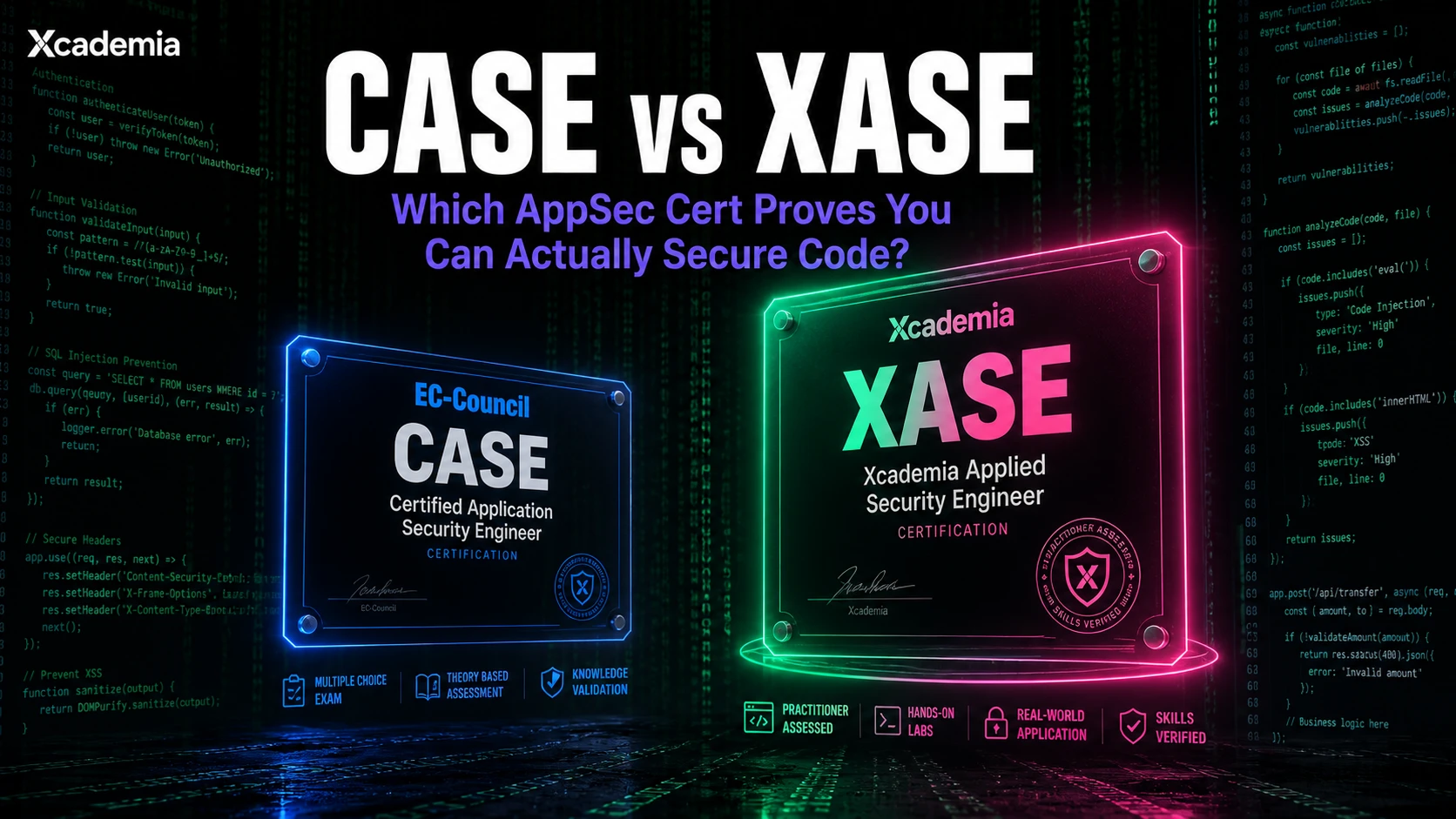
Two certifications are designed for this professional. CASE, EC-Council's Certified Application Security Engineer, available in .NET and Java variants. And XASE, Xcademia's Application Security Engineer practitioner certification. This is an honest comparison of both.
The AppSec engineer shortage is real. Organisations that want to build the capability are competing for a small pool of qualified professionals. The right certification does not just validate existing skills. It builds new ones.
What CASE Is and What It Covers
EC-Council's CASE certification comes in two variants: CASE .NET and CASE Java. They are separate examinations, each focused on the secure coding practices relevant to that specific technology stack. The .NET variant covers C# and ASP.NET security. The Java variant covers Java EE and Spring security.
Each exam consists of 50 multiple choice questions to be completed in two hours. Passing requires a score of 70% or above. The curriculum covers secure coding standards, common vulnerability identification in code, input validation, authentication and session management, error handling, and logging practices.
What CASE does well
Technology-specific: the .NET and Java focus means the content is directly relevant to developers working in those stacks
EC-Council ecosystem: for organisations already using EC-Council certifications (CEH, CCISO), CASE fits naturally into an existing credential framework
Accessible entry point: the exam format is straightforward and preparation materials are well-documented
Developer-friendly: designed for people who write code, not primarily for security professionals
What CASE does not cover
Each CASE variant covers one technology stack. A professional working across .NET and Java environments needs two separate exams and two separate fees. An engineer working in Python, Go, or Node.js will find neither variant directly applicable.
More fundamentally, CASE tests whether you can identify security issues in a controlled multiple choice format. It does not test whether you can conduct a real code review, integrate security testing into a development pipeline, run a threat modelling session with an architecture team, or interpret SAST tool output and triage findings effectively. These are the skills AppSec engineers use daily. The exam does not measure them.
CASE tells an employer you understand secure coding concepts for a specific technology stack. What it cannot tell them is whether you can actually apply those concepts in a real development environment under the pressures and constraints of a live project. Competitor pricing correct at time of publication.
What XASE Is and What It Requires
XASE is Xcademia's Application Security Engineer certification. Six instructor-led days. No multiple choice exam. Assessment is conducted by a senior Xcademia practitioner with real AppSec engineering experience.
What the programme covers
OWASP Top 10: deep technical understanding of each vulnerability class and its exploitation, not just recognition
Threat modelling: running STRIDE sessions with development teams, producing actionable threat model documentation
Code review: manual review techniques across multiple languages, identifying vulnerability patterns in real codebases
SAST and DAST integration: configuring, running, and triaging output from static and dynamic analysis tools within CI/CD pipelines
Software Composition Analysis: identifying and managing third-party dependency vulnerabilities
Secure SDLC: embedding security practices across the development lifecycle, working with engineering teams rather than gatekeeping them
API security: OWASP API Security Top 10, testing approaches for REST and GraphQL APIs
Security requirements: translating business and compliance requirements into specific security controls that developers can implement
How assessment works
Candidates complete a multi-stage capstone. They are given a real-world application with documented security requirements and a codebase to review. The capstone requires producing a threat model, conducting a code review, running and triaging SAST tool output, identifying vulnerabilities across multiple OWASP categories, and producing a findings report that a development team could act on.
The capstone is assessed by a senior Xcademia practitioner against defined competency criteria. The credential is verifiable at xcademia.com/verify.
The XASE capstone mirrors what an AppSec engineer actually does on their first week in role. The professional who completes it has not just demonstrated knowledge. They have demonstrated the ability to work.
FULL COMPARISON MATRIX
| CASE .NET + Java (EC-Council) | XASE (Xcademia) |
Awarding body | EC-Council | Xcademia |
Variants | CASE .NET and CASE Java (separate exams) | XASE covers both environments |
Assessment format | Multiple choice exam, 50 questions, 2 hours | Practitioner capstone, mentor sign-off |
Duration | Self-study (typically 1-3 months per variant) | 6 intensive instructor-led days |
Experience required | 2 years development experience recommended | Practitioner pace, no fixed requirement |
Exam cost | $250 USD per variant ($500 for both) | Included in programme fee |
Total cost (estimate) | $700-$1,500 (prep + exam + materials, both variants) | £3,995 all inclusive |
Renewal | Every 3 years, EC-Council renewal programme | No renewal required |
Coverage | Code review in .NET and Java specifically | OWASP, SAST/DAST, threat modelling, secure SDLC |
Evidence produced | Certificate of passing exam | Practitioner portfolio, verifiable online |
Market recognition | Moderate. EC-Council audience primarily | UK and Middle East, growing |
What it proves | You can identify secure coding issues in MCQ format | You can conduct a real code review and fix findings |
The Stack Coverage Question
One of the most practically significant differences between CASE and XASE is technology coverage.
CASE .NET covers C# and ASP.NET. CASE Java covers Java EE and Spring. If you want both credentials, you sit two separate exams and pay two separate fees. At time of publication, each CASE exam voucher costs $250 USD, making the full dual-stack cost $500 USD in exam fees alone before preparation materials.
XASE covers application security engineering as a discipline: the principles, processes, and practices that apply across languages and frameworks. A professional who holds XASE can apply secure code review techniques to Python, Go, Node.js, Rust, or any other language because the vulnerability classes and the review methodology are language-agnostic. The specific syntax changes. The security thinking does not.
For engineers working in modern polyglot environments, where a single application might have a React frontend, a Python API layer, a Go microservice, and a Node.js integration service, a single-stack certification has limited reach. XASE covers the professional's ability to think about application security across whatever stack they are working in.
Modern applications are not built in a single language. The AppSec engineer who can only review .NET or Java is a specialist in a world that increasingly requires generalist security engineering capability.
Who Should Choose CASE
CASE is the right choice if:
You work exclusively in .NET or Java environments and want a focused credential in that stack
Your organisation already uses EC-Council certifications and you are building within that framework
You are a developer who wants a structured introduction to secure coding concepts without committing to a full practitioner programme
You are in an early-career position and want a lower-cost entry point into AppSec credentialing before building toward more advanced qualifications
CASE | CASE provides structured secure coding knowledge for .NET or Java specifically. It is an accessible entry point for developers wanting an introduction to AppSec concepts. For engineers in mixed or modern stacks, its coverage is limited. |
|---|
Who Should Choose XASE
XASE is the right choice if:
You are targeting an AppSec engineer role and need to demonstrate that you can perform the full range of responsibilities: threat modelling, code review, SAST/DAST, pipeline integration, and team enablement
You work in a polyglot environment where single-stack credentials do not reflect your actual work
You are transitioning from software development into security and want to demonstrate applied AppSec capability rapidly
You have CASE or similar credentials and want to add something that demonstrates capability beyond what a multiple choice exam can show
You are in the UK or UAE market where practitioner-assessed credentials are increasingly valued alongside or above exam-based ones
XASE | XASE builds and evidences the complete AppSec engineering capability: threat modelling, code review, SAST/DAST, API security, and secure SDLC integration. Practitioner-assessed. No MCQ. Verifiable at xcademia.com/verify. |
|---|
The Career Trajectory
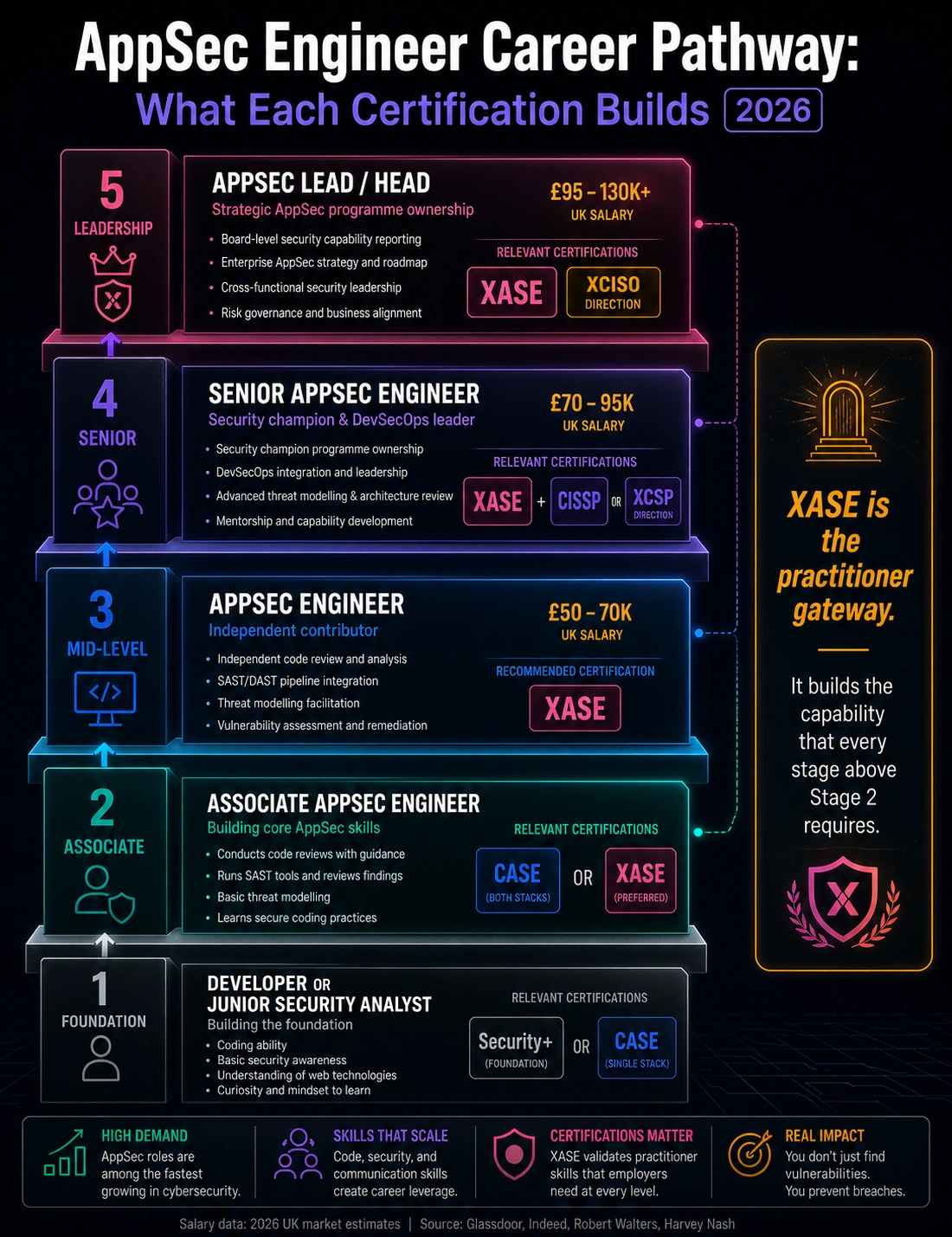
The AppSec engineer role sits at one of the most valuable intersections in the technology job market in 2026. Organisations know they need this capability. They know they do not have enough of it. And they know that finding someone who can actually do the work, rather than someone who has passed an exam about it, is the challenge.
The professionals who are progressing fastest in AppSec careers share a consistent profile. They can read code in multiple languages. They can explain a SQL injection vulnerability to a junior developer and a business risk to a CISO in the same conversation. They have integrated security tooling into CI/CD pipelines and reduced false positive rates to a level that development teams will actually use. They run threat modelling sessions that produce findings rather than arguments.
Neither CASE nor XASE produces this profile automatically. Both certifications are the beginning of a career development investment, not the end of it. The difference is that XASE is built to accelerate the practical capability development that the career requires, while CASE provides structured knowledge that you then have to apply yourself in a real environment.
The AppSec engineer who can show a practitioner-assessed portfolio alongside their certifications is in a fundamentally different position from the one who can show certificates alone. The portfolio is evidence. The certificate is a signal.
Ready to go deeper?
Professional Training
Hands-on, mentor-led training aligned with industry certifications.
About the Author
Sharper every day
Daily tutorials, analysis, and career playbooks across all 12 Xcademia disciplines, straight to your inbox. No spam.