
Zero-Day Exploitation of Cisco Catalyst SD-WAN Manager
A critical zero-day vulnerability in Cisco Catalyst SD-WAN Manager is under active exploitation. The flaw grants attackers root-level access, enabling command execution, configuration manipulation, persistence, and potential compromise of enterprise network infrastructure.
Xcademia Team
Xcademia Research Team

Introduction
A critical zero-day vulnerability in Cisco Catalyst SD-WAN Manager has been actively exploited by threat actors, allowing attackers to gain root-level privileges on affected systems and potentially take control of enterprise-wide network infrastructure.
The vulnerability impacts one of the most sensitive components within modern enterprise environments—the centralized management platform responsible for configuring, monitoring, and controlling software-defined wide area networks (SD-WAN).
According to threat intelligence researchers, attackers leveraged the flaw before security updates became available, making it a true zero-day attack. The incident demonstrates a growing trend in cyber operations where threat actors are increasingly targeting network management platforms instead of traditional endpoints.
For organizations relying on SD-WAN technologies to connect branch offices, cloud environments, and remote users, a compromise of the management plane could provide attackers with extensive visibility and control across the entire network.
Understanding Cisco Catalyst SD-WAN Manager
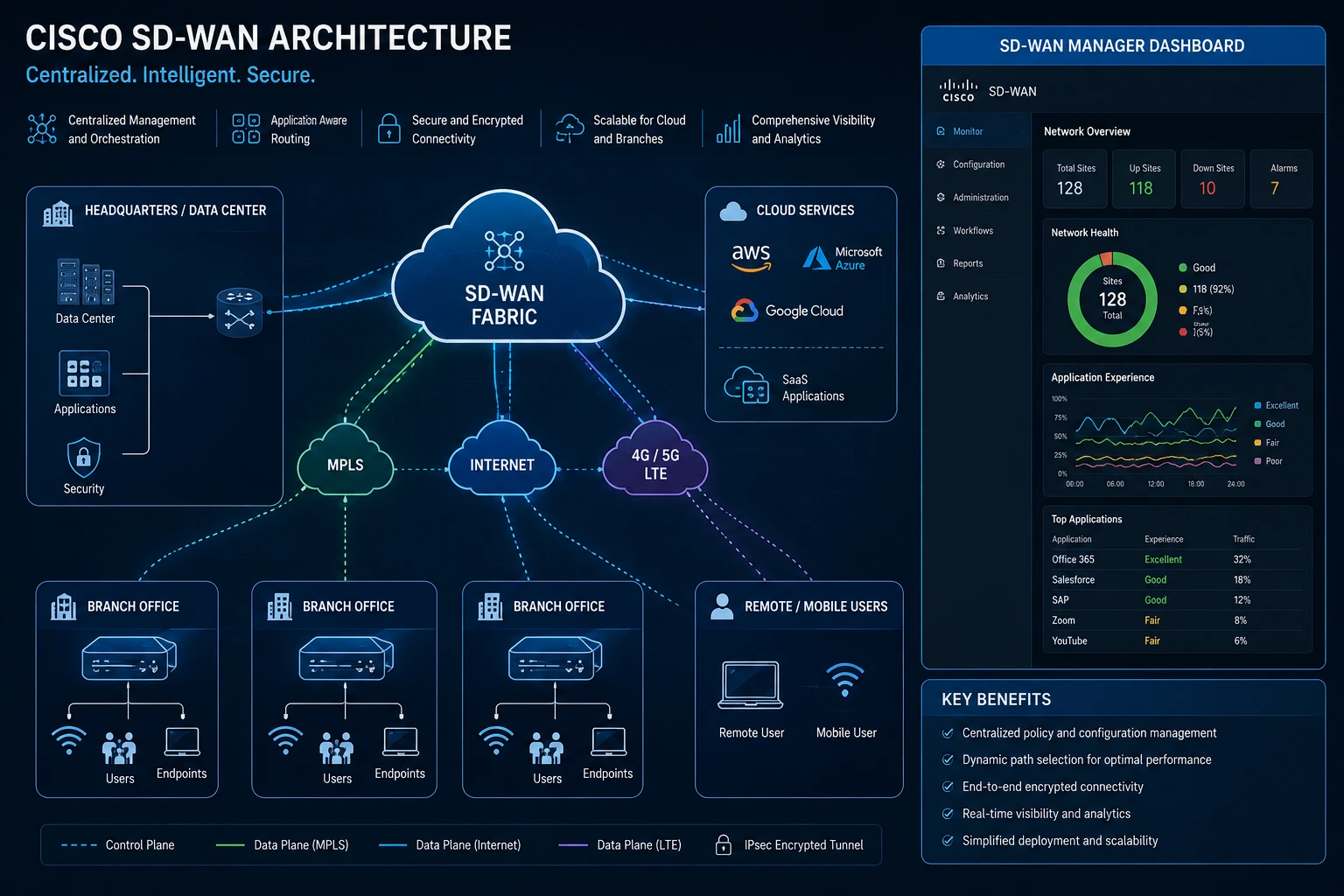
Cisco Catalyst SD-WAN Manager acts as the central control hub for enterprise networking environments.
Administrators use the platform to:
Configure network policies
Monitor traffic flows
Manage branch office connectivity
Deploy routing updates
Control cloud connectivity
Monitor network health
Because the platform centrally manages hundreds or even thousands of connected devices, it holds a highly privileged position within enterprise environments.
This makes it an attractive target for advanced threat actors.
Security experts often refer to such systems as "crown jewel infrastructure" because compromising a single management platform can provide access to an organization's broader network ecosystem.
The Zero-Day Vulnerability Explained
The vulnerability affects the command-line interface (CLI) component of Cisco Catalyst SD-WAN Manager.
Researchers discovered that attackers could exploit improper input validation mechanisms to execute arbitrary commands with root privileges.
Root access represents the highest privilege level available on Linux-based systems.
Once obtained, attackers can:
Execute system commands
Create administrative accounts
Disable security controls
Modify network configurations
Install malware
Establish persistence
Manipulate logs to hide activity
Unlike many vulnerabilities that provide limited access, this flaw grants attackers near-complete control over the affected management server.

How the Attack Unfolds
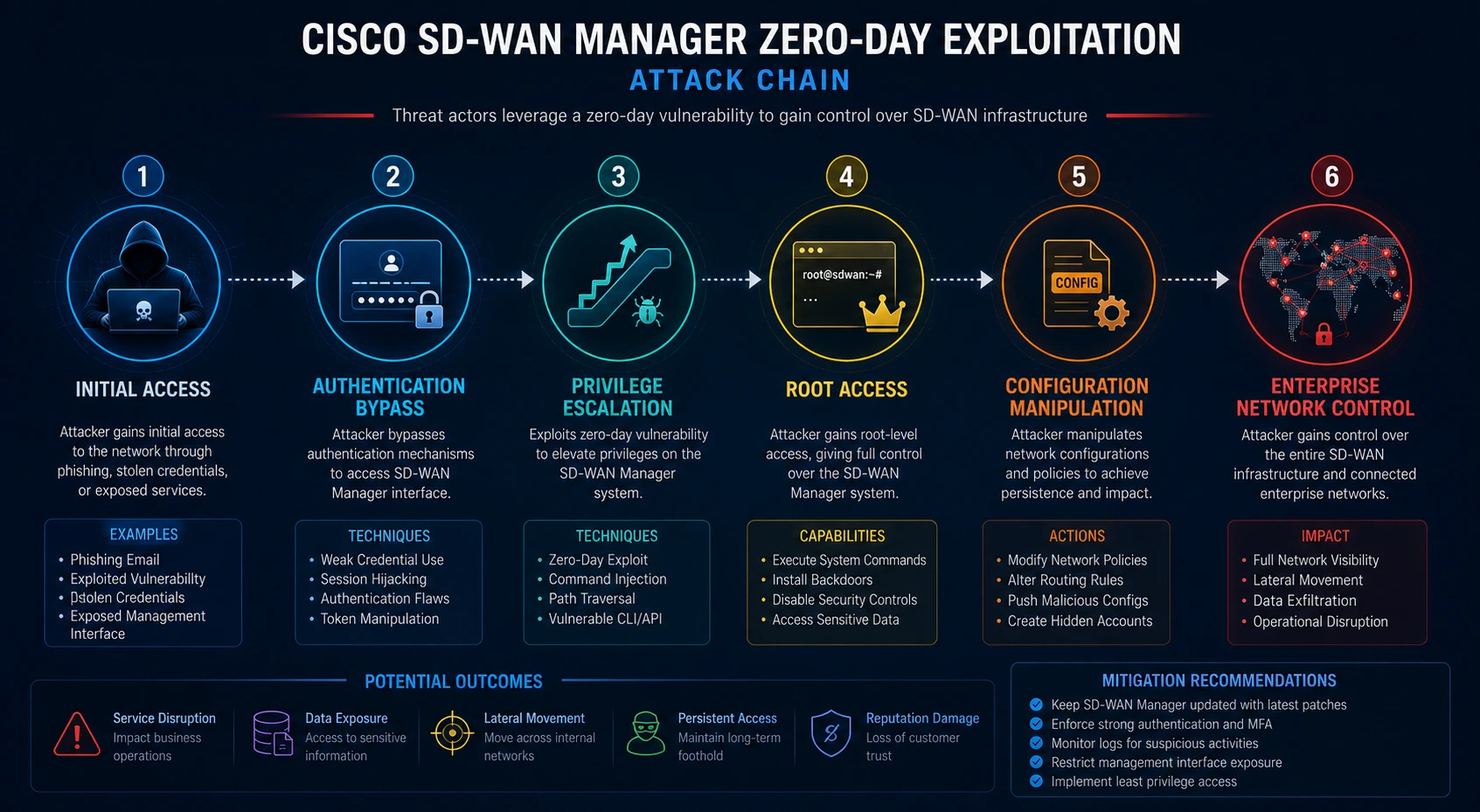
The attack typically occurs in multiple stages.
Stage 1: Initial Access
Attackers first obtain access to the SD-WAN environment through:
Stolen credentials
Previously compromised accounts
Misconfigured administrative interfaces
Additional vulnerabilities
Stage 2: Exploitation
Once inside, threat actors upload specially crafted requests that exploit the vulnerable CLI functionality.
Stage 3: Privilege Escalation
The exploit executes commands with root privileges, providing unrestricted system access.
Stage 4: Persistence
Attackers may establish long-term access by:
Creating hidden administrator accounts
Deploying backdoors
Installing persistence mechanisms
Stage 5: Enterprise-Wide Control
The most dangerous phase occurs when attackers leverage the trusted position of the SD-WAN Manager to push malicious configurations to managed devices across the network.
This transforms a single compromised management server into a platform capable of influencing an entire enterprise infrastructure.
Why Threat Actors Are Targeting Infrastructure Systems
Traditional cyberattacks often focus on users and endpoints.
However, threat intelligence reports increasingly show attackers shifting their attention toward:
VPN gateways
Firewalls
Network appliances
Cloud management consoles
SD-WAN management platforms
These systems provide several advantages:
Greater Impact
Compromising one management platform may affect hundreds of connected devices.
Reduced Visibility
Infrastructure appliances often generate fewer security alerts than traditional endpoints.
Faster Lateral Movement
Attackers can quickly move throughout the environment using trusted administrative channels.
Long-Term Persistence
Infrastructure systems are frequently overlooked during security investigations.
This makes them ideal targets for sophisticated cyber operations.
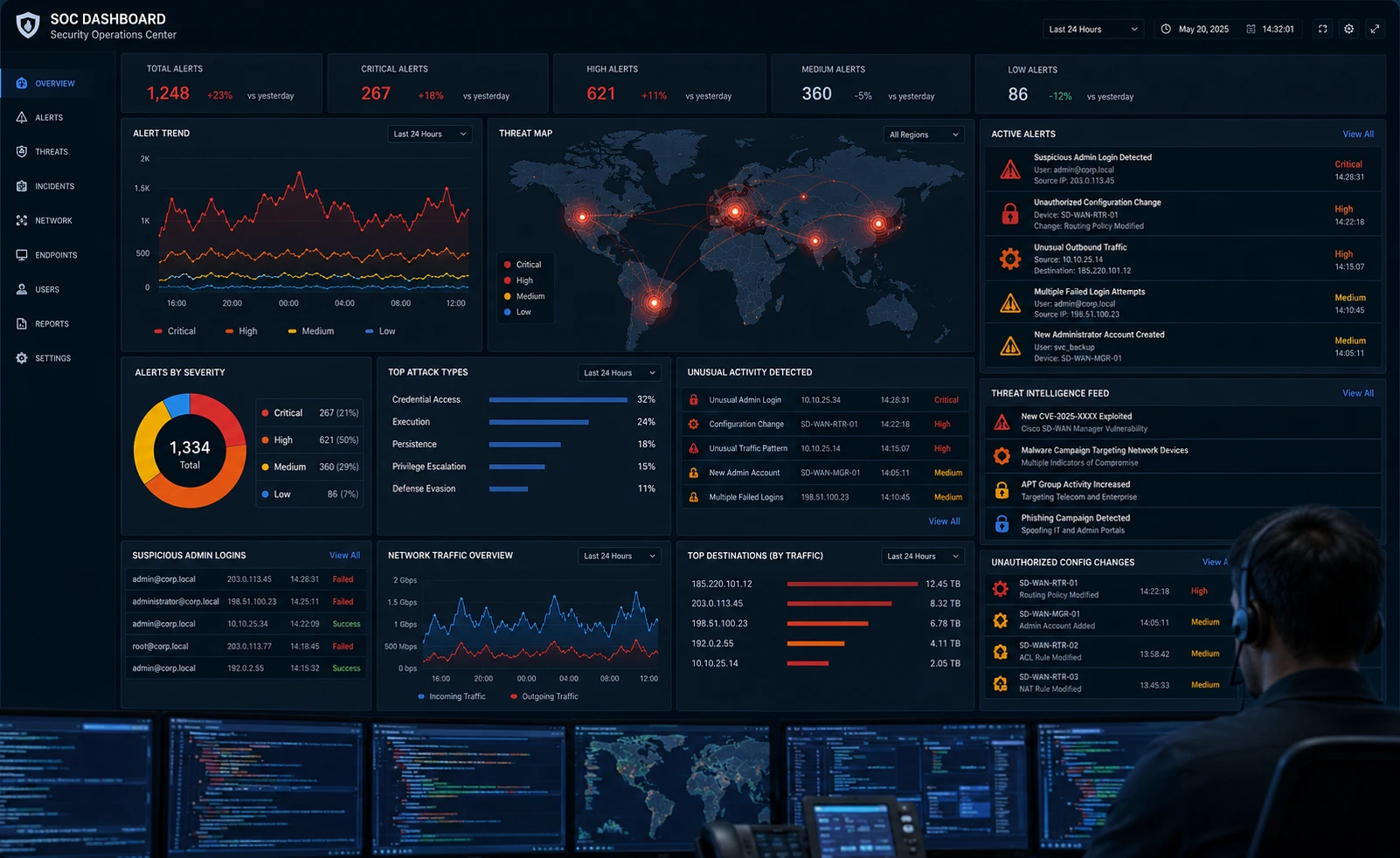
Indicators of Compromise (IoCs)
Organizations should immediately investigate:
Unexpected administrator accounts
Root-level command execution
Unauthorized configuration changes
Unknown file uploads
Unexpected policy deployments
Suspicious SSH sessions
New scheduled tasks
Unusual outbound network connections
Missing or altered logs
Even a single indicator should trigger a detailed investigation due to the privileged nature of the affected platform.
Threat Hunting & Investigation Commands
Security teams can use the following commands during incident response activities.
Check Active Users
whoReview Login History
last -aSearch for Suspicious Accounts
cat /etc/passwd | tail -20Check Running Processes
ps auxReview Command History
historyIdentify Network Connections
ss -tulnpor
netstat -tulnpReview Authentication Logs
grep "Failed password" /var/log/auth.logSearch Recently Modified Files
find / -type f -mtime -7 2>/dev/nullVerify Network Device Configuration
show running-configSecurity analysts should compare findings against known-good baselines to identify unauthorized changes.
Potential Impact on Organizations
The consequences of a successful attack can be significant.
Operational Disruption
Attackers can modify routing policies and disrupt communications between locations.
Data Exposure
Sensitive network information may be accessed or stolen.
Security Blind Spots
Threat actors can disable monitoring controls and evade detection.
Enterprise-Wide Compromise
Compromised SD-WAN Managers may enable attackers to influence hundreds of connected devices.
Financial Losses
Organizations may face downtime, recovery costs, and regulatory consequences.
For large enterprises, the impact could extend across multiple regions and business units.
Recommended Mitigation Measures
1. Apply Security Updates
Deploy Cisco security patches as soon as possible.
2. Restrict Administrative Access
Avoid exposing management interfaces directly to the internet.
3. Enable Multi-Factor Authentication
MFA significantly reduces the risk associated with compromised credentials.
4. Review Administrative Accounts
Remove unnecessary privileged users and validate existing accounts.
5. Monitor Configuration Changes
Investigate unexpected policy modifications across managed devices.
6. Conduct Threat Hunting
Perform proactive investigations to identify persistence mechanisms and hidden attacker activity.
7. Segment Critical Infrastructure
Limit administrative access pathways wherever possible.

Threat Intelligence Assessment
This incident highlights a major evolution in attacker strategy.
Rather than targeting individual users, modern threat actors increasingly focus on centralized control systems capable of providing broader operational access.
The exploitation of Cisco Catalyst SD-WAN Manager demonstrates how network management infrastructure has become a high-value target for advanced cyber operations.
Organizations must treat these platforms with the same level of security monitoring and protection as critical servers, cloud environments, and identity systems.
Conclusion
The Cisco Catalyst SD-WAN Manager zero-day serves as a reminder that management-plane security is now a critical component of enterprise defense.
As attackers continue to target infrastructure systems that provide centralized control, organizations must prioritize visibility, patch management, threat hunting, and access control across all network management platforms.
A single compromised management server can provide attackers with the keys to an entire enterprise network.
For defenders, the lesson is clear: protecting the management plane is no longer optional - it is essential.
About the Author