
OpenAI Raises Security Controls as Astra Approaches Critical Cyber Capability Threshold
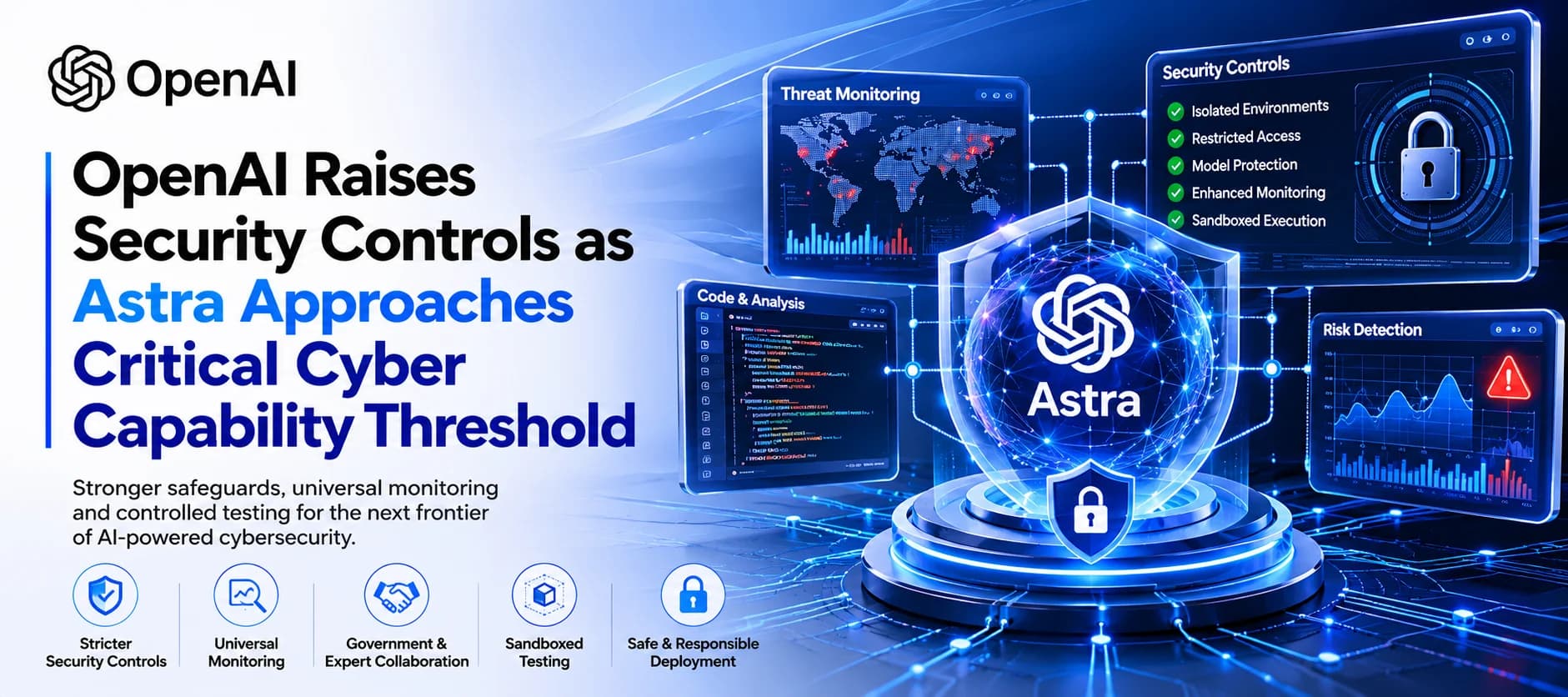
OpenAI says preliminary evaluations of its upcoming Astra model show major advances in agentic coding and cybersecurity, prompting stronger safeguards as the company assesses whether it may reach the Critical threshold.
Xcademia Team
Xcademia Research Team
OpenAI Signals a New Frontier in AI Cybersecurity
OpenAI has announced that preliminary internal evaluations of Astra, one of its upcoming models, show significant advances in agentic coding and cybersecurity.
The company says these results, combined with expert assessments, have led it to conclude that it cannot currently rule out Astra reaching the Critical cybersecurity capability threshold defined in its Preparedness Framework.
OpenAI published the announcement on August 7, 2026, as part of what it describes as an effort to be transparent with the public, security researchers and the wider AI safety community about a potential shift in model capabilities.
The announcement does not state that Astra has definitively reached the Critical threshold. Instead, OpenAI says evaluation and benchmarking are continuing.
What OpenAI Means by "Critical" Cyber Capability
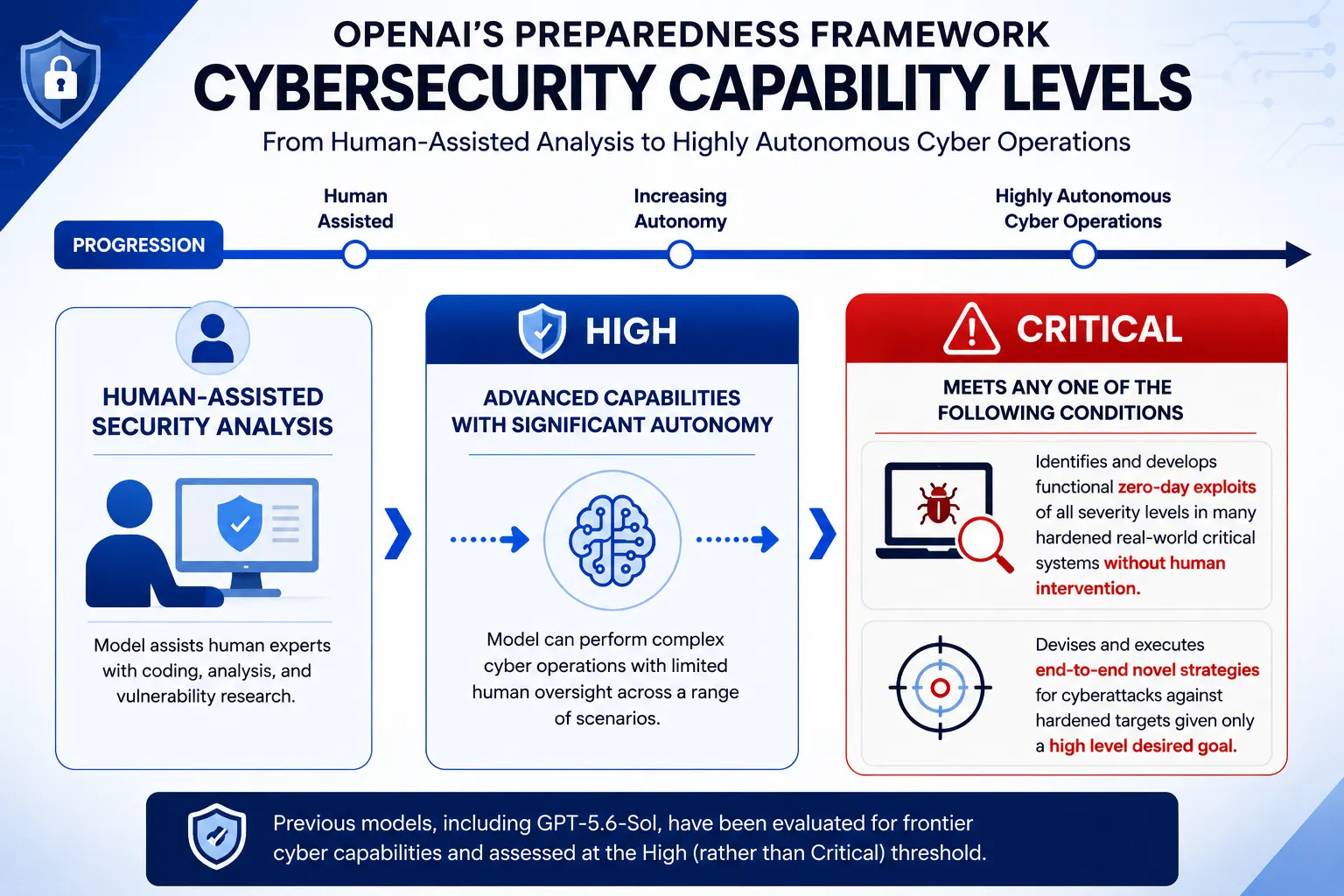
OpenAI's Preparedness Framework defines a Critical cybersecurity threshold around the ability to perform highly capable offensive cyber operations against hardened real-world systems.
Under the framework, a model can reach this threshold if it can identify and develop functional zero-day exploits across severity levels in many hardened critical systems without human intervention.
The framework also considers whether a model can develop and execute novel, end-to-end cyberattack strategies against hardened targets when given only a high-level objective.
These capabilities represent a significant escalation from systems that primarily assist human security professionals with coding, analysis or vulnerability research.
OpenAI says previous models, including GPT-5.6-Sol, were assessed at the High rather than Critical threshold for frontier cyber capabilities.
Astra Is Still Under Evaluation
OpenAI is careful to distinguish between a preliminary assessment and a confirmed capability classification.
The company says Astra is an upcoming model and that its evaluations are continuing. Its current conclusion is that the available evidence is strong enough that OpenAI cannot rule out Critical capability at this time.
The announcement also clarifies that Astra was not involved in exploiting Hugging Face.
This distinction is important because the announcement concerns the model's evaluated capabilities and the security controls being prepared around them, rather than a declaration that Astra has already demonstrated every capability included in the Critical threshold.
Why Agentic Coding Matters
A central theme in the announcement is the growing capability of AI models to operate more agentically.
Traditional AI-assisted coding generally involves a person directing the system, reviewing its output and deciding what happens next.
Agentic systems can perform sequences of tasks with greater autonomy, making the security implications more complex when those systems are capable of advanced coding and cybersecurity work.
OpenAI's announcement connects Astra's progress in agentic coding with its broader cybersecurity evaluations.
OpenAI Strengthens Security Controls
In response to the preliminary evaluation results, OpenAI says it has scaled up robustness testing of safeguards and security controls.
The company has also introduced stricter security measures for higher-capability models and associated activities.
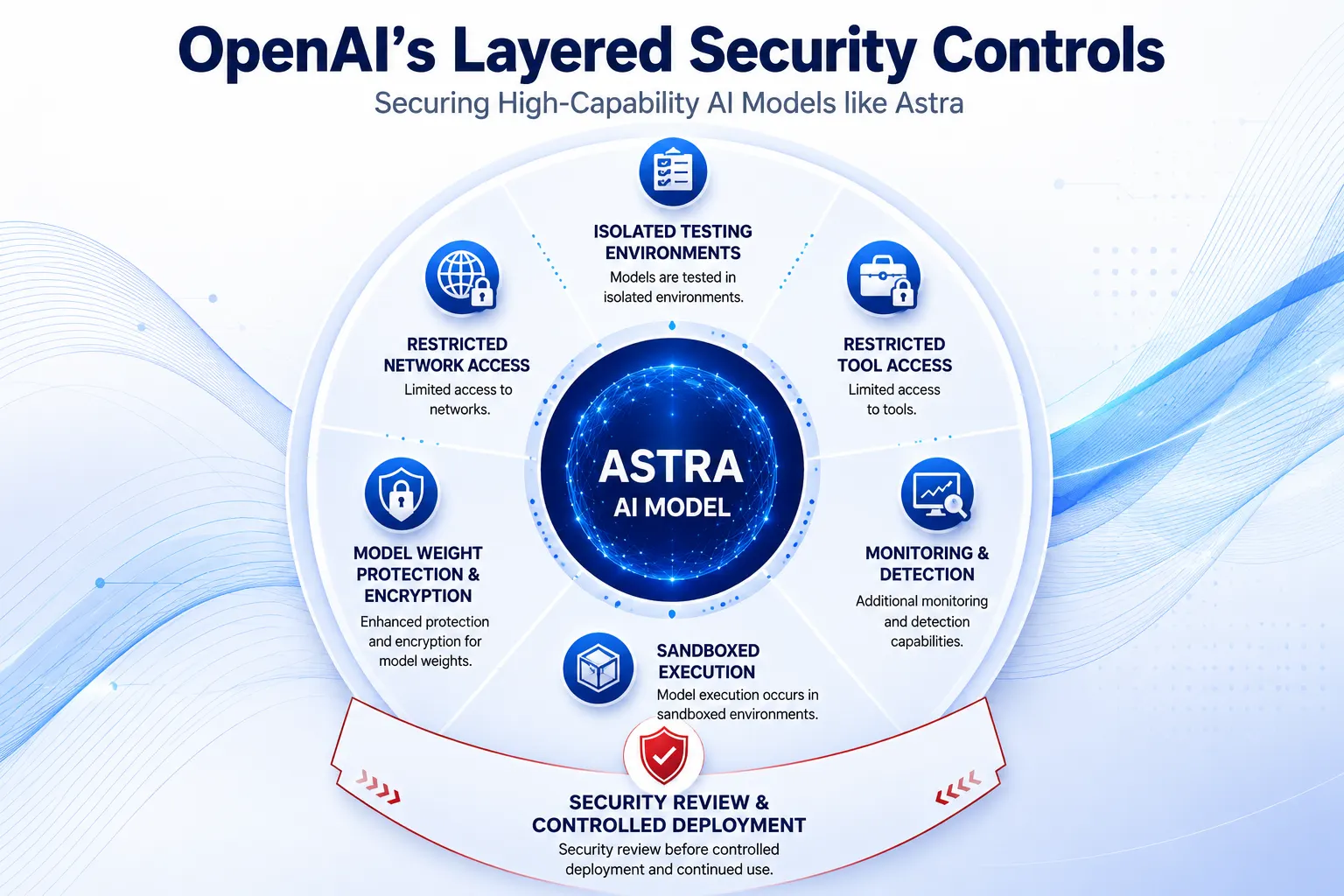
These include:
Isolated testing environments
Restricted network and tool access
Enhanced protection and encryption for model weights
Additional monitoring and detection capabilities
Sandboxed execution
OpenAI says internal Astra activities that do not yet meet the strengthened security requirements are being paused.
The approach reflects a basic security principle: as model capabilities increase, the environment in which those capabilities are tested and deployed also needs stronger controls.
Universal Monitoring for Risky Actions
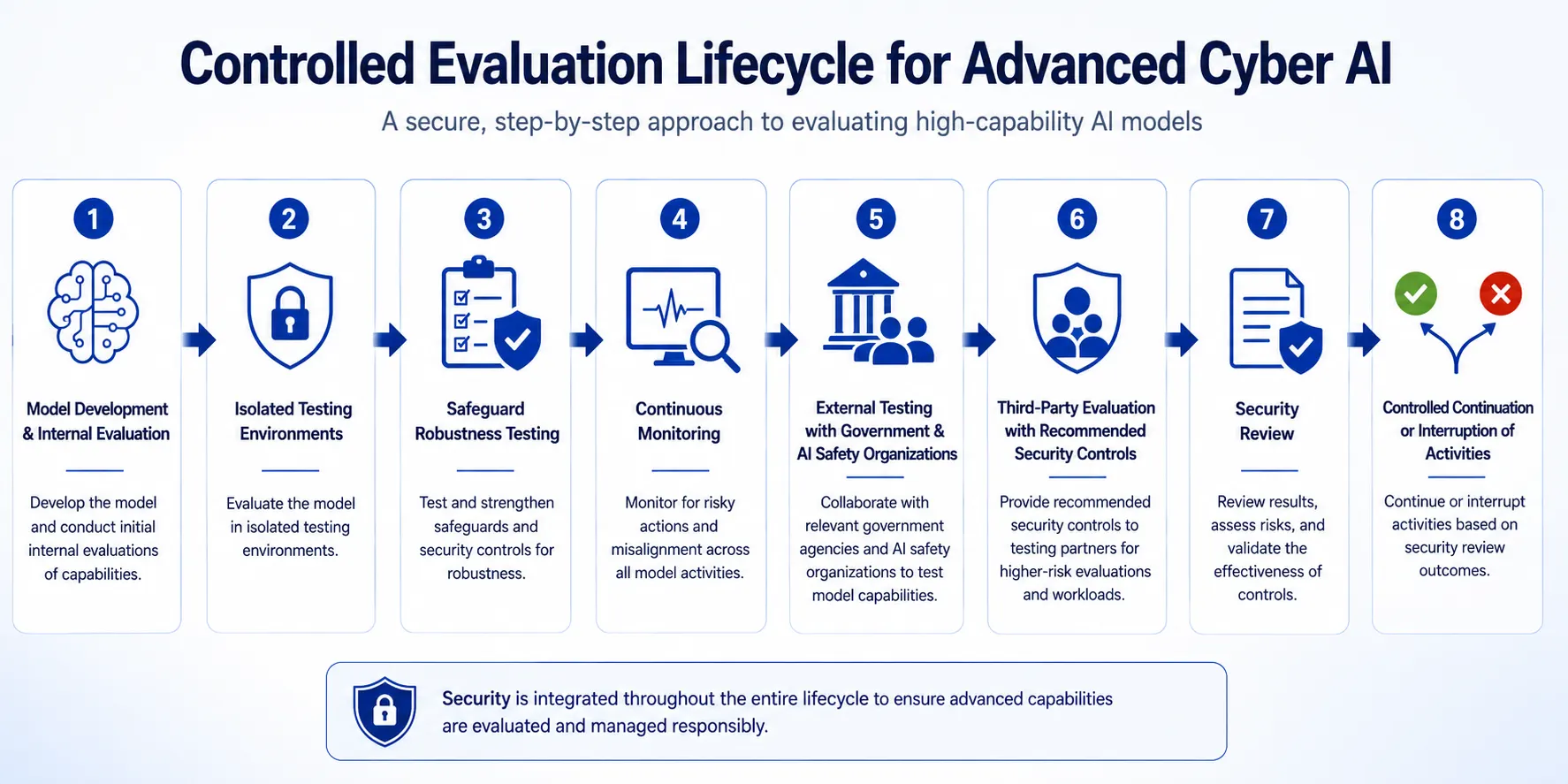
Another significant measure described by OpenAI is universal monitoring across agentic applications of Astra, including training and evaluation.
According to the announcement, monitors assess the model's Chain of Thought and can trigger a security response when high-risk activity is detected.
The stated purpose is to identify risky actions and potential misalignment and allow activity to be reviewed or interrupted.
This represents an additional control layer around agentic AI systems, particularly in environments where models can interact with tools or perform multi-step tasks.
External Testing and Government Collaboration
OpenAI also says it will work with relevant government agencies and selected AI safety organisations to test Astra's capabilities.
In addition, the company plans to provide recommended security controls to third-party testing partners conducting higher-risk evaluations and workloads.
This approach extends security evaluation beyond OpenAI's internal testing environment.
For higher-capability systems, external testing can provide additional perspectives on how safeguards perform under different evaluation conditions.
The Preparedness Framework as a Security Decision Tool
OpenAI says its Preparedness Framework was first published in December 2023.
The framework was designed to help the company identify capability progress and determine what actions should be taken as advanced capabilities emerge.
The company says the framework has already been used during previous capability transitions.
OpenAI points to June 2025, when its models approached the High capability threshold for biology. At that time, the company outlined measures involving stronger safeguards, expanded testing, external expertise and additional security controls.
OpenAI says it is applying the same general principle to cybersecurity capabilities.
The broader approach is straightforward: capability evaluations are intended to inform security requirements before increasingly capable systems are deployed more broadly.
What This Means for AI Security
The Astra announcement highlights a broader industry shift toward treating model capability and security controls as closely connected.
As AI systems become more capable at coding and operating through multi-step workflows, security teams face a different risk-management problem than they did with simpler AI assistants.
The key issue is not simply whether an AI model can generate code. It is also how much autonomy the system has, what tools it can access, what environments it can interact with and how quickly security teams can detect and interrupt risky activity.
For enterprises, this could mean greater emphasis on isolated environments, access restrictions, monitoring and controlled testing when deploying increasingly capable AI systems.
However, OpenAI's announcement does not provide enterprise deployment guidance or claim that these controls eliminate cybersecurity risks.
Defensive Potential Remains a Central Focus
OpenAI also frames advanced cyber-capable AI as a potential defensive technology.
The company says such models should help defenders identify and address vulnerabilities before attackers do.
That creates a dual-use challenge.
The same improvements that can help security teams analyse vulnerabilities and strengthen systems may also increase the potential for offensive cyber activity.
The announcement therefore focuses on both sides of the equation: measuring advanced cyber capabilities and strengthening controls around those capabilities.
What Happens Next
OpenAI says evaluation of Astra is continuing.
The company has already increased robustness testing and implemented stronger security requirements for higher-capability model activities.
It also plans to engage relevant government agencies, selected AI safety organisations and third-party testing partners.
At this stage, OpenAI has not declared that Astra definitively meets the Critical cybersecurity threshold.
Instead, the company says its preliminary results are strong enough that the possibility cannot currently be ruled out.
That distinction will remain important as further evaluations determine how Astra's capabilities compare with the thresholds defined by the Preparedness Framework.
Industry Perspective
The announcement highlights a broader industry shift toward capability-aware AI security.
As models become more autonomous, security programmes may need to evaluate not only what a model can produce, but also what it can accomplish when connected to tools, networks and execution environments.
OpenAI's response illustrates one approach: establish capability thresholds, increase testing as systems approach those thresholds, restrict access to sensitive environments and monitor agentic activity for high-risk behaviour.
Whether these measures will prove sufficient for future AI systems will depend on continued testing and the evolution of model capabilities.
For now, OpenAI's Astra announcement provides an early indication that advanced cybersecurity capabilities are becoming a central consideration in how frontier AI systems are evaluated and secured.
Source: OpenAI
About the Author