
Why AI Agents Need Better Data Infrastructure and How Google's Agentic Data Cloud Solves the Challenge
AI agents are becoming more capable, but fragmented data and legacy infrastructure remain major barriers to enterprise adoption. Google Cloud's Agentic Data Cloud aims to unify data, AI models, and operational systems to power production-ready AI agents.
Xcademia Team
Xcademia Research Team
The Enterprise Data Challenge
Artificial intelligence has entered a new phase where intelligent agents can do far more than answer questions. Modern AI agents can analyze information, reason across multiple data sources, make decisions, and even execute business workflows with minimal human intervention.
However, as organizations begin deploying these autonomous systems in production, many are discovering that the biggest obstacle is no longer the AI model itself. Instead, it is the infrastructure supporting the data those models rely on.
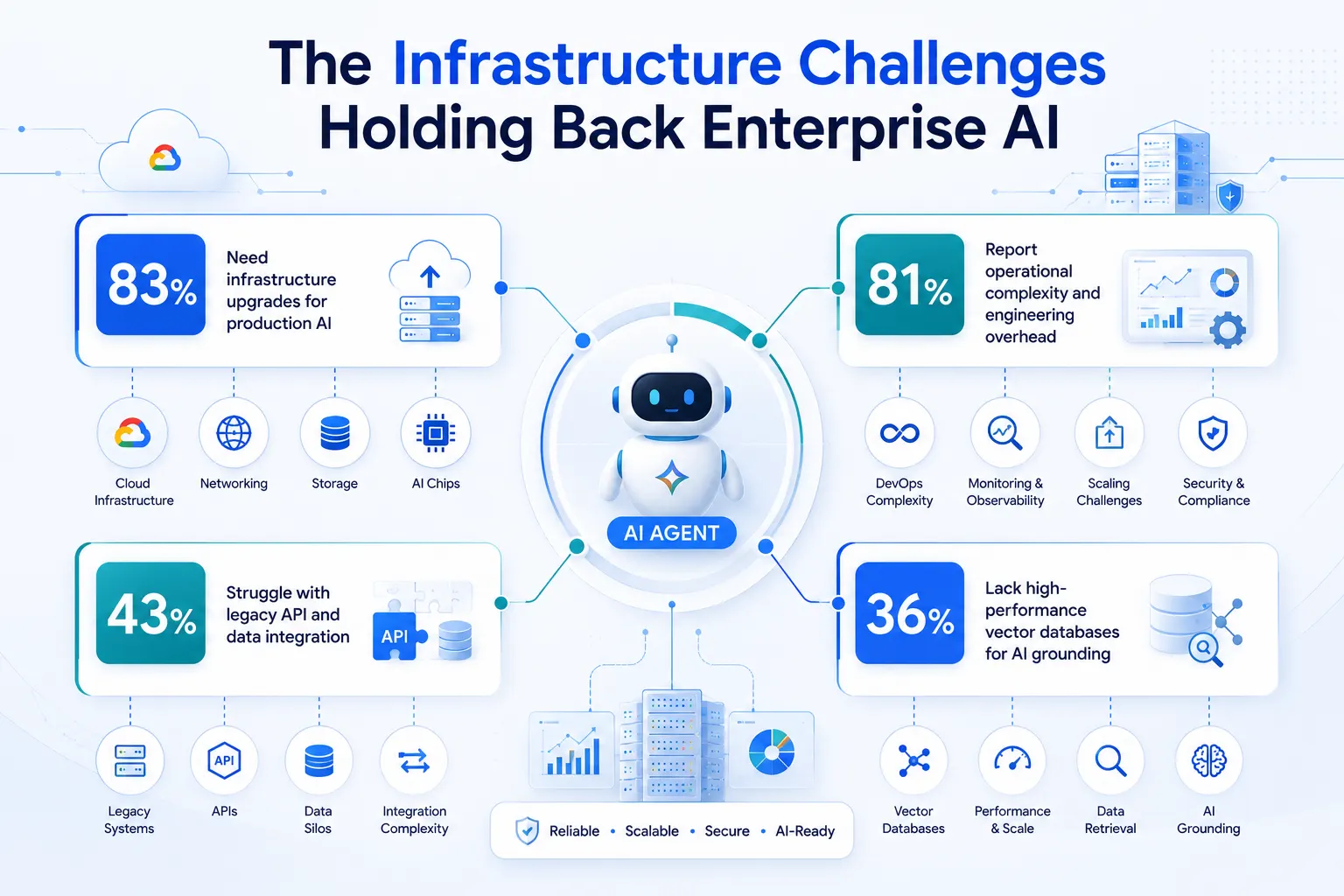
According to Google's State of Infrastructure in the Agentic AI Era report, 83% of organizations believe they need infrastructure upgrades before they can successfully deploy production-grade AI agents. Legacy systems, fragmented data, operational complexity, and limited business context continue to prevent AI initiatives from moving beyond pilot projects.
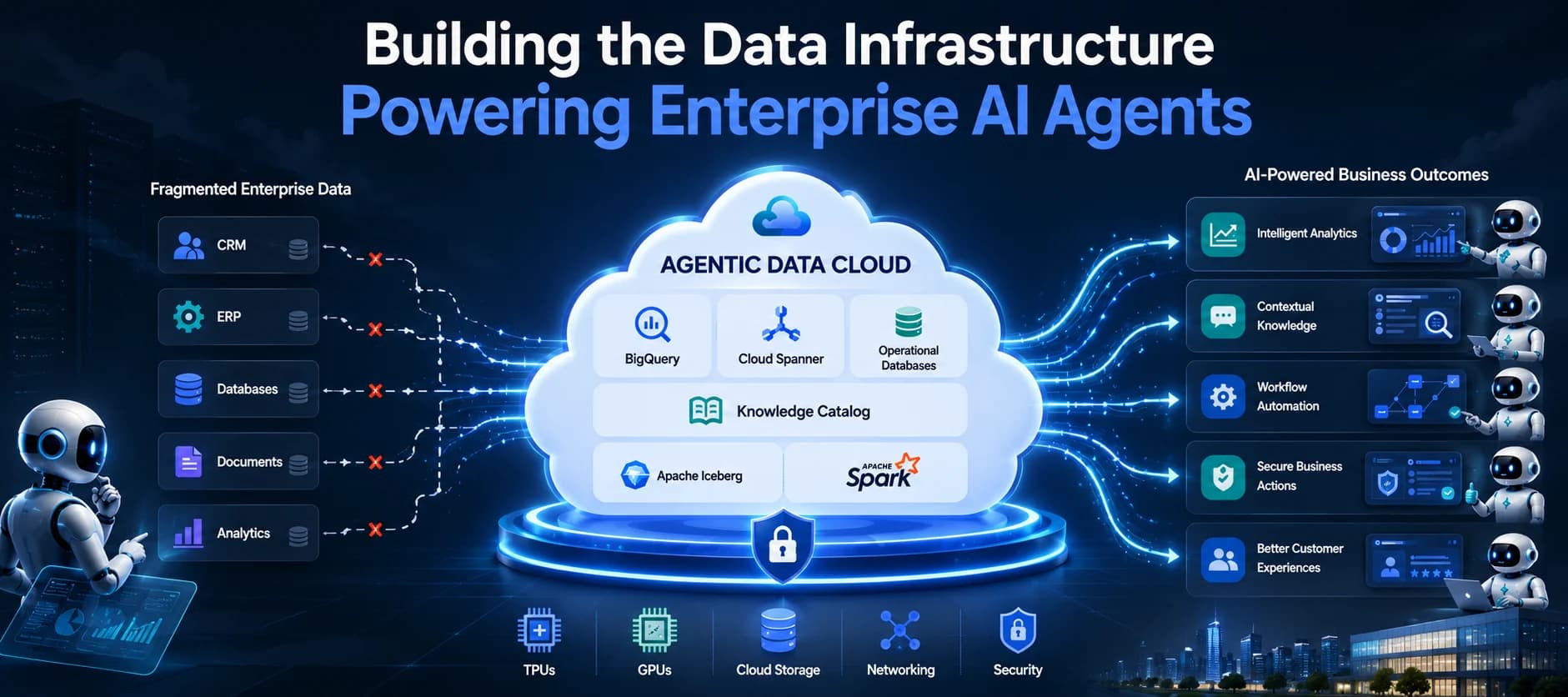
To address these challenges, Google Cloud introduced the Agentic Data Cloud, a platform designed to unify enterprise data, AI models, and operational databases into what Google describes as a System of Action. Rather than simply storing information, the platform aims to help AI agents understand business context, reason over trusted data, and execute tasks securely at enterprise scale.
The Hidden Infrastructure Bottleneck Slowing Enterprise AI
Over the past two years, AI models have advanced at an extraordinary pace. Large language models can generate code, summarize documents, automate customer interactions, and support increasingly complex business processes.
Yet many organizations still struggle to deploy AI agents in production.
The challenge lies beneath the model itself.
Unlike traditional applications, AI agents continuously interact with multiple systems. A single request may require an agent to retrieve information from databases, analyze documents, query APIs, interact with operational systems, and perform business transactions before generating a response.
These complex workflows place significant pressure on the underlying infrastructure.
If networking, storage, compute resources, or data platforms cannot support this workload efficiently, even the most capable AI models become constrained.
Google's research highlights the scale of this challenge:
83% of organizations say infrastructure upgrades are necessary for production-ready AI agents.
81% report operational complexity and engineering overhead as major hidden costs when scaling AI.
43% identify integrating legacy APIs and enterprise data sources as their biggest infrastructure challenge.
36% cite insufficient high-performance vector databases for AI grounding and contextual understanding.
These findings suggest that enterprise AI success increasingly depends on modernizing infrastructure rather than simply adopting more powerful foundation models.
From Systems of Record to Systems of Action
Traditional enterprise data platforms were designed primarily to store, organize, and retrieve information.
These systems of record ensure that business data remains accurate and available for reporting, compliance, and analytics.
AI agents, however, require something fundamentally different.
Instead of simply retrieving information, they must interpret business context, reason across multiple data sources, make decisions, and trigger actions in real time.
This transforms enterprise data into what Google calls a System of Action.
Rather than treating data as static records stored inside isolated applications, the Agentic Data Cloud enables AI systems to work across analytical databases, operational applications, and business processes as part of a unified environment.
This shift allows AI agents to progress beyond answering questions toward executing meaningful business tasks with trusted enterprise knowledge.
What Is Google's Agentic Data Cloud?
Google introduced the Agentic Data Cloud at Google Cloud Next 2026 as an AI-native architecture designed specifically for the emerging generation of autonomous AI agents.
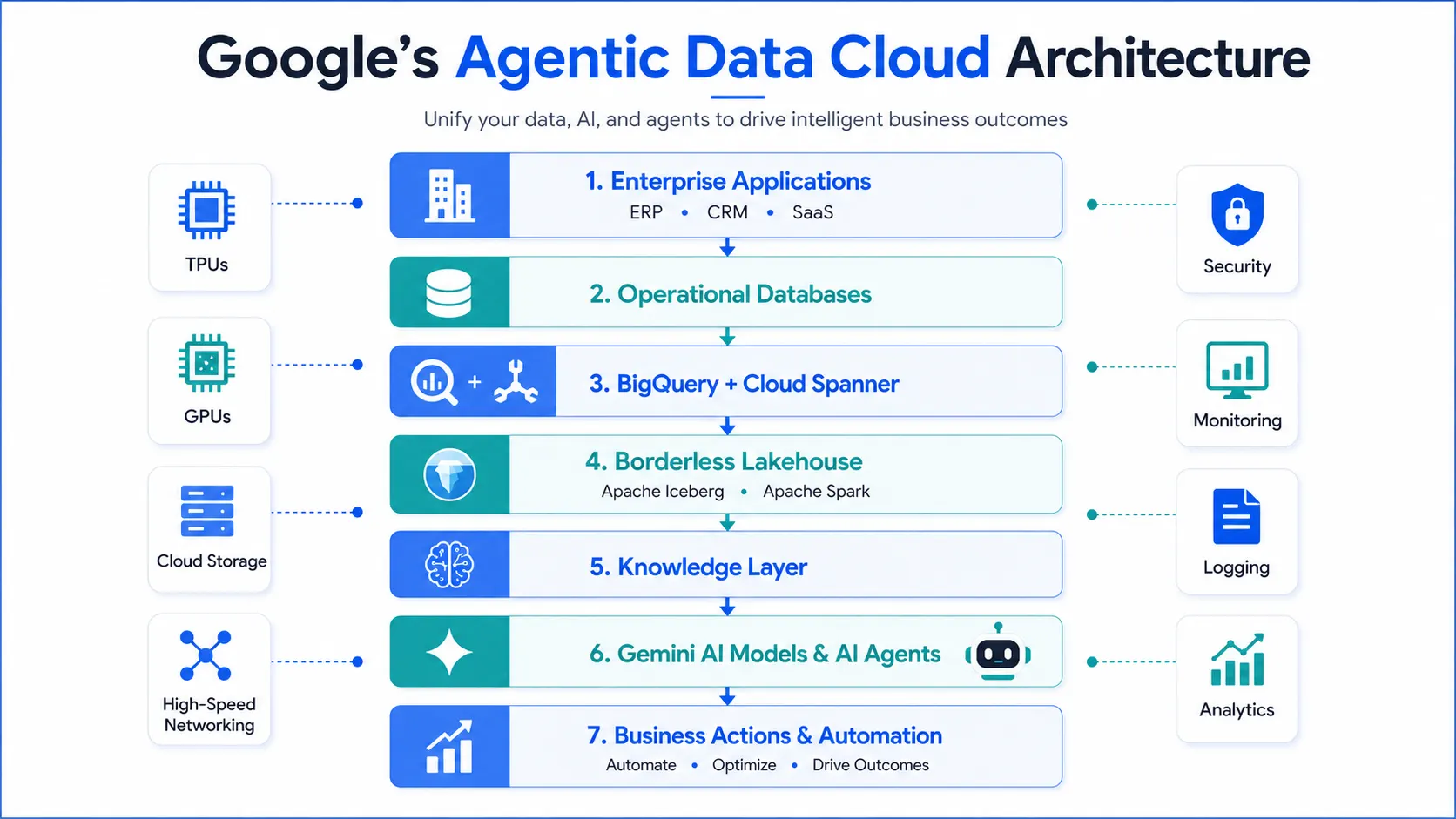
Instead of treating infrastructure, databases, AI models, and applications as separate technology layers, the Agentic Data Cloud integrates them into a unified platform.
Its architecture combines:
Enterprise data platforms
Operational databases
AI foundation models
Analytics engines
AI-native infrastructure
High-performance networking
Accelerated computing resources
By reducing fragmentation across these components, AI agents can retrieve information, reason over enterprise knowledge, and execute business processes more efficiently.
According to Google, the infrastructure itself becomes optimized for AI workloads rather than simply hosting them.
Challenge 1: Overcoming the Lack of Business Context
One of the biggest limitations facing enterprise AI is access to trusted business context.
Organizations often store information across multiple databases, data warehouses, cloud platforms, legacy applications, and third-party systems.
Although each system contains valuable information, AI agents frequently struggle to access that knowledge as a unified source.
As a result, agents may generate incomplete responses, overlook important business rules, or make decisions using only partial information.
Google's infrastructure research found that 43% of IT leaders consider integrating legacy APIs and enterprise data sources to be their largest infrastructure challenge.
Why Fragmented Data Limits AI Agents
Modern AI systems depend on context rather than raw data alone.
For example, an enterprise AI agent responding to a customer request may need information from:
CRM platforms
ERP systems
Financial databases
Product catalogs
Customer support history
Internal knowledge bases
Real-time operational data
When these systems remain isolated, AI agents must repeatedly retrieve and reconcile information across multiple environments, increasing latency, operational complexity, and infrastructure costs.
Google's Borderless Lakehouse Approach
Rather than moving massive datasets into a single repository, Google enables AI agents to access information across environments through a borderless Lakehouse architecture.
The platform combines technologies including:
BigQuery
Cloud Spanner
Apache Iceberg
Apache Spark
Using open standards, AI agents can query data across different storage systems as though it were stored locally.
This architecture reduces unnecessary data movement while allowing agents to reason over distributed enterprise information more efficiently.
Instead of copying datasets between platforms, organizations can leave information where it already resides while still enabling unified AI access.
The result is lower latency, reduced infrastructure costs, and faster access to business knowledge.
Challenge 2: Eliminating Manual Integration Work
As organizations deploy more AI agents, operational complexity often grows faster than expected.
Many enterprises rely on dozens or even hundreds of disconnected business systems.
Engineering teams frequently spend significant time building custom integrations, synchronizing data, maintaining APIs, and manually connecting AI services across environments.
Google's infrastructure research found that 81% of organizations identify engineering overhead and operational complexity as major hidden costs when scaling AI systems.
These manual integration efforts slow deployment, increase maintenance costs, and reduce the ability to rapidly expand AI capabilities.
Instead of focusing on business innovation, engineering teams become occupied with maintaining infrastructure connections.
AI-Native Infrastructure Reduces Complexity
Google argues that solving this problem requires more than simply connecting systems through additional middleware.
Instead, AI infrastructure should be designed as a vertically integrated platform where models, data systems, networking, storage, and computing resources work together.
Within the Agentic Data Cloud, AI models interact directly with analytics platforms and operational databases running on infrastructure optimized for AI workloads.
This tighter integration reduces unnecessary network hops, simplifies system architecture, and enables AI agents to move more efficiently from reasoning to execution.
Rather than spending engineering effort stitching together disconnected services, organizations can build AI applications on a unified foundation designed specifically for agent-based workloads.
Challenge 3: Bringing Trust and Knowledge to Enterprise Data
For AI agents to deliver reliable business outcomes, access to data alone is not enough. They also need to understand the meaning, relationships, and business rules behind that information.
Enterprise data is often distributed across structured databases, unstructured documents, emails, knowledge bases, customer records, and operational applications. Without additional context, AI models may retrieve information but struggle to determine which data is accurate, current, or relevant to a particular task.
Google's research found that 36% of IT leaders identify the lack of specialized, high-throughput vector databases for AI grounding as a major infrastructure gap. Without efficient semantic retrieval and contextual grounding, AI agents may produce incomplete or inaccurate responses.
To move beyond simple information retrieval, organizations need a knowledge layer that continuously enriches enterprise data with business context.
Building Context with Knowledge Catalog
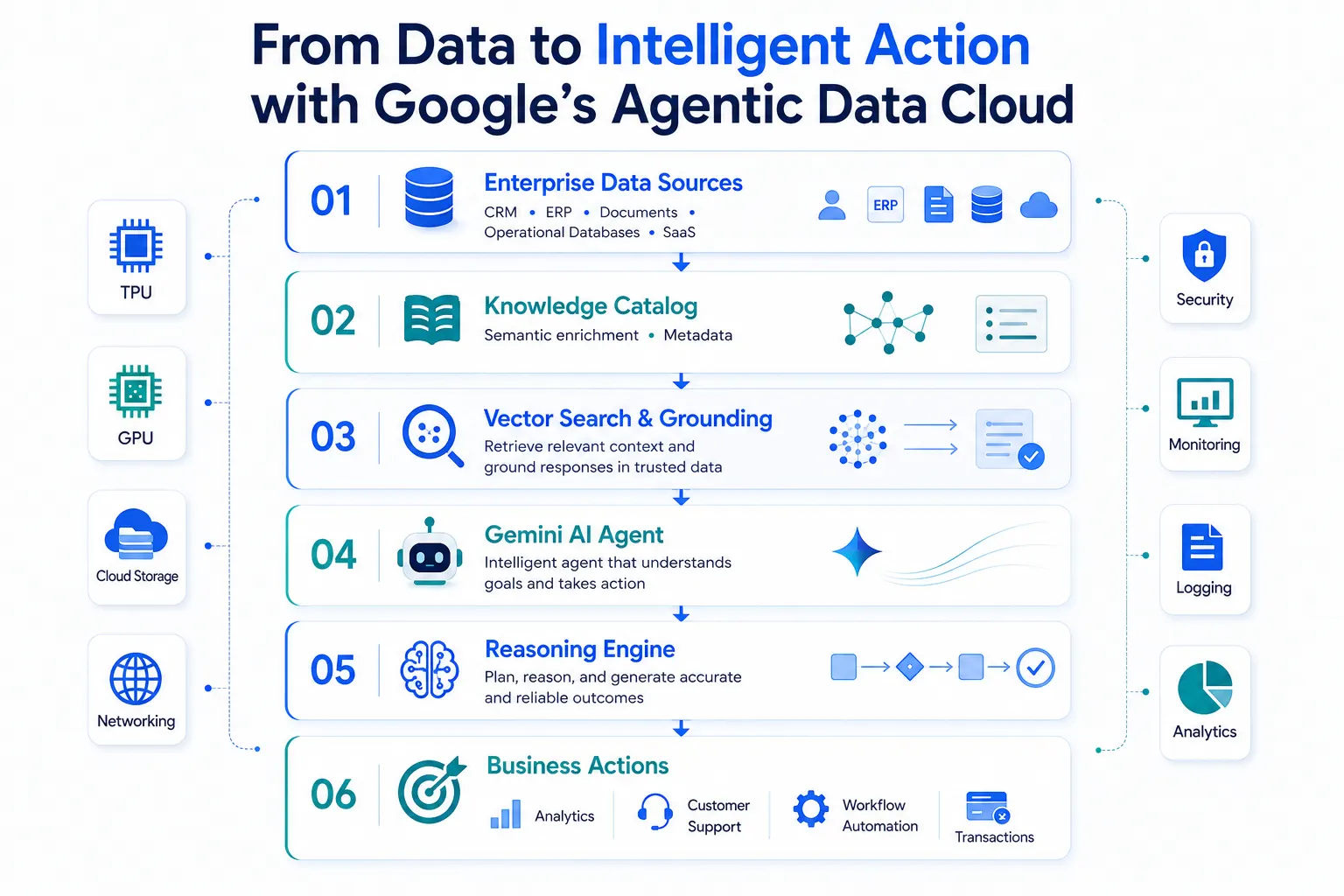
Google addresses this challenge through Knowledge Catalog, a component of the Agentic Data Cloud designed to organize, enrich, and activate enterprise knowledge.
Rather than functioning as a traditional data catalog, Knowledge Catalog creates a semantic layer that helps AI agents understand how information across different systems is connected.
The platform can:
Aggregate metadata from multiple data sources
Extract meaning from unstructured content
Generate semantic relationships automatically
Support intelligent, context-aware search
Provide grounded information for AI agents
Instead of repeatedly processing raw enterprise data for every request, AI agents can retrieve structured business knowledge enriched with context and relationships.
This enables more accurate reasoning while reducing unnecessary processing overhead.
Giving AI Agents Long-Term Business Memory
Enterprise AI often requires understanding information that extends well beyond a single conversation.
For example, an AI agent assisting a customer service representative may need to remember:
Previous customer preferences
Historical purchases
Earlier support cases
Contract details
Internal approval workflows
Without persistent memory, AI systems must repeatedly retrieve and reconstruct this information for every interaction, increasing latency and compute costs.
Google envisions an infrastructure where AI agents can continuously read from and write to enterprise systems in real time while maintaining long-term contextual memory.
This allows agents to use historical knowledge during future interactions without rebuilding context from scratch.
The result is faster responses, more personalized experiences, and improved decision-making across complex business workflows.
Why AI-Native Infrastructure Matters
Google's vision for the Agentic Data Cloud extends beyond software architecture. The company argues that enterprise AI requires infrastructure designed specifically for agent-based workloads.
Unlike traditional applications, AI agents continuously retrieve information, reason over multiple data sources, invoke external services, and execute business actions. These activities generate complex, nonlinear workloads that place simultaneous demands on compute, networking, storage, and databases.
If any layer becomes a bottleneck, overall performance suffers regardless of the capability of the underlying AI model.
Google addresses this by designing an AI-native stack where accelerators, networking, storage, data platforms, and AI models are optimized to work together. This vertical integration reduces latency, minimizes unnecessary data movement, and enables agents to process enterprise information more efficiently.
By co-designing infrastructure for AI workloads, organizations can better support production-scale deployments while reducing operational complexity.
The Future of Enterprise AI
The emergence of AI agents is changing how organizations think about enterprise technology.
For years, businesses focused on building systems that stored information and generated reports. In the agentic era, those systems must evolve into platforms capable of supporting autonomous reasoning and secure action.
Google believes competitive advantage will depend not only on deploying advanced AI models but also on providing those models with trusted, real-time business knowledge.
Organizations that continue to rely on fragmented data architectures may struggle to move AI initiatives beyond pilot projects. In contrast, enterprises that invest in connected, AI-native data platforms will be better positioned to scale intelligent automation across their operations.
This shift represents a transition from systems of record that preserve information to systems of action that enable AI agents to understand context, make informed decisions, and execute business processes with confidence.
Conclusion
As enterprises adopt increasingly capable AI agents, the focus is shifting from model performance to data readiness. Powerful models alone cannot deliver meaningful business outcomes if they lack access to trusted, connected, and contextual enterprise data.
Google Cloud's Agentic Data Cloud addresses this challenge by bringing together analytics platforms, operational databases, AI models, and AI-native infrastructure into a unified architecture designed for the agentic era. Through technologies such as BigQuery, Cloud Spanner, a borderless Lakehouse built on open standards, and Knowledge Catalog, the platform aims to reduce data fragmentation, simplify integration, and provide AI agents with the context they need to reason and act effectively.
Google's research reinforces this need. With 83% of organizations reporting that infrastructure upgrades are required for production-grade AI, 81% citing operational complexity as a hidden cost, 43% struggling with legacy integration, and 36% lacking high-performance vector databases, modern infrastructure has become a critical foundation for enterprise AI success.
As AI continues to evolve from assisting users to autonomously executing business processes, organizations will need more than intelligent models. They will need infrastructure capable of delivering trusted knowledge, real-time access, secure operations, and scalable performance. In the coming years, the enterprises that gain the greatest competitive advantage are likely to be those that invest not only in smarter AI, but also in the connected data ecosystems that enable those agents to operate effectively.
Source: Google Cloud Blog
About the Author